Want more images or videos?
Request additional images or videos from the seller
1 of 11

Claes Oldenburg
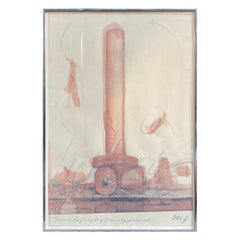
Lipstick Ascending the Caterpillar Tracks, SIGNED Novum Organum No. 7, Yale Univ

1969

$10,000
£7,532.68
€8,788.75
CA$14,145.43
A$14,232.08
CHF 8,260.78
MX$173,450.57
NOK 95,350.79
SEK 97,842.72
DKK 65,693.30

About the Item

Claes Oldenburg Lipstick Ascending the Caterpillar Tracks (Print), plus Novum Organum No. 7, Yale University (broadside), 1969 Print is a Photo offset lithograph on two sided paper, plus separate broadside on offset lithograph Hand signed boldly in black marker and numbered 116 34 × 24 inches Published by Yale University, New Haven, CT Unframed Note: This print is THE original 1969 photolithograph - not to be confused with the poster or later editioned works created in the 1970s. See history below: This listing features 2 Elements: (1) A 2 sided photolithograph of the installation plans for Oldenburg's monumental lipstick sculpture- installed at the height of the pop art movement - a large military tank with a monumental tube of lipstick sprouting out of it appearing uninvited on Yale University's campus in 1969 amidst heated protests against the Vietnam war. This signed and numbered print is based upon Lipstick (Ascending) on Caterpillar Tracks - a weathering steel sculpture by Claes Oldenburg. It is located at Morse College Courtyard, Yale University. An architecture student, Stuart Wrede, and a group of architecture students raised money, under the name of the Colossal Keepsake Corporation of Connecticut, and worked in collaboration with the artist. In addition to the pictured front side, the print also has a back side of arranged text and articles from press releases and statements published by the "Colossal Keepsake Corporation of Connecticut," The work was installed on May 15, 1969, in Beinecke Plaza at Yale University, as a speakers' platform for anti-war protests. It had a soft, inflated lipstick section, and wooden treads. The lipstick was also laden with symbolism, as women were admitted to Yale for the first time in the Fall of 1969. Over the next few years, the sculpture deteriorated and was removed by Oldenburg in March 1970. It was redone in weathering steel and fiberglass, and reinstalled at Morse College, on October 17, 1974. It has been shown at the Guggenheim Museum and The National Gallery of Art. While the sculpture may have seemed like a playful, if elaborate artistic joke, Claes Oldenburg’s Lipstick (Ascending) on Caterpillar Tracks was also deeply critical of the war. (Oldenburg made the 24-foot-high sculpture in collaboration with architecture students at his alma mater and then surreptitiously delivered it to Yale’s Beinecke Plaza.) In Beinecke Plaza, the sculpture overlooked both the office of Yale’s president and a prominent World War I memorial. Lipstick (Ascending) on Caterpillar Tracks became a visible symbol of the anti-war movement that sprung up on college campuses, while also poking fun at the solemnity of the plaza in the academy (Yale). The sculpture served as a stage and backdrop for several subsequent student protests. This is the ORIGINAL photolithographic print published in 1969, that was included inside the broadside that accompanies it. It is hand signed by Oldenburg and numbered 116. There was also a pink edition of this print, also published in 1969, an example of which is held in the permanent collection of the Tate Gallery. Below is an excerpt from the Tate Gallery website, which describes some of the later editions produced AFTER this original one: "...Lipstick (Ascending) on Caterpillar Tracks is a print of a drawing of the large-scale outdoor sculpture of the same name produced in 1969 (Yale University, New Haven). It represents a side-elevation drawing of a giant retractable lipstick mounted on the chassis of a tank-like vehicle with caterpillar tracks. The chassis has been squared up for enlargement, with calculations added. The drawing reproduced in this print provided the basis for an abandoned heliogravure print in 1971, realised in 1972 as a six-colour lithograph produced in an edition of one hundred copies (published by Paul Bianchini, New York). This print, however, was produced in 1969 in a broadsheet print magazine published by architecture students at Yale celebrating the gift of the sculpture to the university (Novum Organum no.7, Special ‘Colossal Monument’ Issue, 15 May 1969). The print was conceived as a work in its own right and was included in the publication Oldenburg: Works in Edition (1971)..." The second element in this lot is even more scarce - see description below: (2) Novum Organum, No. 7: Special “Colossal Monument” Issue focusing on recent gift of Claes Oldenburg’s “Lipstick Ascending on Caterpillar Tracks” - May 15, 1969, Broadside: photo offset and screenprint (recto and verso) Sheet: 86.4 x 55.9 cm (34 x 22 in.) This is the Edition the Yale University Novum Organum, No. 7: Special “Colossal Monument” Issue focusing on recent gift of Claes Oldenburg’s “Lipstick Ascending on Caterpillar Tracks” This historic Yale University student publication is so scarce - the only other copy we've ever seen is at the Yale University Art Gallery's archives -- donated by the very architecture student who instigated the whole installation! A piece of Pop Art and Anti-War history. RARE Bibliography: Yale University Art Gallery Archives Tate Gallery (online) Oldenburg: Works in Edition (1971)
  • Creator:
    Claes Oldenburg (1929, American, Swedish)
  • Creation Year:
    1969
  • Dimensions:
    Height: 34 in (86.36 cm)Width: 24 in (60.96 cm)
  • Medium:
  • Movement & Style:
  • Period:
  • Condition:
  • Gallery Location:
    New York, NY
  • Reference Number:
    1stDibs: LU1745211775732

More From This Seller

View All

You May Also Like

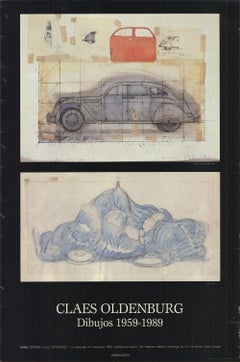
Claes Oldenburg 'Drawings 1959-1989' 1989- Offset Lithograph

Claes Oldenburg 'Drawings 1959-1989' 1989- Offset Lithograph

By Claes Oldenburg

Located in Brooklyn, NY

Paper Size: 39.5 x 26 inches ( 100.33 x 66.04 cm ) Image Size: 39.5 x 26 inches ( 100.33 x 66.04 cm ) Framed: No Condition: B-: Good Condition, Signs of Handling and Age Supplemental...

Category

1980s Prints and Multiples

Materials

Offset

Study for Sculpture in the Form of an Inverted Q Above and Below Ground

Study for Sculpture in the Form of an Inverted Q Above and Below Ground

By Claes Oldenburg

Located in New York, NY

This work is a study for Inverted Q, a large sculpture that Oldenburg created after producing many sketches and small models. At the time he was experimenting with concepts of monume...

Category

1970s Pop Art Abstract Prints

Materials

Etching, Aquatint, Lithograph

Study for Sculpture in the Form of an Inverted Q Above & Below Ground Oldenburg

Study for Sculpture in the Form of an Inverted Q Above & Below Ground Oldenburg

By Claes Oldenburg

Located in New York, NY

Study for Sculpture in the Form of an Inverted Q: Above and Below Ground, 1975 Lithograph, soft-ground etching, and aquatint in six colors on cream, thick, slightly textured Rive BFK paper 14 × 11 in. / 35.2 × 28 cm Signed and dated in pencil, lower right, numbered in pencil, lower left. Edition of 100 with 20 AP. Printed by Bill Law, Winston Roeth and Allan Uglow at Petersburg Press...

Category

1970s Pop Art Abstract Prints

Materials

Etching, Aquatint, Lithograph

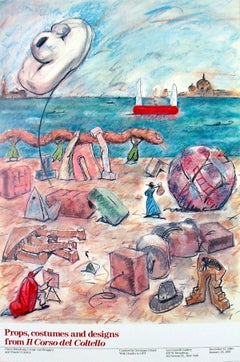
Claes Oldenburg Offset Lithograph, Pop Art, 20th Century, Unframed

Claes Oldenburg Offset Lithograph, Pop Art, 20th Century, Unframed

By Claes Oldenburg

Located in Brooklyn, NY

This offset lithograph from the exhibition "Il Corso del Coltello" held at Leo Castelli Gallery from December 13, 1986, to January 24, 1987, is a notable piece related to Claes Olden...

Category

20th Century Pop Art Prints and Multiples

Materials

Offset

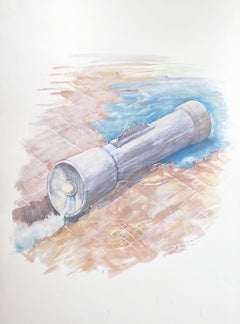
Colossal Flashlight in Place of Hoover Dam

Colossal Flashlight in Place of Hoover Dam

By Claes Oldenburg

Located in Missouri, MO

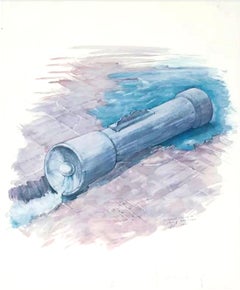
Colossal Flashlight in Place of Hoover Dam, 1982 By Claes Oldenburg (Swedish, American, 1929-2022) Signed Lower Right Dated Middle Right Unframed: 23" x 22" Framed: 36.5" x 27.5" Whimsical sculpture of pop culture objects, many of them large and out-of-doors, is the signature work of Swedish-born Claes Oldenburg who became one of America's leading Pop Artists. He was born in Stockholm, Sweden. His father was a diplomat, and during Claes' childhood moved his family from Stockholm to a variety of locations including Chicago where the father was general consul of Sweden and where Oldenburg spent most of his childhood. He attended the Latin School of Chicago, and then Yale University where he studied literature and art history, graduating in 1950, the same year Claes became an American citizen. Returning to Chicago, he enrolled at the Art Institute of Chicago from 1952 to 1954 and also worked as a reporter at the City News Bureau. He opened his own studio, and in 1953, some of his satirical drawings were included in his first group show at the Club St. Elmo, Chicago. He also painted at the Oxbow School of Painting in Michigan. In 1956, he moved to New York where he drew and painted while working as a clerk in the art libraries of Cooper-Union Museum for the Arts of Decoration. Selling his first artworks during this time, he earned 25 dollars for five pieces. Oldenburg became friends with numerous artists including Jim Dine, Red Grooms and Allan Kaprow, who with his "Happenings" was especially influential on Oldenburg's interest in environmental art. Another growing interest was soft sculpture, and in 1957, he created a piece later titled Sausage, a free-hanging woman's stocking stuffed with newspaper. In 1959, he had his first one-man show, held at the Judson Gallery at Washington Square. He exhibited wood and newspaper sculpture and painted papier-mache objects. Some viewers of the exhibit commented how refreshing Oldenburg's pieces were in contrast to the Abstract Expressionism, a style which much dominated the art world. During this time, he was influenced by the whimsical work of French artist, Bernard Buffet, and he experimented with materials and images of the junk-filled streets of New York. In 1960, Oldenburg created his first Pop-Art Environments and Happenings in a mock store full of plaster objects. He also did Performances with a cast of colleagues including artists Lucas Samaras, Tom Wesselman, Carolee Schneemann, Oyvind Fahlstrom and Richard Artschwager, dealer Annina Nosei, critic Barbara Rose, and screenwriter Rudy Wurlitzer. His first wife (1960-1970) Pat Muschinski, who sewed many of his early soft sculptures, was a constant performer in his Happenings. This brash, often humorous, approach to art was at great odds with the prevailing sensibility that, by its nature, art dealt with "profound" expressions or ideas. In December 1961, he rented a store on Manhattan's Lower East Side to house "The Store," a month-long installation he had first presented at the Martha Jackson Gallery in New York. This installation was stocked with sculptures roughly in the form of consumer goods. Oldenburg moved to Los Angeles in 1963 "because it was the most opposite thing to New York I could think of". That same year, he conceived AUT OBO DYS, performed in the parking lot of the American Institute of Aeronautics and Astronautics in December 1963. In 1965 he turned his attention to drawings and projects for imaginary outdoor monuments. Initially these monuments took the form of small collages such as a crayon image of a fat, fuzzy teddy bear looming over the grassy fields of New York's Central Park (1965) and Lipsticks in Piccadilly Circus, London (1966). Oldenburg realized his first outdoor public monument in 1967; Placid Civic Monument took the form of a Conceptual performance/action behind the Metropolitan Museum of Art, New York, with a crew of gravediggers digging a 6-by-3-foot rectangular hole in the ground. Many of Oldenburg's large-scale sculptures of mundane objects elicited public ridicule before being embraced as whimsical, insightful, and fun additions to public outdoor art. From the early 1970s Oldenburg concentrated almost exclusively on public commissions. Between 1969 and 1977 Oldenburg had been in a relationship with Hannah Wilke, feminist artist, but in 1977 he married Coosje van Bruggen, a Dutch-American writer and art historian who became collaborator with him on his artwork. He had met her in 1970, when she curated an exhibition for him at the Stedelijk Museum in Amsterdam. Their first collaboration came when Oldenburg was commissioned to rework Trowel I, a 1971 sculpture of an oversize garden tool, for the grounds of the Kröller-Müller Museum in Otterlo, the Netherlands. Oldenburg has officially signed all the work he has done since 1981 with both his own name and van Bruggen's. In 1988, the two created the iconic Spoonbridge and Cherry sculpture for the Walker Art Center in Minneapolis, Minnesota that remains a staple of the Minneapolis Sculpture Garden as well as a classic image of the city. Typewriter Eraser...

Category

20th Century American Modern Abstract Prints

Materials

Paper, Lithograph