Want more images or videos?
Request additional images or videos from the seller
1 of 9

Dee Shapiro
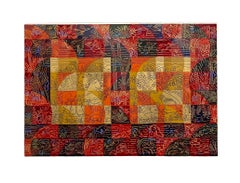
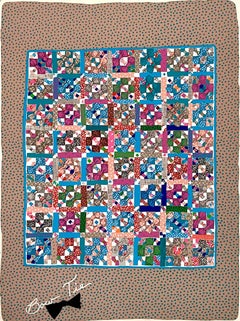
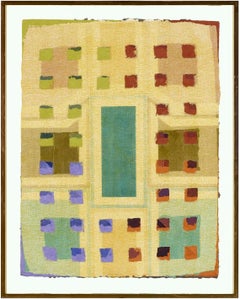
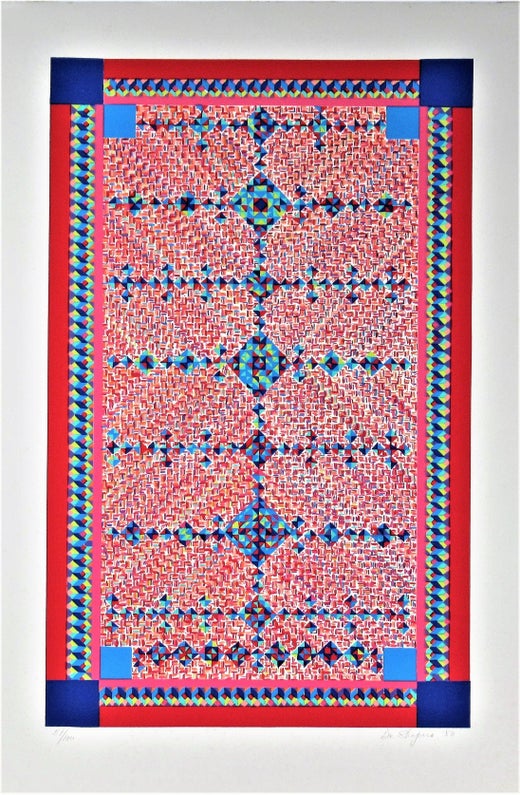
Quilt or Persian Rug Serigraph Pattern and Decoration Feminist Lithograph Print

1983

$650
£491.44
€573.48
CA$924.92
A$938.30
CHF 535.72
MX$11,361.30
NOK 6,306.70
SEK 6,285.77
DKK 4,288.28

About the Item

Dee Shapiro is a Contemporary American artist and writer associated with the Pattern and Decoration movement. I have seen this referred to as Hejaz. Dee Shapiro was inspired to be an Artist in her early years of education. Dee's career started in the 1970s as a pattern painter with her works of art included in the Pattern and Decoration at P.S. 1 (other artists included Mary Grigoriadis, Valerie Jaudon, Joyce Kozloff, Robert Kushner, Kim MacConnel, Miriam Schapiro, Betty Woodman, Robert Zakanitch.) She researched and explored the Fibonacci Progression in color on graph paper and also explored geometric complexity of architectural designs, leading her to create the small horizontal oil paintings of cities and landscapes. Dee Shapiro became a Yaddo fellow in 2017. Dee Shapiro obtained her bachelor's degree in 1958 and Master of Science in 1960 from Queens College, City University of New York. Dee Shapiro is an artist that sees the subject on a large scale, but what she creates is on a diminutive scale. Shapiro's strength is the ability to give expressive power on canvas that makes her work seem larger than they are. Dee Shapiro has been a teacher, lecturer, and writer through career. "I have been concerned with women’s issues most of my life. I have worked to enhance the position of women in society through supporting the work of women artists. As a contributor to Heresies Magazine and a founder of a women’s cooperative gallery as well as developing a body of work that references women’s work and more currently focuses on female sexual imagery, I identify with feminist matters and affairs." Group exhibitions 2018 The American Dream, Emden, Germany Solo exhibitions 2016 Art 101, Brooklyn, NY 2015 Andre Zarre Gallery, NYC 2015 Five Points Gallery, Torrington, CT 2012, 2010, 2009 Andre Zarre Gallery, NYC 2010 Norfolk Library, Norfolk, CT 2009 George Billis Gallery 2006 Harrison Street Gallery, Frenchtown, NJ 2004 The Mercy Gallery. Loomis Chafee, Windsor, CT. 2004,2002, 1998 Andre Zarre Gallery, NY C, National Arts Club, NYC 2000 Principle Gallery, Alexandria, VA 1998 Nassau County Museum of Fine Art, Roslyn, NY 1997 Andre Zarre Gallery, NYC 1996 North Winds, Port Washington, NY 1994, Andre Zarre Gallery, NYC 1984 Ana Sklar Gallery, Miami, FL 1983 Andre Zarre Gallery, NYC 1982 Everson Museum, Syracuse, NY, Andre Zarre Gallery, NYC 1981 Dubins Gallery, Los Angeles, CA, Zenith Gallery, Pittsburgh, PA 1980, 1976 Andre Zarre Gallery, NYC 1979 Gallery 700, Milwaukee, WI Andre Zarre GalleryNYC 1978 St. Mary's College, Notre Dame, IN 1977 University of Arkansas, Little Rock, AK 1975, 1973 Central Hall Gallery, Port Washington, NY, Nassau County Museum of Fine Art, Roslyn, NY Selected bibliography James Panero, Supreme Fiction The Hudson River School Revisited, March, 2010 Piri Halaz, From the Mayor’s Doorstep, April 2010 Steve Starger, Art New England, Dee Shapiro: “On The Horizontal,” Feb/Mar 2005 Maureen Mullarkey, The New York Sun,”The Last Time I Saw Cuba,” April 15, 2004 James Kalm, NY ARTS, International Edition, April 2000 Helen Harrison, The New York Times, April 12, 1998, April 11, 1981 Phyllis Braff, The New York Times, 1989 Charlotte Rubenstein, American Women Artists, Avon, 1982 Barbara Colin, "Pattern of a Painter" New York Arts Journal, Oct-Nov 1981 Helen Harrison, Harald Szeeman, "Pattern Paintings" D U Die Kunstzeitschrift, Zurich, June 1979 Ellen Lubell, "Lush Complexities and Visual Indulgence" Soho Weekly News, Feb.13, 1979 Peter Frank, The Village Voice, May 1, 1979 Judith Tannenbaum, Arts Magazine, April 1978 Peter Frank, "Pattern Painting" ARTnews, February 1978 Madeline Burnside, ARTnews, April 1978 April Kingsley, "Opulent Optimism" The Village Voice, Nov.28.1977 John Canaday, "Talent Blooms" The New York Times, May 9, 1976 Malcolm Preston, Newsday, September 18, 1976 Gordon Brown, Arts Magazine, September 1976 Ellen Lubell, "Watercolor Electricity" Soho Weekly News, Feb.16,1975 Selected collections Albright-Knox Museum, Buffalo, NY Aldrich Museum of Contemporary Art, Ridgefield, CT Birmingham Museum of Art, Birmingham, AL Brown-Foreman, Louisville, KY Chrysler Museum, Norfolk, VA Citibank Collection, NYC Dartmouth Museum of Art, Hanover, NH Dayton Institute, Dayton, OH Owens-Corning Corp., Corning, NY Everson Museum of Art, Syracuse, NY General Electric Co., Fairfield, Ct. Solomon R. Guggenheim Museum, NYC Corporate Collection, Jeddah, Saudi Arabia Heckscher Museum of Art, Huntington,[New York Herbert Johnson Museum, Ithaca NY Hoffman-LaRoche Collection, Zurich, Switzerland IBM Corporation, NY Lehigh University Collection, Bethlehem, PA Louis-Dreyfus Financial Group Mercer Street Medical Center, NYC Mint Museum of Art, Charlotte, NC Neuberger Museum, Purchase, NY New York University Collection, NYC Pepsico Corporation, NY Spencer Museum of Art, Lawrence, KS St. Mary’s College Collection, Notre Dame, IN Texaco Corporation, NY The New Museum, NYC New York University Collection, NYC The Newark Museum, Newark, NJ United States Department of State, Washington, DC University of Arkansas, Little Rock, AK
  • Creator:
    Dee Shapiro (1936, American)
  • Creation Year:
    1983
  • Dimensions:
    Height: 30.75 in (78.11 cm)Width: 21 in (53.34 cm)
  • Medium:
  • Movement & Style:
  • Period:
  • Condition:
    never framed. the colors are a bit hard to capture exactly with the pattern.
  • Gallery Location:
    Surfside, FL
  • Reference Number:
    1stDibs: LU38213402132

More From This Seller

View All
Quilt or Persian Rug Serigraph Pattern and Decoration Feminist Lithograph Print

Quilt or Persian Rug Serigraph Pattern and Decoration Feminist Lithograph Print

By Dee Shapiro

Located in Surfside, FL

Dee Shapiro is a Contemporary American artist and writer associated with the Pattern and Decoration movement. I have seen this referred to as Hejaz. Dee Shapiro was inspired to be an Artist in her early years of education. Dee's career started in the 1970s as a pattern painter with her works of art included in the Pattern and Decoration at P.S. 1 (other artists included Mary Grigoriadis, Valerie Jaudon, Joyce Kozloff, Robert Kushner, Kim MacConnel, Miriam Schapiro, Betty Woodman, Robert Zakanitch.) She researched and explored the Fibonacci Progression in color on graph paper and also explored geometric complexity of architectural designs, leading her to create the small horizontal oil paintings of cities and landscapes. Dee Shapiro became a Yaddo fellow in 2017. Dee Shapiro obtained her bachelor's degree in 1958 and Master of Science in 1960 from Queens College, City University of New York. Dee Shapiro is an artist that sees the subject on a large scale, but what she creates is on a diminutive scale. Shapiro's strength is the ability to give expressive power on canvas that makes her work seem larger than they are. Dee Shapiro has been a teacher, lecturer, and writer through career. "I have been concerned with women’s issues most of my life. I have worked to enhance the position of women in society through supporting the work of women artists. As a contributor to Heresies Magazine and a founder of a women’s cooperative gallery as well as developing a body of work that references women’s work and more currently focuses on female sexual imagery, I identify with feminist matters and affairs." Group exhibitions 2018 The American Dream, Emden, Germany Solo exhibitions 2016 Art 101, Brooklyn, NY 2015 Andre Zarre Gallery, NYC 2015 Five Points Gallery, Torrington, CT 2012, 2010, 2009 Andre Zarre Gallery, NYC 2010 Norfolk Library, Norfolk, CT 2009 George Billis Gallery 2006 Harrison Street Gallery, Frenchtown, NJ 2004 The Mercy Gallery. Loomis Chafee, Windsor, CT. 2004,2002, 1998 Andre Zarre Gallery, NY C, National Arts Club, NYC 2000 Principle Gallery, Alexandria, VA 1998 Nassau County Museum of Fine Art, Roslyn, NY 1997 Andre Zarre Gallery, NYC 1996 North Winds, Port Washington, NY 1994, Andre Zarre Gallery, NYC 1984 Ana Sklar Gallery, Miami, FL 1983 Andre Zarre Gallery, NYC 1982 Everson Museum, Syracuse, NY, Andre Zarre Gallery, NYC 1981 Dubins Gallery, Los Angeles, CA, Zenith Gallery, Pittsburgh, PA 1980, 1976 Andre Zarre Gallery, NYC 1979 Gallery 700, Milwaukee, WI Andre Zarre GalleryNYC 1978 St. Mary's College, Notre Dame, IN 1977 University of Arkansas, Little Rock, AK 1975, 1973 Central Hall Gallery, Port Washington, NY, Nassau County Museum of Fine Art, Roslyn, NY Selected bibliography James Panero, Supreme Fiction The Hudson River School Revisited, March, 2010 Piri Halaz, From the Mayor’s Doorstep, April 2010 Steve Starger, Art New England, Dee Shapiro: “On The Horizontal,” Feb/Mar 2005 Maureen Mullarkey, The New York Sun,”The Last Time I Saw Cuba,” April 15, 2004 James Kalm, NY ARTS, International Edition, April 2000 Helen Harrison...

Category

1980s Abstract Geometric Abstract Prints

Materials

Screen

Pencil Signed Abstract Geometric Graphic Design Lithograph Print, Bauhaus Artist

Pencil Signed Abstract Geometric Graphic Design Lithograph Print, Bauhaus Artist

By M. Peter Piening

Located in Surfside, FL

M. Peter Piening was born on March 14, 1908 in Grabow, Germany. He began his education at a private school in Italy, studied at the Jesuit school of Kloster Ettal in Bavaria, and attended the German Stettin Gymnasium, where he graduated in 1926. Between 1926 and 1928 Piening studied design at the Bauhaus in Dessau, Germany. There he was taught by multiple famous twentieth-century artists, including Joseph Albers, Paul Klee and Mies van der Rohe. After receiving his master’s degree from the Bauhaus in 1929, Piening enrolled at the University of Berlin and obtained his PhD in philosophy in 1931. Piening spent his early career free-lancing as an illustrator and artist for various publishing companies, eventually settling in Paris to work for Condé-Nast’s French publication of Vogue. In 1934 he moved to the United States to work in Condé-Nast’s New York City office. For the next two decades, Piening worked for many important advertising agencies and magazine publishers, including the N. W. Ayer and J. Walker Thompson agencies and Life and Fortune magazines. As art director for Life in the 1930s and for Fortune in the 1940s, Piening completely redesigned the layout of each magazine. He also redesigned the layouts for thirty-four other major American magazines, including Town & Country and Cosmopolitan. Through his design work, Piening had a great impact on the American public, although the millions who encountered his work most likely never knew his name. Between 1934 and 1964, Piening designed over sixty logos and trademarks for internationally-known products and companies. His most widely-recognized logo may have been the three interlocking rings of Ballantine beer. Piening’s other trademark designs include the Lincoln Zephyr...

Category

1960s Abstract Geometric Abstract Prints

Materials

Lithograph

Feminist Surrealist French Abstract Colorful Lithograph Print Myriam Bat Yosef

Feminist Surrealist French Abstract Colorful Lithograph Print Myriam Bat Yosef

By Myriam Bat Yosef

Located in Surfside, FL

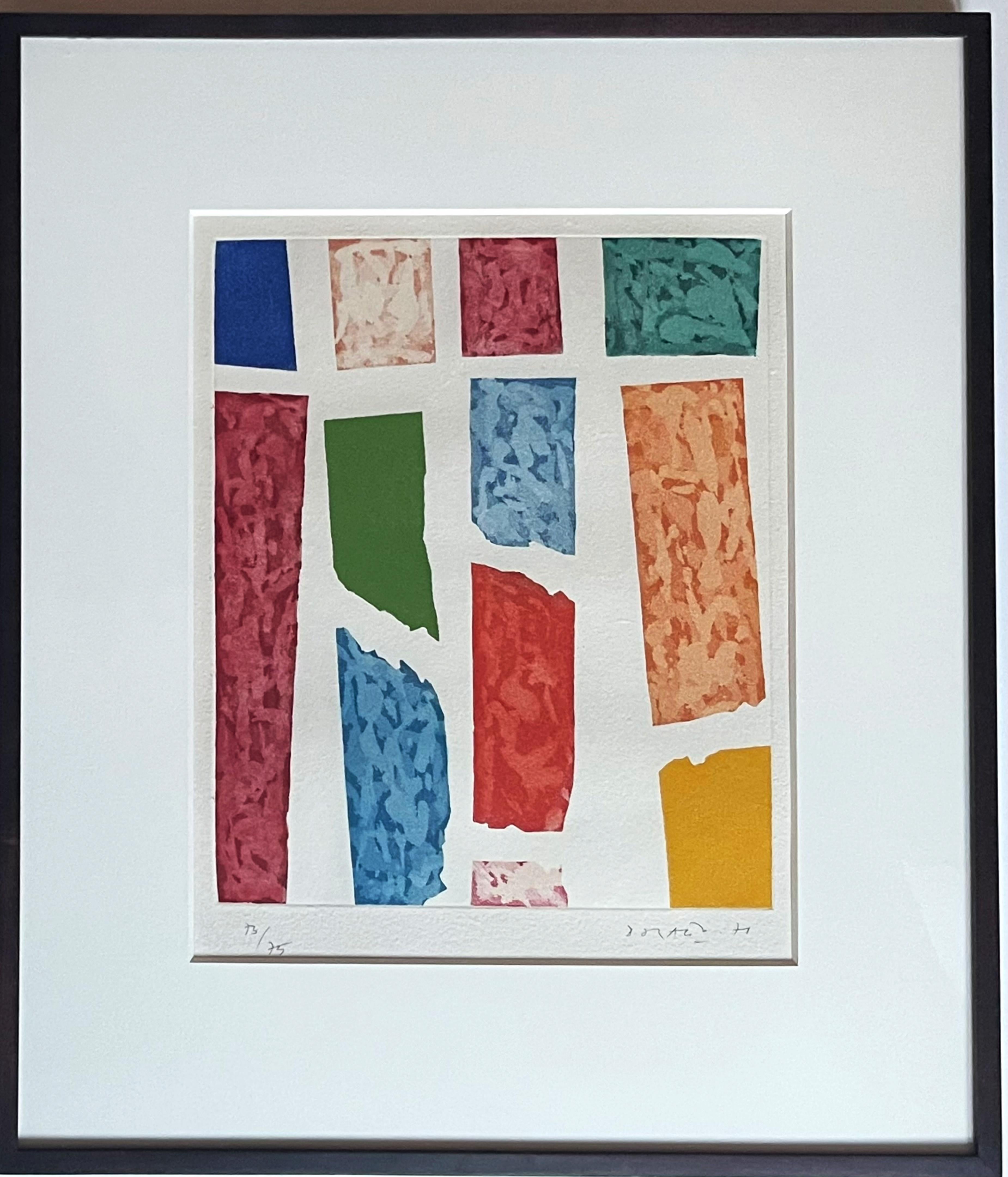
Myriam Bat-Yosef Surrealist abstract lithograph print in colorful abstract shapes and shades Hand signed and dated 1971. sheet measures 9.25 X 9.25 inches The envelope and the Peter Buch poster is just for provenance and is not included in this sale. Myriam Bat-Yosef, whose real name is Marion Hellerman, born on January 31, 1931 in Berlin, Germany to a Jewish family from Lithuania, she is an Israeli-Icelandic artist who paints on papers, paintings, fabrics, objects and human beings for performances. Myriam Bat-Yosef currently lives and works in Paris. In 1933, her family fleeing the Nazi Holocaust, Miriam Bat-Yosef emigrates to Palestine and settles in Jaffa. In 1936, she suffers a family tragedy, her father, militant Zionist, is called to fight, still recovering from an operation of appendicitis. The incision will become infected, antibiotics did not exist yet, and her father will die in the hospital after 9 months of suffering. Myriam and her mother leave Palestine to live in Paris for three years. French is Myriam's first school language. In 1939, still fleeing Nazism, she returned to Palestine, leaving France by the last boat from Marseille. She moved to Tel Aviv with her mother, aunt and maternal grandmother. In 1940, she began attending the Academy of Fine Arts in Tel Aviv and took her name as an artist, Bat-Yosef, which means Joseph's daughter in Hebrew, as a tribute to her father. In 1946, Myriam graduated as a kindergarten teacher but wanted to be an artist. Her mother enrolled her in an evening school to prepare a diploma of art teacher. At 19, she performs two years of military service in Israel. In 1952, with a pension of $50 a month that her mother allocated, she went to study at the Beaux-Arts in Paris. To survive, she has several activities while studying. In 1955, she had her first solo exhibition, at the Israeli Club on Wagram Avenue in Paris. Many artists, such as Yaacov Agam, Yehuda Neiman Avigdor Arikha, Raffi Kaiser, Dani Karavan and sculptors Achiam and Shlomo Selinger attended the opening . In 1956, she enrolled at the School of Fine Arts in Florence. This is where she meets the painter Errô. They share an icy studio in winter. Myriam moves to Milan with friends. She organizes a joint exhibition with Erro, one room each, at the Montenapoleone gallery. Her works are admired by the sculptor Marino Marini and the painters Renato Birolli and Enrico Prampolini. Myriam and Erro exhibit in Rome, Milan, Florence and meet many personalities: Alain Jouffroy and his wife, the painter Manina, Roberto Matta and his wife Malitte, textile artist who was one of the founders of the Pompidou Center. Back in Paris, Myriam and Erro get married, which allows Myriam to avoid being called into the Israeli army during the Suez Canal War. In 1957, Myriam and her husband went to Iceland. Myriam works in a chocolate factory. Having enough money, she starts producing art again. She exhibited in Reykjavik's first art gallery. She meets the artist Sigridur Bjornsdottir, married to the Swiss painter Dieter Roth . In 1958, Myriam and her husband leave for Israel. They exhibit in Germany, then in Israel. Back in Paris, the couple became friends with artists of the surrealist movement, such as Victor Brauner, Hans Bellmer, the sculptor Philippe Hiquily, Liliane Lijn, future wife of Takis and photographer Nathalie Waag. Erro and Myriam have a daughter on March 15, 1960, named Tura, after the painter Cosmè Tura, but also close to the Icelandic Thora or the Hebrew Torah. Bat-Yosef’s complex trajectory throughout the 20th century is linked as much to the transnational history of what was for a time called the School of Paris as it is to a certain legacy of Surrealism. Her work features the same idea of resolving antinomies that also defined the spirit of surrealism, and is enhanced with her readings of the Kabbalah and her spiritual grounding in Taoism. However, while there are reasons for her approach to be associated with the process of the ready-made, it is important to consider the immediate intrication of these works with her practice of performance, during which the body itself is also painted – a feminist response to Yves Klein’s Anthropometries (1960) and an echo of the happenings which Jean-Jacques Lebel organised at the time in Paris. In 1963, Erró told Myriam that if she wants to be a painter, she can not be his wife. Myriam chose to be a painter and the couple divorced in 1964. Since that time, Myriam Bat-Yosef has exhibited in many countries: Europe, United States, Japan, etc. Although long in the shadows, the work of Myriam Bat-Yosef has been greeted by many artists and personalities: Anaïs Nin, Nancy Huston, André Pieyre of Mandiargues, José Pierre, René de Solier , Jacques Lacarrière, Alain Bosquet, Pierre Restany, Sarane Alexandrian and Surrealist André Breton who, after a visit to her studio, confided to having been intrigued by its phantasmagorical dimension. She was included in the book Pop Art and Beyond: Gender, Race, and Class in the Global Sixties by Mona Hadler and Kalliopi Minioudaki. Extract "World Citizen, Artist of the Pop Era Sarah Wilson; Why do we know so little of Myriam Bat-Yosef, the most important female Israeli artist of the Pop era? Issues of identity and sexuality feature constantly in her work. She exhibited internationally from Reykjavik to Tokyo; she had two shows at Arturo Schwarz’s famous Dada/surrealist gallery in Milan; she participated in feminist art events in Los Angeles. Above all, in 1971, she conceived Total Art, a Pop Gesamtkunstwerk inside and outside the Israel Museum, Jerusalem. Painter, performer, and installation artist, she was also a lover, wife, and mother. Of Lithuanian-Jewish descent, she was close to the family of philosopher Emmanuel Levinas. An émigré in Paris she would repudiate a national passport, participating in Garry Davis’s short-lived “World Citizens” movement. She continues the lineage of women surrealist artists: Valentine Hugo, Leonor Fini, Dorothea Tanning, Leonora Carrington, Unica Zürn, Jane Graverol...

Category

1970s Surrealist Abstract Prints

Materials

Lithograph

You May Also Like

Rug Pattern

Rug Pattern

By Dee Shapiro

Located in San Francisco, CA

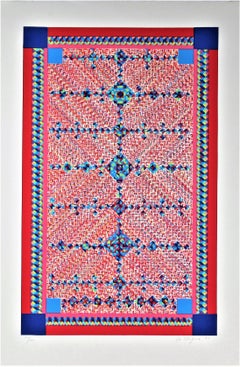
This artwork "Persian Rug" 1983 is an original colors lithograph by noted American artist Dee Shapiro, born 1936. It is hand signed, dated and numbered 57/100 in pencil by the artist. The image size is 25.25 x 16 inches, sheet size is 30 x 20.25 inches. It is in excellent condition. About the artist: Dee Shapiro is a Contemporary American artist and writer associated with the Pattern and Decoration movement. Dee Shapiro was inspired to be an Artist in her early years of education. Dee's career started in the 1970s as a pattern painter. She researched and explored the Fibonacci Progression in color on graph paper and also explored geometric complexity of architectural designs, leading her to create the small horizontal oil paintings of cities...

Category

Late 20th Century American Modern Figurative Prints

Materials

Lithograph

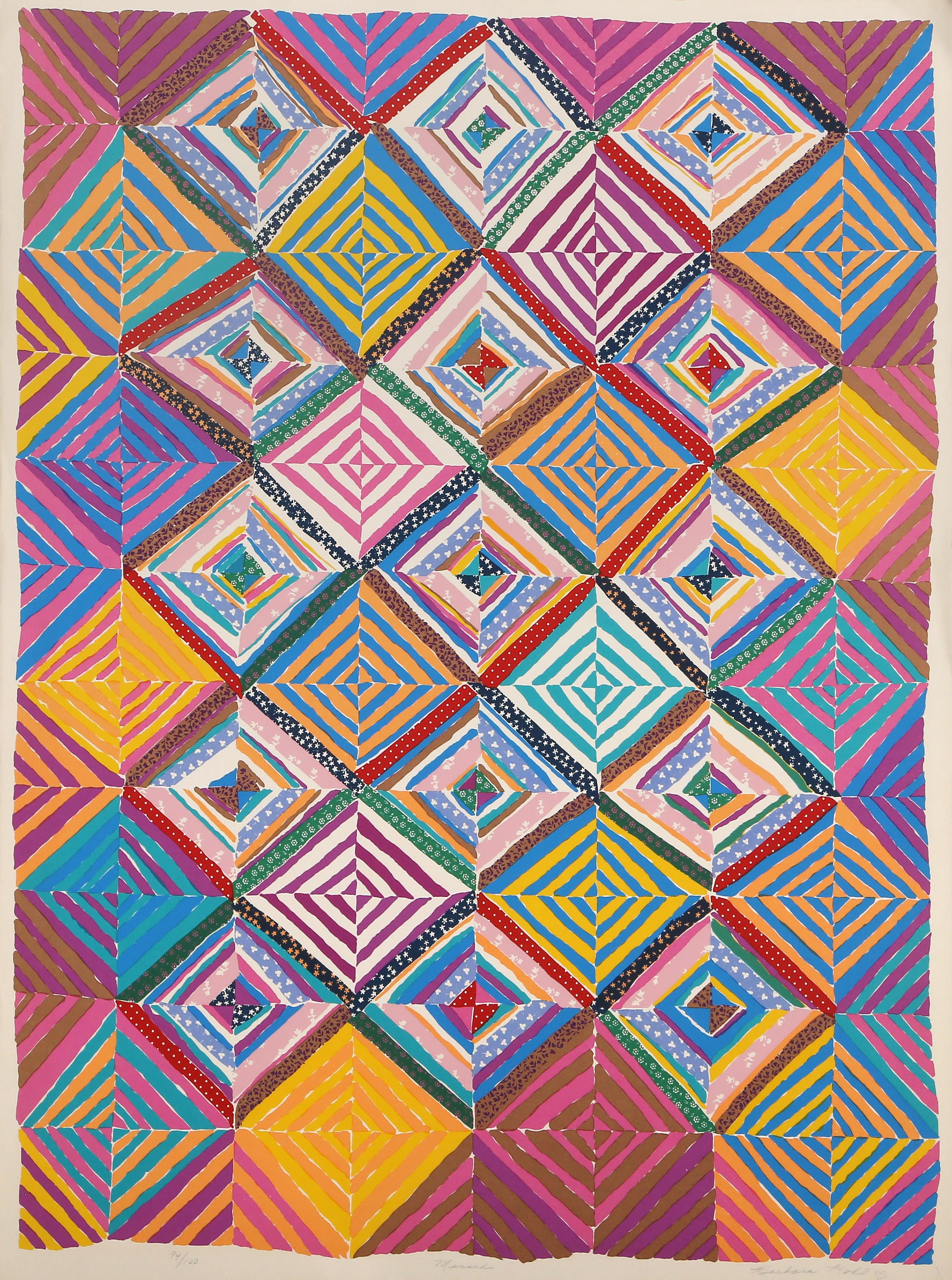
Mensch, Abstract Geometric Screenprint by Barbara Kohl-Spiro

Mensch, Abstract Geometric Screenprint by Barbara Kohl-Spiro

Located in Long Island City, NY

Barbara Kohl-Spiro, American (1941 - ) - Mensch, Year: 1980, Medium: Screenprint on Arches, signed, titled and numbered in pencil, Edition: 100, Image Size: 29 x 21 inches, Size:...

Category

1980s Abstract Geometric Abstract Prints

Materials

Screen

A Stylish, Colorful, Mid-Century Modern 1950s Abstract Geometric Textile Design

A Stylish, Colorful, Mid-Century Modern 1950s Abstract Geometric Textile Design

By Andre Delfau

Located in Chicago, IL

A stylish, colorful 1950s Mid-century Modern abstract geometric textile design (depicting a polychrome Wedge Star pattern in orange, blue, red and yellow tones) by famed French costu...

Category

1950s American Modern Abstract Drawings and Watercolors

Materials

Ink, Gouache, Graphite, Paper

Geometric Post-modern Lithograph Signed Numbered by Chester Solomon

Geometric Post-modern Lithograph Signed Numbered by Chester Solomon

Located in San Diego, CA

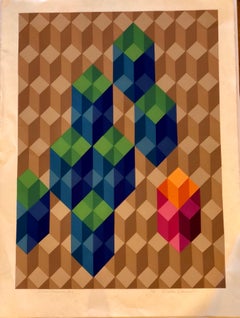
Beautiful Lithograph unframed si2gned and numbered 3/18 circa 1980' s in the style of Victor Vasarely very nice condition. Signed by Chester Solomon , title Cubist Extensions #2.

Category

20th Century Abstract Geometric Abstract Prints

Materials

Paper

A Stylish, Colorful, Mid-Century Modern 1950s Abstract Geometric Textile Design

A Stylish, Colorful, Mid-Century Modern 1950s Abstract Geometric Textile Design

By Andre Delfau

Located in Chicago, IL

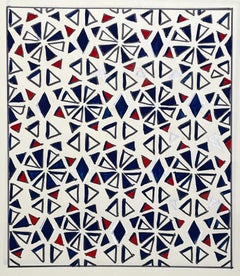
A stylish, colorful 1950s Mid-Century Modern abstract geometric textile design (depicting a polychrome Wedge Star pattern in red, white and blue tones) by notable costume, set and fa...

Category

1950s American Modern Abstract Drawings and Watercolors

Materials

Paper, Ink, Gouache, Graphite