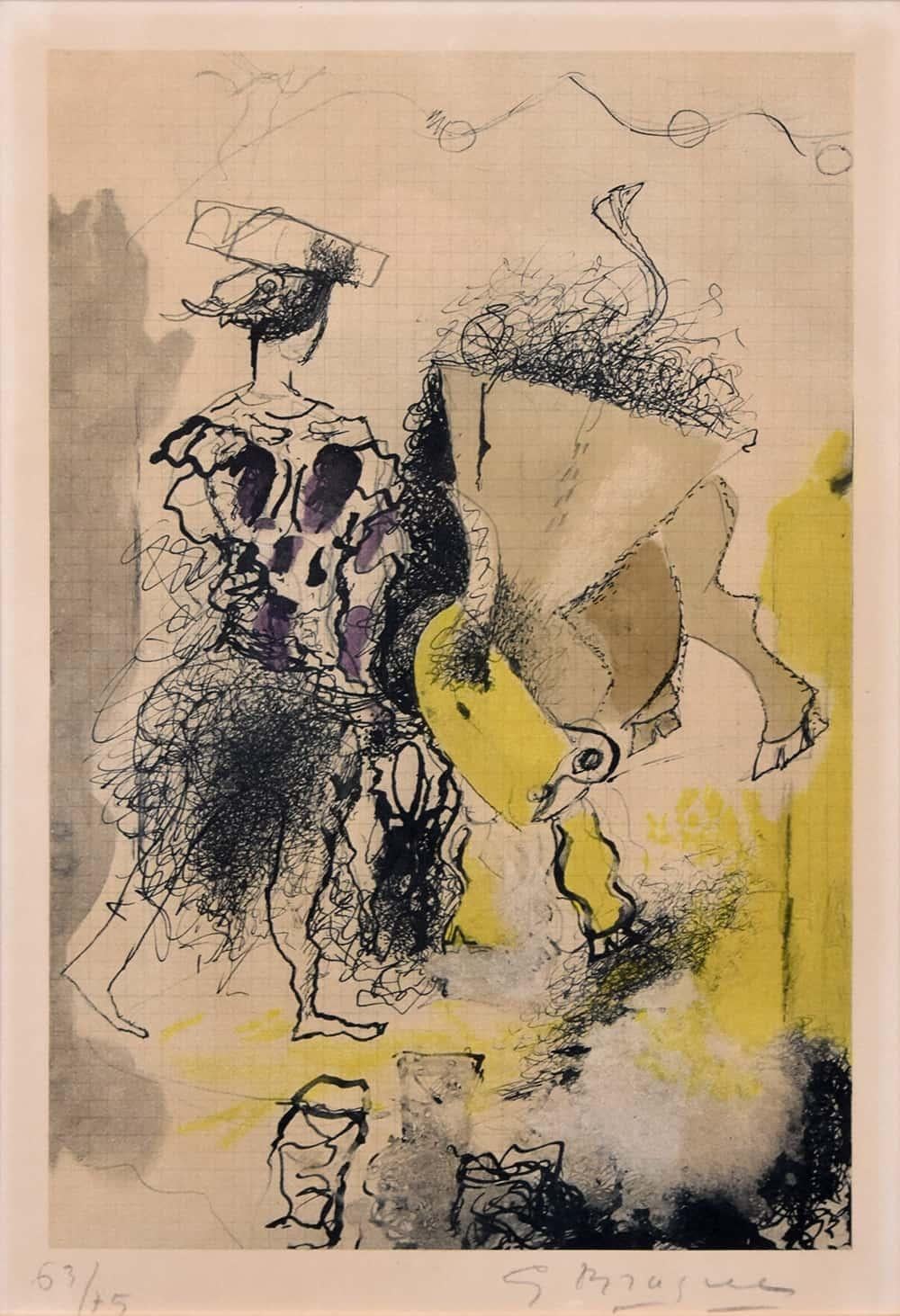
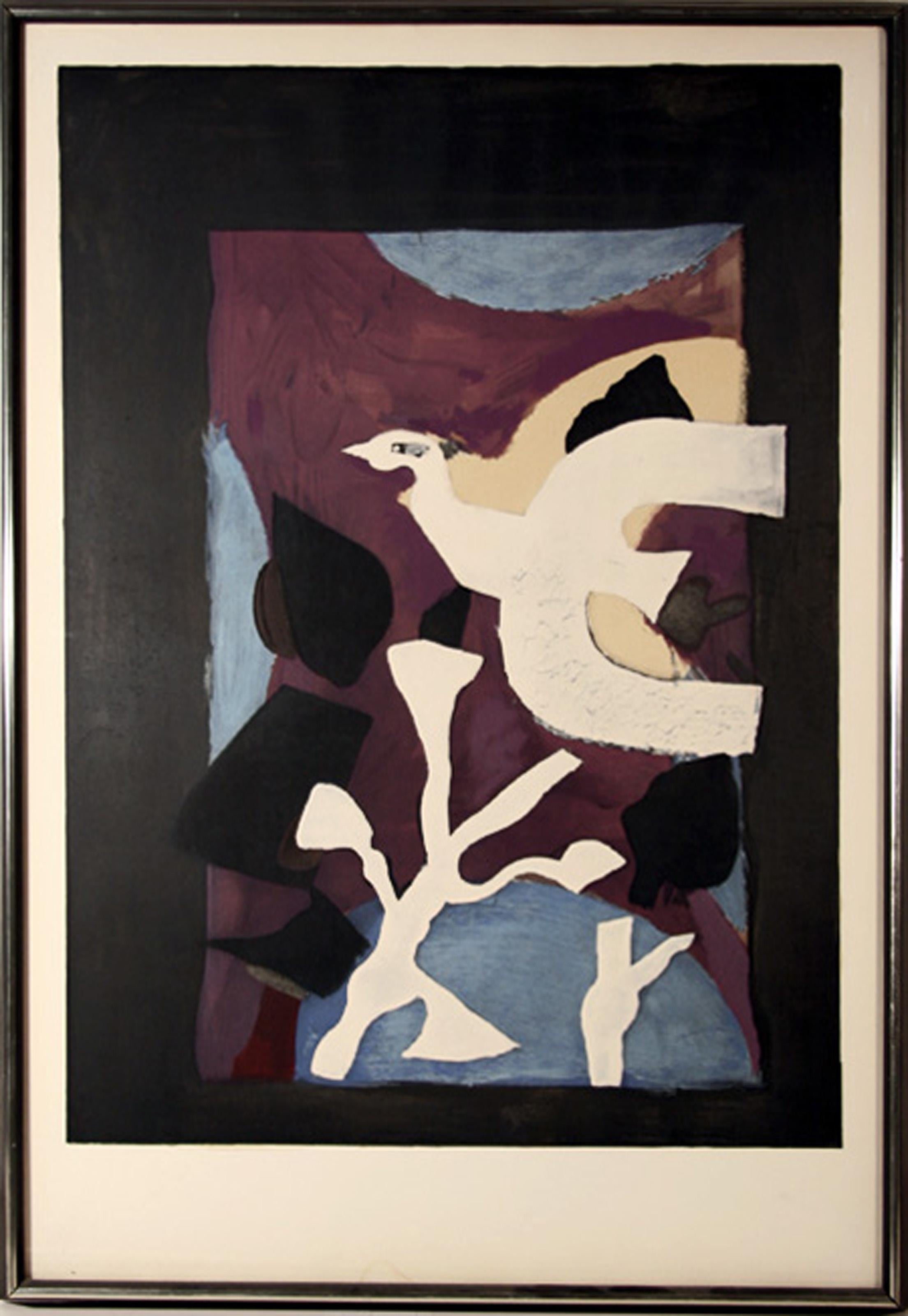
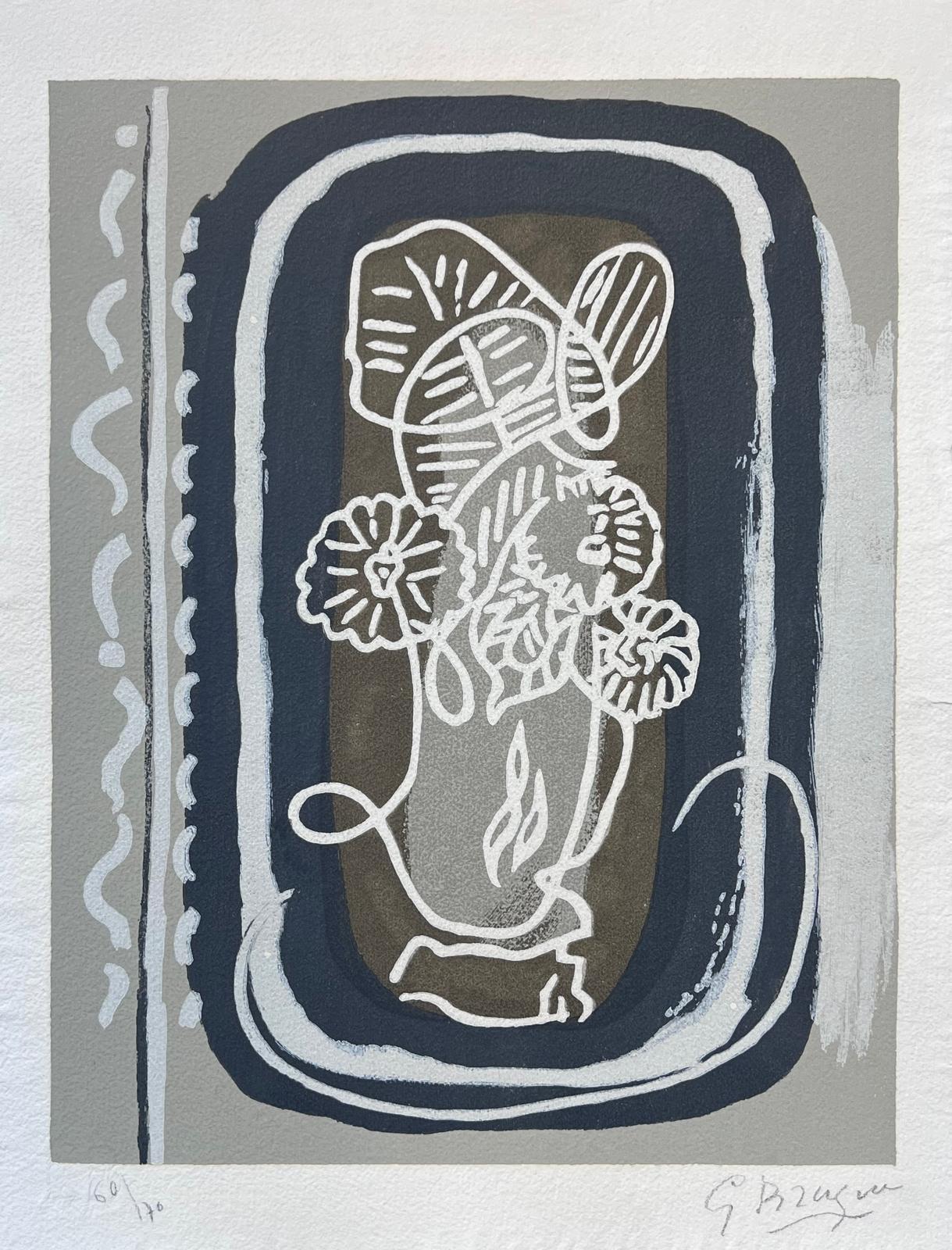
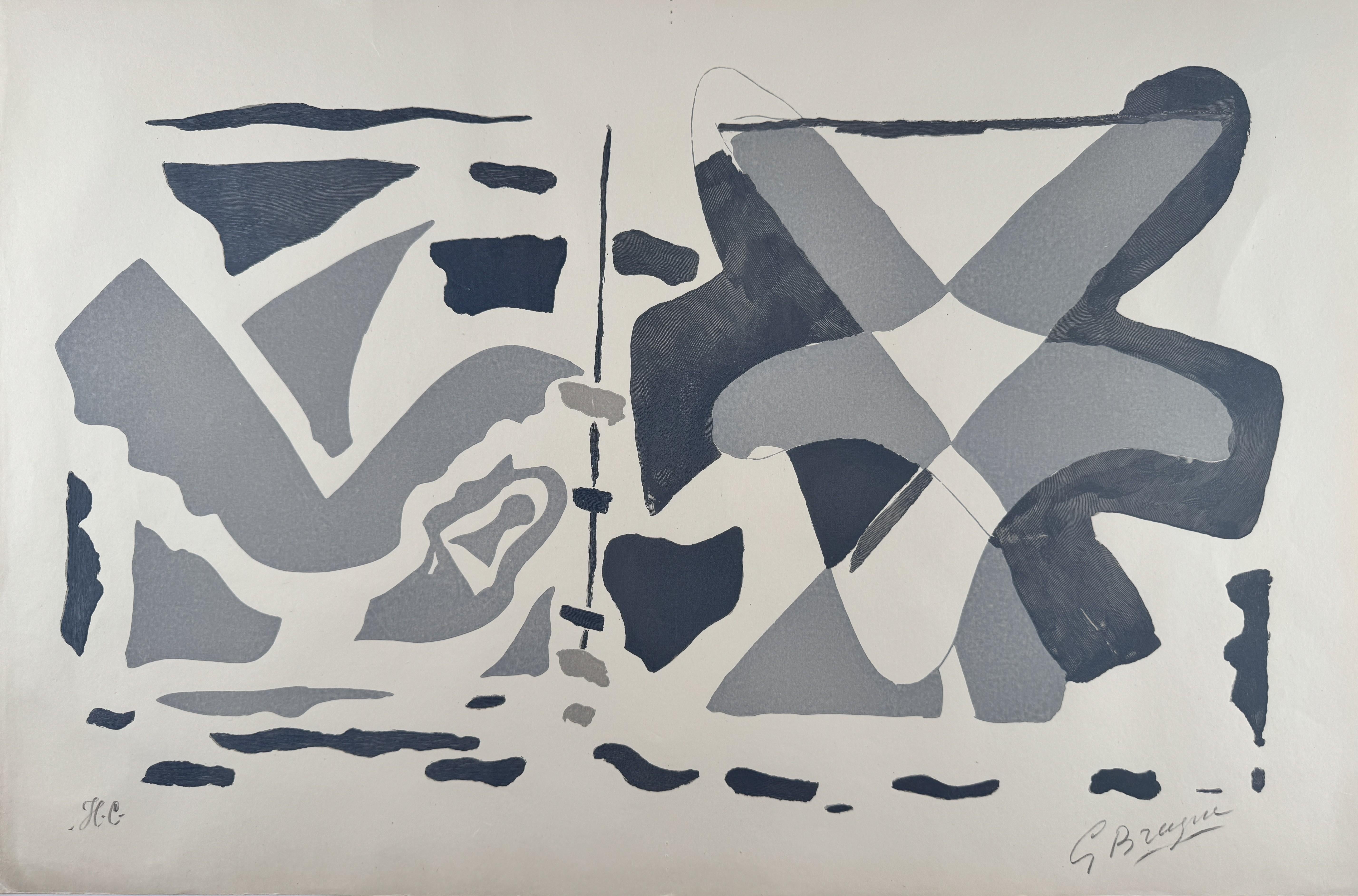
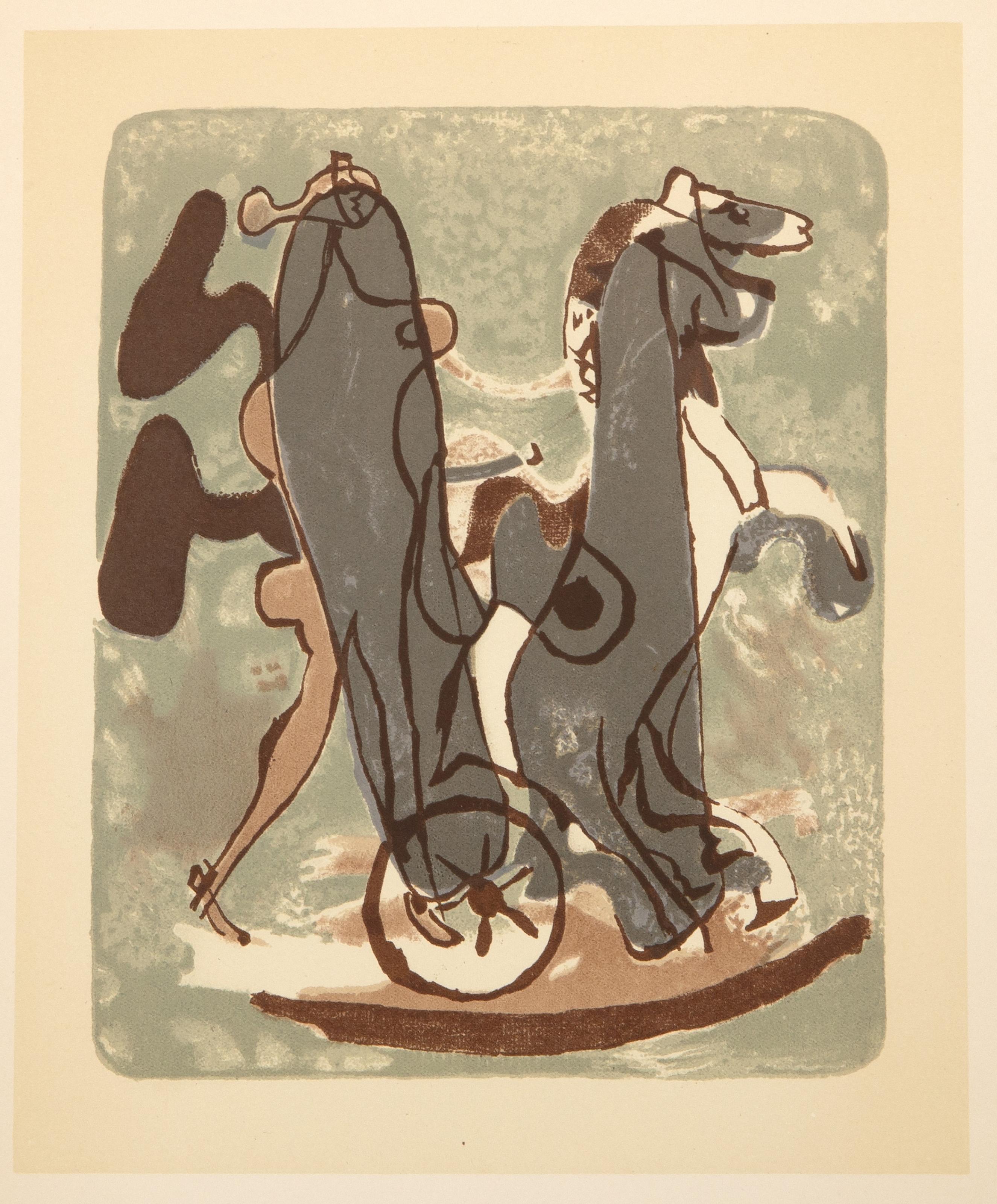
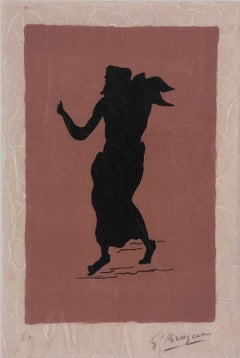
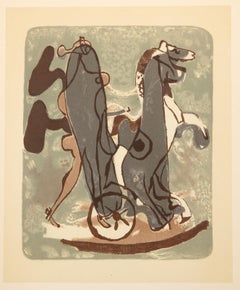
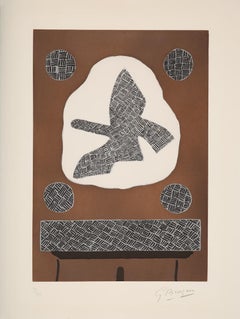
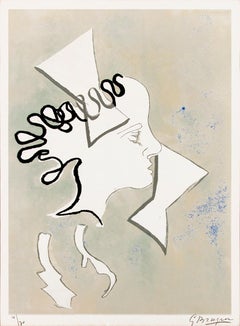
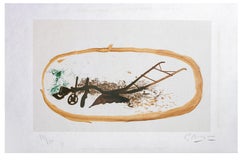
This exquisite lithograph by Georges Braque (1882–1963), titled Conception de costumes, Tartuffe (Costume Design, Tartuffe), from Regards Sur Paris (Views of Paris), originates from the January 22, 1963 issue published by Andre Sauret, Editeur, Paris, and printed by Mourlot Freres, Paris, 1963. This visionary composition reflects Braque’s mastery of the lithographic medium, embodying his refined balance of structure, form, and poetic restraint through subtle tonal relationships and carefully constructed spatial harmony.
Executed as a lithograph on grand velin d'Arches paper, this work measures 15.35 x 11.81 inches (38.99 x 30.00 cm). Unsigned and unnumbered as issued. The edition exemplifies the superb craftsmanship of the Mourlot Freres atelier, renowned for its collaborations with the greatest modern masters of the 20th century.
Artwork Details:
Artist: Georges Braque (1882–1963)
Title: Conception de costumes, Tartuffe (Costume Design, Tartuffe), from Regards Sur Paris (Views of Paris), January 22, 1963
Medium: Lithograph on grand velin d'Arches paper
Dimensions: 15.35 x 11.81 inches (38.99 x 30.00 cm)
Inscription: Unsigned and unnumbered as issued
Date: 1963
Publisher: Andre Sauret, Editeur, Paris
Printer: Mourlot Freres, Paris
Catalogue raisonne references: Vallier, Dora, et al. Braque, the Complete Graphics: Catalogue Raisonne. Translated by Robert Bononno, Gallery Books, 1988, illustration 298.
Condition: Well preserved, consistent with age and medium
Provenance: From Regards Sur Paris, published by Andre Sauret, Editeur, Paris, 1963
Notes:
Excerpted from the folio (translated from French), Completed printing on January 22, 1963, on the presses of the Imprimerie Nationale de France, Daniel Gibelin being director, Georges Arnoul, inspector of typography. This work was composed by hand in type known as “Romain du Roi,” size 24, engraved in 1699 by Grandjean under the order of Louis XIV. The original lithographs were printed by Mourlot Freres and the stones effaced after printing. Justification of the edition, CLXXX examples on grand Velin d'Arches, comprising as follows: X examples numbered at the press from I to X, including a suite on Japon nacre of the original lithographs signed by the artists and a suite on Arches. XX examples numbered at the press from XI to XXX, including a suite on Arches of the original lithographs. CXX examples numbered from XXXI to CL. XXX examples hors commerce marked H.C., reserved for the authors, artists, and craftsmen of the work. All colophons are signed by the ten authors and the ten artists.
About the Publication:
Regards Sur Paris (Views of Paris), published on January 22, 1963 by Andre Sauret in Paris and printed by Mourlot Freres, represents a significant achievement in the tradition of French illustrated folios, bringing together leading literary and artistic figures in a unified creative endeavor. Conceived as a collaborative project, the publication pairs texts by ten authors with original lithographs by ten artists, creating a rich dialogue between word and image that reflects the cultural vitality of mid-20th century Paris. Produced with exceptional craftsmanship, the typography was composed by hand at the Imprimerie Nationale de France using the historic “Romain du Roi” typeface, while the lithographs were executed under the expert supervision of Mourlot Freres, ensuring the highest standards of printmaking. The careful structuring of the edition, including impressions on grand velin d'Arches and special suites on Japon nacre, underscores the publication’s status as a refined collectors’ work. As a whole, Regards Sur Paris stands as a testament to the enduring importance of collaboration between writers, artists, printers, and publishers, embodying the intellectual and artistic spirit of modern France.
About the Artist:
Georges Braque (1882–1963) was a French painter, printmaker, sculptor, and collagist whose visionary innovations and lifelong pursuit of balance, structure, and poetic form made him one of the most influential figures in 20th-century art. Born in Argenteuil-sur-Seine and raised in Le Havre, Braque began as a decorative painter before studying at the Ecole des Beaux-Arts and the Academie Humbert in Paris, where he absorbed the vibrant colorism of the Fauves and the structural logic of Paul Cezanne. His encounter with Pablo Picasso in 1907 led to one of the most groundbreaking collaborations in art history—the invention of Cubism—a movement that redefined visual perception by fragmenting form, rejecting single-point perspective, and reconstructing reality into a multidimensional experience. Between 1908 and 1914, Braque and Picasso revolutionized painting through Analytical Cubism, a style characterized by muted palettes, overlapping planes, and a focus on underlying structure rather than surface appearance. In 1912, Braque pioneered papier colle, the first use of collage in fine art, incorporating wallpaper and printed paper into his compositions and forever changing the relationship between art and the material world. After World War I, he returned to painting with renewed sensitivity, developing a lyrical and introspective form of Synthetic Cubism distinguished by harmony, rhythm, and a meditative sense of stillness. His still lifes, musical instruments, and interior scenes became metaphors for balance and contemplation, uniting intellect and emotion in perfect equilibrium. Immersed in the Parisian avant-garde, Braque worked alongside and exchanged ideas with Pablo Picasso, Alexander Calder, Alberto Giacometti, Salvador Dali, Joan Miro, Wassily Kandinsky, Marcel Duchamp, and Man Ray, each of whom shared his passion for redefining the boundaries of modern art. His innovations in form, collage, and spatial construction deeply influenced later artists, including Jean Dubuffet, Nicolas de Stael, Henry Laurens, Ellsworth Kelly, Richard Diebenkorn, and Jasper Johns, shaping the course of postwar abstraction and modern design. In 1961, Braque became the first living artist to have a solo exhibition at the Louvre, a recognition of his monumental impact on modern aesthetics. His works are now housed in major museums worldwide, including the Museum of Modern Art in New York, the Tate Modern in London, and the Centre Pompidou in Paris, and remain sought after for their intellectual depth and timeless serenity. His highest auction record was achieved by Paysage a la Ciotat, which sold for $15.8 million at Sotheby’s, New York, in 2013, reaffirming Georges Braque’s legacy as one of the founding architects of Cubism and a master whose art continues to define the modern age.
Georges Braque Conception de costumes, Tartuffe, Braque Mourlot Freres, Braque Andre Sauret, Braque 1963 lithograph, Braque grand velin d'Arches, Braque Regards Sur Paris, Braque collectible print, Braque modernist lithograph.