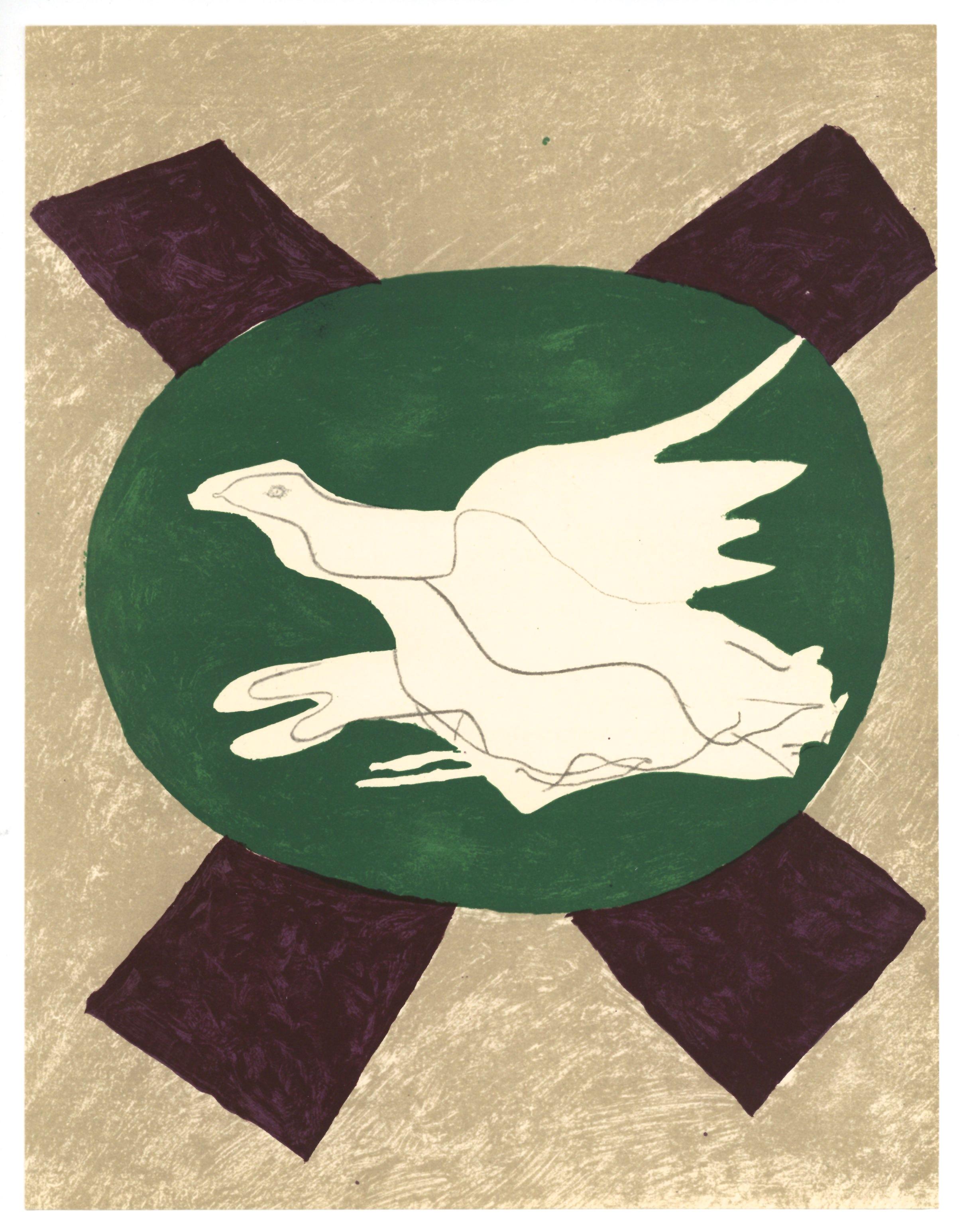
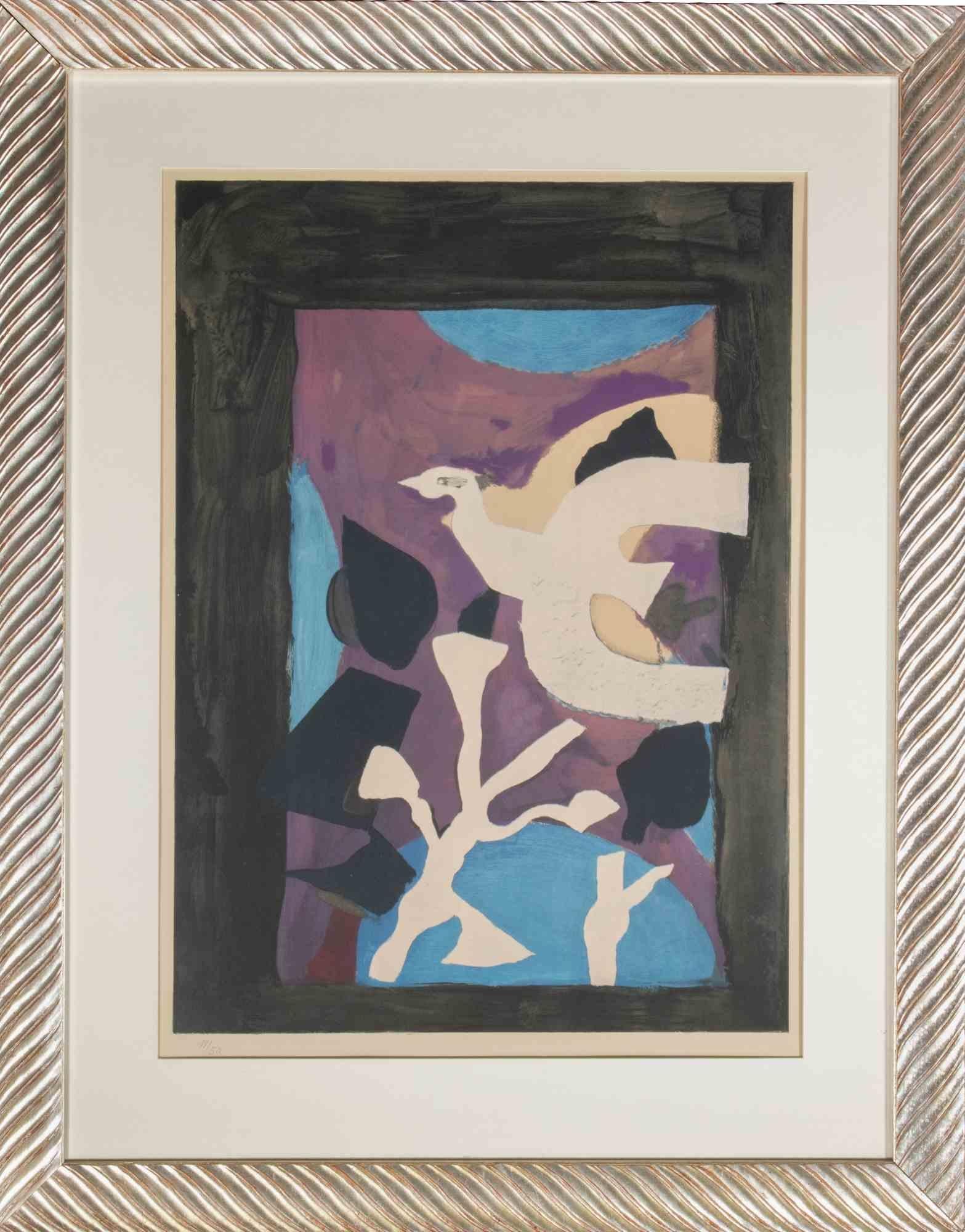
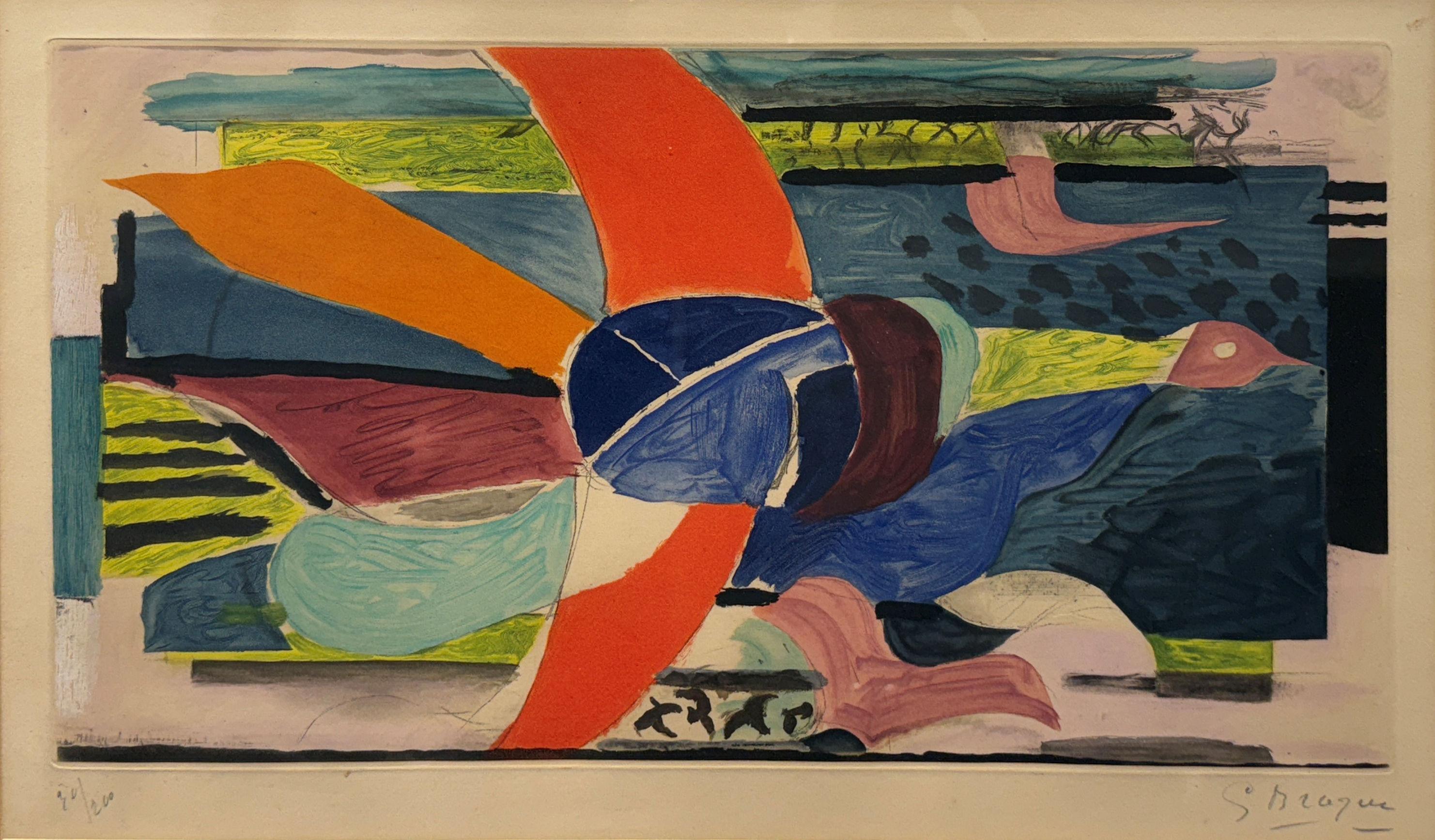
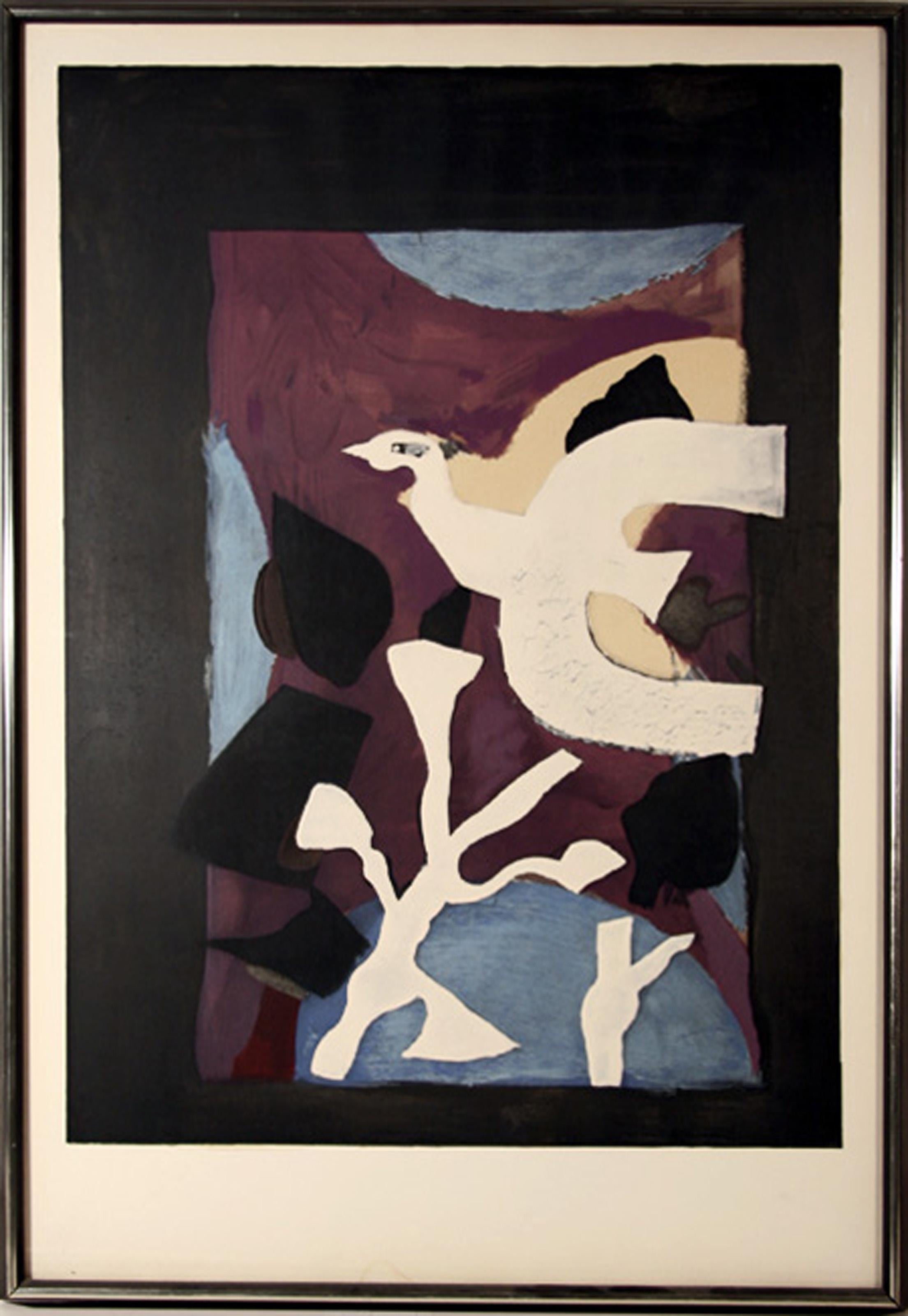
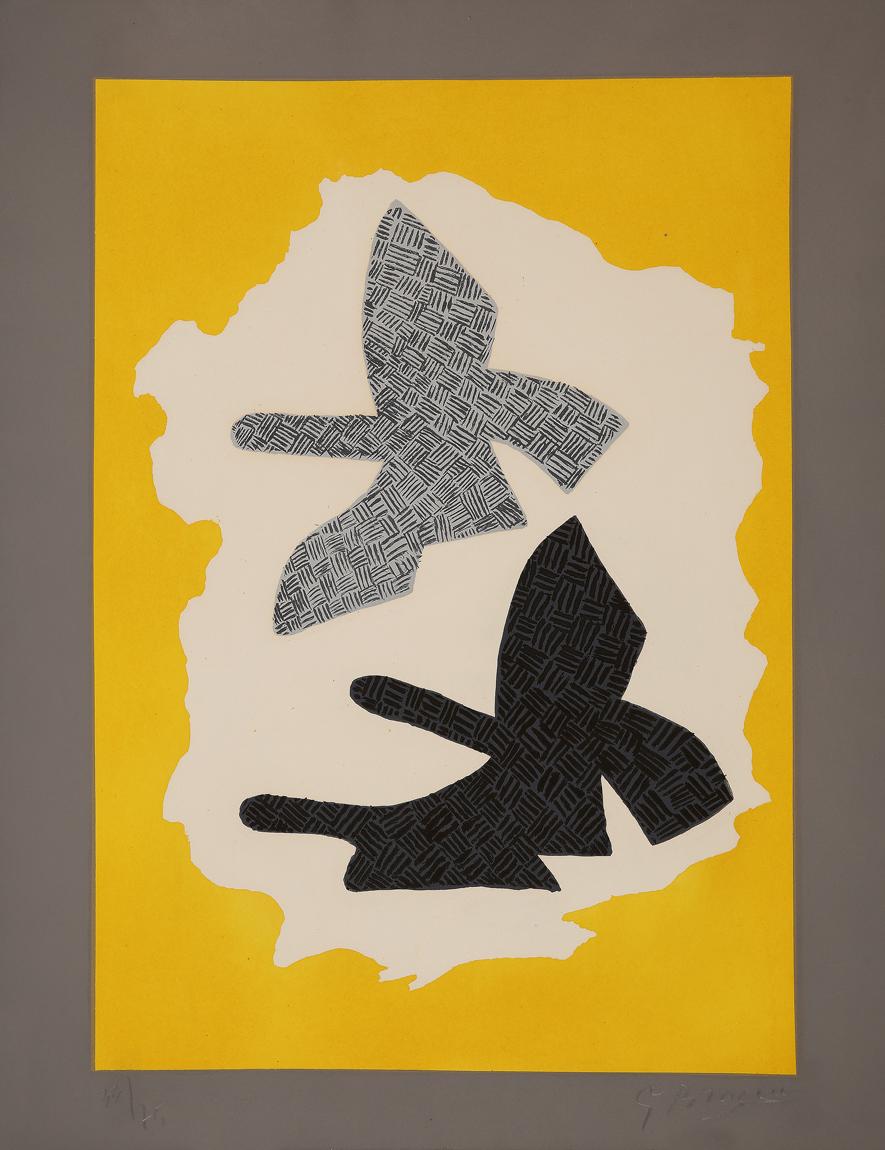
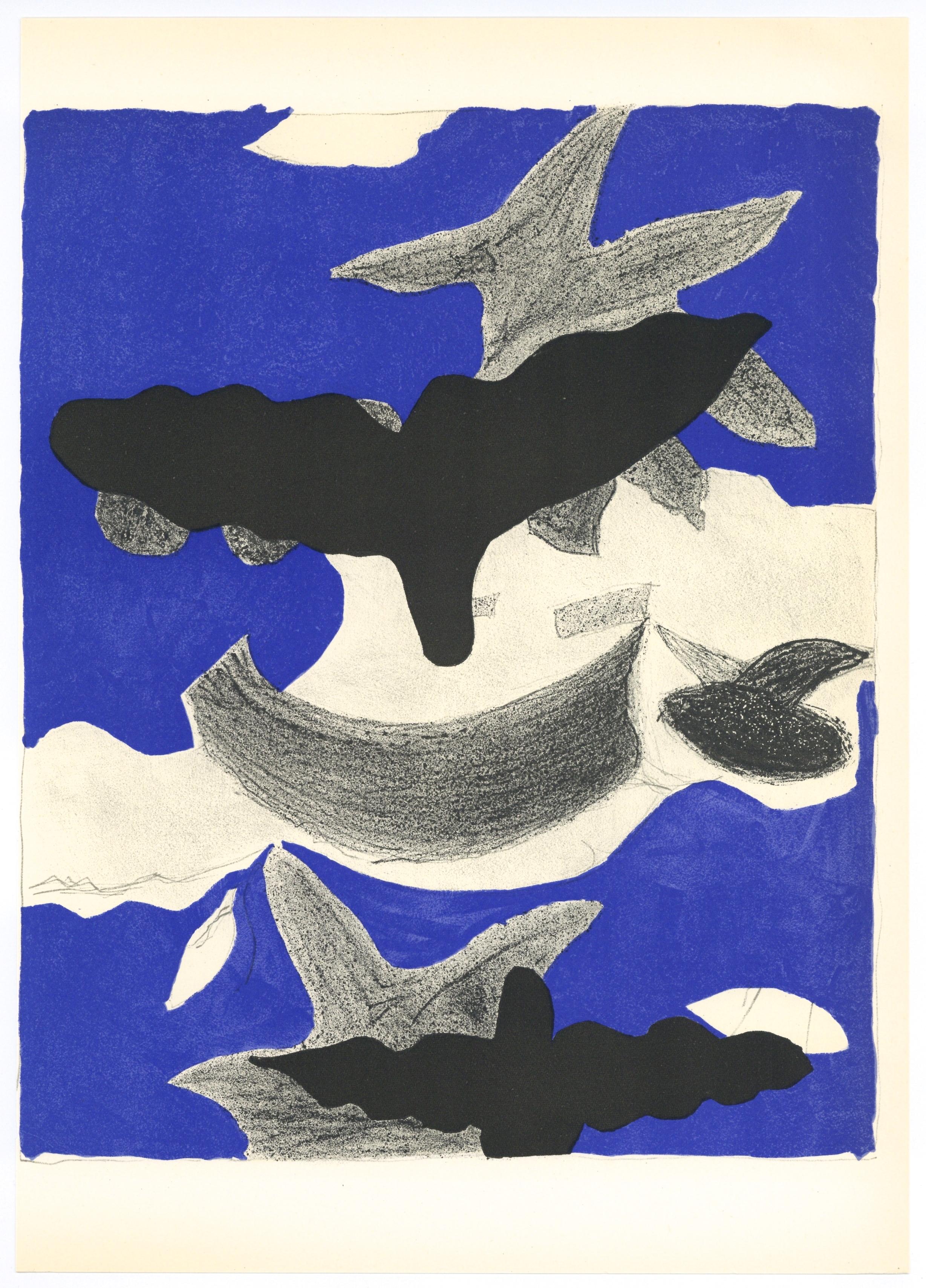
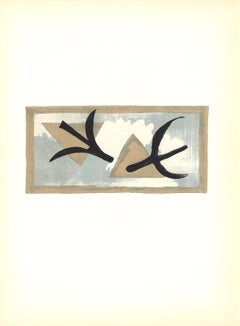
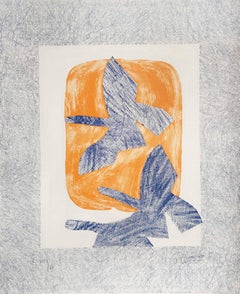
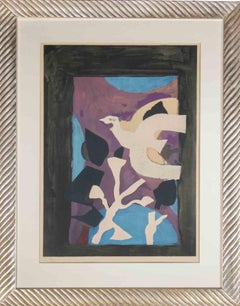
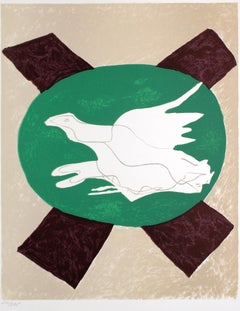
This exquisite collotype after Georges Braque (1882–1963), titled Sans titre (Untitled), from the album Birds, Saint-John Perse, originates from the 1966 edition published by the Bollingen Foundation, New York, in association with Pantheon Books, a division of Random House, Inc., New York, and Editions d’Art Au Vent d’Arles, Paris; printed by Rainbows, Inc., Scitico, 1966. Sans titre reflects the poetic visual language associated with Braque’s late work, where refined structure, lyrical abstraction, and symbolic evocations of nature merge into a composition of quiet rhythm and contemplative balance.
Executed as a collotype on velin paper, this work measures 11 x 14 inches (27.94 x 35.56 cm). Unsigned and unnumbered as issued.
Artwork Details:
Artist: Georges Braque (1882–1963)
Title: Sans titre (Untitled), from Birds, Saint-John Perse
Medium: Collotype on velin paper
Dimensions: 11 x 14 inches (27.94 x 35.56 cm)
Inscription: Unsigned and unnumbered as issued
Date: 1966
Publisher: Bollingen Foundation, New York, in association with Pantheon Books, a division of Random House, Inc., New York, and Editions d’Art Au Vent d’Arles, Paris
Printer: Rainbows, Inc., Scitico
Condition: Well preserved, consistent with age and medium
Provenance: From the album Birds, Saint-John Perse, 1966
Notes:
Excerpted from the folio, Copyright ©1966 by Bollingen Foundation, New York, N.Y. Published by Bollingen Foundation, New York, N.Y. Distributed by Pantheon Books, a division of Random House, Inc., New York, N.Y. French text ©1965 by Editions Gallimard, Paris. This volume is the eighty-second in a series of albums sponsored by and published for Bollingen Foundation. The four Braque etchings from the first edition, “L’Ordre des oiseaux, par Georges Braque et Saint-John Perse,” are rendered by courtesy of Editions d’Art “Au Vent d’Arles,” Paris. Color plates made by Rainbows, Inc., Scitico, Connecticut.
About the Publication:
Birds, Saint-John Perse, published in 1966 by the Bollingen Foundation in New York in association with Pantheon Books and Editions d’Art Au Vent d’Arles in Paris, represents an important mid-twentieth century illustrated art publication that united modern poetry with the visual language of Georges Braque. The project drew upon Braque’s celebrated imagery of birds, which had become one of the central symbolic motifs of his later career, embodying themes of movement, transcendence, and the poetic rhythms of nature. The Bollingen Foundation, renowned for sponsoring major intellectual and artistic publications, produced the tome as part of its distinguished series of albums devoted to literature, philosophy, and the visual arts. The publication incorporated the text of Saint-John Perse alongside renderings derived from Braque’s earlier suite of bird etchings, L’Ordre des oiseaux, originally issued in Paris. Through its collaboration with Pantheon Books, Editions d’Art Au Vent d’Arles, and specialized printer, Rainbows, Inc., the album achieved a carefully balanced integration of typography, imagery, and fine printing techniques. Birds stands as a notable example of twentieth century publishing that brought together poetry, modern art, and scholarly editorial vision in a format intended for collectors, libraries, and institutions devoted to the preservation of modern literary and artistic culture.
About the Artist:
Georges Braque (1882–1963) was a French painter, sculptor, and printmaker whose pioneering vision transformed the course of twentieth century art. A central figure in modernism and the co-founder of Cubism alongside Pablo Picasso, Braque redefined visual perception by breaking objects into geometric forms and reassembling them from multiple perspectives, creating a new visual language that bridged the gap between abstraction and reality. His early work was influenced by the vibrant colors and expressive energy of the Fauvist painters Henri Matisse and Andre Derain, before evolving toward the more analytical and structured compositions inspired by Paul Cezannes theories of form and perspective. Braques collaboration with Picasso between 1908 and 1914 marked one of the most fertile and revolutionary periods in art history, resulting in works that challenged traditional notions of space, depth, and illusion. Throughout his career, Braque maintained a deep interest in harmony, rhythm, and balance, infusing his still lifes, landscapes, and later reliefs with poetic subtlety and intellectual rigor. He moved among a brilliant circle of contemporaries including Pablo Picasso, Henri Matisse, Marc Chagall, Juan Gris, Fernand Leger, and Amedeo Modigliani—artists united in their pursuit of new modes of artistic expression. Braques influence extended well beyond his own era, shaping the creative approaches of later modernists such as Alexander Calder, Alberto Giacometti, Salvador Dali, Joan Miro, Wassily Kandinsky, Marcel Duchamp, and Man Ray, all of whom drew inspiration from his structural innovations and aesthetic integrity. His works are held in major museum collections worldwide, including the Museum of Modern Art, the Centre Pompidou, the Tate, and the Guggenheim, where they continue to embody the essence of modern artistic thought and visual poetry. The highest price ever paid for a Georges Braque artwork is approximately 15 million USD, achieved in 2013 at Christies New York for Paysage a la Ciotat (1907).
Georges Braque Sans titre Birds Saint-John Perse 1966 collotype modern art print.