Want more images or videos?
Request additional images or videos from the seller
1 of 8

Ivan Chermayeff
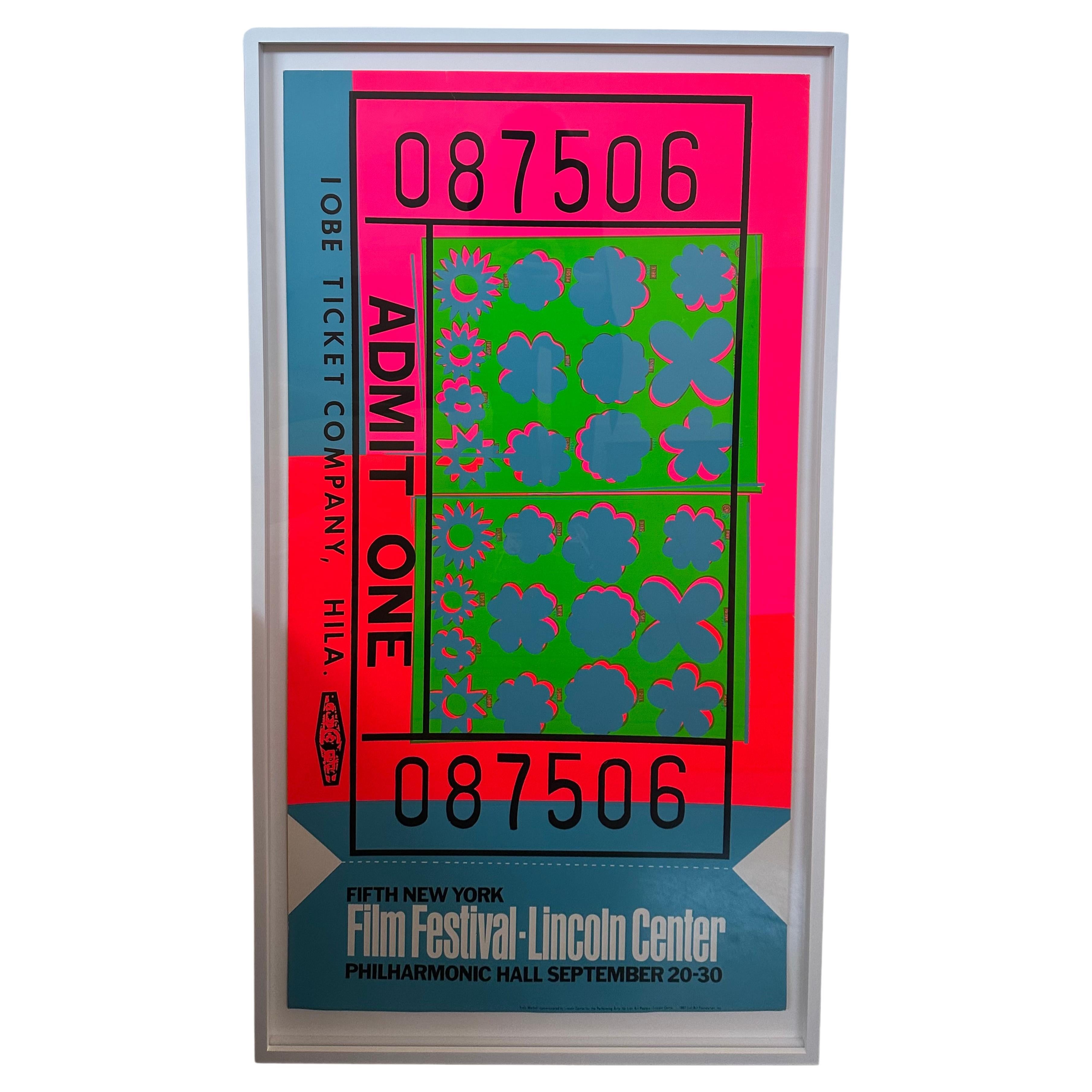
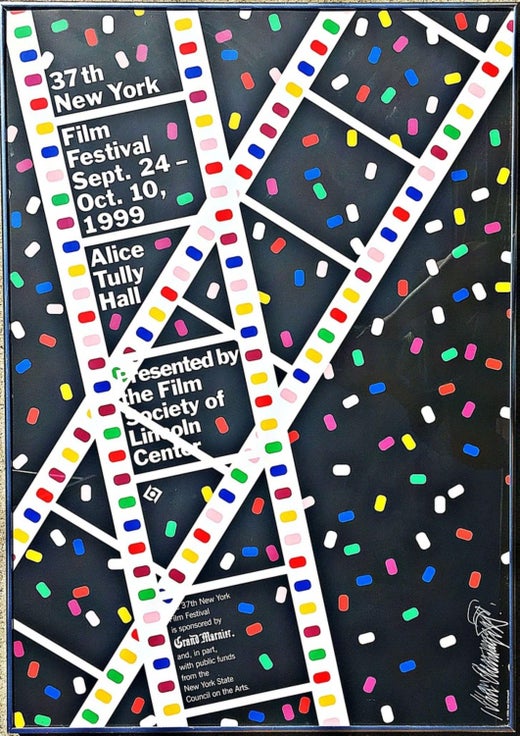
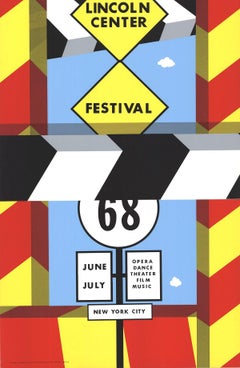
Lincoln Center Film Festival Poster Hand Signed by Ivan Chermayeff vintage frame

1999

$1,000
£748.40
€874.76
CA$1,413.08
A$1,426.38
CHF 819.60
MX$17,289.50
NOK 9,486.51
SEK 9,689.93
DKK 6,539.05

About the Item

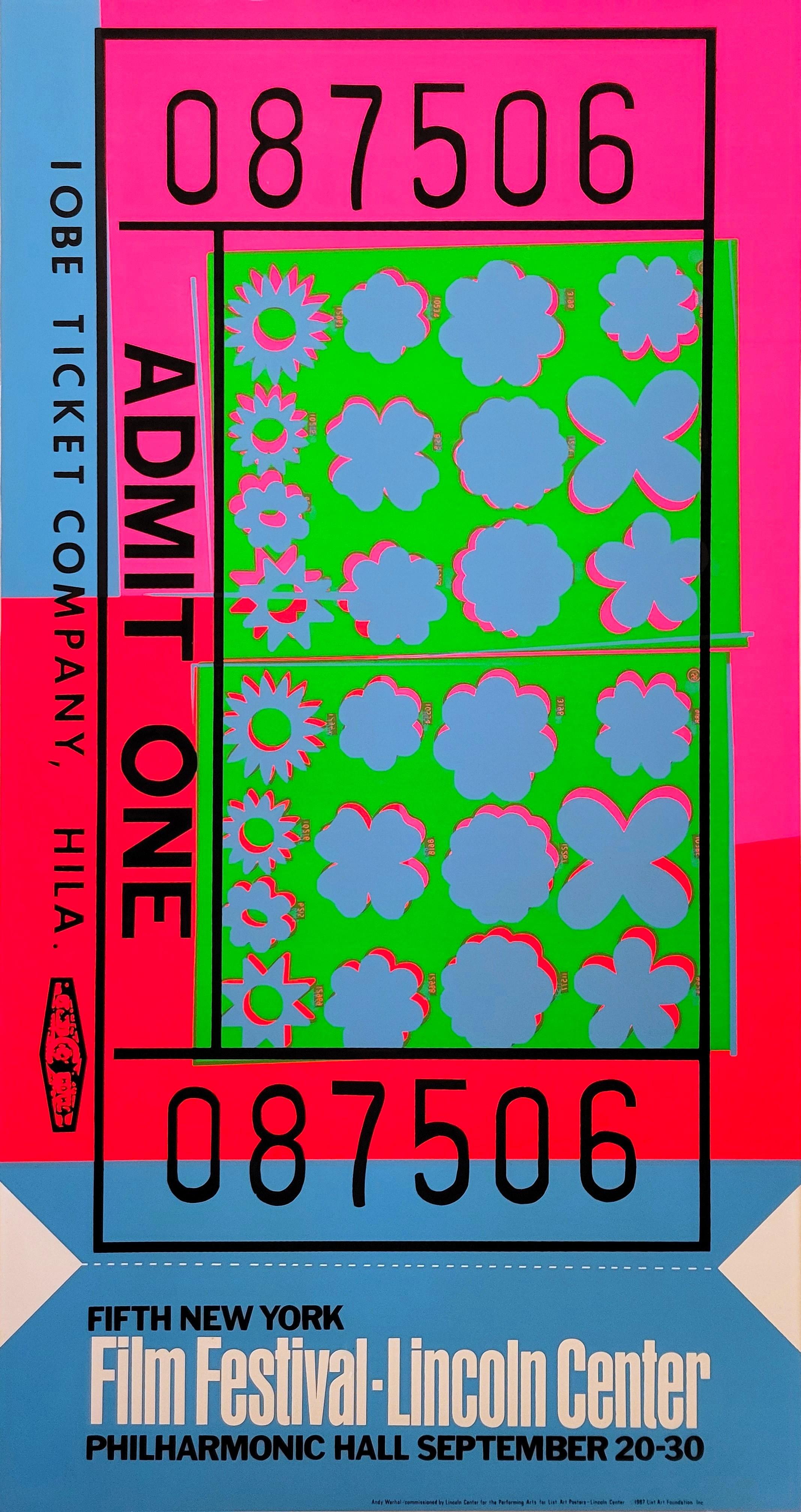
Ivan Chermayeff Lincoln Center Film Festival Poster (Hand Signed by Ivan Chermayeff), 1999 Offset Lithograph Poster (Hand Signed) - Framed Boldly signed in marker on the front, lower right. Unnumbered Frame included: held in the original vintage metal frame Very rare collectors' item when hand signed by the legendary designer Chermayeff - as is the present work. Framed in original vintage metal frame; appears to be in very good condition. An iconic New York work for the Lincoln Center Film Festival. From The Guardian's 2017 Obituary of Ivan Chermayeff Ivan Chermayeff, who has died aged 85, was one of the most admired graphic designers of a generation that redefined the profession. His 60-year professional life, from which he never retired, was shared with a fellow student from Yale, Tom Geismar, and a succession of other partneirs, the first having been Robert Brownjohn and the most recent Sagi Haviv. The work of their firm - currently known as Chermayeff & Geismar & Haviv – included many famous corporate logos, of which that of Mobil is probably the best known, but it ranged widely over 3D objects, such as the giant red figure 9 on the pavement in West 57th Street, New York (1974), signage, museum displays and campaigns for the environment and politics. One of Chermayeff’s most frequently reproduced images, for the US broadcast of the TV drama Churchill: The Wilderness Years in 1983, shows a cloud of scratched-out smoke from a lighted cigar obscuring a face, topped by a Homburg hat. As well as simplification, Chermayeff and his partners often adopted “the supermarket principle” of showing in posters, or exhibition displays, a superabundance of related objects repeated in grid formation. Although his professional education and career were in the US, Ivan was born in London, to Barbara (nee May) and Serge Chermayeff. Serge’s life had brought him from Chechnya to London, via a stint in Argentina, and in 1932 he was turning from an interior designer into an architect. On the garden terrace of the family house in Sussex that Serge completed in 1938, Ivan used to sit in the lap of Henry Moore’s Recumbent Figure, now in Tate Britain. With Ivan’s younger brother, Peter, later an architect, the family emigrated to the US in 1940 and Serge started a new career as a teacher. Never an easy man to live or work with, he supported both his sons in their careers, and his connections with Walter Gropius, Marcel Breuer and other painters, sculptors, writers, designers and architects meant that they grew up in the aristocracy of modernism, spending holidays on Cape Cod among like-minded people at play. Ivan claimed it took him seven years to recover from his design education, which included Harvard, the Institute of Design in Chicago, and Yale, where Paul Rand, whom he greatly admired, was among his teachers. He relied on instinct and a good eye, claiming that the best ideas came in the back of a taxi on the way to see the client. He liked outsider art and rubbish, “the carbons from forms, the envelopes from letters, candy bar wrappers”. He collected single workmen’s gloves left behind on roads and squashed by wheels, and all these found places in the collages, mostly of faces, that he made for his own enjoyment. Chermayeff and his partners claimed their work was “problem-solving”, which included first working out what the problem actually was. Wittily eliminating the superfluous, it struck home with techniques ranging from hand-drawing and collage to unadorned photography. In 1985, Chermayeff metaphorically located himself in “a little corner close to the children where no one speaks in riddles or through layers of fog. I want everyone, as well as myself, to be closer to art, which is sideways to life, and to a kind of graphic design which is sideways to art.” In 1958, Chermayeff, Geismar and Brownjohn (who left for London in 1960) designed the interior of the US pavilion at the Brussels International Exhibition in a novel style, using fragments of signage to create the impression of a lively street. With Peter Chermayeff’s Cambridge Seven Associates, they followed this with the interior of Buckminster Fuller’s US dome at Expo 67 in Montreal. Their exhibition work included the display in the John F Kennedy Memorial Library in 1977, and in 1984 the exhibition about immigration at Ellis Island. Posters for non-commercial TV programmes sponsored by Mobil, which included the Churchill one, adorned bus shelters. There was still time for playful personal projects, such as the miniature book Watching Words Move (1962), in which the shape and spacing of the letters echo their meaning, and a number of books for children, illustrated with photographs or Matisse-like cut paper. Behind all the work was a seriousness of purpose, however, for, as Chermayeff told the Aspen Conference on Design as early as 1964: “Our visual environment … is deteriorating at a pace that is shocking and perhaps irretrievable.” In media from book jackets and posters to a graphic identity manual for the US Environmental Protection Agency in 1977, the practice memorably pointed up messages of peace and concern for the future. The work of the partnership was recorded in the book Designing (2003) and in two books, Chermayeff and Geismar Associates: Trademarks (1979) and Trademarks Designed by Chermayeff and Geismar (2000). In addition, Chermayeff published several books of his collages, which in 2014 formed the basis of an exhibition, Cut and Paste, at the De La Warr Pavilion, Bexhill, the public building which had been designed by his father in partnership with Erich Mendelsohn in the 1930s. Tall, smiling and purposeful, Chermayeff was an engaging personality for whom work and leisure seemed to mingle without separation.
  • Creator:
    Ivan Chermayeff (1932 - 2017, American)
  • Creation Year:
    1999
  • Dimensions:
    Height: 33.75 in (85.73 cm)Width: 23.75 in (60.33 cm)Depth: 0.3 in (7.62 mm)
  • Medium:
  • Movement & Style:
  • Period:
  • Condition:
    Not examined outside of vintage frame but appears very good; frame is vintage.
  • Gallery Location:
    New York, NY
  • Reference Number:
    1stDibs: LU1745214976212

More From This Seller

View All
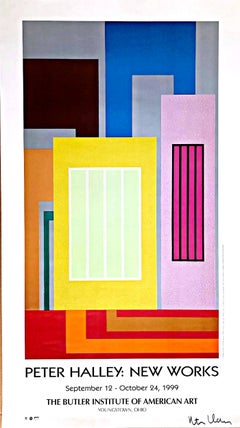
The Butler Institute of American Art poster (Hand Signed by Peter Halley)

The Butler Institute of American Art poster (Hand Signed by Peter Halley)

By Peter Halley

Located in New York, NY

Peter Halley New Works, The Butler Institute of American Art (Hand Signed), 1999 Offset lithograph poster (signed by Peter Halley) 38 × 21 1/2 inches Boldly signed in black marker by...

Category

1990s Abstract Geometric Abstract Prints

Materials

Offset, Lithograph

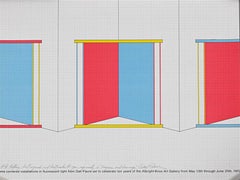
Rare Albright Knox museum poster (hand signed and inscribed to renowned curator)

Rare Albright Knox museum poster (hand signed and inscribed to renowned curator)

By Dan Flavin

Located in New York, NY

Dan Flavin Dan Flavin at Albright Knox Gallery (hand signed and inscribed to renowned curator) Offset Lithograph. Hand signed and inscribed by Dan Flavin 18 × 22 inches Provenance: Estate of artist and collector Rick Collar Unframed Uniquely inscribed and hand signed 1972 Dan Flavin exhibition poster from his Albright Knox exhibition. Dan Flavin hand signs and inscribes it to Paulus Hendrik Hefting, the curator of the Neue Nationalgalerie in Berlin. The inscription reads: "Best regards and best wishes to you especially in "diagrams and drawings". What Flavin is referring to is the important exhibition also in 1972, "Diagrams & Drawings" curated by Hefting, at the Rijksmuseum Kröller-Müller (Netherlands), which featured Carl Andre, Christo, Walter De Maria, Dan Flavin, Michael Heizer, Don Judd, Sol LeWitt, Robert Morris, Bruce Nauman, Claes Oldenburg, Richard Serra, Robert Smithson. An extremely rare signed poster with a unique inscription to a major European curator referencing an historic Minimalist exhibition in the early 1970s. We may not see the likes of something like this anytime soon! Dan Flavin Biography From 1963, when he conceived the diagonal of May 25, 1963 (to Constantin Brancusi), a single gold fluorescent lamp installed diagonally on the wall, until his death in 1996, Dan Flavin (1933-1996) produced a singularly consistent and prodigious body of work that utilized commercially available fluorescent lamps to create installations (or “situations,” as he preferred to call them) of light and color. Through these light constructions, Flavin was able to establish and redefine space. Flavin’s first solo exhibitions were held at the Judson Gallery in 1961 and the Green Gallery in 1964, both in New York. His first European exhibition was in 1966 at Galerie Rudolf Zwirner in Cologne, Germany; and in 1969, the National Gallery of Canada, Ottawa, organized his first major museum retrospective. His work was included in a number of key early exhibitions of Minimal art in the 1960s, among them Black, White, and Gray (Wadsworth Atheneum Museum of Art, Hartford, Connecticut, 1964); Primary Structures (The Jewish Museum, New York, 1966); and Minimal Art (Gemeentemuseum, The Hague, 1968). Flavin’s work would continue to be presented internationally over the course of the pursuant decades at venues including the St. Louis Art Museum, Missouri (1973); Kunsthalle Basel (1975); Museum Boymans-van Beuningen, Rotterdam (1975); Stedelijk Museum, Amsterdam (1986); and the Solomon R. Guggenheim Museum, New York (1992), among others. A major museum retrospective devoted to Flavin’s work was organized, in cooperation with the Estate of Dan Flavin, by the Dia Art Foundation in association with the National Gallery of Art, Washington, DC, where it was first on view in 2004. The exhibition traveled from 2005 to 2007 to the Modern Art Museum of Fort Worth, Texas; Museum of Contemporary Art, Chicago; Hayward Gallery, London; Musée d’Art Moderne de la Ville de Paris...

Category

1970s Abstract Geometric Abstract Prints

Materials

Pencil, Lithograph, Offset

You May Also Like

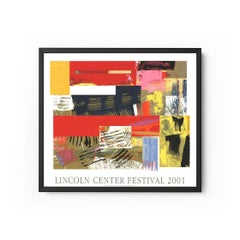
Lincoln Center Festival 2001 Poster

Lincoln Center Festival 2001 Poster

By Sam Gilliam

Located in New York, NY

Medium: Serigraph Poster Size: 34 3/4 in × 39 1/2 in Framed Size: 36 3/4 in x 41 1/2 in Signed: No Framing Options: Available in Black, White, & Natural Frames *posters framed to the edge of paper Large colorful abstract screenprint by African-American color field painter and lyrical abstractionist artist Sam Gilliam from a deluxe, limited edition of 108. Signed by Gilliam and numbered in pencil. Published by Lincoln Center List Poster and Print Program, New York. This poster was a part of those produced in partnership with Lincoln Center & Vera List Art...

Category

Early 2000s Abstract Abstract Prints

Materials

Screen

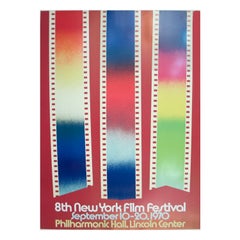
1970 New York Film Festival Rosenquist Original Vintage Poster

1970 New York Film Festival Rosenquist Original Vintage Poster

By James Rosenquist

Located in Winchester, GB

Beautiful poster for the 8th New York Film Festival, held between September 10th to 20th 1970 at the Philharmonic Hall at Lincoln Center. This piece "Short Cuts" was designed by the ...

Category

Vintage 1970s American Posters

Materials

Paper

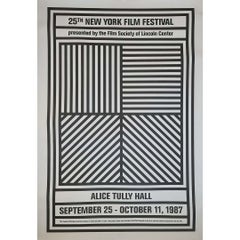
Original 1987 New York Film Festival Poster by Sol LeWitt

Original 1987 New York Film Festival Poster by Sol LeWitt

By Sol LeWitt

Located in PARIS, FR

Designed by the celebrated American conceptual artist Sol LeWitt (1928–2007) for the 25th New York Film Festival, this original 1987 poster perfectly embodies the artist's distinctive visual language, where geometry, repetition and systematic order become powerful aesthetic statements. Created for the Film Society of Lincoln Center, the poster commemorates one of the world's most prestigious annual celebrations of international cinema. The composition is striking in its simplicity. Four adjoining squares filled with carefully arranged vertical, horizontal and diagonal black lines create an elegant optical rhythm that is instantly recognizable as LeWitt's work. The minimal palette of black and white reinforces the graphic precision of the design, while the subtle shifts in direction produce a dynamic visual tension that rewards prolonged viewing. One of the pioneers of Conceptual Art and Minimalism, Sol LeWitt transformed contemporary art by arguing that the underlying idea was as important as the finished object. Throughout his career he developed systems based on geometric forms, serial structures and predetermined rules, producing wall drawings, prints and sculptures that continue to influence generations of artists and designers. His work is represented in the collections of the Museum of Modern Art, the Guggenheim Museum, Tate Modern and countless major institutions worldwide. Founded in 1963, the New York Film Festival quickly established itself as one of the most influential showcases for international auteur cinema. Organized by the Film Society of Lincoln Center, it has premiered landmark works by directors including Ingmar Bergman, Federico Fellini, Akira Kurosawa, Martin Scorsese, François Truffaut, Pedro Almodóvar and many others. The 1987 edition, celebrating the festival's twenty-fifth anniversary, marked an important milestone in its history. Rather than illustrating scenes from cinema, LeWitt chose to create an abstract composition that reflects the structural language shared by both modern art and filmmaking. The orderly arrangement of lines recalls rhythm, editing and visual sequencing—the essential building blocks of cinematic storytelling—while remaining entirely autonomous as a work of graphic art. Posters commissioned by major cultural institutions from internationally renowned contemporary artists occupy a unique place within twentieth-century design history. They function simultaneously as exhibition announcements and collectible original artworks, bridging the worlds of fine art, graphic design and cultural history. Elegant, intellectually engaging and visually timeless, this original 25th New York Film Festival poster...

Category

1980s More Prints

Materials

Linen, Paper, Lithograph

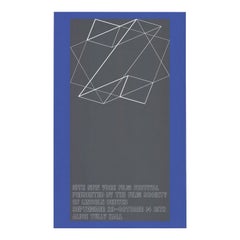
1972 10th New York Film Festival - Josef Albers Signed Original Vintage Poster

1972 10th New York Film Festival - Josef Albers Signed Original Vintage Poster

By Josef Albers

Located in Winchester, GB

Beautiful poster for the 10th New York Film Festival, held between September 29th to October 14th 1972 at the Alice Tully Hall at Lincoln Center. This extremely rare piece was produced in 1972 as a limited edition of 144 hand signed editions and is signed by renowned German-American artist Josef Albers. Albers is one of the most prominent artists and art teachers of the 20th century and this piece exemplifies his well known colour theory.  The festival featured films by the likes of Luis Bunuel, Robert Altman and Ken Loach...

Category

Vintage 1970s American Posters

Materials

Paper

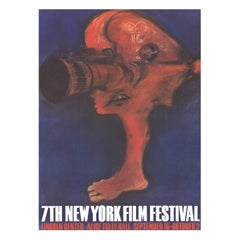
1969 7th New York Film Festival Original Vintage Poster

1969 7th New York Film Festival Original Vintage Poster

Located in Winchester, GB

Brilliant poster for the 7th New York Film Festival, held between September 16th to October 2nd 1969 at the Alice Tully Hall at Lincoln Center. This piece features artwork by Marisol...

Category

Vintage 1960s American Posters

Materials

Paper