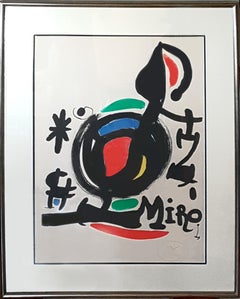
JOAN MIRÓ (1893–1983) – “ITALIA 1969”
Color Lithograph ⚜ Hand Signed and Numbered ⚜ Gilt Wood Frame
ARTWORK DETAILS:
▸ Title: Italia 1969
▸ Artist: Joan Miró (1893–1983)
▸ Medium: Color Lithograph
▸ Year of Creation: 1970
▸ Signature: Hand Signed Lower Right in Pencil with the Artist’s Monogram
▸ Edition: 188/200
▸ Publisher: Galleria del Milione (Al Milione), Milan, Italy
▸ Printer: Sala Gaspar, Barcelona, Spain
▸ Plate: Cancelled
▸ Documentation: Joan Miró Lithographe IV: 1969–1972 (Maeght Éditeur, Paris, 1981), Mourlot no. 625
▸ Provenance: Private Collection
▸ Country of Origin: Spain
▸ Dimensions:
— ◼︎ Image Area: 26 x 21 inches
— ◼︎ Paper Size: 29.875 x 22.875 inches
— ◻︎ Frame Size: 36.75 x 29.75 x 1.75 inches
▸ Condition: Excellent, with very minor foxing consistent with this type of work and age
▸ Framing: Float Framed in Custom Gilt Wood Frame, conservation quality with no mat burn, ready to display
INCLUDED DOCUMENTATION:
✓ Copy of the original Certificate of Authenticity from New York Graphic Society Ltd., dated December 17, 1971, with embossed seal
PUBLISHED FOR ONE OF ITALY’S MOST IMPORTANT MODERNIST GALLERIES
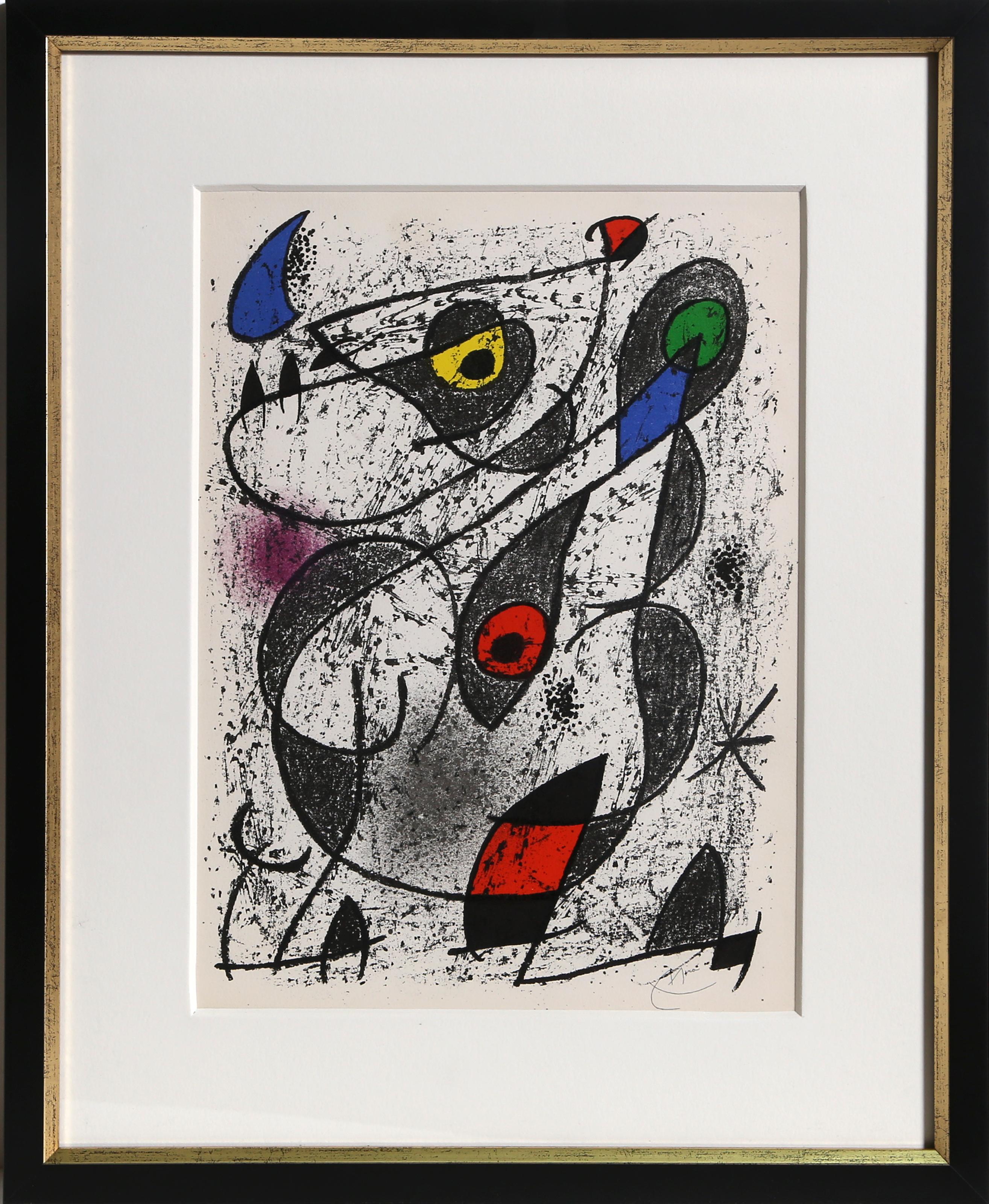
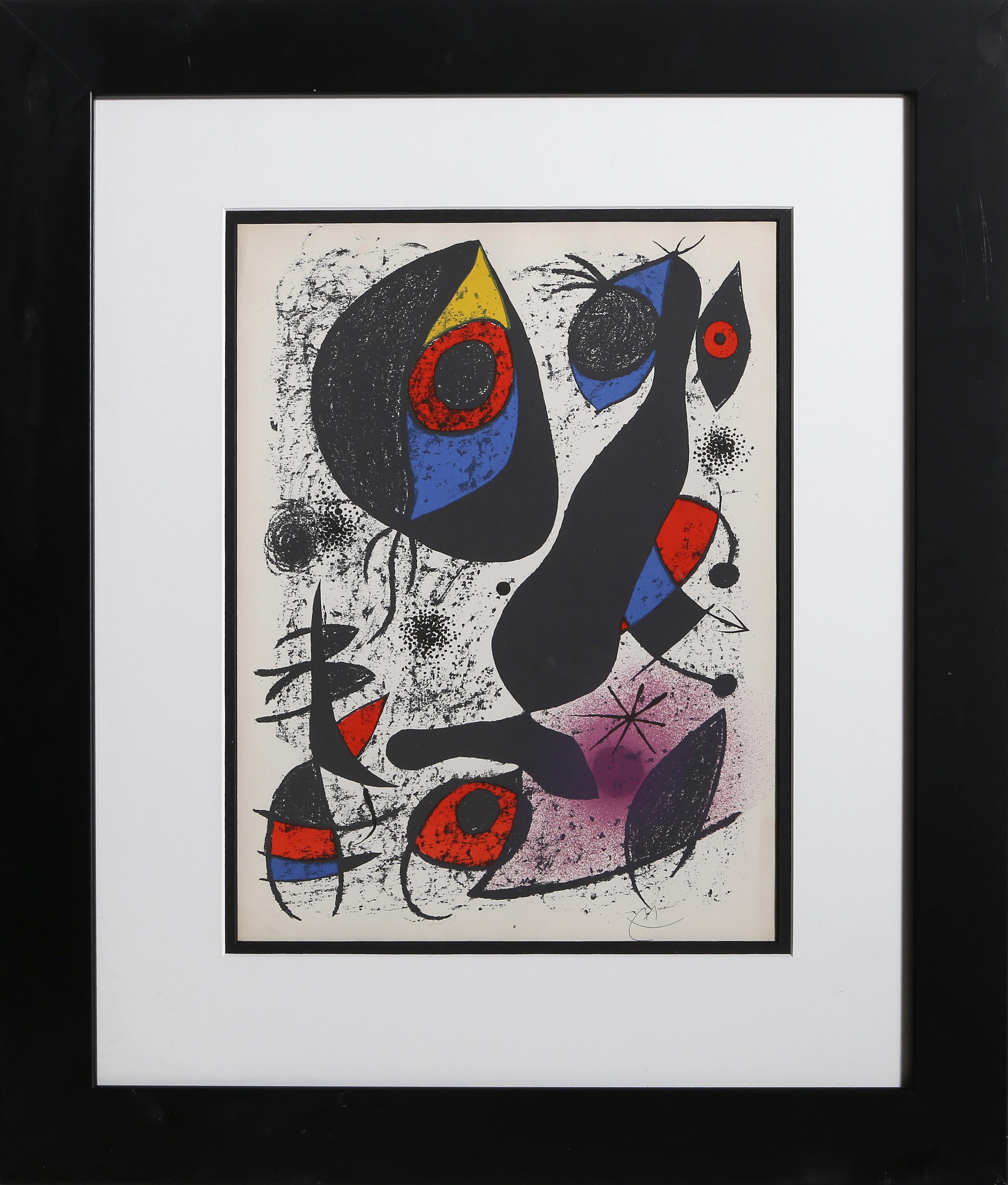
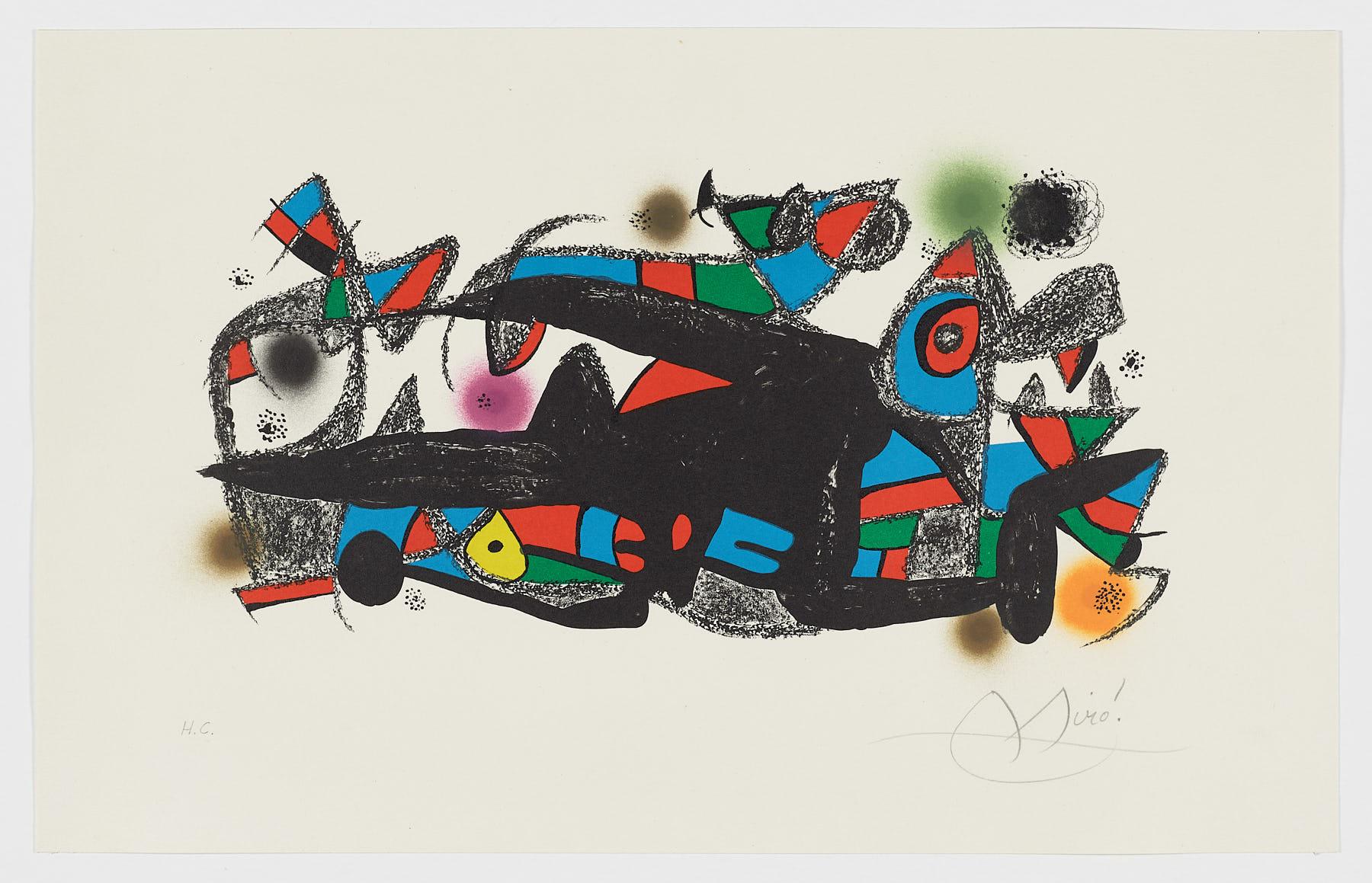
“Italia 1969” is an original color lithograph by Joan Miró, hand signed in pencil with the artist’s monogram and numbered 188 from the limited edition of 200. The composition is one of Miró’s most historically resonant graphic images of the period: it was first used in May and June of 1969 as the exhibition poster for Galleria del Milione in Milan, where the gallery presented Juan Perucho’s landmark monograph and the accompanying 1968 Polígrafa portfolio Les Essències de la Terra (“The Essences of the Earth”). The poster version, printed with the gallery’s exhibition text, is widely documented in Miró literature. The following year, in 1970, the same image was released as a signed and numbered limited edition of 200 without the exhibition text, presenting the composition as a finished collector’s lithograph in its own right. This impression is from that 1970 limited edition. The lithographic plate has been cancelled, guaranteeing that no further impressions can be pulled.
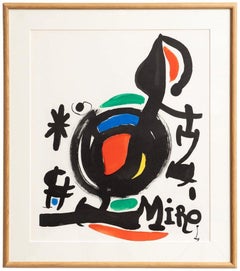
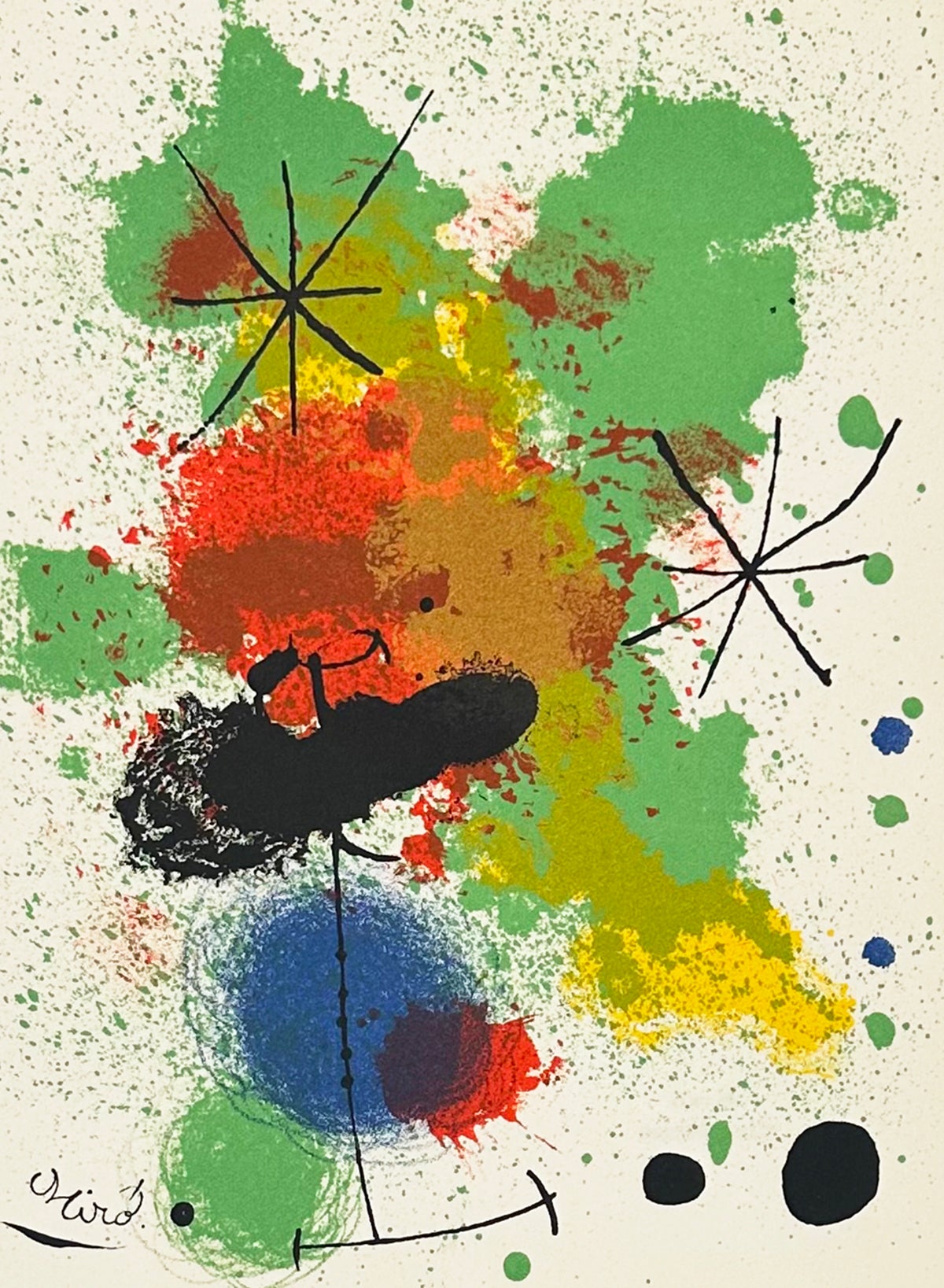
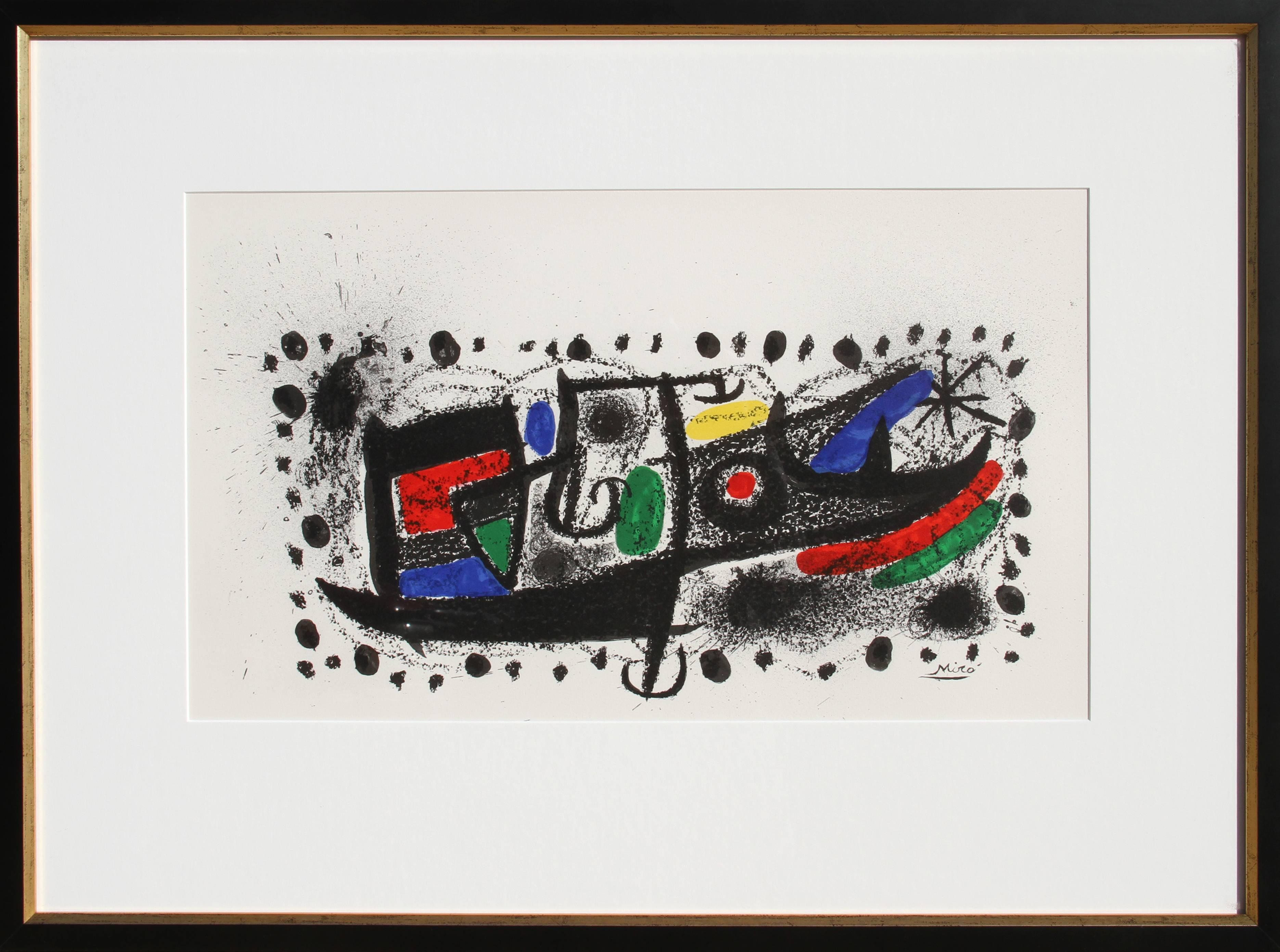
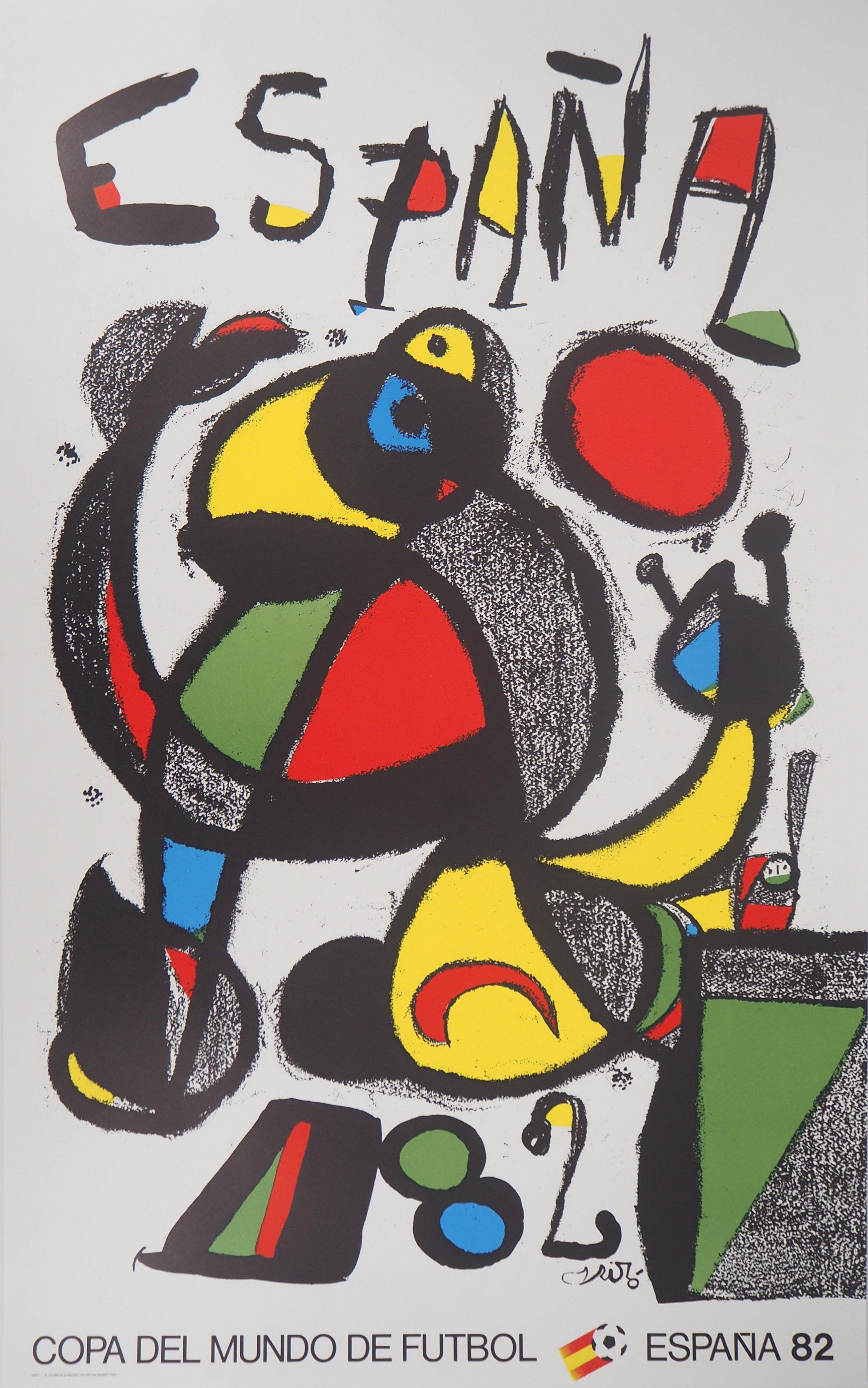
On closer reading, the composition resolves into one of Miró’s beloved oiseau, or bird, figures, rendered in the artist’s mature visual shorthand. A vigorous black orb forms the body, its interior animated by isolated planes of red, blue, and yellow that suggest plumage and interior markings. At the upper-left edge sits a small circular eye paired with a curved green beak, with a band of cobalt blue beneath that reads as a second beak or open mouth. Rising from the top of the body is a tapered black tail crowned by a curling hooked terminus and a tongue of red, the curve sweeping back rather than forward in the manner Miró used for the elaborate tails of his stylized roosters and exotic birds. A horizontal black bar at the base of the body extends into legs and feet, with a small pictographic character at lower-left that suggests a perch or ground sign. Smaller signs animate the surrounding white space, a black star, a delicate asterisk, the artist’s stylized “Miró” inscription at lower right, and a sweeping red mark along the base, all participating in the rhythmic balance of the composition. The figure remains classically Miró in its productive ambiguity, but the bird reading carries a particular resonance for a work created for an Italian audience, where flight, song, and Mediterranean iconography all converge.
By 1970, Miró had refined a visual language that drew on Catalan folk art, Surrealist automatism, and the calligraphic energy of Asian brush painting, distilling them into a system of universal signs. “Italia 1969” embodies that distillation, combining playfulness with formal rigor in a single image, and carries an additional layer of historical resonance through its connection to Galleria del Milione, the storied Milan gallery founded in the early 1930s by the Ghiringhelli brothers and one of the most influential venues for modernist art in twentieth-century Italy. The print is float framed in a custom gilt wood frame, displaying all four paper edges and the original pencil signature and numbering, and shows no mat burn after more than five decades, an uncommon feature for works of this period and a clear indication of careful, conservation-grade handling. Equally exceptional is a copy of the original 1971 Certificate of Authenticity issued by the New York Graphic Society Ltd., a survival that is genuinely for Miró works of this period and a meaningful enhancement to the work’s provenance and long-term collectibility. The lithograph is well suited to a wide range of interiors, from a contemporary loft or modernist living room to a gallery wall of School of Paris masters, a collector’s study devoted to Surrealist and modern art, or any space that benefits from an injection of bold color, rhythm, and twentieth-century pedigree.
WHY COLLECT THIS WORK?
✓ Galleria del Milione Heritage – Composition first used as the exhibition poster for the May–June 1969 Miró show at the historic Al Milione gallery in Milan; this is the signed limited edition pulled the following year without the exhibition text
✓ Plate Cancelled – The original lithographic plate has been cancelled, guaranteeing no further impressions can ever be pulled
✓ Catalogue Raisonné Documented – Hand signed in pencil with Miró’s monogram, numbered 188/200, and listed in Joan Miró Lithographe IV: 1969–1972 (Maeght Éditeur, Paris, 1981), Mourlot no. 625
✓ Conservation Float Framed – Float framed showing all four paper edges with no mat burn after five decades, uncommon for works of this period
✓ Accompanied by a copy of the original 1971 Certificate of Authenticity from New York Graphic Society Ltd., an exceptional survival for Miró works of this period that materially enhances provenance and long-term collectibility
THE ARTIST:
Joan Miró i Ferrà (1893–1983) was a Catalan painter, sculptor, ceramicist, and printmaker, and one of the most influential figures of twentieth-century modern art. Born in Barcelona and raised between the city and the family farm at Mont-roig del Camp in southern Catalonia, Miró trained at the Escola de la Llotja and the Escola d’Art de Francesc Galí before moving to Paris in 1920, where he entered the orbit of the avant-garde and quickly became a central figure within the emerging Surrealist movement. His early friendships and exchanges with Pablo Picasso, André Masson, Max Ernst, Jean Arp, and the Surrealist theorist André Breton helped shape his radical departure from representation toward an intensely personal vocabulary of biomorphic forms, stars, birds, women, and celestial signs.
From the late 1940s onward, Miró devoted ever greater attention to printmaking, beginning a defining collaboration with master lithographer Fernand Mourlot in Paris and, later, with the Sala Gaspar atelier in Barcelona, the Polígrafa workshop, and the Maeght family of publishers led by Aimé Maeght. He produced more than one thousand lithographs over his lifetime, alongside extensive bodies of etchings, aquatints, and carborundum prints with such collaborators as Joan Barbarà and the Atelier Lacourière. In 1954 he received the Grand Prize for Graphic Work at the Venice Biennale, cementing his reputation as one of the great printmakers of the modern era. His work is often discussed alongside that of Wassily Kandinsky, Paul Klee, and Marc Chagall for its lyrical abstraction, and his close friendships with Alexander Calder and the gallerist Pierre Matisse helped secure his lasting reception in the United States, where his vocabulary of signs profoundly influenced the next generation of American painters including Mark Rothko, Arshile Gorky, Robert Motherwell, and Adolph Gottlieb.
Miró’s work is held in the permanent collections of the Museum of Modern Art in New York, the Tate Modern in London, the Centre Pompidou in Paris, the Reina Sofía in Madrid, the Guggenheim in New York and Bilbao, and the Fundació Joan Miró in Barcelona, founded by the artist himself in 1975 with the architect Josep Lluís Sert. Major monumental commissions include the ceramic murals for the UNESCO building in Paris, the Sun and Moon Walls at the Wilhelm-Hack Museum in Ludwigshafen, and the towering Dona i Ocell sculpture in Barcelona. He died in Palma de Mallorca on December 25, 1983, leaving a body of work whose visual language of color, sign, and gesture has become one of the most recognizable in modern art and continues to be sought by collectors of Surrealism, School of Paris modernism, and twentieth-century master printmaking.
![Charles Levier [Mélodie cosmique] circa 1955 signed oil on board, Surrealist](https://a.1stdibscdn.com/charles-levier-paintings-charles-levier-melodie-cosmique-circa-1955-signed-oil-on-board-surrealist-for-sale/a_28432/a_168628921771312049130/Levier_Charles_Me_lodiecosmique_circa1955_101391_FT_1_Hero_Ratio_1_361_SM_Complete_HR_master.jpg?width=240)