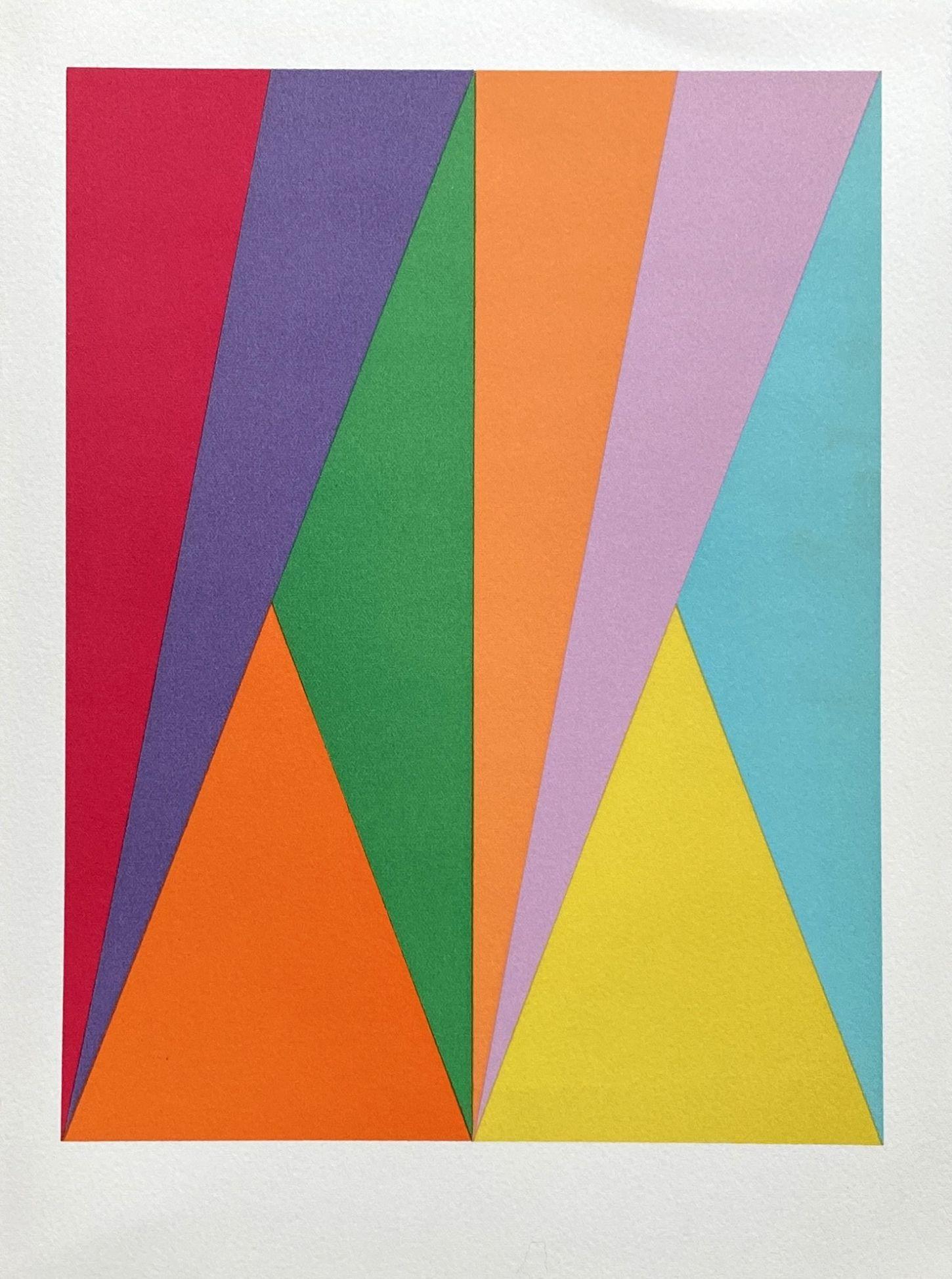
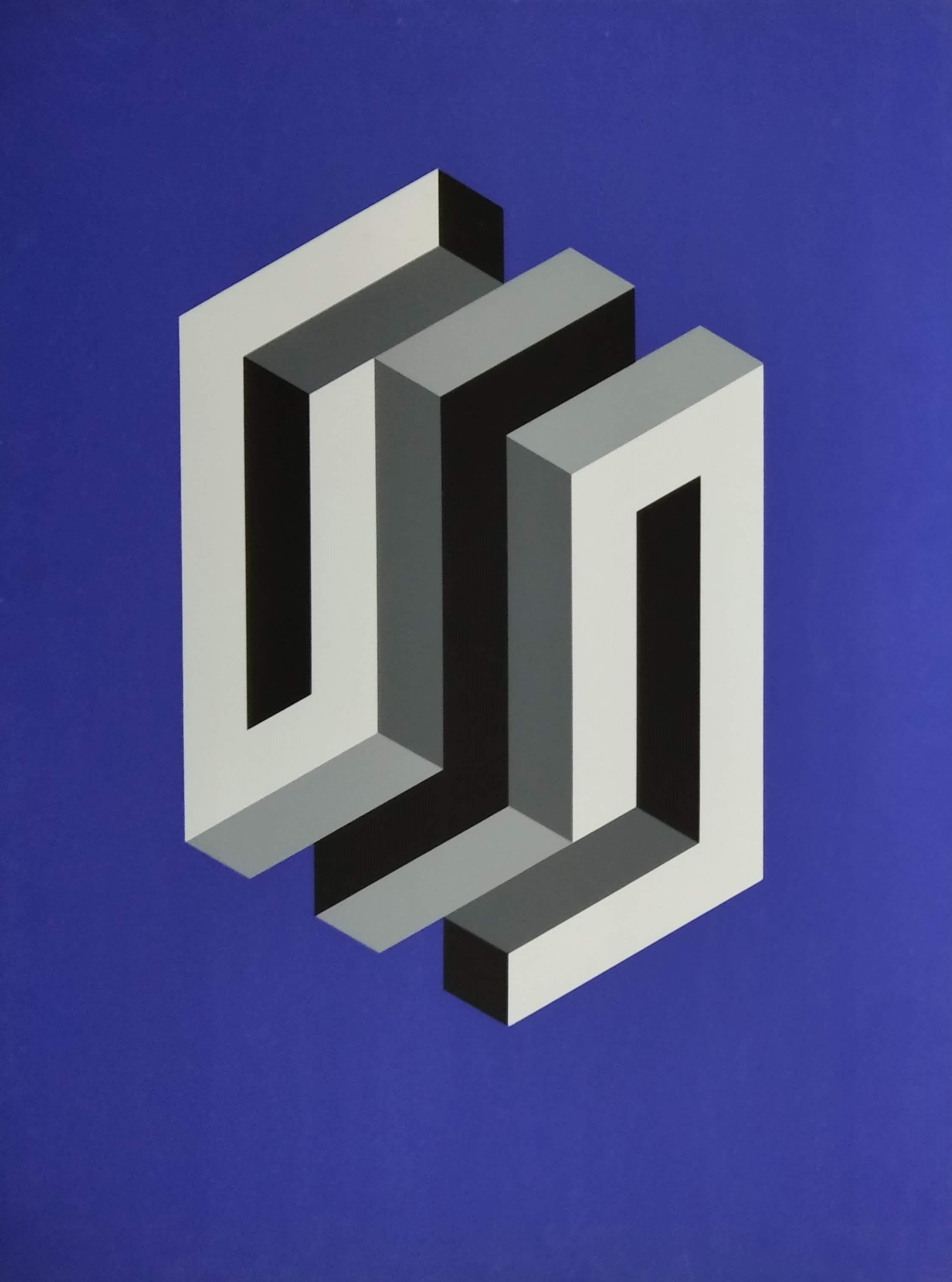
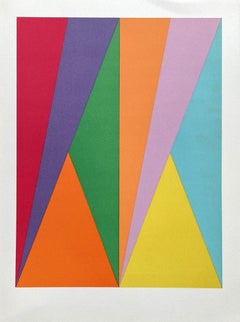
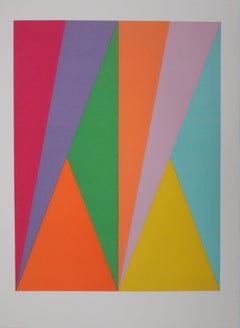
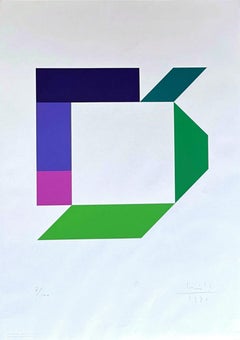
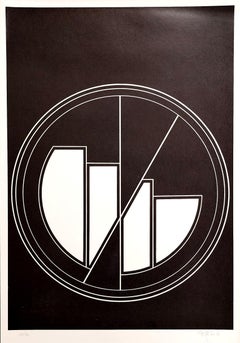
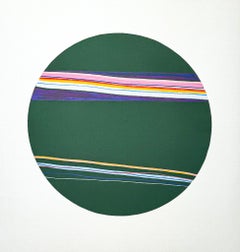
This exquisite lithograph by Max Bill (1908–1994), titled Variation 13, from the album XXe siecle, Chroniques du jour, 13 rue Valette (5e), Directeur G. di San Lazzaro, Sommaire du no. 4, Noel, 1938, originates from the 1938 edition published by Gualtieri di San Lazzaro, editeur, Paris, in collaboration with Societe Internationale d'Art XXe siecle, Paris, and printed by Mourlot Freres, Paris. Variation 13 reflects Bill’s precision and intellect, fusing mathematical order with aesthetic clarity in a perfect expression of the Concrete Art movement.
Executed as a lithograph on velin paper, this work measures 12.5 × 9.75 inches (31.75 × 24.77 cm). Unsigned and unnumbered, as issued. The edition exemplifies the superb craftsmanship of Mourlot Freres, Paris.
Artwork Details:
Artist: Max Bill (1908–1994)
Title: Variation 13, from the album XXe siecle, Chroniques du jour, 13 rue Valette (5e), Directeur G. di San Lazzaro, Sommaire du no. 4, Noel, 1938
Medium: Lithograph on velin paper
Dimensions: 12.5 × 9.75 inches (31.75 × 24.77 cm)
Inscription: Unsigned and unnumbered, as issued
Date: 1938
Publisher: Gualtieri di San Lazzaro, editeur, Paris, in collaboration with Societe Internationale d'Art XXe siecle, Paris
Printer: Mourlot Freres, Paris
Condition: Well preserved, consistent with age and medium
Provenance: From the album XXe siecle, Chroniques du jour, 13 rue Valette (5e), Directeur G. di San Lazzaro, Sommaire du no. 4, Noel, 1938, published by Gualtieri di San Lazzaro, editeur, Paris
About the Publication:
Gualtieri di San Lazzaro’s XXe Siecle (Twentieth Century) was one of the most influential art journals of the modern era, founded in Paris in 1938 as a platform for the greatest painters, sculptors, and writers of the 20th century. San Lazzaro—a visionary editor, critic, and champion of modernism—believed that art and literature should coexist as expressions of a shared human imagination. Under his direction, XXe Siecle became a cultural bridge between Europe and the wider world, publishing special issues devoted to leading figures such as Picasso, Matisse, Chagall, Braque, Calder, Miro, Kandinsky, and Leger. Each edition combined essays by renowned critics and poets with original lithographs printed by the foremost ateliers of Paris, including Mourlot, Arte, and Bellini, creating a uniquely rich dialogue between text and image. Through XXe Siecle, San Lazzaro preserved the creative spirit of the avant-garde during and after World War II, championing freedom of expression and the evolution of abstraction, Surrealism, and modern thought. Over nearly four decades, the journal shaped international taste and defined the intellectual landscape of postwar art publishing. Today, XXe Siecle remains celebrated for its extraordinary synthesis of art, literature, and design—an enduring testament to Gualtieri di San Lazzaro’s belief that the visual arts are the soul of the modern age.
About the Artist:
Max Bill (1908–1994) was a Swiss artist, architect, designer, and theorist whose fusion of geometry, mathematics, and artistic precision made him one of the most influential figures of 20th-century modernism. A leading pioneer of Concrete Art, Bill believed that beauty and truth could be expressed through structure, proportion, and rational order—an idea that shaped an entire generation of modern designers and painters. Born in Winterthur, Switzerland, he studied at the Bauhaus in Dessau between 1927 and 1929 under Wassily Kandinsky, Paul Klee, Josef Albers, and Laszlo Moholy-Nagy, whose teachings on color theory, abstraction, and the unity of art and technology profoundly shaped his vision. Drawing inspiration from Bauhaus ideals, Bill pursued the integration of art, science, and design in every medium—painting, sculpture, architecture, typography, and industrial design. His precise geometric compositions, such as *Konstruktion aus Kreisen (Construction with Circles)* (1942–43) and his iconic *Kontinuitat (Continuity)* sculptures, demonstrate his mastery of mathematical form and balance, embodying a serene interplay between movement, space, and harmony. His ideas were in dialogue with contemporaries like Pablo Picasso, Alexander Calder, Alberto Giacometti, Salvador Dali, Joan Miro, Marcel Duchamp, and Man Ray, whose explorations of motion, perception, and abstraction paralleled his own. Like Kandinsky, he saw geometry as a spiritual and universal language; like Calder, he sought rhythm and balance; and like Duchamp and Man Ray, he understood art as conceptual and analytical. Beyond the studio, Bill made an equally profound impact as an architect and educator, founding the Hochschule fur Gestaltung (School of Design) in Ulm, Germany, in 1953, where he served as its first rector and extended Bauhaus principles into the industrial age. The Ulm School became one of the most influential design institutions in the world, shaping modern architecture, typography, and product design. Bill’s influence extended far beyond mid-century Europe—his disciplined aesthetic inspired artists and designers including Ellsworth Kelly, Donald Judd, Sol LeWitt, Bridget Riley, Frank Stella, and Josef Muller-Brockmann, who expanded upon his synthesis of clarity, precision, and visual logic. His works, exhibited in the Museum of Modern Art, the Tate Modern, the Centre Pompidou, and the Kunsthaus Zurich, continue to exemplify the rational beauty and intellectual rigor of modern art. Standing alongside Pablo Picasso, Alexander Calder, Alberto Giacometti, Salvador Dali, Joan Miro, Wassily Kandinsky, Marcel Duchamp, and Man Ray, Max Bill remains a cornerstone of 20th-century abstraction—a polymath whose belief that form and reason could create harmony forever changed the course of art and design. His highest auction record was achieved by *Konstruktion aus Kreisen (Construction with Circles)* (1942–43), which sold for $1.1 million USD at Christie’s, Zurich, on December 5, 2018, reaffirming Max Bill’s enduring legacy as one of the most visionary, intellectually rigorous, and collectible artists of the modern era.
Max Bill Variation 13, Bill XXe siecle, Bill Mourlot, Bill 1938 lithograph, Bill velin paper, Bill Concrete Art, Bill Bauhaus, Bill collectible print.