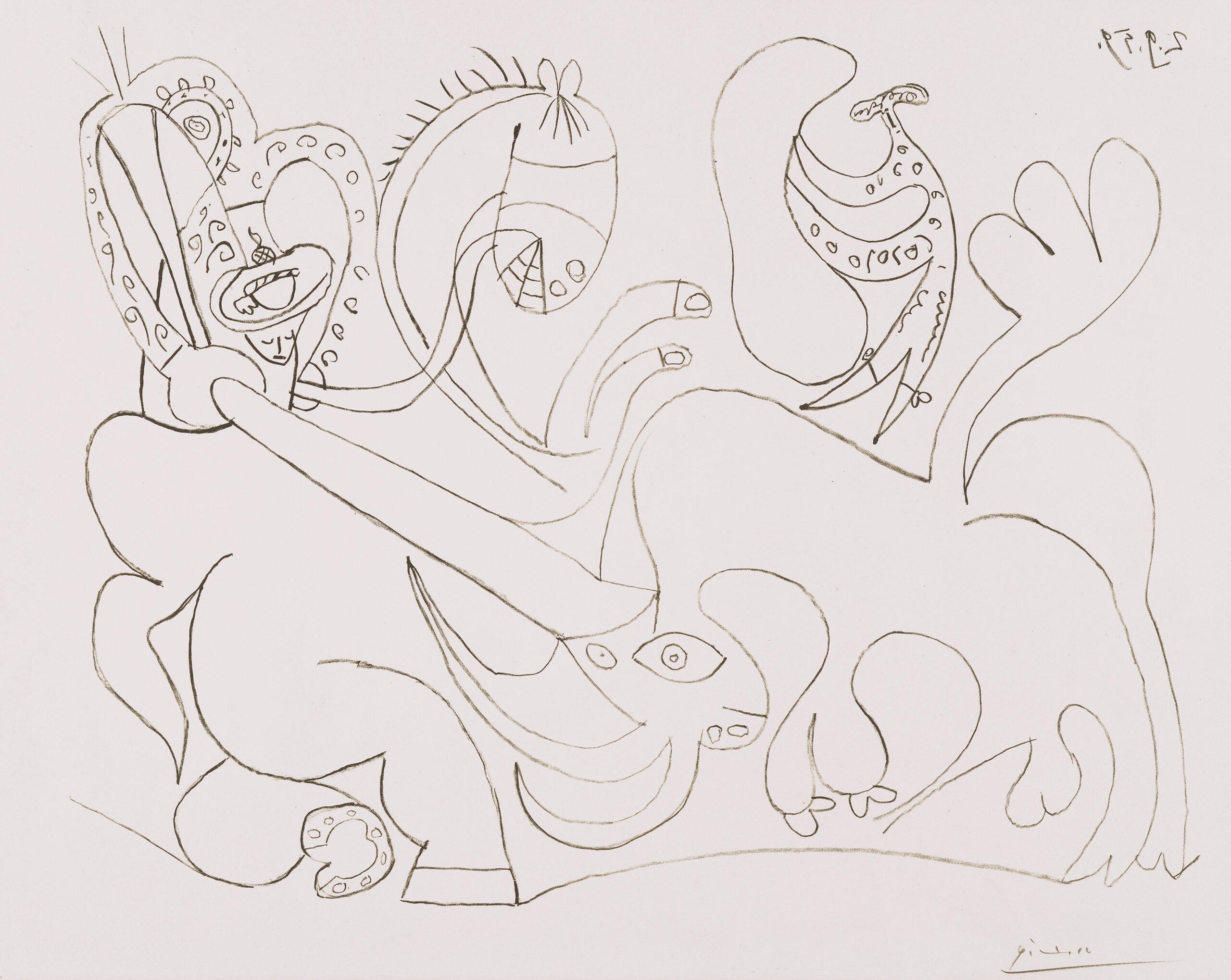
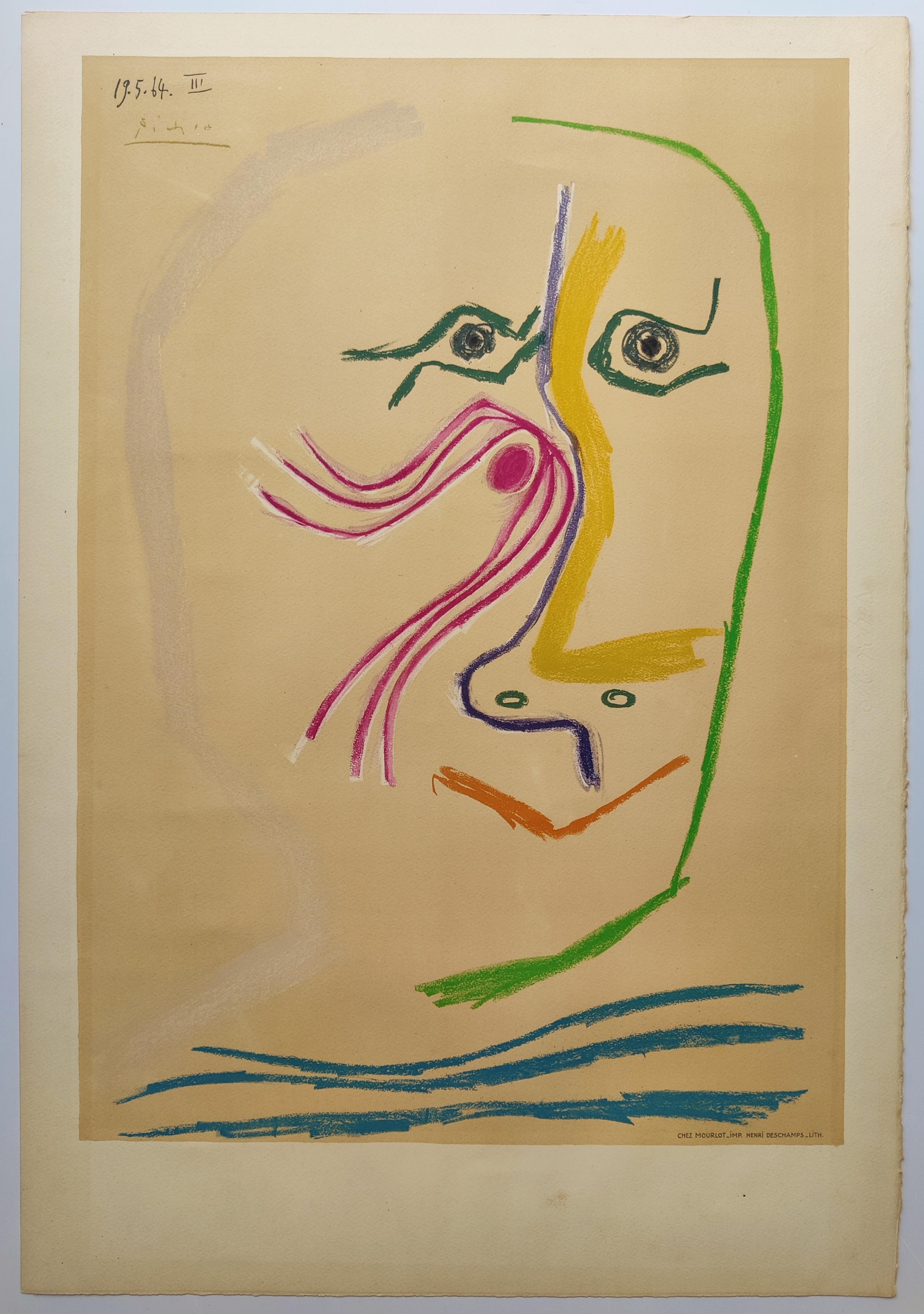
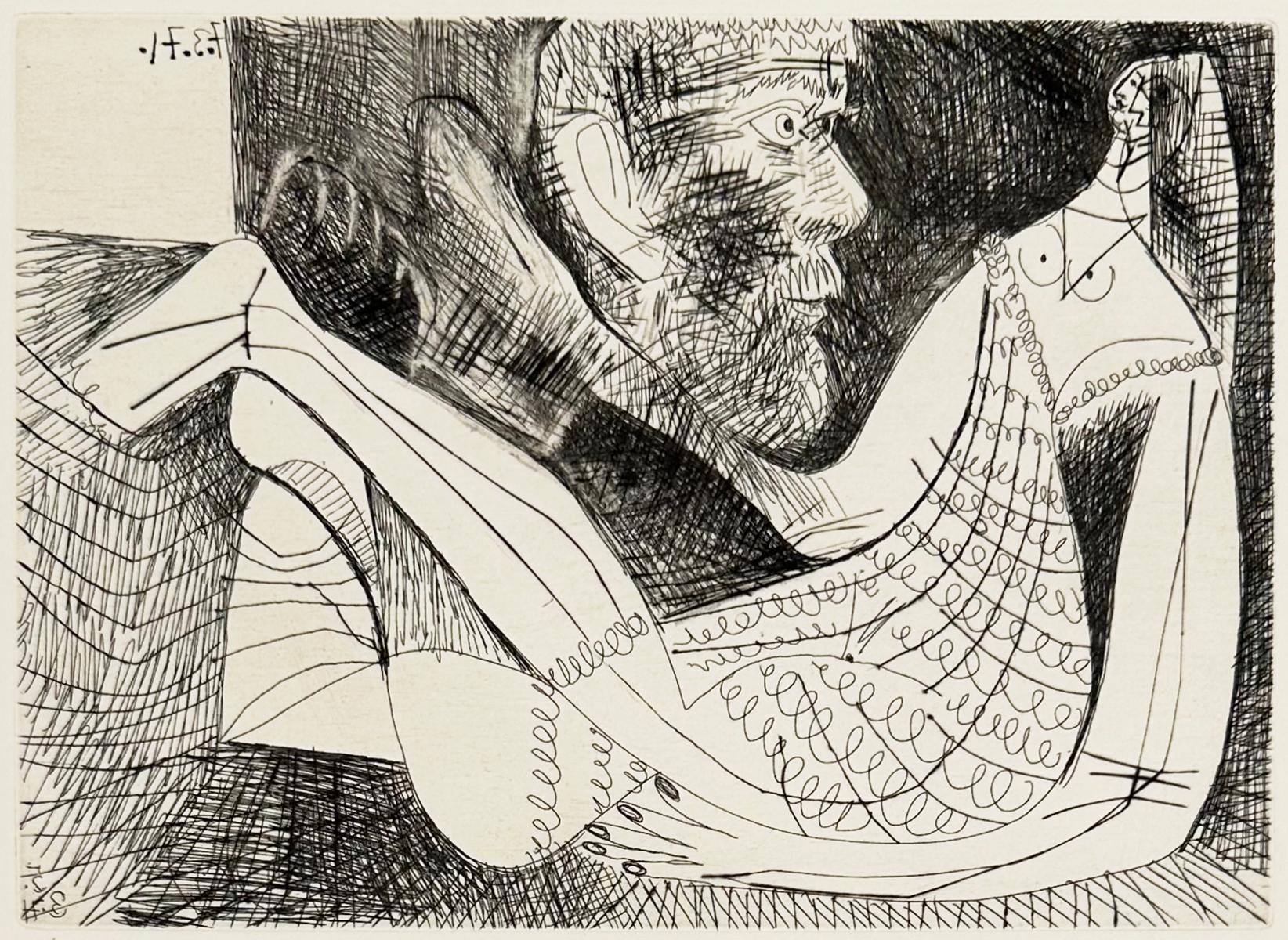
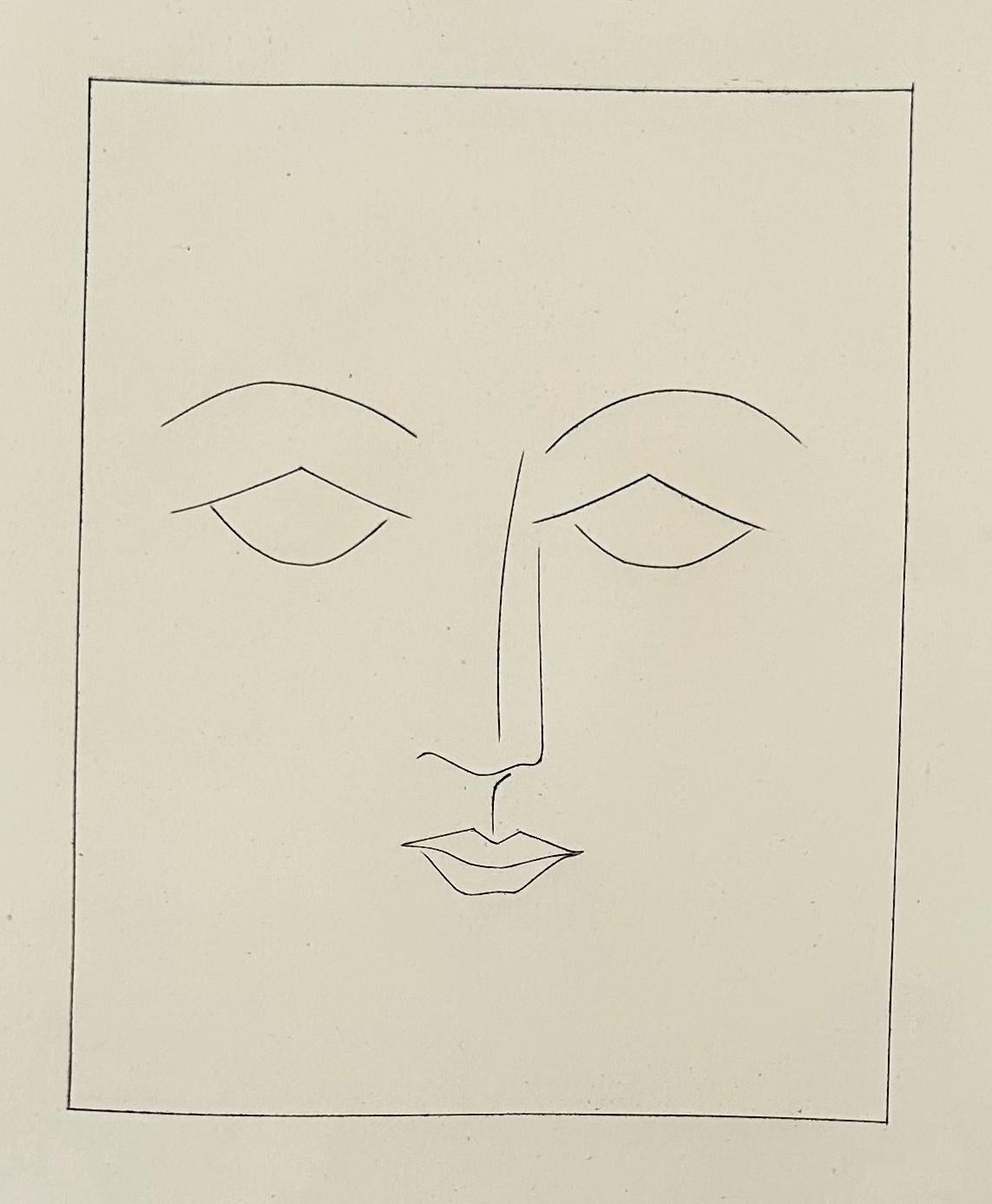
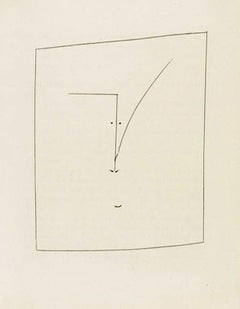
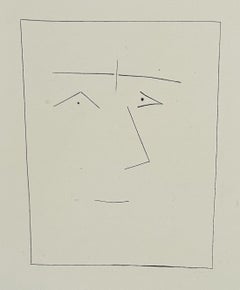
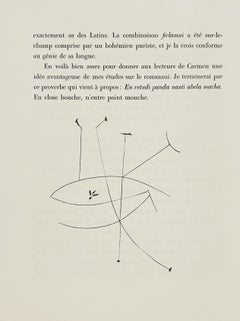
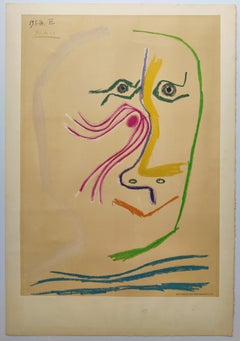
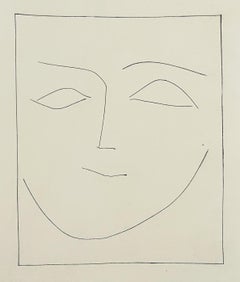
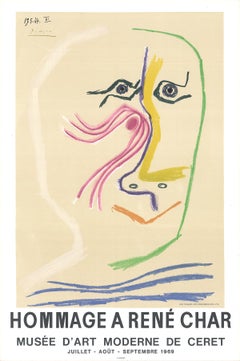
This exquisite engraving by Pablo Picasso (1881–1973), titled Sans titre (Untitled), from the folio Picasso, Carmen (Picasso, Carmen), originates from the 1949 edition published by La Bibliotheque Francaise, Paris; printed by Atelier Lacouriere-Frelaut, Paris, under the direction of Roger Lacouriere, Paris, October 25, 1949. This compelling composition reflects Picasso’s mastery of intaglio technique, where incisive line, dramatic contrast, and expressive distortion converge to translate the passionate intensity of Prosper Merimee’s celebrated narrative into a powerful graphic language.
Executed as an engraving on velin de Montval paper, this work measures 13 x 10.187 inches (33.02 x 25.88 cm). Unsigned and unnumbered as issued. The impression exemplifies the technical excellence and material sensitivity characteristic of Atelier Lacouriere-Frelaut’s celebrated editions.
Artwork Details:
Artist: Pablo Picasso (1881–1973)
Title: Sans titre (Untitled), from Picasso, Carmen (Picasso, Carmen)
Medium: Engraving on velin de Montval paper
Dimensions: 13 x 10.187 inches (33.02 x 25.88 cm)
Inscription: Unsigned and unnumbered as issued
Date: 1949
Publisher: La Bibliotheque Francaise, Paris
Printer: Atelier Lacouriere-Frelaut, Paris
Catalogue raisonne references: Bloch, Georges. Pablo Picasso: Catalogue of the Printed Graphic Work 1904–1967. Kornfeld & Klipstein, 1968, illustration 531-572; Cramer, Patrick. Pablo Picasso, The Illustrated Books: Catalogue Raisonne. Patrick Cramer, 1983, illustration 52.
Condition: Well preserved, consistent with age and medium
Provenance: From the folio Picasso, Carmen (Picasso, Carmen), 1949
Notes:
Excerpted from the album (translated from French), Printing was completed on October 25, 1949 on the presses of Lacouriere and Frelaut, intaglio printers in Paris, for La Bibliotheque Francaise. The present edition, printed in CCCXX examples, including XI examples on Japon imperial numbered at the press in Roman numerals from I to XI, CCCIX examples on Velin de Montval numbered by hand, the first from I to CCLXXXIX, and the remainder constituting XX collaborators examples marked from A to T, contains XXXVIII original plates engraved with the burin by Picasso. The examples on Japon imperial, in addition to these XXXVIII plates, include IV original plates engraved in aquatint and a suite on papier de Chine. All examples were signed by the artist and the copper plates were cancelled after printing.
About the Publication:
Picasso, Carmen (Picasso, Carmen), published in Paris in 1949 by La Bibliotheque Francaise and printed by the renowned Atelier Lacouriere-Frelaut under the direction of master printer Roger Lacouriere, represents one of the most important postwar illustrated art editions devoted to the work of Pablo Picasso. Conceived as a luxurious livre d'artiste, the publication united Prosper Merimee’s celebrated novella Carmen with an extensive suite of original engravings created by Picasso specifically for the project. The collaboration with Lacouriere and Frelaut, among the most respected intaglio printers in twentieth century Paris, ensured an exceptional level of technical precision and artistic fidelity. The edition was printed in carefully structured tiers on fine papers including Japon imperial and velin de Montval, with special suites and additional aquatint plates reserved for the most prestigious examples. The folio contains thirty eight engravings executed with the burin, demonstrating Picasso’s remarkable command of engraving and his ability to translate narrative drama into stark and expressive linear compositions. As part of the rich tradition of French artist illustrated editions, Picasso, Carmen stands as a landmark collaboration between artist, printer, and publisher, embodying the enduring vitality of the livre d'artiste in the twentieth century.
About the Artist:
Pablo Picasso (1881–1973) was a Spanish painter, sculptor, printmaker, and ceramicist whose extraordinary vision revolutionized modern art and defined the visual language of the 20th century. A child prodigy from Malaga, Spain, Picasso’s career spanned more than seven decades and encompassed an astonishing range of styles and innovations—from the melancholic Blue and romantic Rose periods to his pioneering invention of Cubism with Georges Braque, which shattered conventional notions of perspective and form. Influenced by the bold expressiveness of El Greco, the structure of Cezanne, and the vitality of African and Iberian sculpture, Picasso became a central figure of the Paris avant-garde, working in creative dialogue with contemporaries such as Henri Matisse, Alexander Calder, Alberto Giacometti, Salvador Dali, Joan Miro, Wassily Kandinsky, Marcel Duchamp, and Man Ray. His insatiable experimentation extended across painting, drawing, printmaking, ceramics, and sculpture, forever expanding the boundaries of artistic expression. A master of reinvention, Picasso profoundly shaped generations of artists who followed—from Andy Warhol, Roy Lichtenstein, David Hockney, and Jean-Michel Basquiat to Jeff Koons and Banksy—cementing his status as a timeless cultural icon whose works remain among the most sought after worldwide. His landmark painting Les Femmes d'Alger (Version "O") achieved a record-breaking sale of $179,365,000 at Christie's, New York, on May 11, 2015, affirming Picasso's enduring legacy as one of the most influential and valuable artists in history.
Pablo Picasso Sans titre Carmen 1949 engraving Lacouriere Frelaut Montval modern master print.