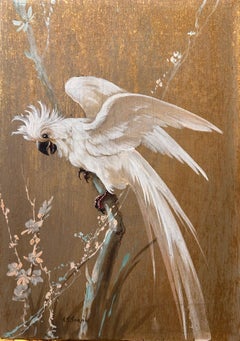
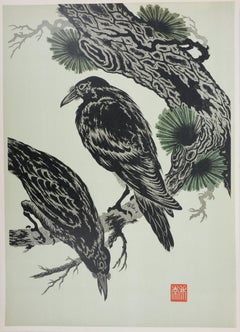
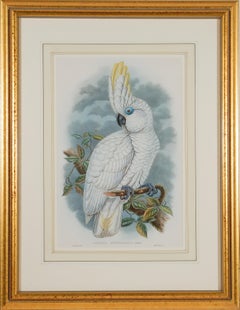
Ohara Koson, 'Cockatoo and Pomegranate', color woodblock print, 1927. Signed 'Shoson' with the artist's, red seal 'Shoson'. A fine, posthumous impression, with fresh colors and with embossing (gauffrage) in the birds feathers, on cream wove Japanese paper, in excellent condition. Published by Watanabe Shozaburo, with his copyright Heisei-seal in the lower left margin and with the 7mm round seal in black on the black background (visible in raking light), in the lower left image corner. Archivally sleeved, unmatted.
Image size 14 1/4 x 9 3/8 inches (362 x 238 mm) ; sheet size 15 1/4 x 10 1/8 inches (387 x 257 mm).
Literature: 'Crows, Cranes & Camellias: The Natural World of Ohara Koson', Amy R. Newland, Jan Perry & Robert Schaap, Leiden; Hotei Publishing, 2001, pg 200, pl S36.1.
Impressions of this work are held in the permanent collections of the Art Institute of Chicago, Brooklyn Museum, Harvard Art Museums, Los Angeles County Museum of Art, Museum of New Zealand, and the Rijksmuseum (Amsterdam).
ABOUT THIS WORK
Ohara Koson’s 1927 color woodblock print 'Cockatoo and Pomegranate' is a masterful example of the shin-hanga bird-and-flower (kachō-e) tradition. A majestic white cockatoo, perched on a gnarled branch beside a split pomegranate of rich rose-madder red and deep green foliage, is dramatically silhouetted against a velvety matte-black background. Koson renders the bird with exceptional delicacy: subtle pink-blush shading warms the predominantly white plumage, while finely articulated feather patterns and extensive embossing (gauffrage) give the cockatoo a remarkable tactile dimension. The restrained palette, meticulous printing, and striking contrast between the luminous bird and striking black background lend the composition both elegance and imposing dramatic presence.
ABOUT THE ARTIST
Koson Ohara (also Shōson and Hōson, 1877–1945) was among the most renowned Japanese artists of early 20th-century kachō-ga (bird-and-flower pictures) woodblock printmaking. With meticulous detail, sensitive color, and a palpable reverence for flora and fauna, Koson helped bring the genre into the modern era.
Koson was born in Kanazawa with the given name Matao Ohara. He began his artistic career studying painting under the Shijō-style master Kason. Around the turn of the century, Koson was associated with the Tokyo School of Fine Arts, where he came into contact with Ernest Fenollosa, the American collector and scholar who played a central role in introducing Japanese art to Western audiences. Fenollosa encouraged and supported Koson’s efforts to bring his bird-and-flower imagery to American collectors.
Around 1905, Koson began producing woodblock prints. Between 1900 and 1912, he worked with several publishers and designed a series of Russo-Japanese War prints, reflecting the commercial demand for wartime imagery, as well as genre landscapes, though his primary focus remained kachō-ga. His earliest and rarest designs are notable for their narrow formats and soft, atmospheric color. Most of his early woodblock prints were signed or sealed Koson and were published by firms including Kokkeidō and Daikokuya. After 1912, he adopted the name Shōson and devoted himself primarily to painting.
A decade later, Koson returned to printmaking, a renewal that coincided with and significantly contributed to the Shin Hanga movement. In 1926, he began designing woodblock prints for the esteemed publisher Shōzaburō Watanabe. Around 1930, he adopted the name Hōson for designs collaboratively published by Sakai and Kawaguchi. During this later period, he also served in an advisory capacity to the National Museum of Modern Art, Tokyo.
Koson’s prints are held in major museum collections worldwide, including the British Museum (London), Brooklyn Museum, Freer Gallery of Art, Harvard Art Museums, Los Angeles County Museum of Art, Museum of Fine Arts, Boston, Metropolitan Museum of Art, Museum für Ostasiatische Kunst (Cologne), Museum of New Zealand Te Papa Tongarewa (Wellington), National Museum of Modern Art (Tokyo), Ota Memorial Museum of Art (Tokyo), Rijksmuseum (Amsterdam), and the Royal Ontario Museum (Toronto).