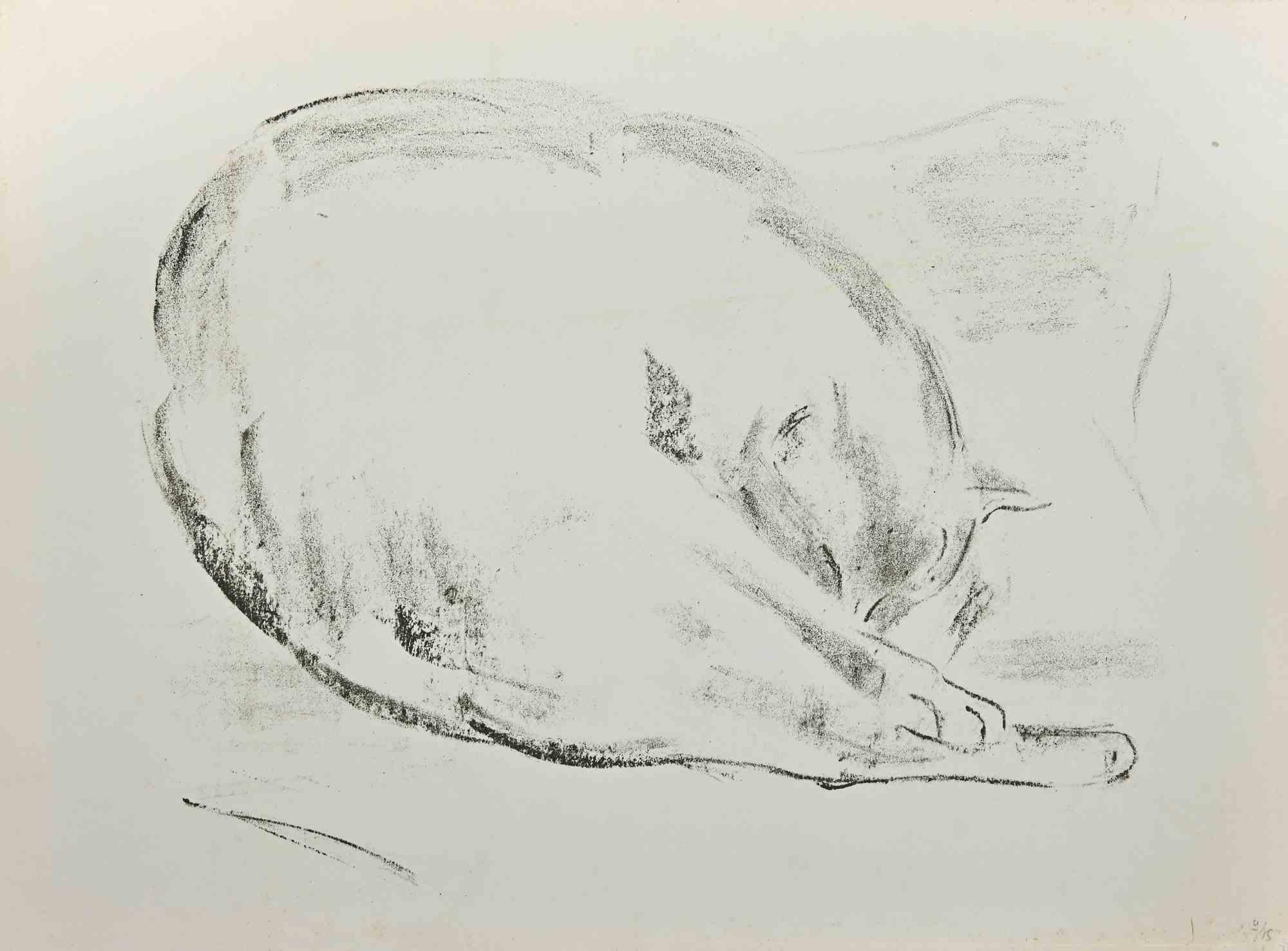
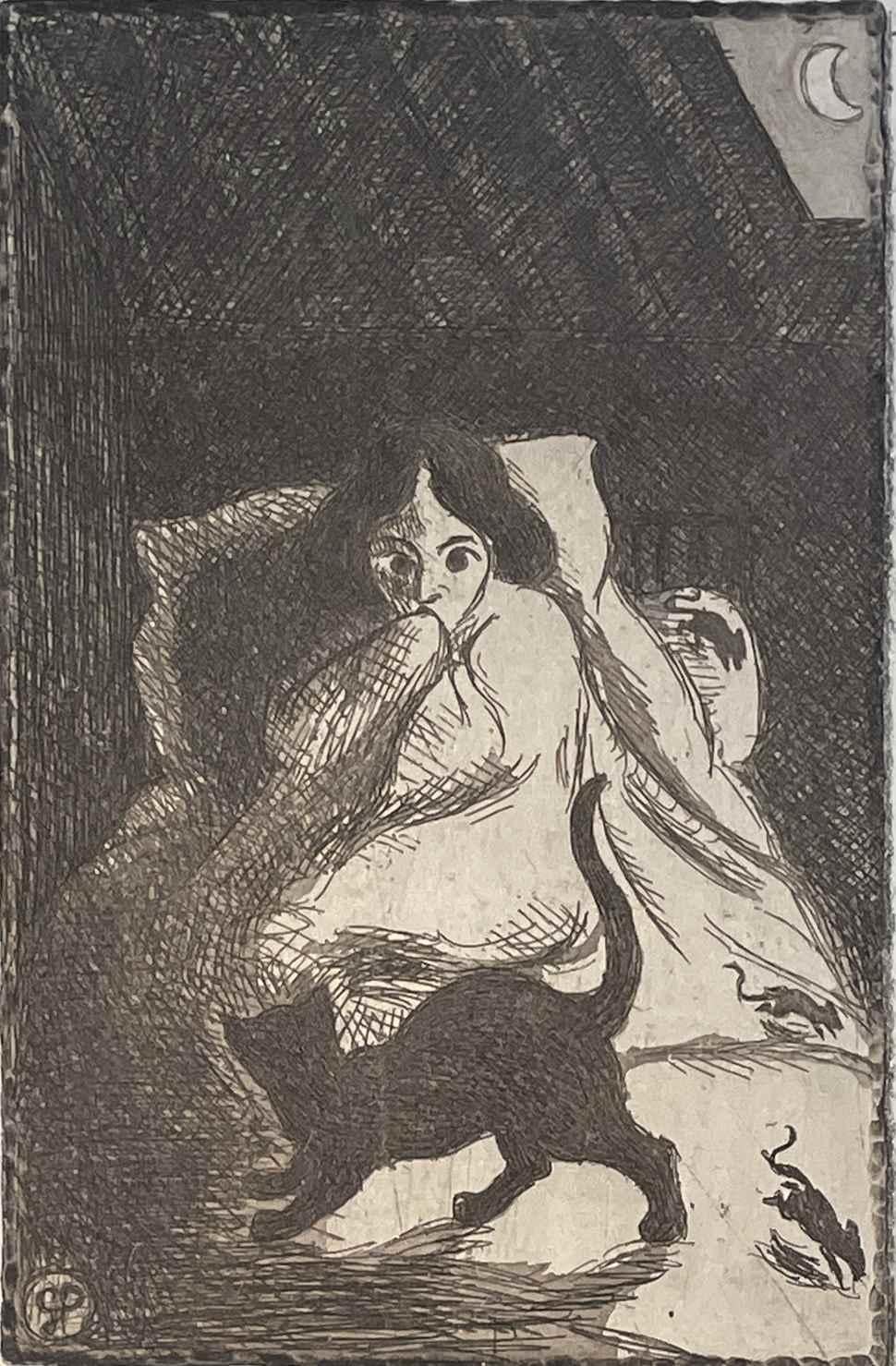
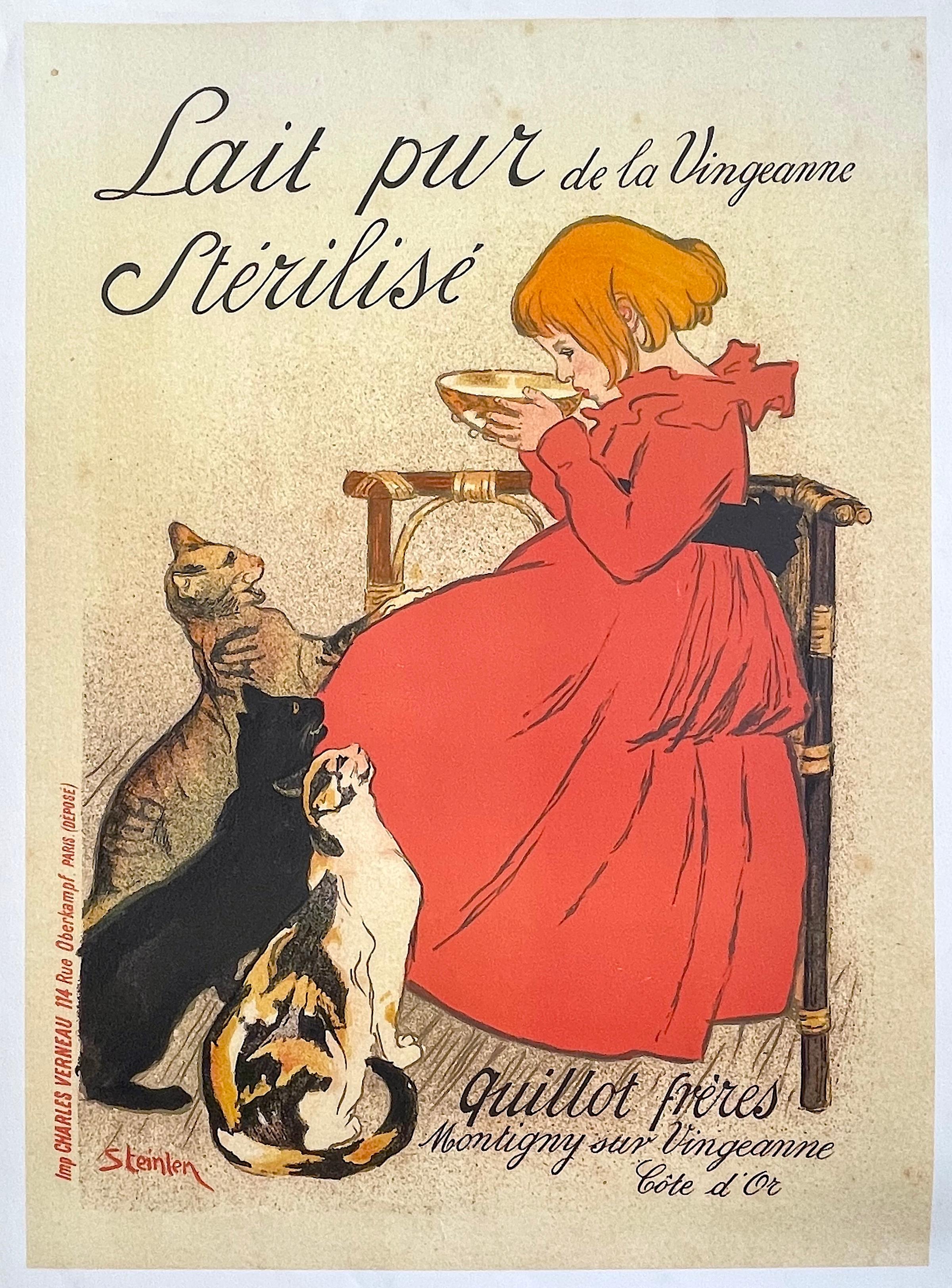
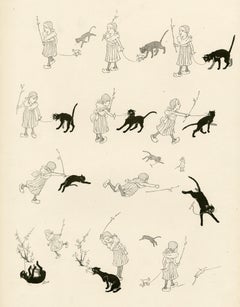
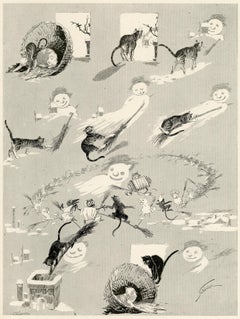
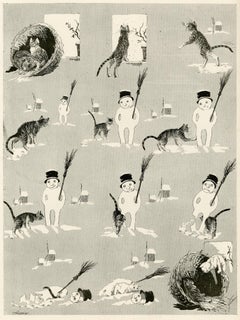
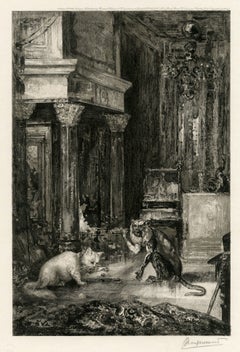
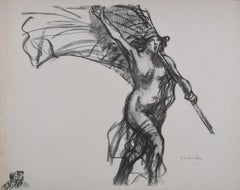
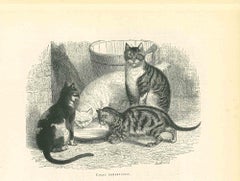
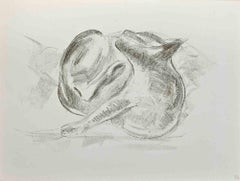
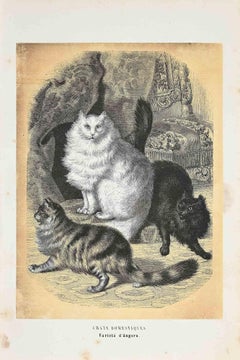
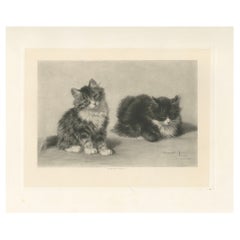
A black and white cat play with a mouse, from Le Chat Noir
Gillotage chromotype, 1898
Signed in the image lower right (see photo)
An impression of this image is in the collection of the de Young/Legion of Honor Fine Arts Museum of San Francisco
This print is page from the collected album Des Chats. Dessins sans paroles par Steinlen. The sheets were originally published in the journal Le Chat Noir and are reproduced here in gillotage.
Printer Charles Verneau
Gillotage was a 19th-century relief printing technique that converted a lithographic image on a metal plate into a printable relief block. Developed by Firmin Gillot around 1850 and later improved by his son Charles Gillot, the process involved transferring an image to a zinc plate, dusting the drawn parts with an acid-resistant resin, and then using acid to etch away the surrounding metal, creating a raised surface for printing. This method was a cheaper and faster alternative to methods like wood engraving for reproducing illustrations in books and newspapers.
Condition: Excellent
Image size: 14 x 10 inches
Reference: Not in Cruzat
Provenance: Edmund Sagot, Paris (1857-1917)
Maurice Le Garrec, Paris (1881-1937)
By descent
Le Chat Noir (French pronunciation: [lə ʃa nwaʁ]; French for "The Black Cat") was a 19th century entertainment establishment in the bohemian Montmartre district of Paris. It was opened on 18 November 1881 at 84 Boulevard de Rochechouart by impresario Rodolphe Salis, and closed in 1897 not long after Salis' death.
Le Chat Noir is thought to be the first modern cabaret: a nightclub where the patrons sat at tables and drank alcoholic beverages while being entertained by a variety show on stage. The acts were introduced by a master of ceremonies who interacted with well-known patrons at the tables. Its imitators have included cabarets from St. Petersburg (Stray Dog Café) to Barcelona (Els Quatre Gats) to London's Cave of the Golden Calf.
In its heyday it was a bustling nightclub that was part artist salon, part rowdy music hall. From 1882 to 1895 the cabaret published a weekly magazine with the same name, featuring literary writings, news from the cabaret and Montmartre, poetry, and political satire. It was the subject of an iconic Théophile Steinlen poster in 1896.
Famous men and women to patronize Le Chat Noir included Jane Avril, Franc-Nohain, Adolphe Willette, Caran d'Ache, André Gill, Émile Cohl, Paul Bilhaud, Sarah England, Amy Levy, Paul Verlaine, Henri Rivière, Claude Debussy, Erik Satie, Charles Cros, Jules Laforgue, Yvette Guilbert, Charles Moréas, Albert Samain, Louis Le Cardonnel, Coquelin Cadet, Emile Goudeau, Alphonse Allais, Maurice Rollinat, Maurice Donnay, Armand Masson, Aristide Bruant, Théodore Botrel, Paul Signac, Porfirio Pires, August Strindberg, George Auriol, Marie Krysinska, and Henri de Toulouse-Lautrec.
This print is page from the collected album Des Chats. Dessins sans paroles par Steinlen. The sheets were originally published in the journal Le Chat Noir and are reproduced here in gillotage.