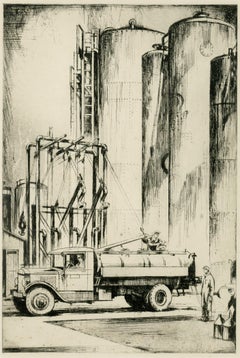
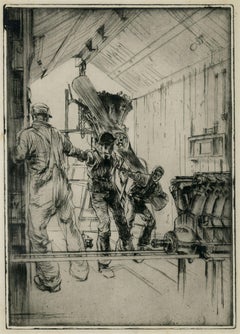
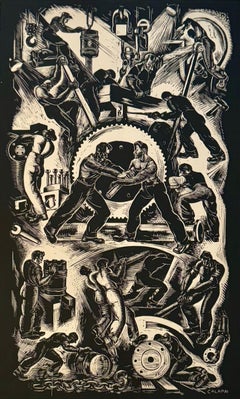
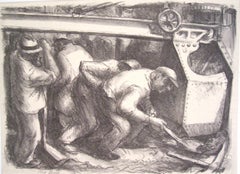
Machinists with Truck Engines (Autocar Truck Assembly Line)
Etching with Drypoint, c. 1929
Unsigned
Provenance: Estate of the Artist
New York Financial Institution
The strongest evidence is that the Philadelphia Museum of Art Archives preserves a March 1929 issue of Autocar Messenger whose cover reproduces a print by Earl Horter. Autocar manufactured heavy trucks at its plant in Ardmore, Pennsylvania, near Philadelphia, making the subject entirely consistent with Horter’s local commercial work. The National Gallery of Art also owns another Horter etching catalogued as Untitled (Autocar Company), dated about 1925, establishing that he produced multiple images for the company.
An impression of this image is in the collection of the Philadelphia Museum of Art
A very rich impression full of burr.
Condition: Excellent
Image/Plate size: 10 1/4 x 8 1/4 inches
An impression of this image is in the collection of the Philadelphia Museum of Art.
Horter, Earl
Philadelphia, 1880−Chestnut Hill, Pa., 1940
Earl Horter was a Philadelphia based artist and collector of early twentieth-century American and French art, African sculpture, and Native American artifacts, with a particular interest in Cubist works by Pablo Picasso and Georges Braque from 1909 to 1914. Over the span of just a decade, Horter assembled and then sold off one of the largest collections of modern art in the United States.
Horter grew up in a working-class family in Philadelphia. He earned his living as a self-taught draftsman, engraving stock certificates for the John Wanamaker store. In 1903 he moved to New York to work as an artist for the Calkins anHortd Holden advertising agency, and later founded the firm’s first art department. Horter studied etching at the Art Students League in 1908 and regularly showed his work at the annual Exhibition of Advertising Art at the National Arts Club and through the Association of American Etchers. In 1913 he also began casually collecting prints after visiting The International Exhibition of Modern Art (also known as the Armory Show), where he purchased a suite of thirteen lithographs by Edouard Vuillard. In the following years, he bought an additional twelve lithographs through Ambroise Vollard and began frequenting such galleries as Alfred Stieglitz’s 291, Macbeth, Montross, Berlin Photographic Company, and Washington Square’s collection of African sculpture.
Horter returned to Philadelphia in 1916, accepting a position at the N.W. Ayer and Son advertising firm, where he eventually became art director. Around this time he began socializing with the “Thirty-One Philadelphia Artists,” a group (including Charles Demuth and Charles Sheeler) who had trained at the Pennsylvania Academy of Fine Arts. Through this circle, Horter met Arthur B. Carles, who had studied in Paris from 1907 to 1912 and knew American collectors Gertrude and Leo Stein personally. Carles further exposed Horter to European contemporary art, particularly Cubist works by Braque and Picasso. In the early 1920s, although Horter had been collecting American art—predominantly prints—since 1913, his focus turned toward European modernism.
Horter traveled to Europe for the first time in 1921 on a commission to draw European monuments for a client, the Joseph Dixon Crucible Company. He likely attended the first auction of Cubist dealer Daniel-Henry Kahnweiler’s holdings at the Hôtel Drouot and visited American artists in Paris, alongside Carles. Throughout the 1920s he returned often to Paris, acquiring works for his growing collection. Although the details surrounding his purchases in Europe are largely unknown, Horter generally collected without the help of a dealer and preferred acquiring works from the artist directly whenever possible. He assembled the majority of his works by Braque, Picasso, and Juan Gris between 1925 and 1928; many had once been in Kahnweiler’s stock or were acquired from Léonce Rosenberg. Key examples include Picasso’s Portrait of Daniel-Henry Kahnweiler (1910; Art Institute of Chicago) and Playing Cards, Glasses, Bottle of Rum: ‘Vive la France’ (1914; The Metropolitan Museum of Art, Promised Gift from Leonard A. Lauder Cubist Collection); Gris’s Guitar and Glass (1916; Yale University Art Gallery, New Haven); and Braque’s Bottle, Glasses, and Newspaper (1913; The Metropolitan Museum of Art, Promised Gift from Leonard A. Lauder Cubist Collection). Acquisitions made in the United States were typically purchased from New York galleries. Horter bought Picasso’s Still Life with Bottle of Port (1919; Dallas Museum of Art), from the Whitney Studio Galleries and purchased several works from collector John Quinn’s estate sale in 1926.
Additionally, Horter developed an interest in African art after visiting a 1914 exhibition at 291 entitled Statuary in Wood by African Savages: The Root of Modern Art. Inspired by fellow collector and friend Albert C. Barnes, in 1925 Horter began acquiring African sculpture through the help of Paul Guillaume and Stieglitz; highlights in his collection included a Guro mask from the Ivory Coast, several Songye male figurines from Congo, and a Kota reliquary guardian figure from Gabon.
Horter collected extravagantly and beyond his financial means. His personal papers suggest that he owned ten works by Picasso in 1926, and that this figure had doubled by the end of 1927. At the peak of his collecting, Horter possessed thirty works by Picasso and Braque; two works by Gris; one painting by Henri Matisse; four sculptures by Constantin Brancusi; and Marcel Duchamp’s Nude Descending a Staircase, No. 1 (1911; Philadelphia Museum of Art). He housed his collection in his small residence at 2219 Delancey Street in Philadelphia and interspersed his Cubist works with examples of African sculpture.
With the onset of the Great Depression, Horter could no longer afford to buy new works; he began lending to exhibitions with the hope that his collection would sell intact. The Collection of Earl Horter was presented at the Philadelphia Museum of Art in the spring of 1934, followed by Modern Paintings from the Collection of Mr. Earl Horter of Philadelphia at the Arts Club of Chicago. Although several works sold, Horter was forced to begin dispersing his collection through private sales by the mid-1930s. Important works were acquired by the likes of Douglas Cooper, Charles B. Goodspeed, Pierre Matisse, and Louise and Walter Arensberg. With proceeds from these sales, Horter began augmenting his collection of Native American artifacts—specifically objects crafted by the Plains Indians—which were much more affordable than modern European painting and sculpture. Although the details surrounding these purchases are generally undocumented, Horter seems to have made the majority of such acquisitions in 1938 and 1939. At the time of his death, Horter’s Native American collection numbered roughly 1,500 objects and was left to his fourth wife, Elizabeth Lentz Horter.
Contributed by Rachel Boate, August 2018
Courtesy Metropolitan Museum of Art
A painter, draftsman and printmaker who also worked for advertising agencies as a commercial artist, Earl Horter amassed a notable collection of modern art, African sculptures and Native American art during the 1920s. Born in Philadelphia in 1880, little is known about is early life and artistic training. Horter was described as a landscape artist in the census of 1900. He was hired by the Calkins and Holden advertising agency in New York City around 1903, based on his ability as a draftsman. He apparently took classes in etching at night, with his first etching dated to 1908. He married the first of his four wives in 1909. Horter quickly established a reputation as an etcher. In 1911 he was one of three artists (including Joseph Pennell [1857-1926]) commissioned by the New York Edison Company to create illustrations of scenes of New York for “Glimpses of New York: An Illustrated Handbook of the City.” In 1914 he showed his works at the first exhibition of the New York Society of Etchers, for which he was also a juror and the secretary. Horter exhibited four etchings in San Francisco’s Panama-Pacific International Exposition of 1915, where he received a silver medal. The following year his first solo show of 30 etchings and 33 drawings was held at the Frederick Keppel and Company gallery. Later in 1916 Horter agreed to join the N. W. Ayer and Son advertising agency in Philadelphia, where he started work the following January. He soon rose to the position of an art director. One of his significant projects was to travel in the United States and Europe creating drawings using the Joseph Dixon Crucible Company’s “Eldorado” pencil, a specialty product sold to artists and architects. Over a period of years Horter produced about 55 drawings that appeared in Dixon’s advertisements.
Courtesy of the Fine Art Museums of San Francisco