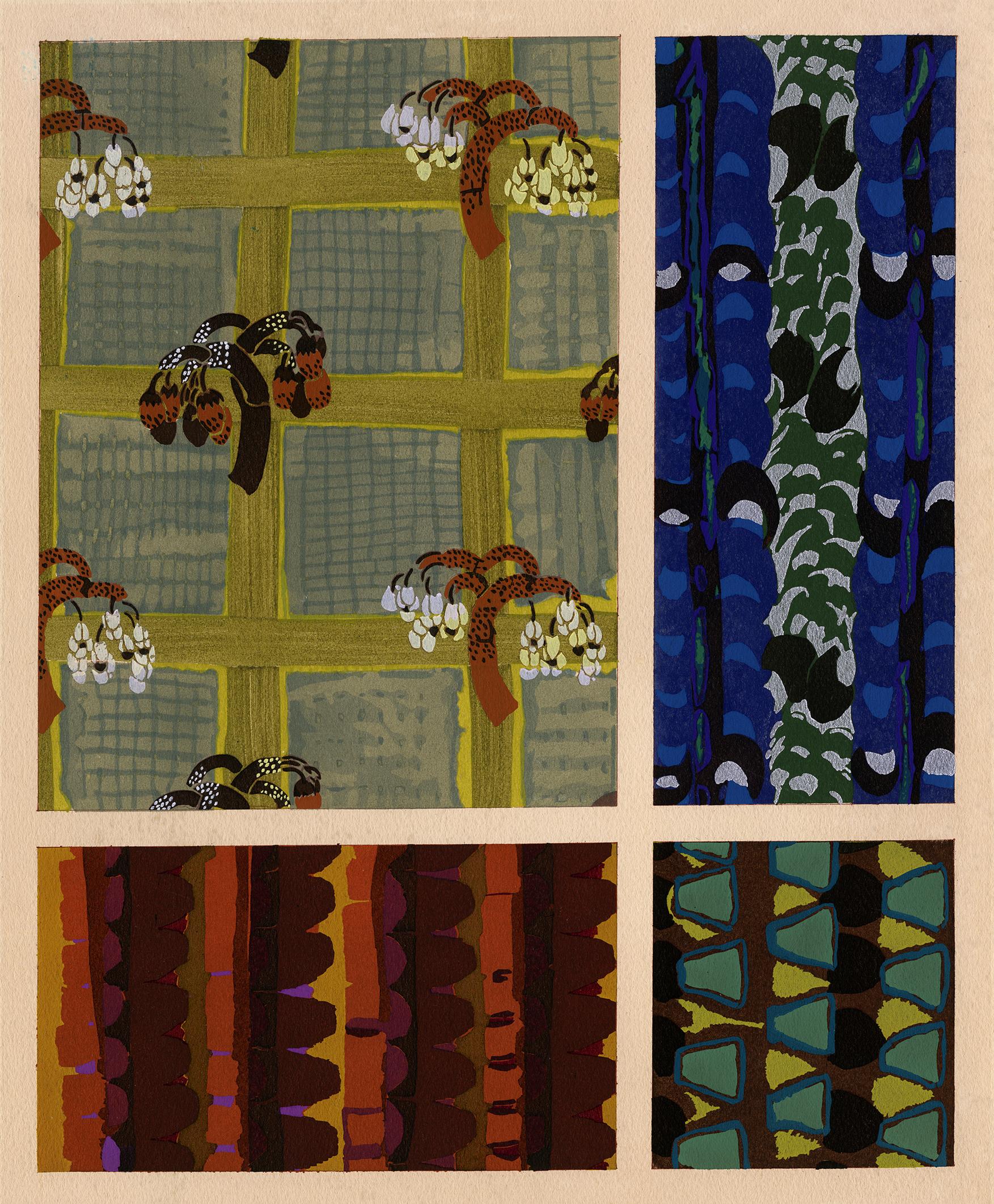
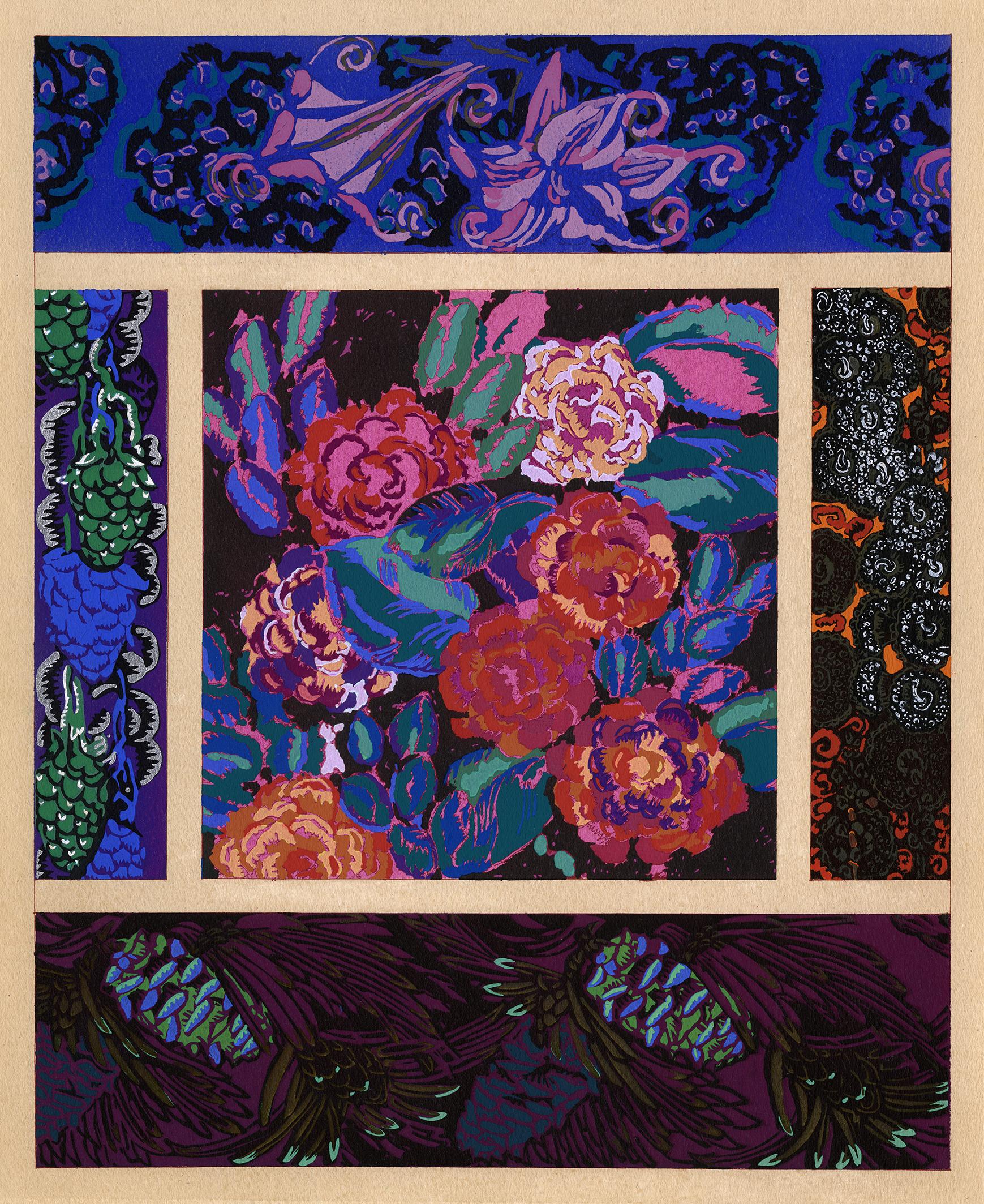
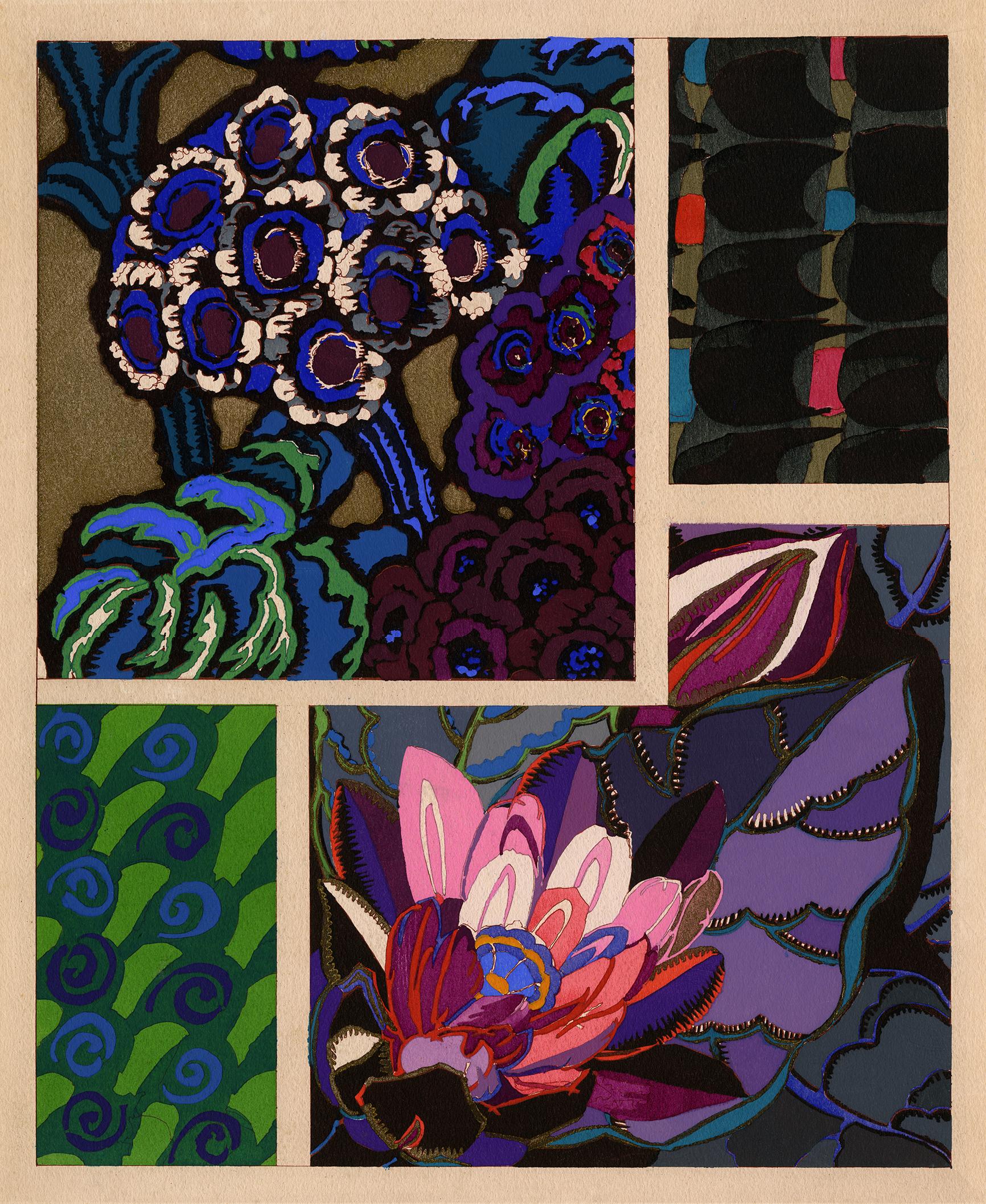
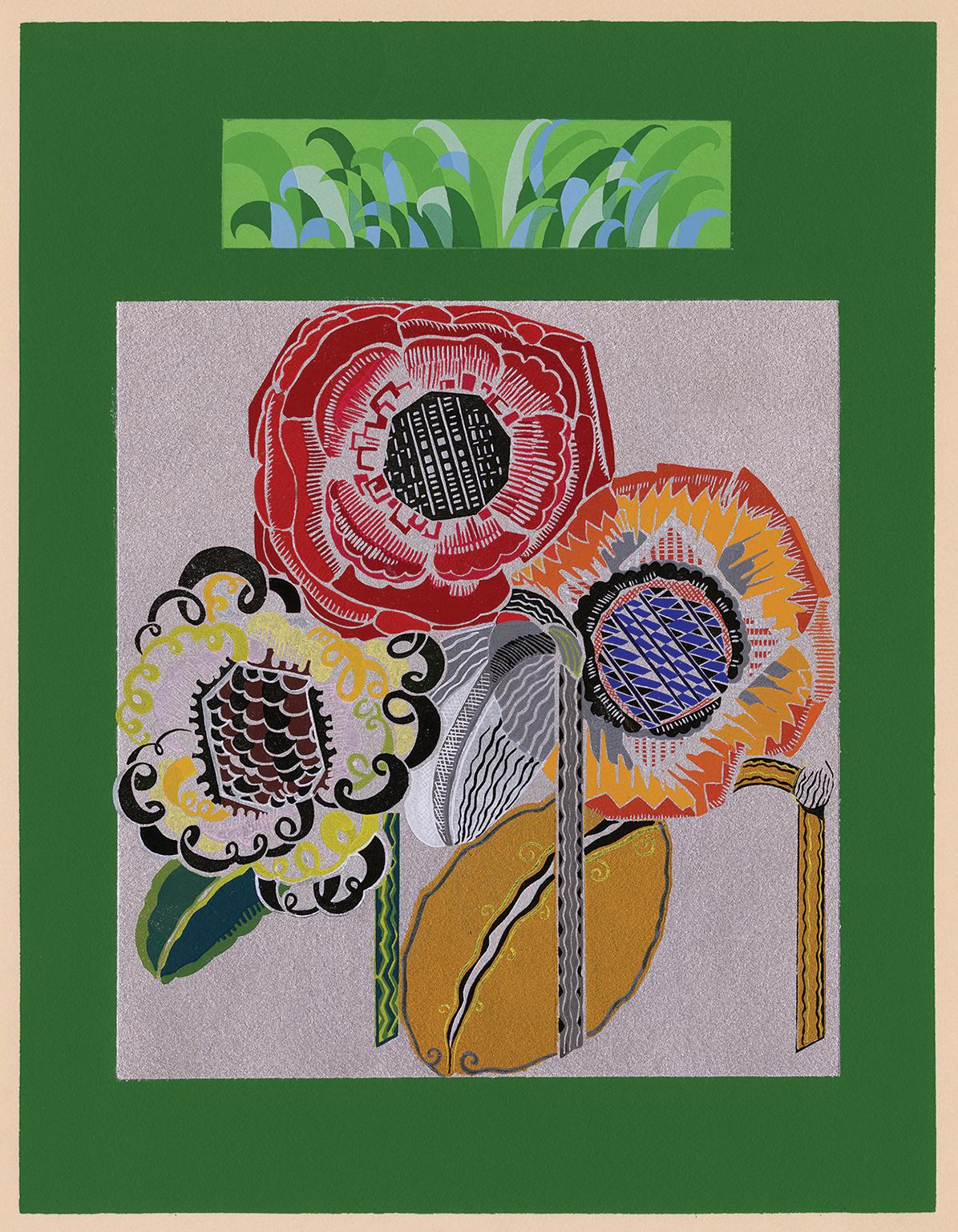
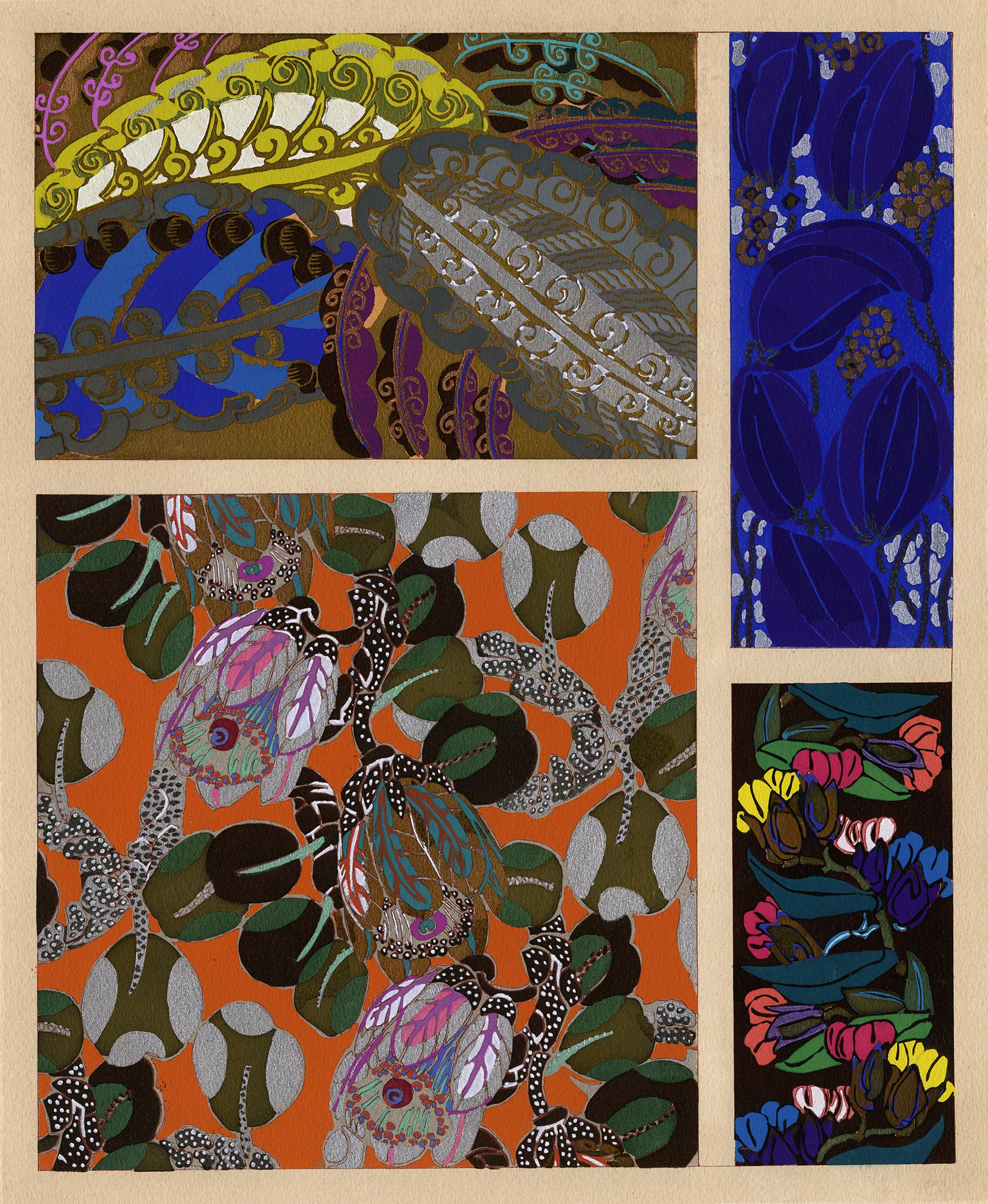
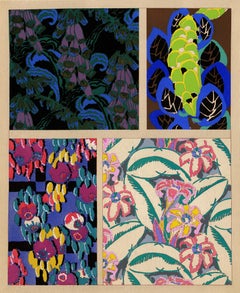
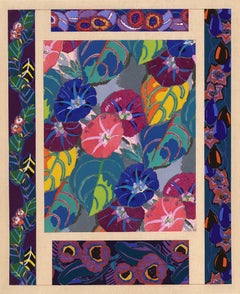
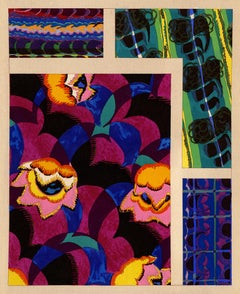
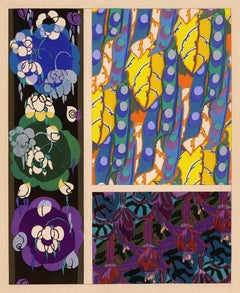
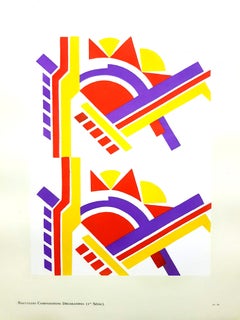
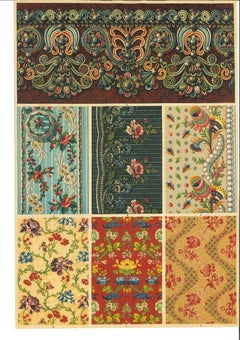
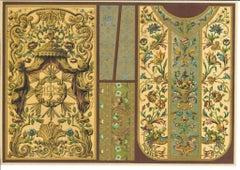
Edouard Benedictus, 'Variations, plate 8' from the portfolio 'Variations Quatre-Vingt-Six Motifs Décoratifs en Vingt Planches', color pochoir, edition not stated, 1923. Signed in the matrix, in the left bottom margin. A superb, painterly impression, with fresh, vivid colors and metallic silver, on heavy, buff wove paper, with margins (1 1/4 to 1 7/8 inches). A barely visible, archivally reinforced crease, in the left margin the length of the sheet and into the lower beige colored border, but not affecting the image, otherwise in good condition. Presents well. Archivally sleeved, unmatted.
Image size 14 3/8 x 11 1/2 inches; sheet size 18 x 14 1/8 inches.
The pochoir production is by Jean Saudé, the French printmaker known for his mastery of the technique and the author of the first how-to book on the pochoir process. Published by Éditions Albert Levy, Librairie Centrale des Beaux-Arts, Paris.
Collections: Metropolitan Museum of Art, Minneapolis Institute of Art, New York Public Library, Victoria and Albert Museum.
Additional works from this stunning suite of vibrant Art Deco floral designs are available from Keith Sheridan LLC on 1stDibs.
ABOUT THIS WORK
Pochoir is a refined stencil-based technique employed to create multiples or to add color to prints produced in other mediums. Characterized by its crisp lines and rich color, the print-making process was most popular from the late 19th century through the 1930s, with its center of activity in Paris. The pochoir process began with the analysis of an image’s composition, including color tones and densities. The numerous stencils (made of aluminum, copper, or zinc) necessary to create a complete image were then designed and hand-cut by the 'découpeur.' The 'coloristes' applied watercolor or gouache pigments through the stencils, skillfully employing a variety of different brushes and methods of paint application to achieve the desired depth of color and textural and tonal nuance. The pochoir process, by virtue of its handcrafted methodology, resulted in the finished work producing the effect of an original painting, and in fact, each print was unique.
ABOUT THE ARTIST
Edouard Benedictus (1878 -1930), artist, designer, composer, and chemist, was born and died in Paris. A highly-regarded designer and art critic of the Art Nouveau era, Benedictus gained renown as a colorist and creator of Art Deco-inspired geometric and floral motifs. His work had a significant influence on international fashions in clothing, home furnishings, graphic design, and decorative objects of the period, earning him commissions from leading European design firms. In 1925 he was invited to represent Art Deco textile design in the Pavillion de l'Ambassade Francaise at the important Exposition des Arts Decoratifs in Paris. Benedictus’ work is held in the collections of the Musee d'Orsay (Paris), Musee National des Beaux-Arts du Quebec, the U. S. Library of Congress, the Art Institute of Chicago, the Minneapolis Museum of Art, and the Victoria and Albert Museum (London).
Benedictus is also credited with the invention of shatter-proof glass in 1903. Having accidentally knocked a beaker off of a shelf in his studio and seeing that the pieces were surprisingly still connected, he surmised that it had to do with the liquid nitrocellulose that the beaker contained. Some experimenting finally produced what he called "laminated glass," in which a layer of celluloid was bonded between two sheets of glass. He patented his invention in 1909, and it became widely used during World War I; by 1919, Henry Ford was installing the glass in all of his automobiles. Refinements of the process lead to the 1936 invention of polyvinyl butyral, today's basis for bulletproof glass.
For his achievements in art and science, Benedictus was awarded a ‘Knight of the Legion of Honor’ and an ‘Officer of the Legion of Honor’ by the French Government.