Video Loading
Want more images or videos?
Request additional images or videos from the seller
1 of 11

Elizabeth Catlett
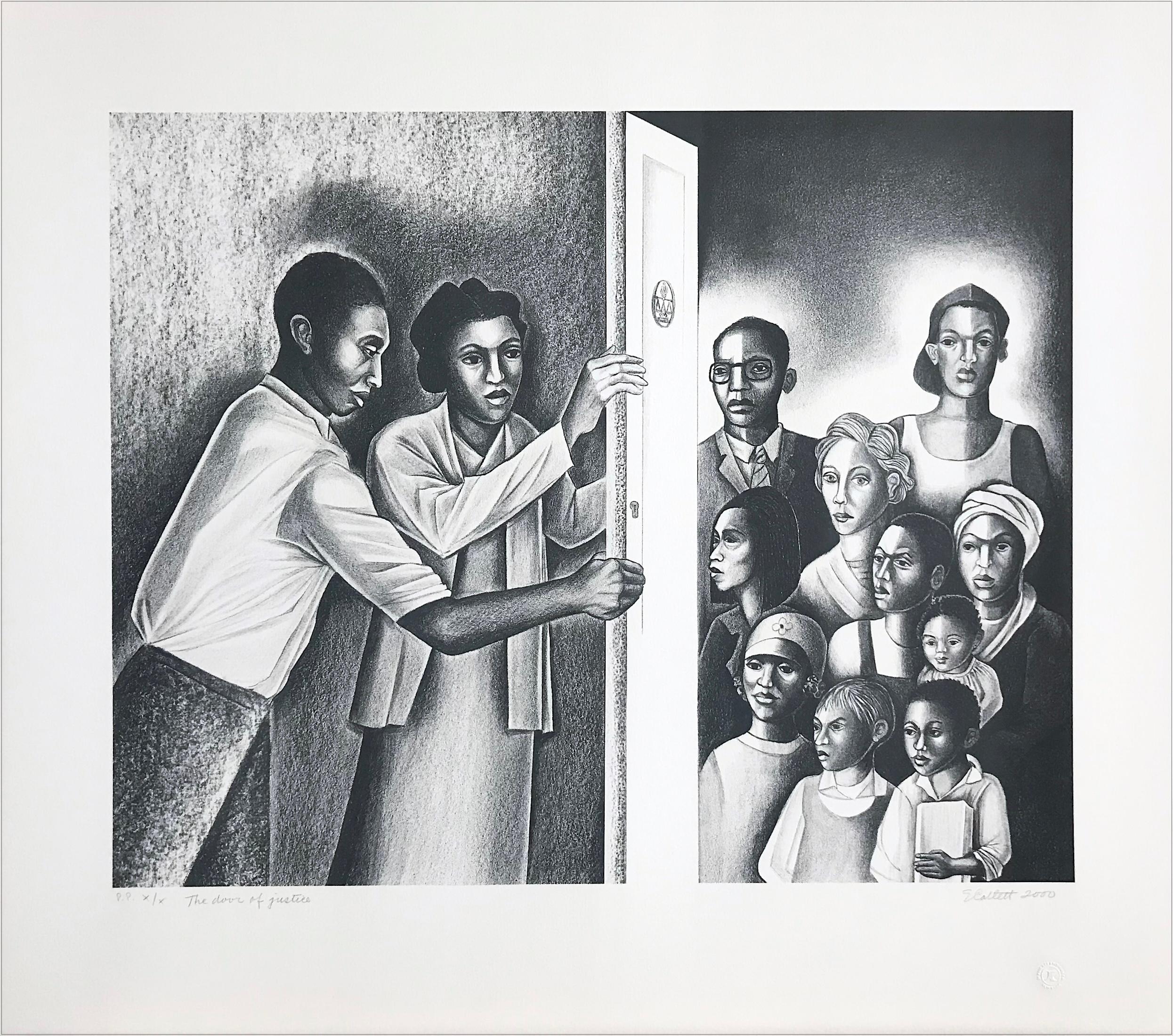
The Door of Justice Lithograph, Unframed, 32.75 x 27.5"

2000

$1,500
£1,121.25
€1,309.95
CA$2,110.11
A$2,135.59
CHF 1,224.49
MX$25,902.04
NOK 14,240.30
SEK 14,495.25
DKK 9,792.33

About the Item

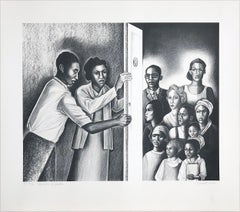
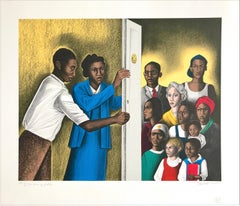
THE DOOR OF JUSTICE is a rare poster edition lithograph printed in seven colors using traditional hand lithography techniques (not a photo reproduction or digital print) on heavyweight archival Coventry paper, 100% acid free, designed by the renowned African American woman artist Elizabeth Catlett (1915-2012). This rarely seen, limited edition, commemorative fine art poster was exclusively created for the NAACP LDF (Legal Defense and Educational Fund, Inc.) in the year 2000 to celebrate their 60th anniversary. Superb quality and craftmanship, vivid colors, this impressive lithograph depicts two black lawyers opening the "door of justice" to the gathering of multicultural people waiting outside the door for legal representation and social justice. Print size - 32.75 x 27.5 in., unframed, unsigned, pristine condition, superb craftsmanship Image size - 26 x 27.5 in. Poster Edition size - 500 printed on Coventry paper concurrently with the signed and numbered limited edition lithograph of 100 printed on Arches printmaking paper. Year published - 2000 Printed by J K Fine Art Editions Co., NJ in collaboration with the artist Elizabeth Catlett. Lithograph is in mint condition, unsigned, never been framed or mounted. Printers chop embossed on lower margin, Print documentation/COA provided Elizabeth Catlett (born April 15, 1915, Washington, D.C., U.S.—died April 2, 2012, Cuernavaca, Mexico), American-born Mexican sculptor and printmaker renowned for her intensely political art. Catlett, a granddaughter of enslaved people, was born into a middle-class Washington family; her father was a professor of mathematics at Tuskegee Institute. After being disallowed entrance into the Carnegie Institute of Technology because she was Black, Catlett enrolled at Howard University (B.S., 1935), where she studied design, printmaking, and drawing and was influenced by the art theories of Alain Locke and James A. Porter. While working as a muralist for two months during the mid-1930s with the Federal Art Project of the Works Progress Administration, she became influenced by the social activism of Mexican muralist Diego Rivera. In 1940 Catlett became the first student to earn a master of fine arts degree in sculpture at the University of Iowa. The Regionalist painter Grant Wood, a professor at the university at the time, encouraged her to present images drawn from Black culture and experience and influenced her decision to concentrate on sculpture. After Catlett held several teaching positions while continuing to expand her range of media, she went to Mexico City in 1946 to work at the Taller de Gráfica Popular, an artists’ collective. There, along with her then husband, the artist Charles White, she created prints depicting Mexican life. As a left-wing activist, she underwent investigation by the U.S. House Un-American Activities Committee during the 1950s. In 1962 she took Mexican citizenship. Catlett was known largely for her sculpture, especially for works such as Homage to My Young Black Sisters (1968) and various mother-child pairings, the latter of which became one of her central themes. She was also an accomplished printmaker who valued prints for their affordability and hence their accessibility to many people. Catlett alternately chose to illustrate famous subjects, such as Harriet Tubman and Malcolm X, and anonymous workers—notably, strong solitary Black women—as depicted in the terra-cotta sculpture Tired (1946). Other notable works include the linocuts Sharecropper (1968) and Survivor (1983) and the lithograph Negro es bello (1968; “Black Is Beautiful”). She remained a working artist into her 90s. -The Editors of Encyclopedia Britannica
  • Creator:
    Elizabeth Catlett (1915 - 2012, American)
  • Creation Year:
    2000
  • Dimensions:
    Height: 32.75 in (83.19 cm)Width: 27.5 in (69.85 cm)
  • Medium:
  • Movement & Style:
  • Period:
  • Condition:
  • Gallery Location:
    Union City, NJ
  • Reference Number:
    1stDibs: LU832315265362

More From This Seller

View All
SECOND GENERATION Signed Lithograph, For My People by Margaret Walker, Protest

SECOND GENERATION Signed Lithograph, For My People by Margaret Walker, Protest

By Elizabeth Catlett

Located in Union City, NJ

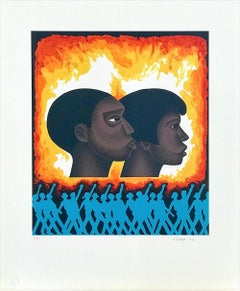
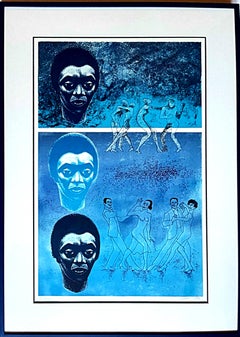
SECOND GENERATION is an original hand drawn limited edition lithograph by the highly acclaimed African-American woman artist Elizabeth Catlett, master printmaker and sculptor best known for her depictions of the African-American experience. SECOND GENERATION portrays a double portrait of a boy and girl in profile, bordered by bright yellow, orange and red flames with a row of turquoise blue silhouette figures marching in protest across the lower portion of this striking composition by Elizabeth Catlett. From the FOR MY PEOPLE suite of prints, a set of 6 lithographs illustrating the well known 1942 poem by Margaret Walker. "Let a new earth rise. Let another world be born. Let a bloody peace be written in the sky. Let a second generation full of courage issue forth; let a people loving freedom come to growth. Let a beauty full of healing and a strength of final clenching be the pulsing in our spirits and our blood. Let the martial songs be written, let the dirges disappear. Let a race of men now rise and take control." stanza from the poem FOR MY PEOPLE by Margaret Walker...

Category

1990s Contemporary Portrait Prints

Materials

Lithograph

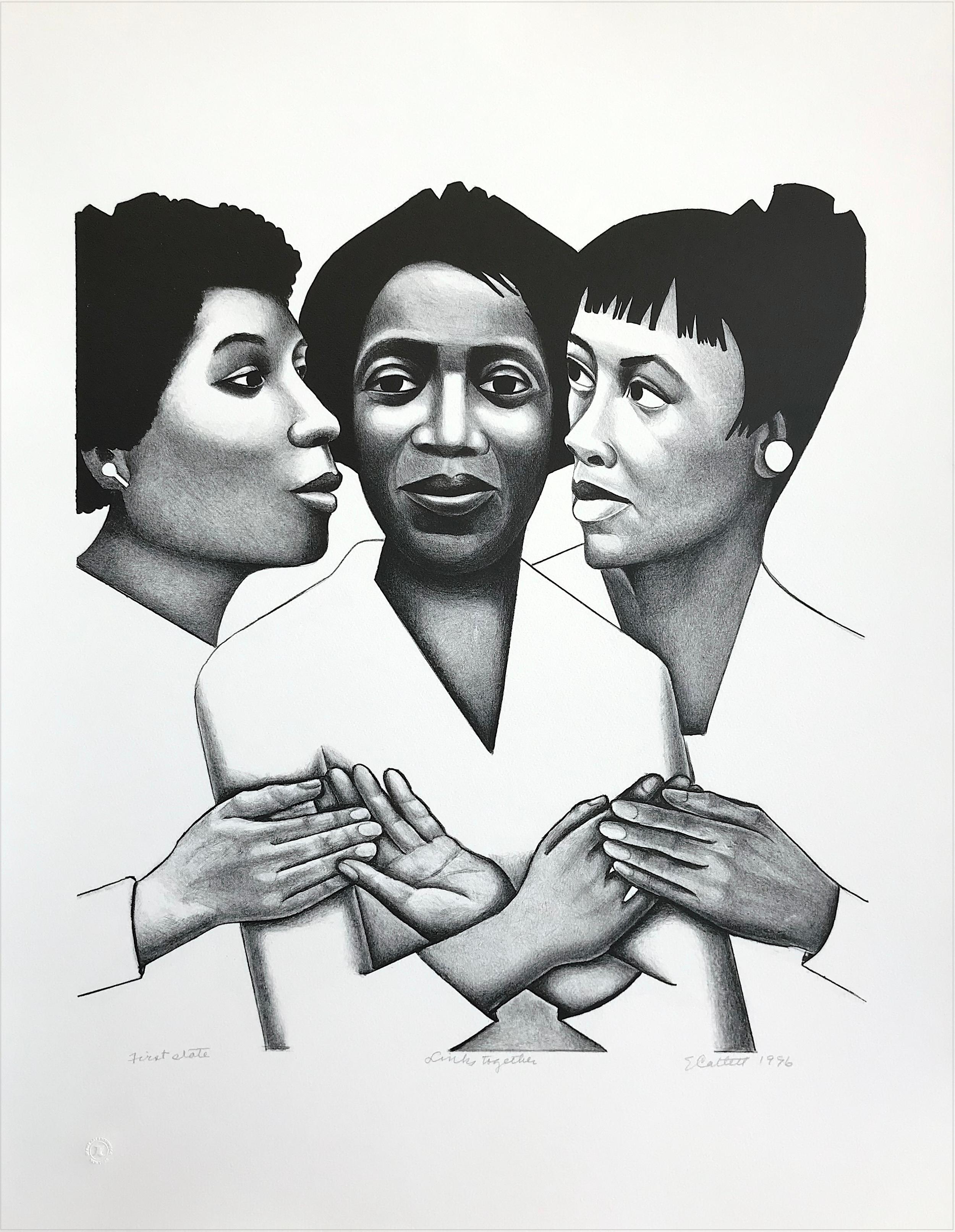
LINKS TOGETHER Original Lithograph Poster, 1996, Black Women Unity Art

LINKS TOGETHER Original Lithograph Poster, 1996, Black Women Unity Art

By Elizabeth Catlett

Located in Union City, NJ

LINKS TOGETHER is a very unique, and rarely seen original fine art lithograph poster printed in five colors using traditional hand lithography techniques (not a photo reproduction or...

Category

Early 2000s Contemporary Portrait Prints

Materials

Lithograph

You May Also Like

Celie Lithograph, Signed Realist Print, 1986, Edition 65/80, Framed

Celie Lithograph, Signed Realist Print, 1986, Edition 65/80, Framed

By Elizabeth Catlett

Located in Astoria, NY

Elizabeth Catlett (American/Mexican, 1915-2012), "Celie", Lithograph, 1986, signed in pencil and dated lower right, titled and numbered edition "65/80" lower left, wood frame. Image...

Category

1980s Realist Portrait Prints

Materials

Paper, Lithograph

"To Marry" Lithograph in Colors from For My People Portfolio

"To Marry" Lithograph in Colors from For My People Portfolio

By Elizabeth Catlett

Located in Astoria, NY

Elizabeth Catlett (American/Mexican, 1915-2012), "To Marry", Lithograph in Colors on Arches paper, 1992, from the For My People portfolio, signed in pencil and dated lower right, num...

Category

1990s Contemporary Portrait Prints

Materials

Paper, Lithograph

Man

Man

By Elizabeth Catlett

Located in Missouri, MO

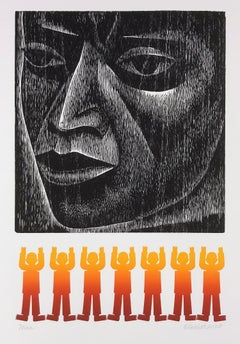
Elizabeth Catlett “Man” 1975 (The Print Club of Cleveland Publication Number 83, 2005) Woodcut and Color Linocut Printed in 2003 at JK Fine Art Editions Co., Union City, New Jersey Signed and Dated By The Artist Lower Right Titled Lower Left Ed. of 250 Image Size: approx 18 x 12 inches Elizabeth Catlett (1915-2012) is regarded as one of the most important women artists and African American artists of our time. She believed art could affect social change and that she should be an agent for that change: “I have always wanted my art to service black people—to reflect us, to relate to us, to stimulate us, to make us aware of our potential.” As an artist and an activist, Catlett highlighted the dignity and courage of motherhood, poverty, and the working class, returning again and again to the subject she understood best—African American women. The work below, entitled, “Man”, is "carved from a block of wood, chiseled like a relief. Catlett, a sculptor as well as a printmaker, carves figures out of wood, and so is extremely familiar with this material. For ‘Man’ she exploits the grain of the wood, allowing to to describe the texture of the skin and form vertical striations, almost scarring the image. Below this intense, three-dimensional visage parades seven boys, printed repetitively from a single linoleum block in a “rainbow roll” that changes from gold to brown. This row of brightly colored figures with bare feet, flat like a string of paper dolls, raise their arms toward the powerful depiction of the troubled man above.” Biography: Elizabeth Catlett (1915-2012) Known for abstract sculpture in bronze and marble as well as prints and paintings, particularly depicting the female figure, Elizabeth Catlett is unique for distilling African American, Native American, and Mexican art in her work. She is "considered by many to be the greatest American black sculptor". . .(Rubinstein 320) Catlett was born in Washington D.C. and later became a Mexican citizen, residing in Cuernavaca Morelos, Mexico. She spent the last 35 years of her life in Mexico. Her father, a math teacher at Tuskegee Institute in Alabama, died before she was born, but the family, including her working mother, lived in the relatively commodious home of his family in DC. Catlett received a Bachelor of Arts degree from Howard University, where there was much discussion about whether or not black artists should depict their own heritage or embrace European modernism. She earned a Master of Fine Arts degree in 1940 from the University of Iowa, where she had gone to study with Grant Wood, Regionalist* painter. His teaching dictum was "paint what you know best," and this advice set her on the path of dealing with her own background. She credits Wood with excellent teaching and deep concern for his students, but she had a problem during that time of taking classes from him because black students were not allowed housing in the University's dormitories. Following graduation in 1940, she became Chair of the Art Department at Dillard University in New Orleans. There she successfully lobbied for life classes with nude models, and gained museum admission to black students at a local museum that to that point, had banned their entrance. That same year, her painting Mother and Child, depicting African-American figures won her much recognition. From 1944 to 1946, she taught at the George Washington Carver School, an alternative community school in Harlem that provided instruction for working men and women of the city. From her experiences with these people, she did a series of paintings, prints, and sculptures with the theme "I Am a Negro Woman." In 1946, she received a Rosenwald Fellowship*, and she and her artist husband, Charles White, traveled to Mexico where she became interested in the Mexican working classes. In 1947, she settled permanently in Mexico where she, divorced from White, married artist Francisco Mora...

Category

Late 19th Century American Modern Figurative Prints

Materials

Linocut, Woodcut