Want more images or videos?
Request additional images or videos from the seller
1 of 9

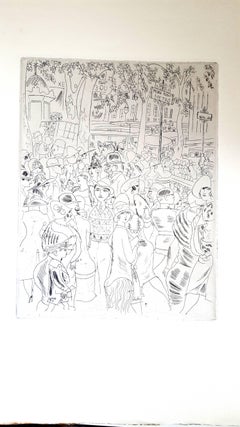
Félix Hilaire Buhot
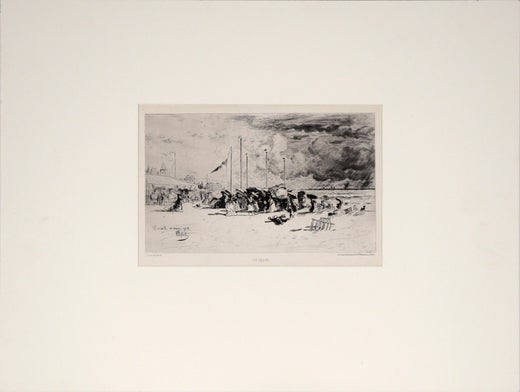
La Fête Nationale du Boulevard Clichy

1878

$2,500
£1,883.68
€2,201.80
CA$3,540.25
A$3,605.36
CHF 2,069.63
MX$43,505.21
NOK 23,985.96
SEK 24,315.44
DKK 16,461.60

About the Item

La Fête Nationale du Boulevard Clichy Etching, drypoint, and aquatint, 1878 Signed lower left in the plate (see photo) Printed chine collee, mounted on white wove paper Upper plate mark weak from printing Condition: Upper plate mark weak from printing very clean and rich impression Image/Plate Size: 12 1/2 x 9 1/4" (31.75 x 23.50 cm) Sheet size: 17 1/8 x 13 inches Reference: Bourcard/Goodfriend 127 vi/VIII, "with the arms of the city..." very clean and rich impression According to Goodfriend, " The holiday, one will notice from the inscription, is June 30, not July 14, for this is before Bastille Day was made the official French national holiday. " Some have made the association of the similar subject matter and composition to the "Flag Paintings" and lithographs by the American artist Childe Hassam (1859-1935) created in 1910. Félix-Hilaire Buhot French, 1847 - 1898 Among the most original prints made in France during the last quarter of the nineteenth century are those by Félix Buhot. Born in 1847 in the small Normandy town of Valognes, in northern France, Buhot moved to Paris in 1865, where a year later he enrolled in the École des Beaux-Arts, studying painting and drawing under various artists. Buhot first learned to etch in about 1873, producing his first etching later that year and quickly establishing himself as a successful printmaker. The young artist made his living by decorating fans and illustrating lithographic sheet music. Buhot lived and worked most of his life in Paris, with frequent visits back to northern France and extended trips to England where he met his wife, Henrietta Johnston, whom he married in 1881. By 1892 Buhot had ceased making prints, and in 1898, after suffering prolonged bouts of deep depression, he died at the age of fifty-one. Along with Edgar Degas and Camille Pissarro, Félix Buhot numbers among the most experimental printmakers of his day. In exploring the unique aspects of etching, he developed an approach to printmaking that was very painterly; in fact he called his prints "paintings on copper." A true printmaker's printmaker, Buhot delighted in all the technical variables and regularly combined multiple processes to produce a single print: he achieved even greater tonal variation by employing the more traditional techniques of etching, drypoint, and aquatint along with several less familiar methods. Unlike many contemporary printmakers who disliked photography, Buhot heartily embraced the medium and used it as a creative aid. He also used different inks and papers for varied effects. His most original contribution to the history of printmaking is a device he termed marges symphoniques (symphonic margins): by amplifying the main subject, such illustrations became an integral part of the print. In his many prints of city views and seascapes, Buhot was intent on creating a specific atmosphere, especially the effects of weather such as rain, snow, mist, and fog. He turned to his immediate neighborhood in and around the boulevard de Clichy in Montmartre, Paris, for inspiration for his prints of everyday city life. Buhot delighted in portraying the varied street life of the vibrant capital city not only in different seasons (Winter in Paris, 1879) but also in moments of public display, from a festive holiday celebration (National Holiday on the Boulevard de Clichy, 1878) to a somber death observance (Funeral Procession on the Boulevard de Clichy, 1887). His city views also include London scenes (Westminster Palace and Westminster Bridge, both of 1884). And Buhot's love for the sea is evidenced in the many prints exploring its ever-changing atmospheric conditions and moods. Buhot's boat trips to England inspired two of his most characteristic prints, A Pier in England and Landing in England, both from 1879. With his experimental printmaking techniques, Buhot became one of the best-known, admired, and collected printmakers of his day. He achieved success for his prints at the annual Salons between 1875 and 1886, and a number of his works were published in leading periodicals and books. He also found critical acclaim and support for his prints in the United States, especially after his first one-man exhibition organized by the New York print dealer Frederick Keppel in 1888. Courtesy: National Gallery of Art, Washington, D. C.
  • Creator:
    Félix Hilaire Buhot (1847 - 1898, French)
  • Creation Year:
    1878
  • Dimensions:
    Height: 12.5 in (31.75 cm)Width: 9.25 in (23.5 cm)
  • Medium:
  • Movement & Style:
  • Period:
  • Condition:
  • Gallery Location:
    Fairlawn, OH
  • Reference Number:
    Seller: FA82051stDibs: LU14014197142

More From This Seller

View All
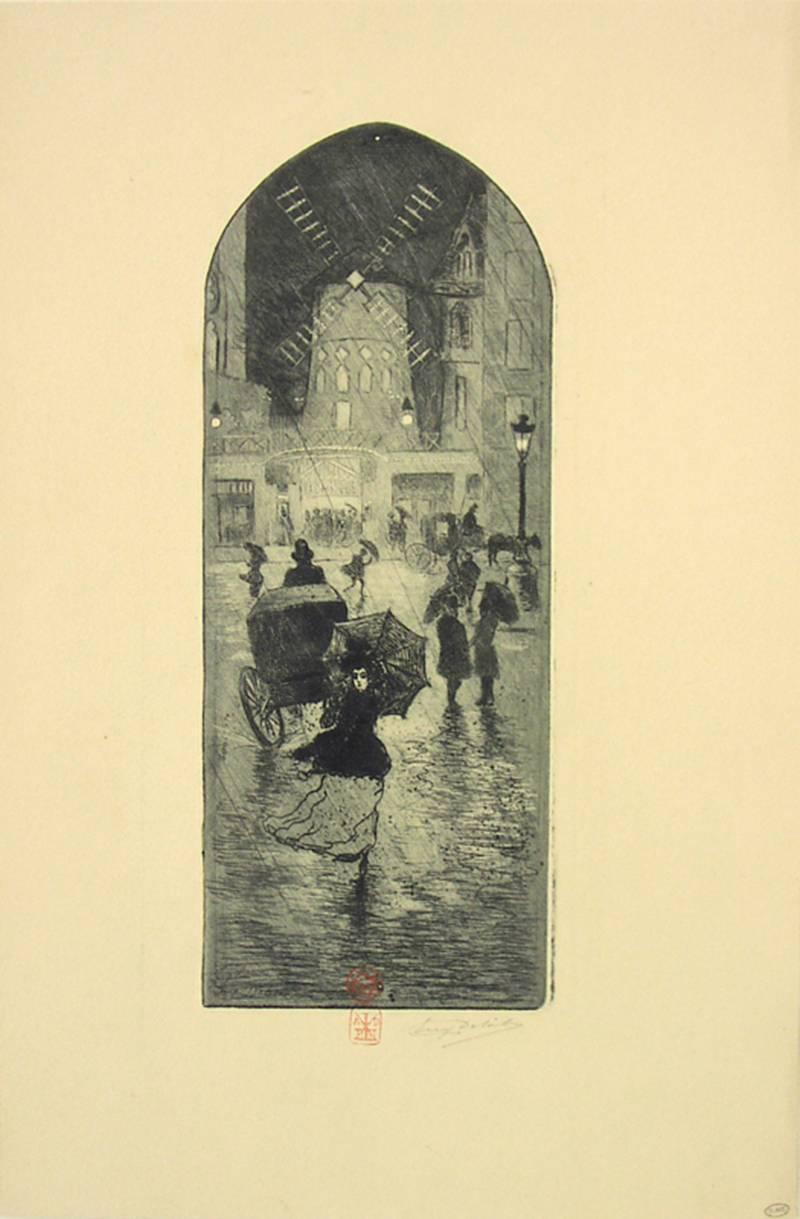
Night Life at the Moulin Rouge

Night Life at the Moulin Rouge

By Henry Somm

Located in Fairlawn, OH

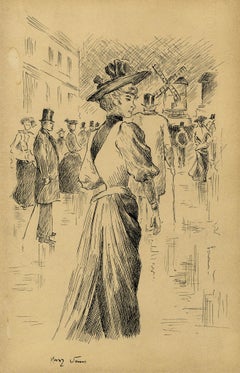
Night Life at the Moulin Rouge Pen and ink drawing, c. 1890 Signed lower left (see photo) A scene of the night life near the Moulin Rouge, Paris. The Moulin Rouge is the famous caba...

Category

Late 19th Century French School Drawings and Watercolor Paintings

Materials

Ink

La Promenade Etching, Art Nouveau, Signed, Edition of 50, 1900s

La Promenade Etching, Art Nouveau, Signed, Edition of 50, 1900s

By Edgar Chahine

Located in Fairlawn, OH

La Promenade Etching, soft-ground, aquatint & drypoint, Signed in pencil lower left Published by Edmund Sagot, Paris Edition of 50 in black only, aside from the edition of 50 in co...

Category

Early 1900s Art Nouveau Figurative Prints

Materials

Drypoint, Etching, Aquatint

Moto-Fuite

Moto-Fuite

By Georges Meunier

Located in Fairlawn, OH

Moto-Fuite Color lithograph, c. 1902 Signed in the stone lower right (see photo) Published by Edmund Sagot (1857-1917), Paris Printed by Atelier Chaix, Paris Large edition with titl...

Category

Early 1900s Art Nouveau Figurative Prints

Materials

Lithograph

Un Debarquement en Angleterre (A Disembarking in England)

Un Debarquement en Angleterre (A Disembarking in England)

By Félix Hilaire Buhot

Located in Fairlawn, OH

Un Debarquement en Angleterre (A Disembarking in England) etching, drypoint, aquatint, roulette and spirit ground, 1879 Signed with the artist’s red owl stamp, Lugt 977 (see photo) ...

Category

1870s Impressionist Landscape Prints

Materials

Drypoint

Moto-Flirt

Moto-Flirt

By Georges Meunier

Located in Fairlawn, OH

Moto-Flirt Color lithograph, c. 1902 Signed in the stone lower right (see photo) Published by Edmund Sagot (1857-1917), Paris Printed by Atelier Chaix, Paris Large edition with title...

Category

Early 1900s Art Nouveau Figurative Prints

Materials

Lithograph

You May Also Like

Alfred Bendiner, Rue des Matrys (Paris)

Alfred Bendiner, Rue des Matrys (Paris)

By Alfred Bendiner

Located in New York, NY

World traveler that he was, Bendiner was clearly at home in Paris. He found everyone fascinating and has made this print a compendium of local characters and types. Nothing escapes h...

Category

1950s American Modern Landscape Prints

Materials

Lithograph

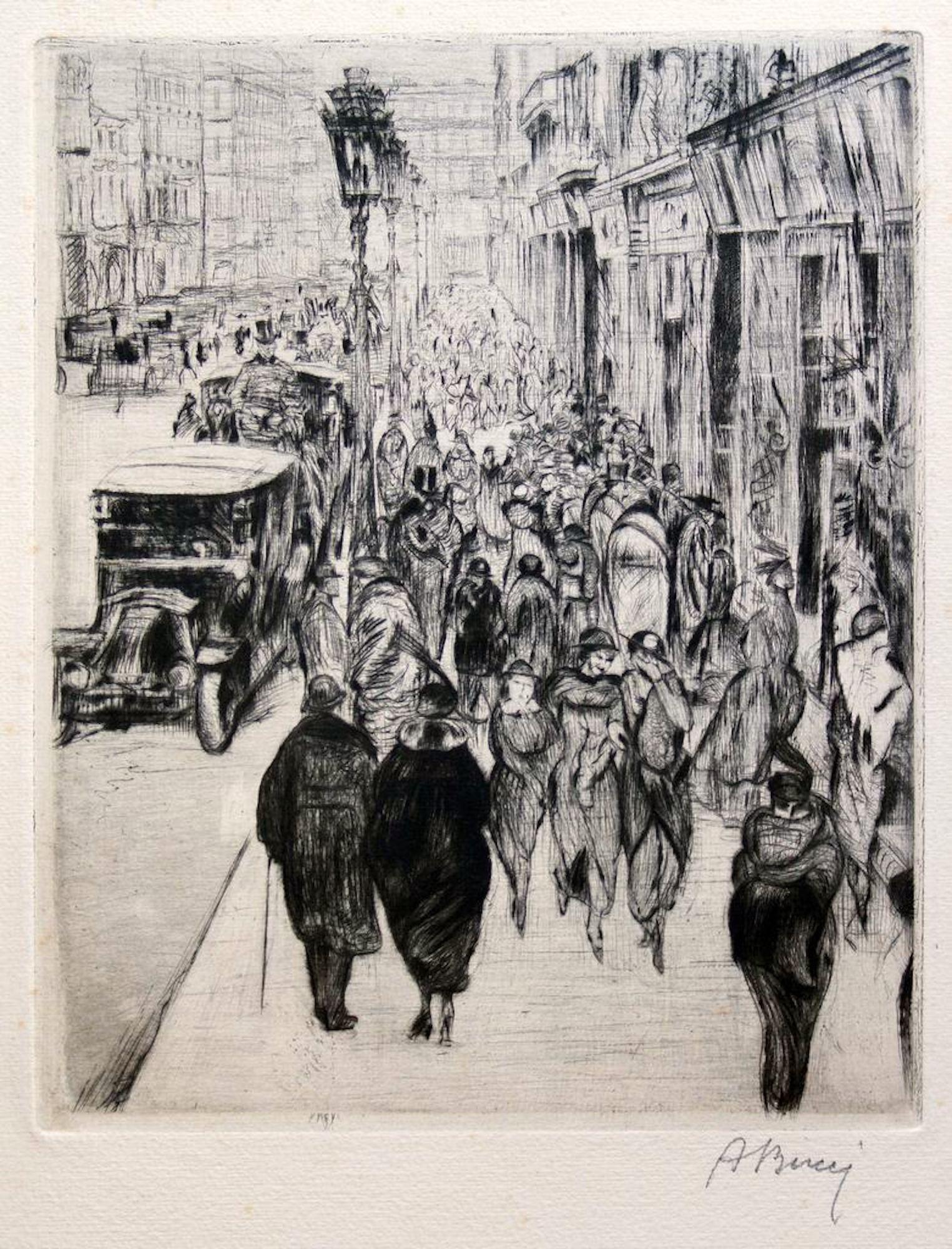
Matinée Avenue de Clichy

Matinée Avenue de Clichy

By Auguste Brouet

Located in Middletown, NY

Drypoint etching on buff wove paper, 9 1/2 x 10 3/4 inches (240 x 271 mm) full margins. Signed in the image, lower left. With the "Musée Louvre Chalcographie" blind stamp in the lowe...

Category

Early 20th Century French School Landscape Prints

Materials

Handmade Paper, Drypoint, Etching

Sortie de Theatre a Londres

Sortie de Theatre a Londres

By Jean-Emile Laboureur

Located in New York, NY

Jean-Emile Laboureur (1877-1943), Sortie de Theatre a Londres, etching and drypoint, 1911, signed in pencil lower left [also signed and dated in the plate upper right]. Reference: Laboureur 104, third state (of 3). Published for La Societe des amis de l’eau-forte, with the blindstamp with the inscription: Circle Librairie Estampes. From an edition in the third state of 109; there were also 5 impressions of the first state and five of the second state. In excellent condition, the full sheet with deckle edges bottom and sides, 6 3/4 x 14; a remarque lower left 2 x 3 1/2, the sheet 12 3/4 x 19 3/4 inches. Provenance: unknown collector’s mark verso (GOE in oval) A fine rich impression, printed in dark brown ink on cream laid paper with the Arches watermark. The small remarque lower left is actually another print printed on a separate plate; it shows a man running after a London horse...

Category

1910s Naturalistic Figurative Prints

Materials

Drypoint

La diligence de Beaucaire

La diligence de Beaucaire

By Félix Hilaire Buhot

Located in Middletown, NY

Paris: Lemerre, 1880. Etching, drypoint, aquatint (dust ground and spirit ground), spit bite, and roulette in black on cream laid paper with a deckle edge, 6 3/4 x 4 1/2 inches (170 x 112 mm), full margins. Third state (of 3). An illustration from Alphonse Daudet's, Lettres de mon moulin, Paris, 1880. In very good condition with some light uniform toning and two areas of paper tape at the top right and left corners on the verso (from a former mount). With the 1921 J.H. de Bois circular ink stamp in green ink in the lower right margin on the recto (Lugt L.733). [Bourcard 110]. A note regarding the provenance: J. H. de Bois was a well known late-19th century modern art...

Category

1880s French School Interior Prints

Materials

Laid Paper, Drypoint, Etching, Aquatint

La Parade

La Parade

By Auguste Brouet

Located in Middletown, NY

Etching on wove Japon paper, 8 5/8 x 9 1/4 inches (219 x 235 mm), wide margins. Signed, titled, and numbered 6/75 in pencil, lower margin, and with the Dietrich & Cie éditeurs blinds...

Category

Early 20th Century French School Interior Prints

Materials

Handmade Paper, Etching

Chas Laborde - Paris - Capucine's Boulevard - Original Etching

Chas Laborde - Paris - Capucine's Boulevard - Original Etching

By Chas (Charles) Laborde

Located in Collonge Bellerive, Geneve, CH

Chas Laborde - Paris - Capucine's Boulevard - Original Etching Dimensions : 13 x 10". Paper : Rives vellum. Edition : 225 copies. 1927 From Tableaux de Paris, Emile-Paul Freres, Paris Chas LABORDE Charles Laborde was born in Buenos Aires on August 8, 1886. He was the youngest of the five sons of Adolphe-Sylvestre Laborde-Pinou, a Basque-Bearne millionaire who had made a fortune selling spirits to the Indians and luxury goods imported from France to wealthy Argentines. The family returned to France when Charles was six months old. His mother died when he was two. He spent his childhood at their family château d’Escout outside Oloron-Sainte-Marie in the Pyrenees. His brothers went to a boarding-school, his father was often in Paris on business, and little Charles was left to his devices. Though it was a lonely childhood, he was a darling of his generous and magnanimous father. Charles got his early drawing skills from a village artist and found support in his brother Jean-Felix. Charles frequently accompanied his father visiting artisans and helped him choose de luxe objects to be sold in Argentine. He first attended the Rollin college in Paris, then a lyceum in Pau, where he lived with full board and lodging after his father’s death in 1901. From childhood Charles wanted to be an artist and tried several pseudonyms for himself: Ch. Laborde, Carlos Laborde,Carlos Edrobal and Carl Lab. He started wearing a velvet suit and a large hat. At 17, the timid shortsighted teenager wearing big glasses was expelled from college for smoking and drinking alcohol and went to Paris into the custody of his elder brother Jean-Felix, who carried on his father’s business. Charles enrolled in the prestigious l’Académie Julian, studying under Henri Royer and Marcel Baschet. Simultaneously he was a pupil of William Bouguereau and Luc-Olivier Merson at l’École des Beaux-Arts. The latter was famous for being the designer of the 50 and 100 franc banknotes, and he believed that he was teaching a “little Daumier”. In England, where he went every year from 1905 to 1914 with the family of his friend Cooper, a classmate at l’Académie Julian, he found not only his pseudonym Chas (short for Charley), but also the land of his dreams. Peculiarities of London and its inhabitants were reflected in drawings of William Hogarth and Thomas Rowlandson, whose album The Microcosm of London (1808) prompted Charles to make his London Streets Scenes (1928). Owing to those trips Charles took a liking to the atmosphere of England and its reserved and terse humor. In 1905 the château d’Escout and the Buenos Aires Commercial Fund were sold. After coming into inheritance, Laborde became financially independent and obtained an atelier in Montmartre at 11 bis Rue des Saules. His neighbors were de la Butte, Francis Carco and Pierre Mac Orlan, who sympathized with the easy-going young man with a positive attitude to life. His friend Pierre Falke...

Category

1920s Modern Landscape Prints
Materials

Etching