Want more images or videos?
Request additional images or videos from the seller
1 of 9

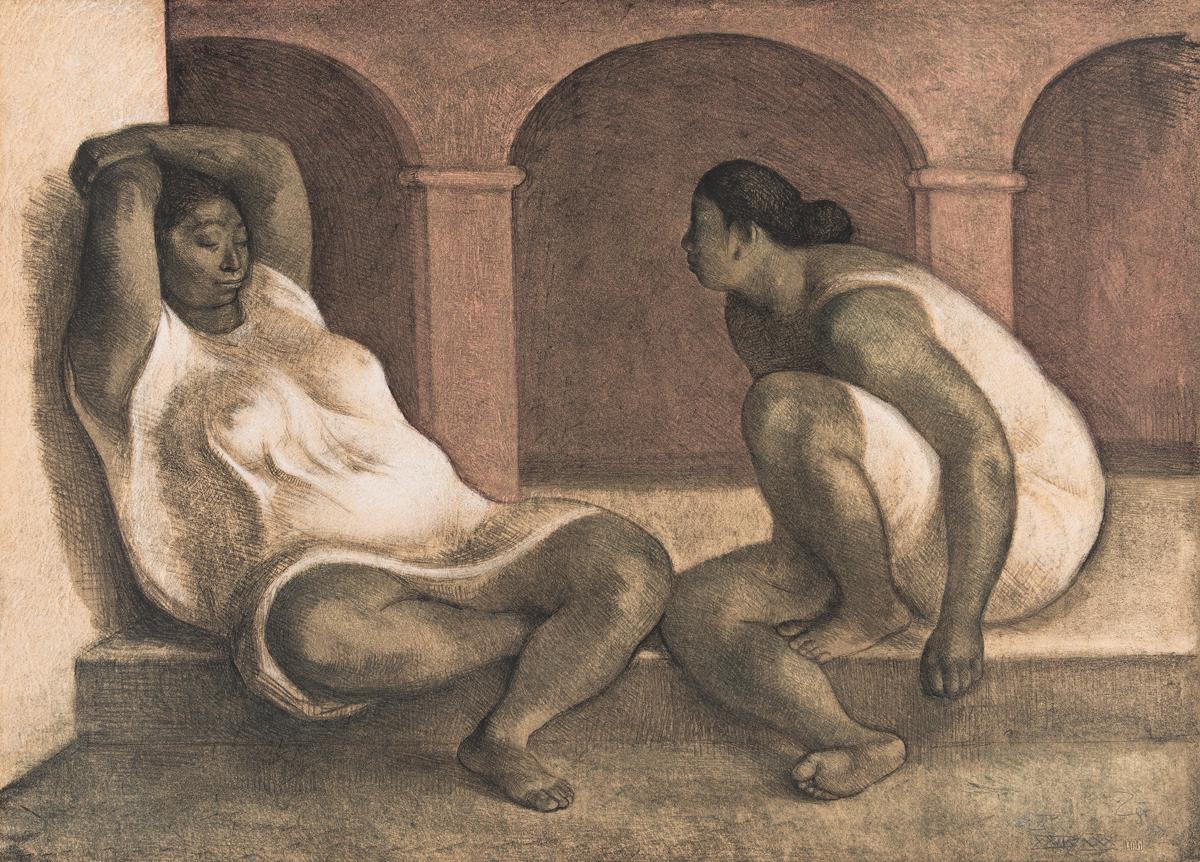
Francisco Dosamantes
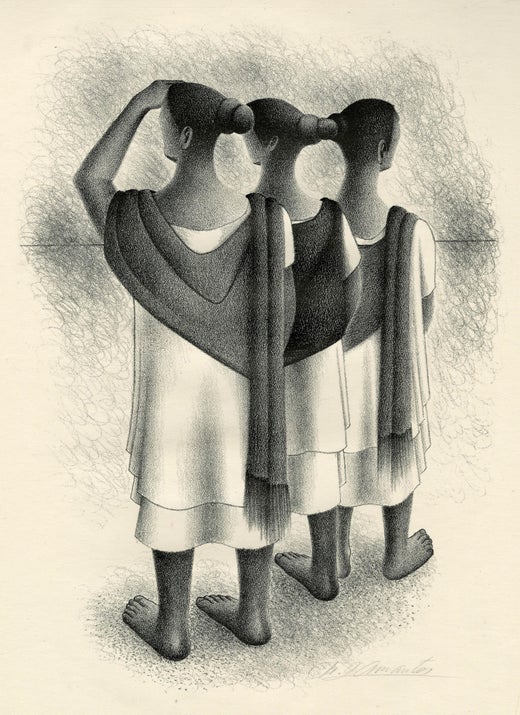
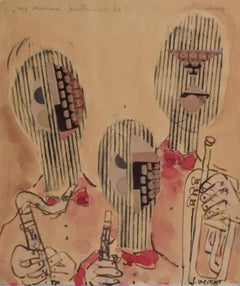
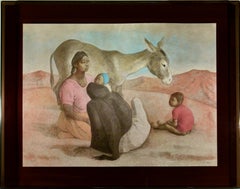
Mayan Trio

1950

$700
£530.63
€618.85
CA$1,004.69
A$1,012.92
CHF 576.77
MX$12,312.52
NOK 6,808.51
SEK 6,788.96
DKK 4,625.85

About the Item

Mayan Trio Lithograph, 1950 Signed in pencil lower right (see photo) Edition 250 for Associated American Artists Publsihed 1950 Reference: AAA Cat.: 1950‑05; 1958‑01 AAA Index 1087 Condition: Excellent Image size: 13 x 9 1/2 inches Francisco Dosamantes (b. October 4, 1911 - d. July 18.1986) was a Mexican artist and educator who is best known for is educational illustrations and graphic work against fascism. He was a founding member of the Taller de Gráfica Popular and the Salón de la Plástica Mexicana. Life Francisco Dosamantes was born in Mexico City on October 4, 1911. His father was Daniel Dosamantes who was a builder, interior decorator and painter. He was not registered into the civil registry until he was about twenty years old on March 6, 1939. His mother’s name is not listed on the certificate. As a child, he demonstrated a strong interest in drawing and color, influenced by his father and his uncle Juan. The Mexican Revolution occurred while he was a young child and he stated that he remembered events such as soldiers on horses charging as well as the execution of rural farm workers. He attended primary and high school in Mexico City but stated that his education was irregular and deficient. He then entered the Escuela Nacional de Artes Plásticas, where he studied for five years. Initially, however, he was disappointed with the inexperience of the young professors and he left for a short time to study on his own. During this time, some of the dissatisfied professors organized the 30 30 group against the academic system of the school and which whom he sympathized. The effort gained the attention of established artists such as Diego Rivera who intervened. He died on Mexico City on July 18, 1986 Career After he graduated, he worked with the cultural missions of the Secretaría de Educación Pública in Oaxaca, Michoacán, Guerrero, Colima, Coahuila and Chihuahua (state) from 1932 to 1937 then again from 1941 to 1945. He stated that this experience was vital to his conscience as he worked with rural farm workers and others he stated were worthy of dignity and respect, but victims of deceit and exploitation. When he returned to Mexico City, he gave classes in high schools from 1937 to 1941. In 1945 he founded and directed the Taller Escuela de Dibujo y Pintura “Joaquín Claussell” in Campeche, Campeche. Dosamantes was a politically and culturally active artist with most of his work and affiliations related to such. He was a member of the Liga de Escritores y Artistas Revolucionarios from 1934 to 1938. He was a founding member of the Taller de Gráfica Popular, serving as administrator in 1940 and remaining a member until his death except for one short hiatus. He created posters for conferences about fascism and Nazism such as Alemania bajo bayonetas (Germany under bayonets) in 1938. In 1940 he became the secretary general of the Sindicato de Maestros de Artes Plásticas. He was also a member of the Sociedad para el Impulso de las Artes Plásticas en 1948, a founding member of the Salón de la Plástica Mexicana in 1949 and a member of the Frente Nacional de Artes Plásticas from 1952. He painted a number of murals in rural areas of Mexico generally when he was there on cultural missions. His main mural is at the former home of José María Morelos in Carácuaro, Michoacán, but there are a number at various rural schools. These were all painted between 1941 and 1946. As a book illustrator he mostly worked for the Secretaría de Educación Pública working on books for literacy campaigns. He exhibited his works, which included engravings, oils, tempuras and lithographs in Mexico and abroad. His first individual exhibition was in 1930 at the Galeria de Arte Moderno in Mexico City. His major exhibitions include the Excelsior Gallery in Mexico City in 1932, various exhibitions in New York, Washington, Philadelphia and Los Angeles in 1937; the Nelson Gallery of Art in Kansas City, Missouri in late 1947, and the Gallery of Mexican Art in Mexico City in 1946 and 1948. The most important individual exhibition was the Homenaje 40 Años de Labor event in 1970 at the Salón de la Plástica Mexicana. He also participated in various group exhibitions in Mexico, Cuba, Spain, the U.S. and France. His work can be found at the Museum of Modern Art and the Metropolitan Museum of Art in New York, the Latin American Art Museum in Russia, the University of Michigan Museum of Art, the New York Public Library and the Library of Congress in Washington DC. Recognitions for his work include a silver medal at the 1929 exhibiotn "Ibero Americana" in Seville, Spain, an honorable mention at the "La Ciudad de México" exhibition in 1949, first place in lithography at the "Asamblea Nacional de Cirujanos" in 1952, a silver medal at the Salón Panamericano de Arte in Porto Alegre, Brazil in 1958 and a win at the Certamen de pintura Mexicana, organized by the Consejo Nacional de Turismo in 1962. In 1981, there was a retrospective of his work at the Salón de la Plástica Mexicana. Artistry He was a painter, book illustrator and engraver. His painting has been described as having "clarity of thematic content, precision of line, simplification of form, and application of color." His best known work is a series of lithographs based on the lives of rural Maya in Campeche, along with a number of politically themed ("expressly anti-fascist and critical of the government") graphic works. He best politically themed work is a lithograph entitled Soldado muerto (Dead soldier) from 1940 which was part of an exhibition called “La Revolución sobre papel: grabados mexicanos 1910-1960” in the British Museum in 2009. Another important lithograph from the same period is Bombardeo, España, 1937 in opposition to the rebellion by Francisco Franco against the Spanish Republic. It has elements similar to Picasso’s painting related to the bombing of Guernica. Courtesy Wikipedia
  • Creator:
    Francisco Dosamantes (1911 - 1986, Mexican)
  • Creation Year:
    1950
  • Dimensions:
    Height: 13 in (33.02 cm)Width: 10.5 in (26.67 cm)
  • Medium:
  • Movement & Style:
  • Period:
  • Condition:
  • Gallery Location:
    Fairlawn, OH
  • Reference Number:
    Seller: FA44151stDibs: LU14015736792

More From This Seller

View All
Three Graces

Three Graces

By Ray H. French

Located in Fairlawn, OH

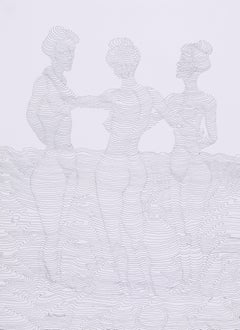
Three Graces Pentel marker on paper, 1965 Signed and dated by the artist lower left (see photo) Part of a series of 100 drawings, this number 97 (annotated lower right corner) Condition: Excellent Sheet/Image size: 20 x 15 inches Provenance: Estate of the Artist Martha A. French Trust Ray H. French: The Evolution of an Artistic Innovator Printmaker, painter, and sculptor Ray H. French was born in Terre Haute, Indiana on May 16, 1919. Terre Haute was a cultural wasteland before the opening of the Sheldon Swope Art Museum in 1942. Thus, with a father as a coal miner and carpenter, art remained a luxury for Ray. Nevertheless, local art teachers Mabel Mikel Williams and Nola E. Williams helped to foster his creativity and unshakable drive to create things of beauty. After high school, Ray attended the John Herron School of Art in Indianapolis. His studies there were interrupted by the outbreak of World War II, during which he developed surveillance photographs for the Army Air Force. After the war, Ray transferred to the University of Iowa on the G.I. Bill, where he received both his BFA and MFA degrees. The University of Iowa during the 1940s was a cultural mecca with many major art historians and artists. While in Iowa, Ray played an important role in this culture by becoming a founding member of the Iowa Print...

Category

1960s American Modern Nude Drawings and Watercolors

Materials

Permanent Marker

The One Set

The One Set

By Julio de Diego

Located in Fairlawn, OH

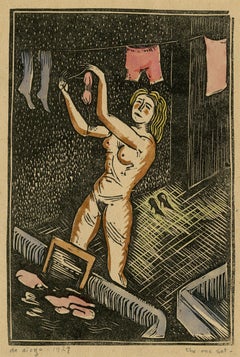
The One Set Woodcut with hand coloring, 1929 Signed, dated and titled in pencil (see photos) The earliest know and dated graphic work done in America by the artist Condition: Excelle...

Category

1920s American Modern Figurative Prints

Materials

Woodcut

Untitled (Aztec heads in profile) A Prelimimary Study for a Mural

Untitled (Aztec heads in profile) A Prelimimary Study for a Mural

By Julio de Diego

Located in Fairlawn, OH

Untitled (Aztec heads in profile) A Prelimimary Study for a Mural watercolor, goucahe, ink and colored pencil on paper, 1943-1946 Unsigned Provenance: Estate of the Artist Kiriki Metzo (his daughter) Fletcher Gallery (her agent) Inspired by the artist's trip to ancient Aztec Mexico with fellow surrealist artist Carlos Merida (1891-1985) Influence of Carlos Merida interaction with de Diego How Carlos Mérida's Mayan-inspired modernism and Mexican folk motifs specifically transformed Julio de Diego's surrealist compositions and color palette in the 1940s Carlos Mérida’s Mayan inspired modernism pushed Julio de Diego’s 1940s surrealism away from purely European, dream like imagery toward hybrid, flatter, more patterned compositions built from stylized “Mexican” motifs, while situating his use of color within the vibrant, abstract field and pattern approach associated with modernized Mayan art—even though surviving texts describe Mérida’s palette much more explicitly than de Diego’s. Mérida’s Mayan modernism: form and color • Mérida is described as a key modernist who fused Surrealism, Cubism, muralism and European abstraction with pre Columbian Mayan...

Category

1940s Surrealist Abstract Drawings and Watercolors

Materials

Watercolor

Keresan Dancers

Keresan Dancers

By Gene Kloss

Located in Fairlawn, OH

Keresan Dancers Etching & drypoint, 1962 Signed lower right (see photo) Inscribed lower left: "Artist's Proof Keresan Dancers" Depicts Keresan speaking peoples at Sam Felipe Pueblo Contemporary Puebloans are customarily described as belonging to either the eastern or the western division. The eastern Pueblo villages are in New Mexico along the Rio Grande and comprise groups who speak Tanoan and Keresan languages. Tanoan languages such as Tewa are distantly related to Uto-Aztecan, but Keresan has no known affinities. The western Pueblo villages include the Hopi villages of northern Arizona and the Zuni, Acoma, and Laguna villages, all in western New Mexico. Born Alice Glasier in Oakland, CA, Kloss grew up amid the worldly bustle of the San Francisco Bay Area. She attended the University of California at Berkeley, graduating with honors in art in 1924. She discovered her talents in intaglio printmaking during a senior-year course in figurative drawing. The professor, Perham Nahl, held up a print from Kloss’ first plate, still damp from the printing process, and announced that she was destined to become a printmaker. In 1925, Gene married Phillips Kloss, a poet and composer who became her creative partner for life. The match was uncanny, for in her own way Gene, too, was a poet and a composer. Like poetry, her artworks capture a moment in time; like music, her compositions sing with aesthetic harmony. Although she was largely self-taught, Kloss was a printmaking virtuoso. On their honeymoon the Klosses traveled east from California, camping along the way. They spent two week is Taos Canyon – with a portable printing press cemented to a rock near their campsite – where Gene learned to appreciate the wealth of artistic subject matter in New Mexico. The landscape, the cultures, and the immense sky left an indelible impression on the couple, who returned every summer until they made Taos their permanent home 20 years later. Throughout her life, Kloss etched more than 625 copper plates, producing editions ranging from five to 250 prints. She pulled every print in every edition herself, manually cranking the wheel of her geared Sturges press until she finally purchased a motorized one when she was in her 70s. Believing that subject matter dictated technique, she employed etching, drypoint, aquatint, mezzotint, roulette, softground, and a variety of experimental approaches, often combining several techniques on the same plate. She also produced both oil and watercolor paintings. Kloss’ artworks are filled with drama. Her prints employ striking contrasts of darkness and light, and her subjects are often illuminated by mysterious light sources. Though she was a devout realist, there is also a devout abstraction on Kloss’ work that adds an almost mythical quality. For six decades Kloss documented the cultures of the region-from images of daily life to those of rarely seen ceremonies. She and her husband shared a profound respect for the land and people, which made them welcome among the Native American and Hispanic communities. Kloss never owned a camera but relied instead on observation and recollection. Her works provide an inside look at the cultures she depicted yet at the same time communicate the awe and freshness of an outsider’s perspective. Although Kloss is best known for her images of Native American and Penitente scenes, she found artistic inspiration wherever she was. During the early years of their marriage, when she and Phil returned to the Bay Area each winter to care for their aging families, she created images of the California coast. And when the Klosses moved to southwestern Colorado in 1965, she etched the mining towns and mountainous landscapes around her. In 1970 the Klosses returned to Taos and built a house north of town. Though her artwork continued to grow in popularity, she remained faithful to Taos’ Gallery A, where she insisted that owner Mary Sanchez keep the prices of her work reasonable regardless of its market value. Kloss continued to etch until 1985, when declining health made printmaking too difficult. From her first exhibition at San Francisco’s exclusive Gump’s in 1937 to her 1972 election to full membership in the National Academy of Design, Kloss experienced a selective fame. She received numerous awards, and though she is not as well known as members of the Taos Society of Artists...

Category

1960s American Realist Figurative Prints
Materials

Drypoint

NEW YORK, the promised land

NEW YORK, the promised land

By Stephen Longstreet

Located in Fairlawn, OH

NEW YORK, the promised land Ink, gouache and watercolor on paper, c. 1960's Signed in ink lower left edge (see photo) Titled in pencil (see photo) Depicts two so8uthern (Texan?) jazz...

Category

1960s American Modern Figurative Paintings

Materials

Watercolor

Jazz Moderne in Monterey Calif. '62

Jazz Moderne in Monterey Calif. '62

By Stephen Longstreet

Located in Fairlawn, OH

Jazz Moderne in Monterey Calif. '62 Watercolor and collage on paper, 1962 Signed in ink lower right (see photo) Titled in pencil (see photo) A fabulous modernist work depicting Jazz ...

Category

1960s American Modern Figurative Paintings

Materials

Watercolor

You May Also Like

Familia Indigena III

Familia Indigena III

By Francisco Zúñiga

Located in San Francisco, CA

This artwork titled "Familia Indigena III" 1983 is an original colors lithograph on Wove paper by renown Costa Rican/Mexican artist Francisco Zuniga, 1912-1998. It is hand signed, dated and numbered 67/100 in pencil by the artist. The artwork size is 22 x 29.85 inches, framed size is 28.5 x 36.5 inches. Published and printed by La Poligrafa, Barcelona, Spain. Referenced and pictured in the artist's catalogue raisonne "Zuniga The Complete Graphics, 1972-1984, by Jerry Brewster, plate #93. Beautifully framed in a custom acrylic display box, with brown fabric backing. It is in excellent condition. About the artist: Internationally acclaimed sculptor and printmaker Francisco Zuñiga was born in Costa Rica. He studied drawing, stone sculpture, and engraving at the School of Fine Arts in San Jose. Later, in 1936, he studied stone carving at La Esmeralda in Mexico City. He was appointed to the faculty of La Esmeralda where he remained until his retirement in 1970. Zuniga's art reflects a love and respect for Central American people and traditions. In 1972, he created his first lithograph. As a complement to his emotionally powerful sculpture, Zuniga's prints articulate the sensitivity and sensuality of the human figure. He has been the recipient of numerous international prizes and awards. His work is exhibited frequently in prominent galleries throughout the world and may be found in the permanent collections of twenty-nine museums, including the Metropolitan Museum of Art in New York, the Los Angeles County Museum, the Mexican Museum in San Francisco, and the Phoenix Art Museum. In 1936, Francisco Zuniga left San Jose, Costa Rica, where he had studied drawing at the School of Fine Arts and worked as an assistant in his father's studio, a workshop which produced religious sculpture for the churches and convents in and around the city. His destination was Mexico City. It was from there that he would begin an illustrious career as a sculptor and draftsman. Zuñiga's exploration into the nuances of volume, in line and space, are demonstrated in this, the most complete exhibition of his work to be shown in more than a decade. Mexico City in 1936 was, even then, one of the major art centers of the Americas. As such it witnessed and participated in many of the frenzied and controversial art movements which reflected the political and intellectual climate of the first three decades of the twentieth century. Muralism, the graphic arts, the incorporation of in-ternational movements had produced an artistic climate, which would eventually attract to Mexico international artists and intellectuals such as Sergei Eisenstein...

Category

Late 20th Century Realist Figurative Prints
Materials

Lithograph

Yucatecas en la Parque, State II, Folk Art Lithograph by Francisco Zuniga

Yucatecas en la Parque, State II, Folk Art Lithograph by Francisco Zuniga

By Francisco Zúñiga

Located in Long Island City, NY

Artist: Francisco Zuniga, Mexican (1912 - 1998) Title: Yucatecas en la Parque, State II Year: 1986 Medium: Lithograph on Japon, Signed and numbered in pencil Edition: PA 5 Size: 21 ...

Category

1980s Expressionist Figurative Prints
Materials

Lithograph

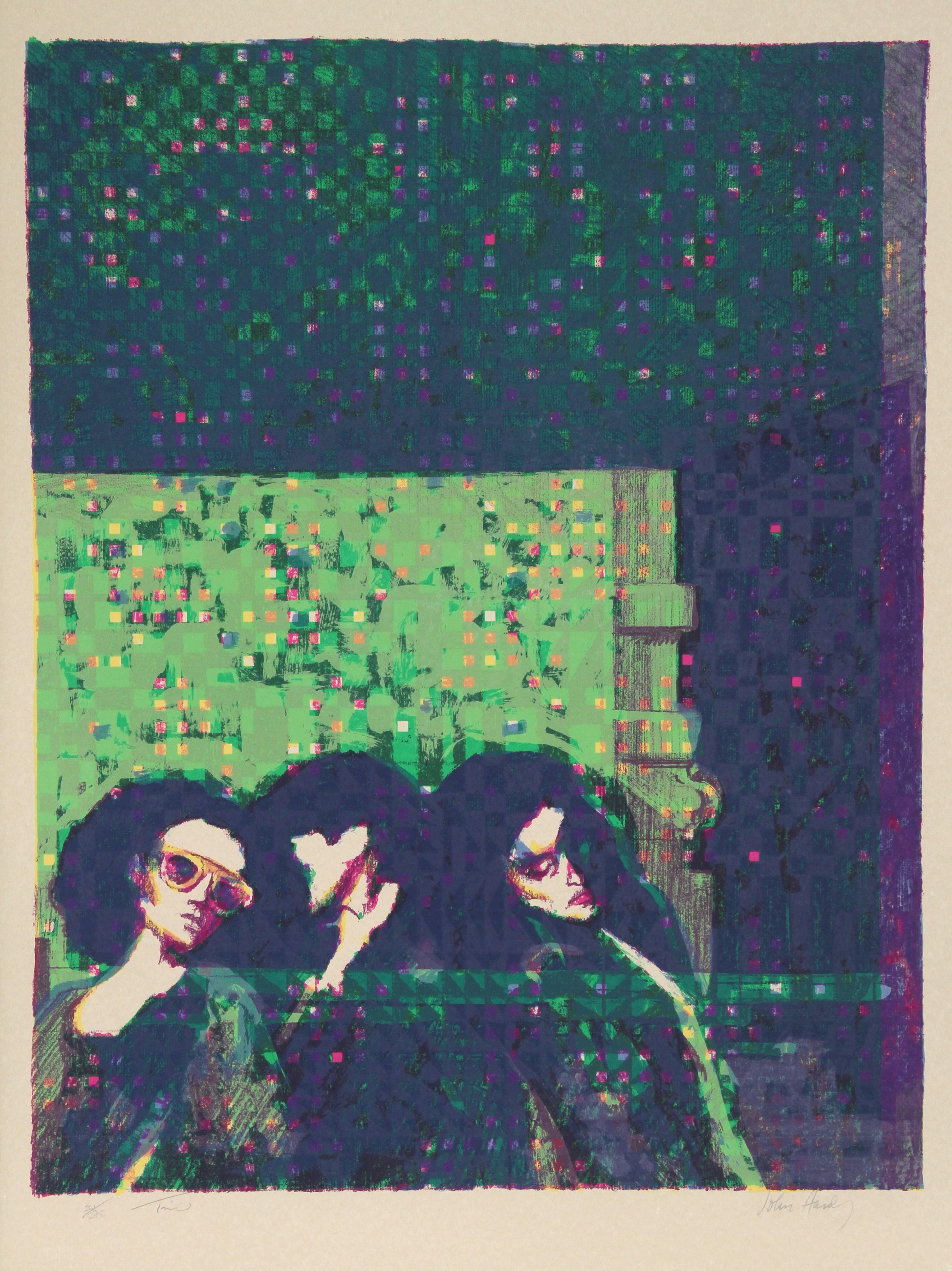
Trio

Trio

By John Hardy (Artist)

Located in Long Island City, NY

Artist: John Hardy, American (1923 - 2014) Title: Trio Year: circa 1977 Medium: Lithograph, signed and numbered in pencil Edition: 275 Image Size: 26 x 20 inches Paper Size: 30 in....

Category

1970s Contemporary Figurative Prints

Materials

Lithograph

Yucatecas en la Parque, Folk Art Lithograph by Francisco Zuniga

Yucatecas en la Parque, Folk Art Lithograph by Francisco Zuniga

By Francisco Zúñiga

Located in Long Island City, NY

Artist: Francisco Zuniga, Mexican (1912 - 1998) Title: Yucatecas en la Parque Year: 1986 Medium: Lithograph, signed and numbered in pencil Edition: 150 Size: 21 in. x 30 in. (5...

Category

1980s Expressionist Figurative Prints

Materials

Lithograph