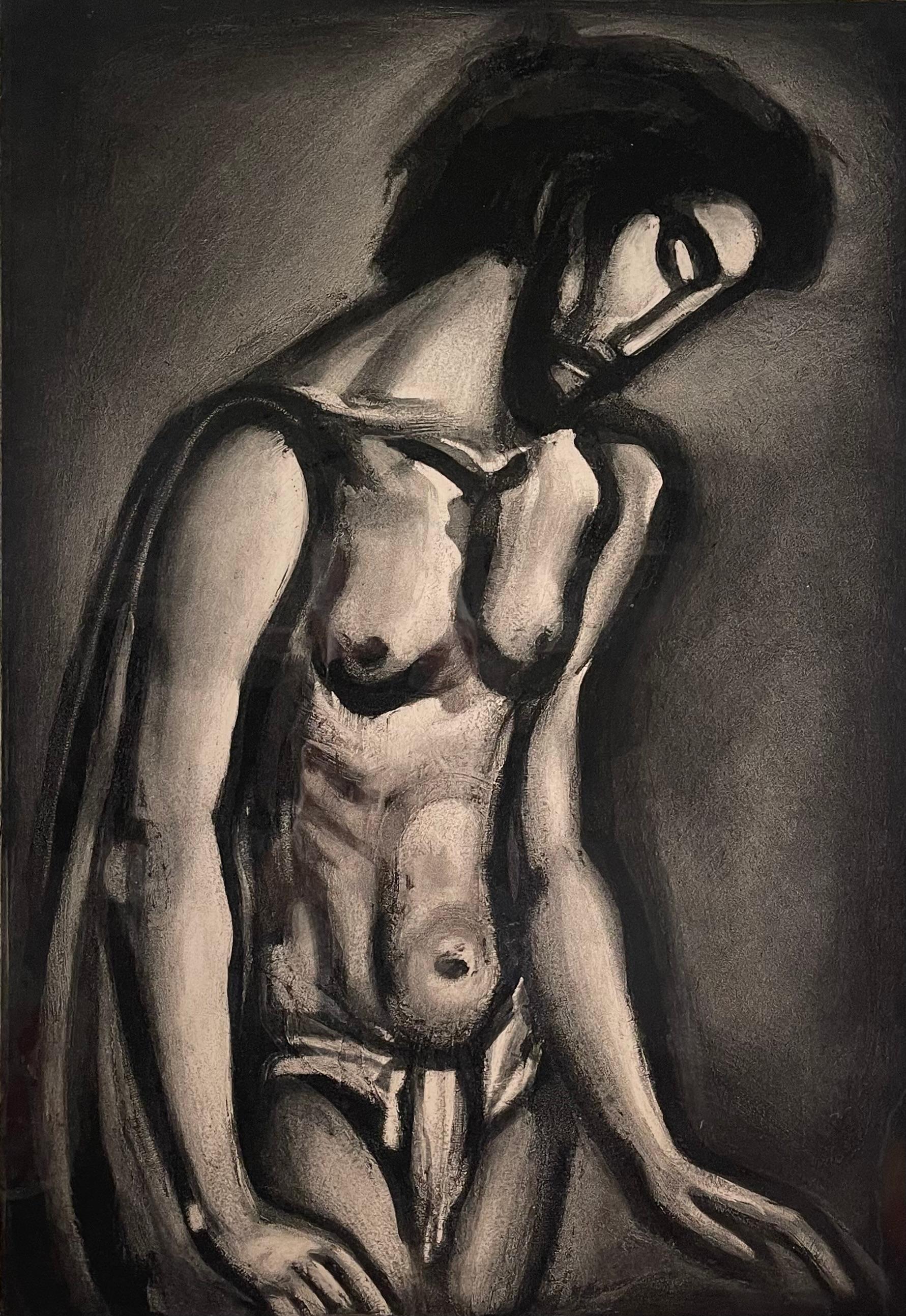
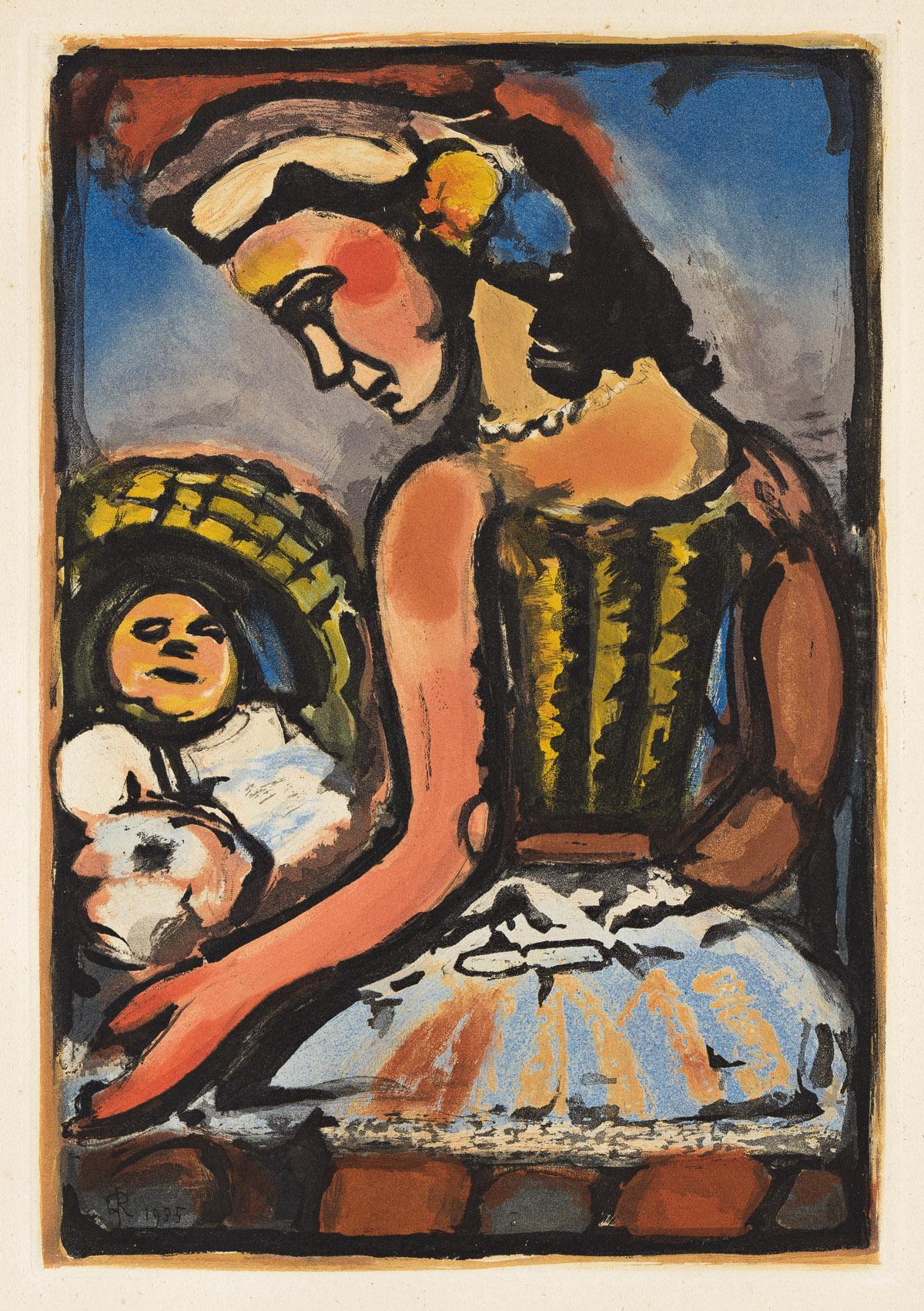
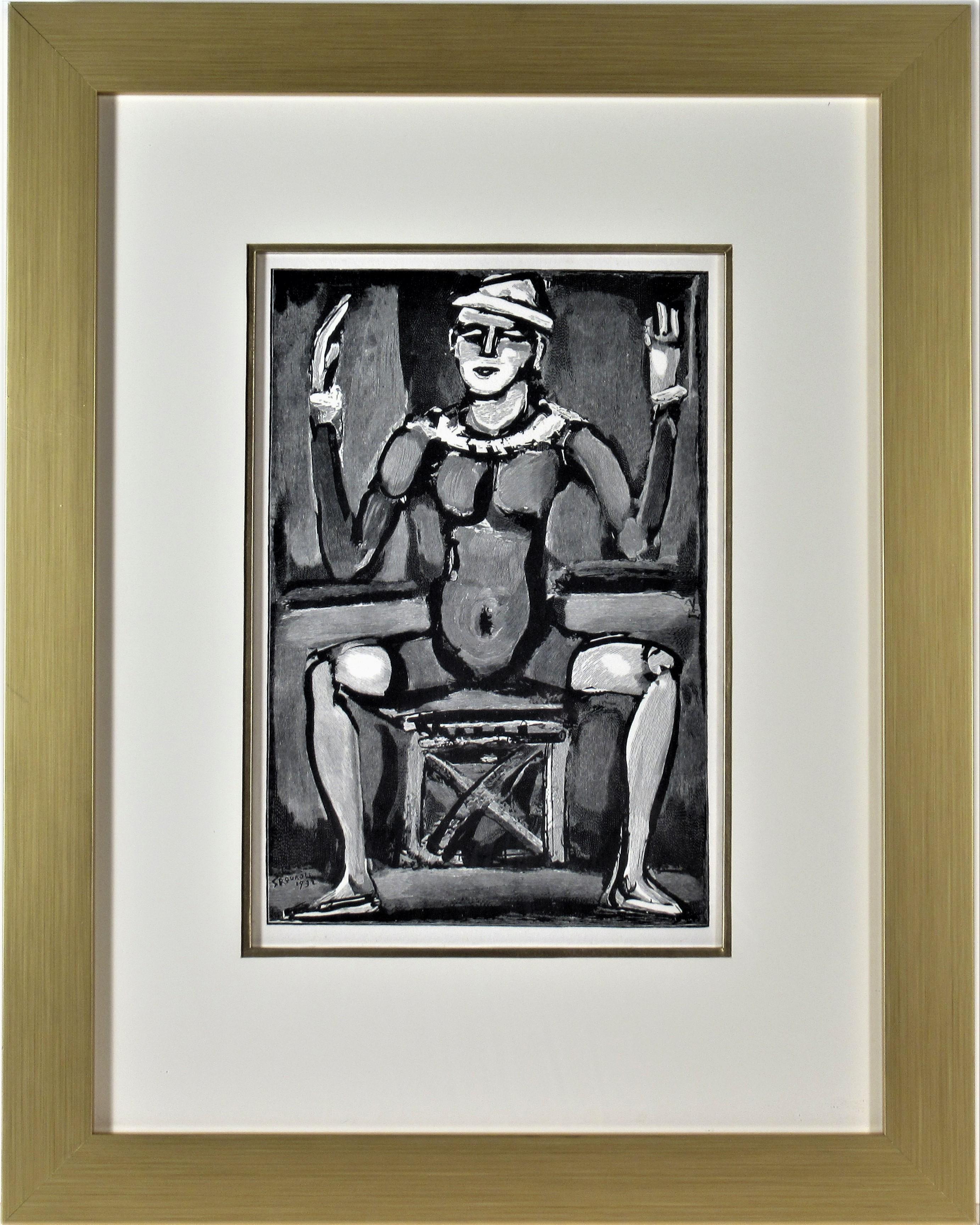
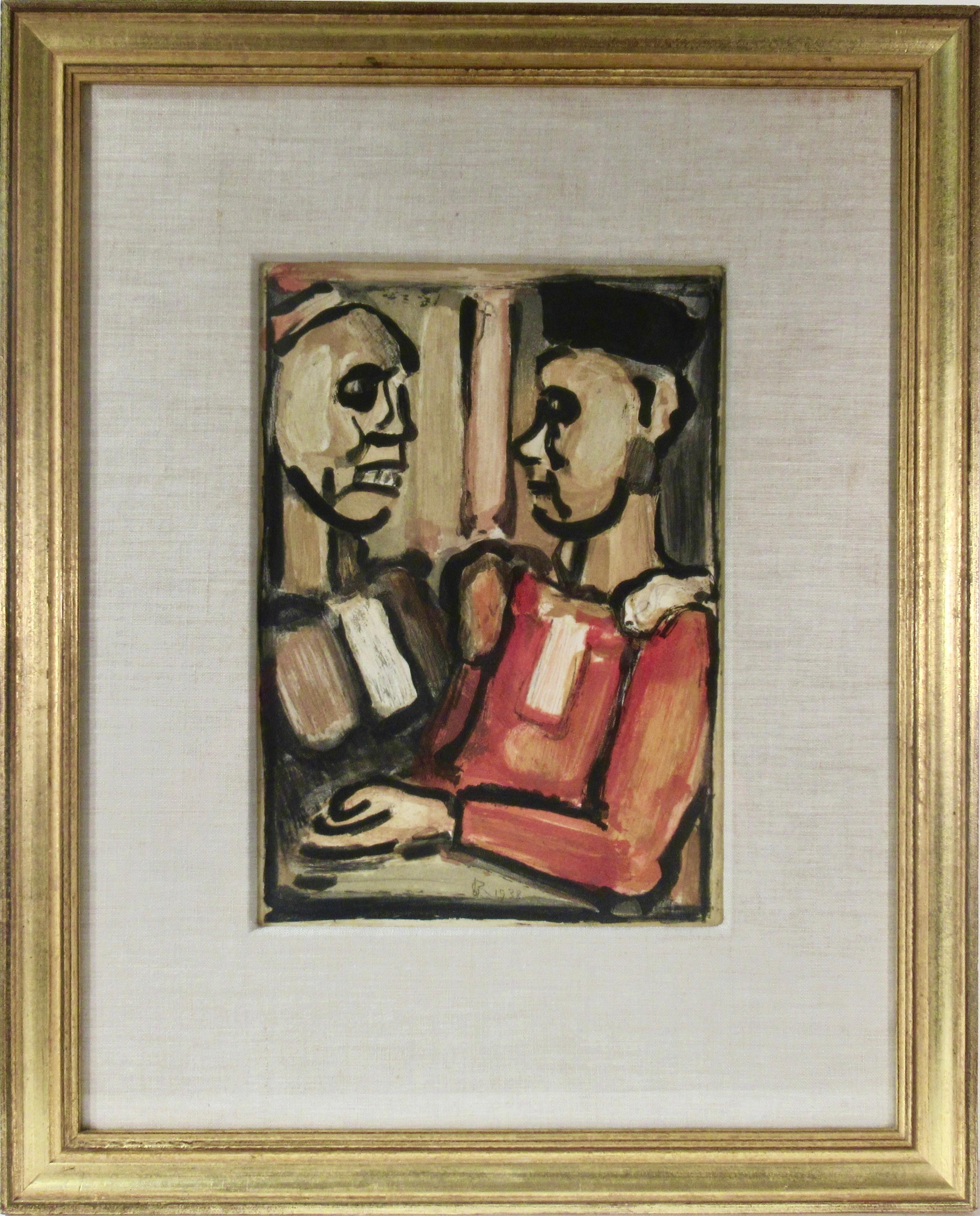
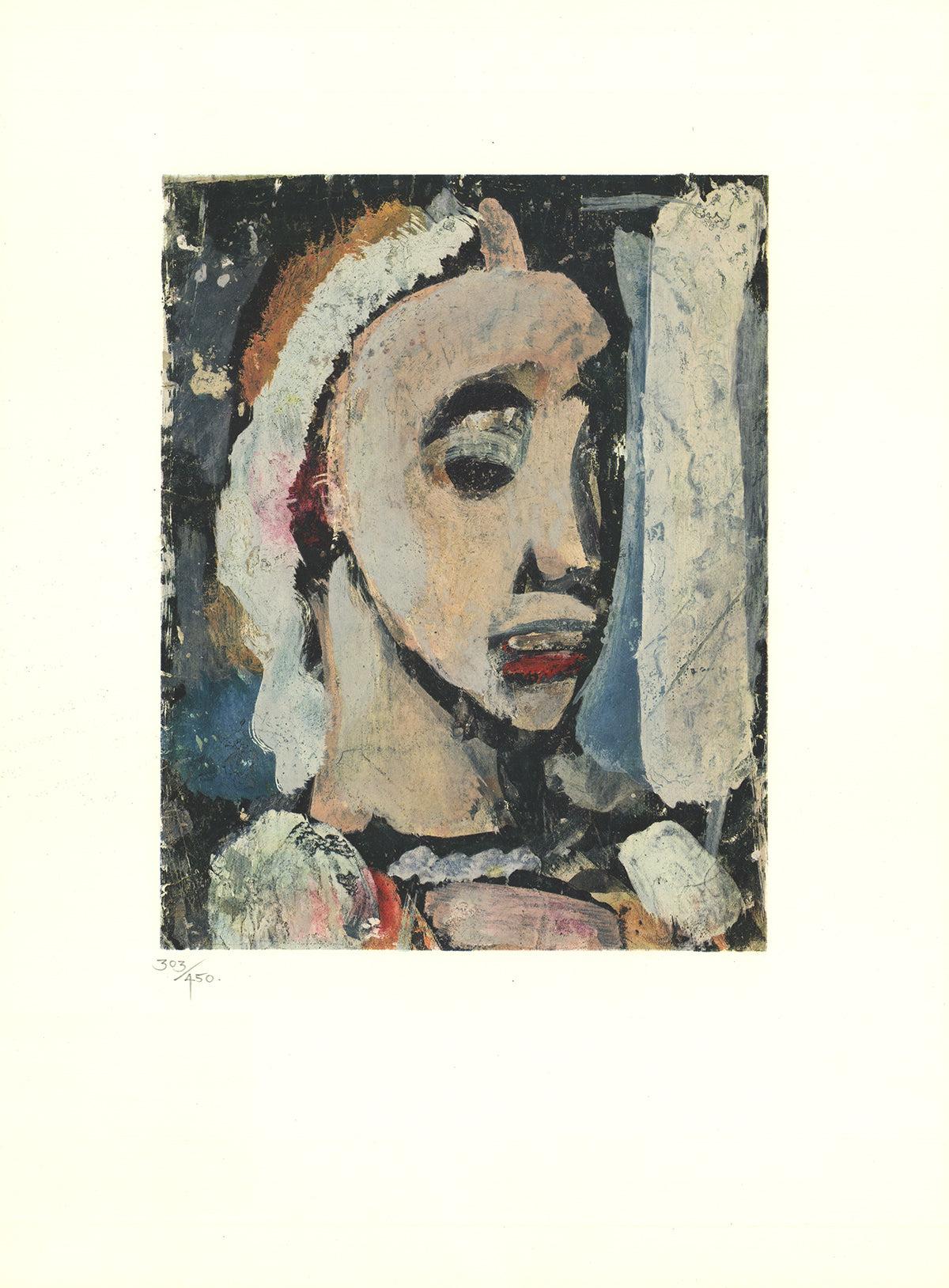
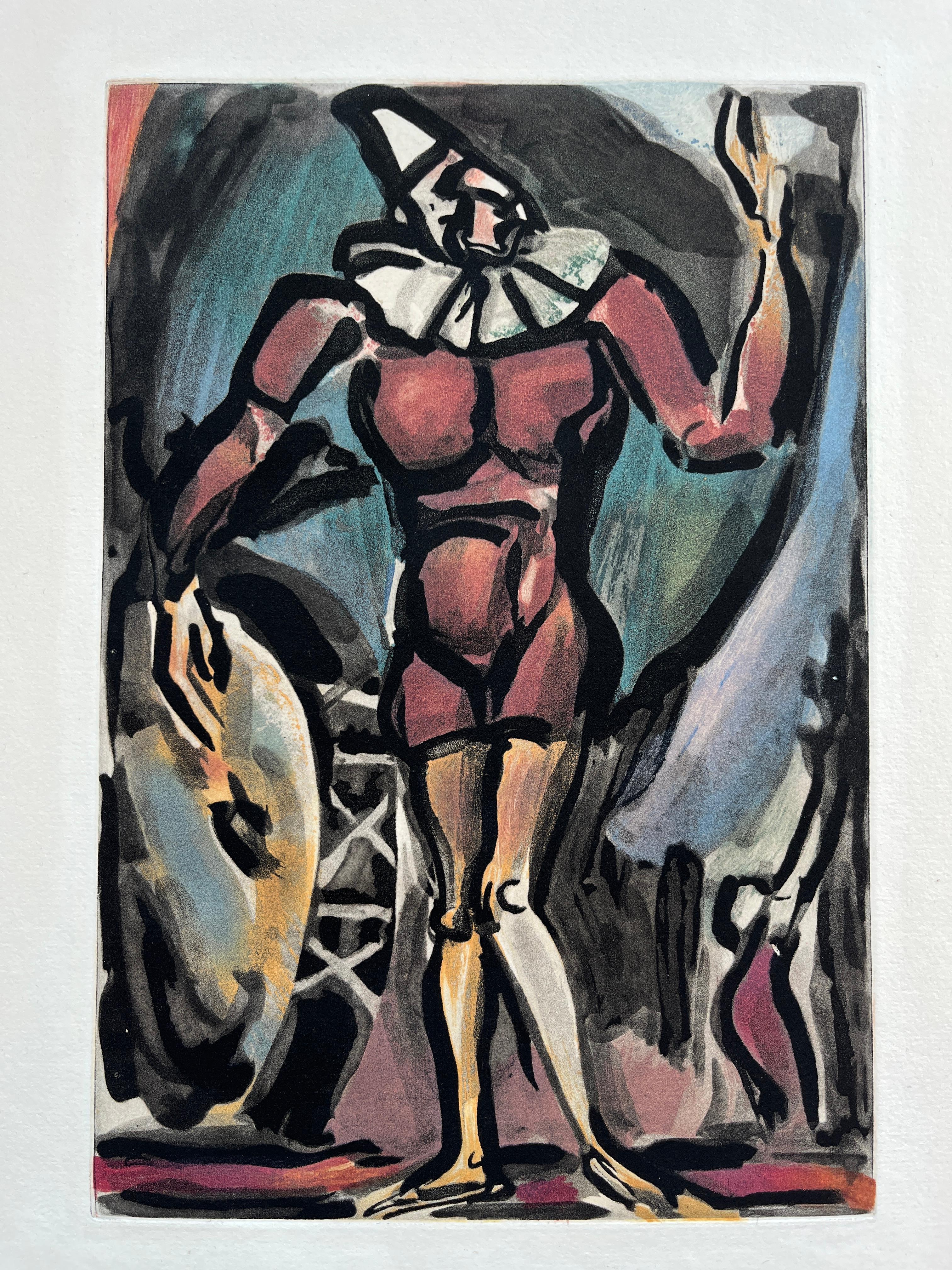
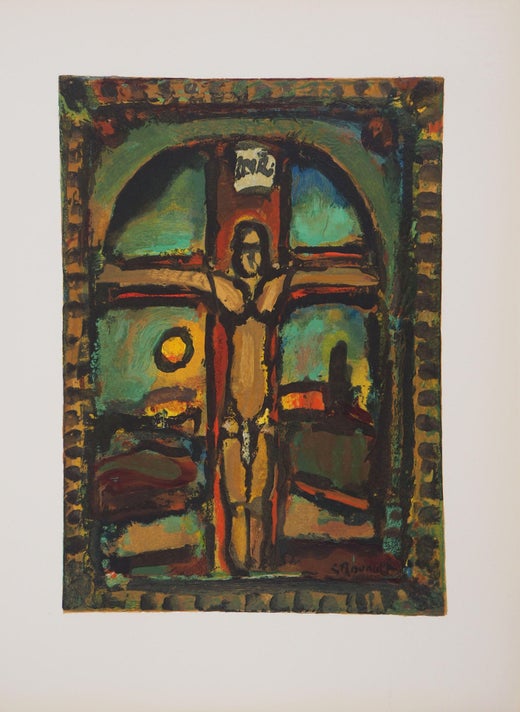
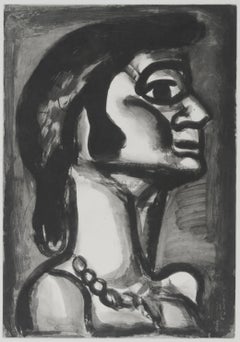
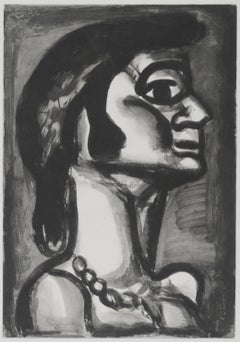
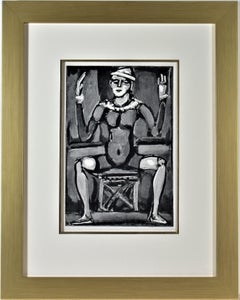
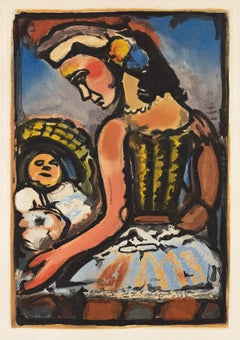
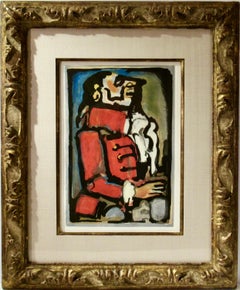
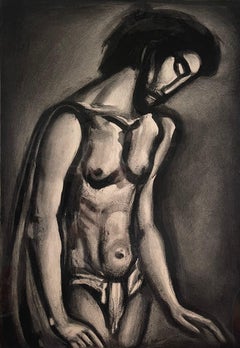
This exquisite lithograph by Georges Rouault (1871–1958), titled Mange Tout (Eat Everything), from the album Georges Rouault, Divertissement, originates from the 1943 edition published by Editions de la Revue Verve, Paris, under the direction of Teriade, Editeur, Paris, and printed by Drager Freres, Maitres-Imprimeurs, Paris, 1943. Mange Tout reveals Rouault’s mastery of human expression and moral allegory, portraying a character rendered in his signature thick black contours and radiant, jewel-like colors. With a mixture of humor, pathos, and spiritual resonance, Rouault transforms the everyday into a meditation on excess, humility, and the universal struggle between indulgence and redemption. The image reflects his profound empathy for human weakness, expressed through color, texture, and light that recall the sacred glow of stained glass.
Executed as a lithograph on velin d'Arches paper, archivally mounted to a larger velin d'Arches support sheet, as issued. 16 x 12.5 inches, paper size; 11 x 8 inches, image size. Signed in the plate and unnumbered as issued. The edition exemplifies the exceptional craftsmanship of the Drager Freres atelier, which faithfully reproduced Rouault’s painterly texture, tonal depth, and chromatic richness.
Artwork Details:
Artist: Georges Rouault (1871–1958)
Title: Mange Tout (Eat Everything), from Georges Rouault, Divertissement, 1943
Medium: Lithograph on velin d'Arches paper, archivally mounted to a larger velin d'Arches support sheet, as issued
Dimensions: 16 x 12.5 inches, paper size; 11 x 8 inches, image size
Inscription: Signed in the plate and unnumbered as issued
Date: 1943
Publisher: Editions de la Revue Verve, Paris, under the direction of Teriade, Editeur, Paris
Printer: Drager Freres, Maitres-Imprimeurs, Paris
Condition: Well preserved, consistent with age and medium
Provenance: From Georges Rouault, Divertissement, published by Editions de la Revue Verve, Paris, 1943
Notes:
Excerpted from the folio (translated from French), This Manuscript, entirely illustrated by Georges Rouault, was engraved by the Maitres-Imprimeurs, Drager Freres, and completed printing by them in 1943 under the direction of Teriade for the Editions de la Revue Verve. It was taken from this album: XL examples on Chine ancien paper with suite, numbered from I to XL, MCC examples on Velin d'Arches, made especially for this album, numbered from XLI to MCCXL, and XXX examples on Arches marked from I to XXX.
About the Publication:
Georges Rouault, Divertissement (1943) was an album published by Editions de la Revue Verve under the artistic direction of Teriade, one of the most important publishers of fine art in 20th-century France. Conceived during the German occupation, the album exemplifies Teriade’s vision of uniting contemporary art and literature in exquisitely printed editions that preserved the vitality of modernism. The Divertissement portfolio was entirely illustrated by Georges Rouault, whose imagery of clowns, acrobats, and performers symbolized the fragile interplay between joy and suffering, faith and humanity. Printed by the master lithographers Drager Freres, the edition was completed in 1943 and represents a triumph of artistic collaboration during a period of adversity. As with Verve’s other legendary projects, the album embodies the intersection of modern art, craftsmanship, and poetic expression that defined Teriade’s legacy in the history of fine art publishing.
About the Artist:
Georges Rouault (1871–1958) was a French painter, printmaker, and stained-glass artist whose profound emotional intensity, luminous color palette, and moral vision made him one of the most original and spiritual figures in 20th-century modern art. Rooted in both the Symbolist and Fauvist movements, Rouault’s work transcended stylistic boundaries to express a deep empathy for humanity, exploring themes of suffering, compassion, faith, and redemption. Trained under the great Symbolist painter Gustave Moreau at the Ecole des Beaux-Arts in Paris, Rouault absorbed Moreau’s emphasis on spirituality, imagination, and symbolism while forging his own bold visual language that combined the radiance of stained glass with the emotional realism of Rembrandt and the structural innovation of Paul Cezanne. His use of heavy black contours and radiant, jewel-toned color imbued his paintings with a sacred, timeless quality, whether depicting clowns, judges, or Christ figures—subjects through which he revealed the duality of sin and grace within the human condition. A leading participant in the Fauvist circle alongside Henri Matisse, Andre Derain, and Albert Marquet, Rouault’s art bridged expressive modern color with profound spiritual reflection. His contemporaries and peers included some of the most transformative artists of his era—Pablo Picasso, Henri Matisse, Georges Braque, Marc Chagall, Alexander Calder, Alberto Giacometti, Salvador Dali, Joan Miro, Wassily Kandinsky, Marcel Duchamp, and Man Ray—each of whom, in different ways, shared his commitment to reimagining form, feeling, and faith in modern art. Rouault’s work continues to be celebrated for its sincerity, moral depth, and technical mastery, earning a central place in major museum collections such as the Musee d’Orsay, the Centre Pompidou, the Museum of Modern Art, the Tate, and the Art Institute of Chicago. The highest price ever paid for a Georges Rouault artwork is approximately $2.5 million USD, achieved in 2011 at Christie’s London for Le Dernier Roman du clown (circa 1917–1920).
Georges Rouault Mange Tout, Rouault Divertissement, Rouault Verve, Rouault Drager Freres, Rouault Teriade, Rouault 1943 lithograph, Rouault velin d’Arches, Rouault French modernist print, Rouault collectible lithograph.