Want more images or videos?
Request additional images or videos from the seller
1 of 3

James Lesesne Wells
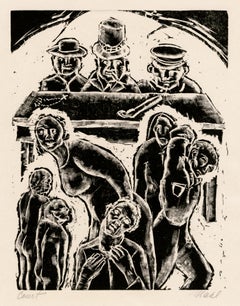
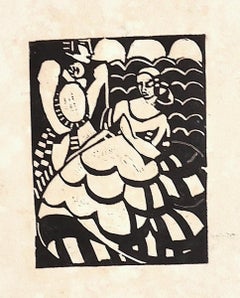
'Sisters' — Renowned Black, Harlem Renaissance Artist, Rare Signed Woodcut

1928

$3,500
£2,627.33
€3,062.93
CA$4,956.71
A$4,970.41
CHF 2,875.65
MX$60,522.90
NOK 33,371.10
SEK 34,012.87
DKK 22,899.44

About the Item

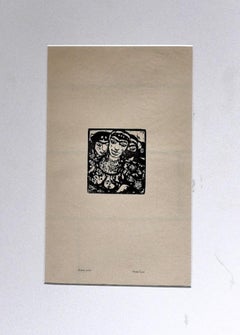
James Lesesne Wells, 'Sisters', linocut, edition not stated but small, 1928. Signed, titled, and annotated 'imp' in pencil. A fine impression on off-white wove Japan paper, with wide margins (1 7/8 to 3 3/4 inches), in excellent condition. Printed by the artist. Very scarce. Matted to museum standards, unframed. Image size 8 3/16 x 6 3/4 inches (208 x 171 mm); sheet size 13 1/2 x 10 3/4 inches (343 x 273 mm). Exhibition and Literature: 'Narratives of African American Art and Identity: The David C. Driskell Collection,' The Art Gallery at the University of Maryland, extensive touring exhibition, 1998-2000. Collections: Pennsylvania Academy of the Fine Arts, Smithsonian Institution (Anacostia Community Museum). ABOUT THE ARTIST “Wells is more than an artist with a deep concern for his fellow man. He carries many of his themes a step further into an apocalyptic world, a world of revelation and shifting lights. … He works on large blocks in a bold free style. … His work has a vigor, therefore, that is not often used in the medium today.” —Jacob Kainen (painter, critic, and collector) from Richard J. Powell’s 1986 essay Phoenix Ascending: The Art of James Lesesne Wells. James Lesesne Wells was an American painter, printmaker, educator, and pioneering figure of the Harlem Renaissance, whose work established a vital connection between African heritage, modernist form, and African American cultural identity. Known for his innovative use of linoleum and woodblock printing, Wells played a key role in shaping 20th-century African American art and inspired countless students throughout his lengthy career as a teacher at Howard University. Born in Atlanta, Georgia, Wells' early exposure to the arts came through church and community, where African American cultural traditions were central. He pursued formal artistic training at Lincoln University in Pennsylvania (earning a B.A. in 1924), followed by studies at the Pennsylvania Academy of the Fine Arts and the Barnes Foundation, where he encountered European modernists as well as traditional African sculpture, which profoundly influenced his style. Wells moved to New York in the late 1920s, swiftly immersing himself in the lively artistic and intellectual scene of Harlem. There, he became associated with artists, writers, and thinkers of the Harlem Renaissance, contributing to the growth of Black cultural identity. Considered a mentor to many famed artists of the Harlem Renaissance, Wells served as director of a summer art workshop in Harlem where his assistants included Charles Alston, Jacob Lawrence, and Palmer Hayden. He developed a particular interest in printmaking, especially woodcuts and linocuts—mediums that were accessible, democratic, and capable of powerful graphic expression. His prints often depicted religious themes, African American life, and social justice topics, characterized by bold forms and rhythmic compositions that reflected both African art and modernist abstraction. Throughout the 1930s, Wells exhibited widely in New York and participated in notable shows at the Harmon Foundation, which supported African American artists. His work was also disseminated through print portfolios and illustrated publications, establishing him as one of the most recognized African American printmakers of his era. In 1929, Wells joined the faculty of Howard University in Washington, D.C., where he taught until his retirement in 1968. Early recognition of Wells' work came when he won a gold medal at the 1931 Harmon Foundation exhibition. At Howard, he mentored multiple generations of Black artists, including Alma Thomas, Elizabeth Catlett, and David Driskell. His teaching focused on both technical excellence and cultural awareness, encouraging students to draw inspiration from African art traditions and modernist innovations. Wells also engaged with broader artistic communities, participating in the Works Progress Administration (WPA) during the Depression and exhibiting at prominent venues such as the Corcoran Gallery of Art and the Smithsonian Institution. His reputation as a leading African American modernist grew steadily through the mid-20th century. In the postwar years, Wells continued exhibiting while dedicating more time to teaching and art writing. During his retirement, he received renewed recognition for his pioneering contributions to African American printmaking. In the 1980s and early 1990s, major exhibitions and publications reevaluated his influence on American modernism and Black art history. Wells’ work is held in major collections, including the Baltimore Museum of Art, Howard University Gallery of Art, Library of Congress, Metropolitan Museum of Art, Museum of Modern Art, National Gallery of Art, The Phillips Collection, and the Smithsonian American Art Museum.
  • Creator:
    James Lesesne Wells (1902 - 1992, American)
  • Creation Year:
    1928
  • Dimensions:
    Height: 8.19 in (20.81 cm)Width: 6.75 in (17.15 cm)
  • Medium:
  • Movement & Style:
  • Period:
  • Condition:
  • Gallery Location:
    Myrtle Beach, SC
  • Reference Number:
    Seller: 1043501stDibs: LU532316829262

More From This Seller

View All
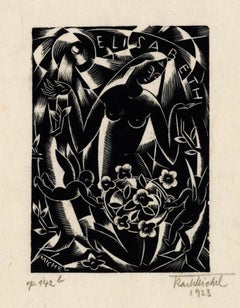
'Elisabeth' — 1020s German Expressionist, Signed Woodcut

'Elisabeth' — 1020s German Expressionist, Signed Woodcut

By Karl Michel

Located in Myrtle Beach, SC

Karl Michel, 'Elisabeth', woodcut, edition 20, 1923. Signed, dated, and numbered 'op.142b' and '12/20' in pencil. Signed in the block, lower left. Annotated 'Vorgesdruck' [artist’s proof] in pencil. A fine impression, on heavy fibrous Japan paper, with full margins (1 3/16 to 3 1/2 inches), in good condition. Printed by the artist, With the artist’s blindstamp in the bottom center margin. Scarce. Matted to museum standards, unframed. Image size 4 15/16 x 6 inches (131 x 152 mm); sheet size 10 x 6 inches (254 x 152 mm). ABOUT THE ARTIST Karl Michel (1889-1984) was a noted graphic designer and expressionist printmaker during Germany's pre-Nazi Weimar Republic (1919-1933). Michel’s work was the subject of a feature article in the influential German graphic design magazine Das Plakat (The Poster) in 1920. An anti-war advocate, Michel created a suite of 12 wood engravings depicting his impressions of the humanitarian toll of WWII entitled ‘Humanitas’ (Humanity). The German publishing house Greifenverlag published the series in a reduced folio of unsigned prints. Michel’s graphic work is held in the permanent collections of the Auckland War Memorial Museum (New Zealand), Frederikshavn Kunstmuseum & Exlibrissamling (Denmark), Museum of Applied Arts (Budapest), The Robert Gore Rifkind Center for German Expressionist Studies at the Los Angeles County Museum of Art, and the German Expressionism...

Category

1920s Expressionist Figurative Prints

Materials

Woodcut

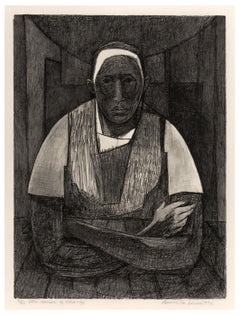
The House of Shango — African American Woman Artist, Signed Lithograph

The House of Shango — African American Woman Artist, Signed Lithograph

By Samella Lewis

Located in Myrtle Beach, SC

Samella Sanders Lewis, 'The House of Shango', lithograph, 1992, edition 60. Signed, dated, titled, and numbered '31/60' in pencil. A superb, richly-inked impression, on Arches cream wove paper; the full sheet with margins (1 1/4 to 3 1/2 inches), in excellent condition. Image size 24 x 18 inches (610 x 457 mm); sheet size 30 inches x 22 1/4 inches (762 x 565 mm). Archivally matted to museum standards, unframed. Impressions of this work are held in the collections of the Los Angeles County Museum of Art, and Scripps College. ABOUT THIS WORK “The title of this piece is an unmistakable harkening to African roots. Shango is a religious practice with origins in Yoruba (Nigerian) belief, deifying a god of thunder by the same name. Shango has been adopted in the Caribbean, most notably in Trinidad and Tobago, a fact that underscores the importance of transnationalism to Samella Lewis’s piece. Her work often grapples with issues of race in the U.S., and The House of Shango is no exception. Through a reliance on the gradual transformation of Shango—one that took place across continents and time—Lewis’s piece forms a powerful link between black Americans and their African and Caribbean counterparts. The figure depicted in the piece appears to emerge, quite literally, from the house of Shango. Given the roots and transformative process of the religion, The House of Shango can draw attention to the historical intersections to which black American culture is indebted.” —Laura Woods, Scripps College, Ruth Chander Williamson Gallery, Collection Highlights, 2018 ABOUT THE ARTIST Samella Lewis’ lifelong career as an artist, art historian, critic, curator, collector, and advocate of African American art has helped empower generations of artists in the United States and worldwide, earning her the designation “the Godmother of African American art.” Born and raised in Jim Crow era New Orleans, Lewis began her art education at Dillard University in 1941, transferring to Hampton University in Virginia, where she earned her B. A. and master's degrees. She completed her master's and a doctorate in art history and cultural anthropology at Ohio State University in 1951, becoming the first female African American to earn a doctorate in fine art and art history. Lewis taught art at Morgan State University while completing her doctorate. She became the first Chair of the Fine Arts Department at Florida A&M University in 1953. That same year Lewis also became the first African American to convene the National Conference of African American artists held at Florida A&M University. She was a professor at the State University of New York, California State University, Long Beach, and at Scripps College in Claremont, California. Lewis co-founded, with Bernie Casey, the Contemporary Crafts Gallery in Los Angeles in 1970. In 1973, she served on the selection committee for the exhibition BLACKS: USA: 1973 held at the New York Cultural Center. Samella Lewis's 1969 catalog 'Black Artists on Art', featured accomplished black artists typically overlooked in mainstream art galleries. She said of the book, "I wanted to make a chronology of African American artists, and artists of African descent, to document our history. The historians weren't doing it. It was really about the movement." From the 1960s through the 1970s, her work, which included lithographs, linocuts, and serigraphs, reflected her concerns with the values of human dignity, democracy, and freedom of expression. Between 1969 and 70, Lewis and E.J. Montgomery were consultants for a groundbreaking exhibition at the Oakland Public L designed to create greater awareness of African American history and art. Lewis was the founder of the International Review of African American Art in 1975. In 1976, she founded the Museum of African-American Art with a group of artistic, academic, business, and community leaders in Los Angeles, California. Lewis, the museum’s senior curator, organized exhibitions and developed new ways of educating the public about African American art. She celebrated African American art as an 'art of experience’ inspired by the artists’ lives. And she espoused the concept of African American art as an 'art of tradition', urging museums to explore the African roots of African American art. In 1984, Lewis produced an extensive monograph on Elizabeth Catlett, her beloved mentor at Dillard University. Lewis has been collecting art since 1942, focusing primarily on the WPA era and work created during the Harlem Renaissance. Pieces from her collection were acquired by the Hampton University Museum in Virginia, the world’s earliest collection of African American fine art...

Category

1990s Realist Figurative Prints
Materials

Lithograph

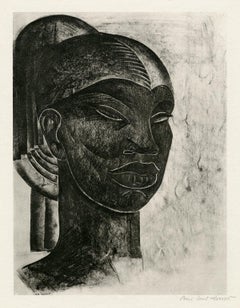
Portrait of an African Woman — 1920s Modernism

Portrait of an African Woman — 1920s Modernism

By Boris Lovet-Lorski

Located in Myrtle Beach, SC

Boris Lovet-Lorski, Untitled (Portrait of an African Woman), lithograph, edition 250, 1929. Signed and numbered 13 in pencil. Number 13 of Volume 2, a series of 10 lithographs publis...

Category

1920s Art Deco Figurative Prints

Materials

Lithograph

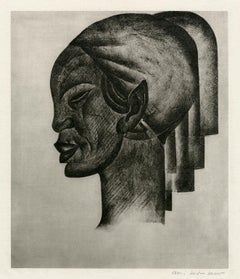
Untitled (Profile of an African Woman) — 1920s Modernism

Untitled (Profile of an African Woman) — 1920s Modernism

By Boris Lovet-Lorski

Located in Myrtle Beach, SC

Boris Lovet-Lorski, 'Untitled (Profile of a Black Woman)', lithograph, edition 250, 1929. Signed and numbered 14 in pencil. Number 14 of Volume 2, a series of 10 lithographs publishe...

Category

1920s Art Deco Figurative Prints

Materials

Lithograph

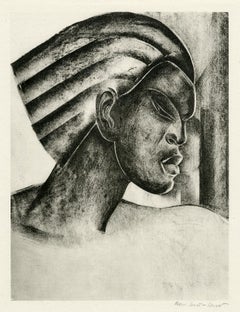
Profile of an African Woman — 1920s Modernism

Profile of an African Woman — 1920s Modernism

By Boris Lovet-Lorski

Located in Myrtle Beach, SC

Boris Lovet-Lorski, Untitled (Profile of an African Woman), lithograph, edition 250, 1929. Signed and numbered 15 in pencil. Number 15 of Volume 2, a series of 10 lithographs publish...

Category

1920s American Modern Figurative Prints

Materials

Lithograph

You May Also Like

Figures - Woodcut Print on Paper - Early 20th Century

Figures - Woodcut Print on Paper - Early 20th Century

Located in Roma, IT

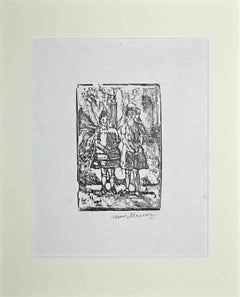
Figures is an original xylograph on paper by Anonymous Artist of the early 20th Century. In good conditions except for diffused stains. Not signed. This artwork represents two the...

Category

Early 20th Century Modern Figurative Drawings and Watercolors

Materials

Woodcut

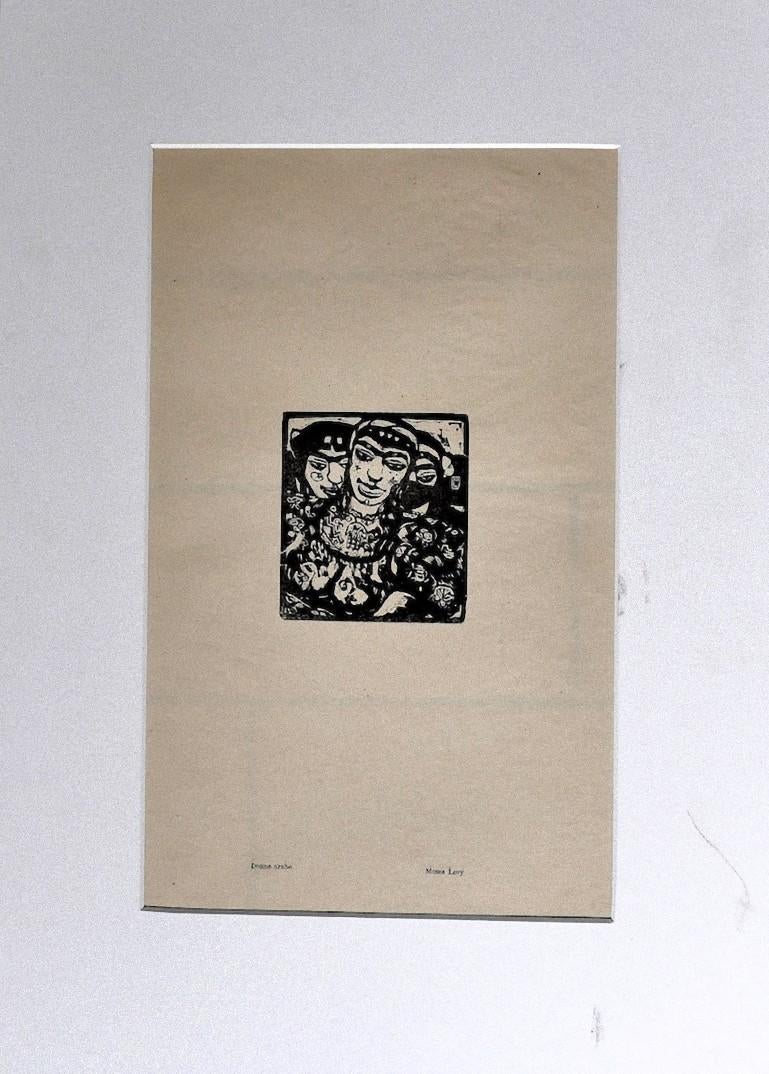
Arabian Women - Woodcut by Moses Levy - XX Century

Arabian Women - Woodcut by Moses Levy - XX Century

Located in Roma, IT

Arabian Women is an original woodcut on yellowish paper realized by Moses Levy. Signed and titled in Italian" Donne Arabe". The State of preservation is very good. Included a Passepartout: The artwork represents three Arabian women, through confident and strong strokes in intense black, The artwork is made by the Expressionistic style of creation, the contrast between black and white are well defined. Moses Levy (Italian, 1885–1968) In 1900 he enrolled at the Institute of Fine Arts in Lucca and found Lorenzo Viani as a fellow student. Levy and Viani also attend courses at the Nude School of the Academy of Fine Arts held by the painter Giovanni Fattori together in Florence. During this period, Levy became passionate about graphics and came into contact with Renato Natali...

Category

20th Century Figurative Prints

Materials

Woodcut

Womanly Preoccupation - Original Woodcut Print by Paul Baudier - 1930s

Womanly Preoccupation - Original Woodcut Print by Paul Baudier - 1930s

By Paul Baudier

Located in Roma, IT

Womanly Preoccupation is an original woodcut print on ivory-colored paper realized by Paul Baudier (1881-1962) in the 1930s. On the lower right description in French. Very good con...

Category

1930s Modern Figurative Prints

Materials

Woodcut

Femmes - Linocut by Albert Flocon - 1987

Femmes - Linocut by Albert Flocon - 1987

By Albert Flocon

Located in Roma, IT

Femmes is a linocut print realized by Albert Flocon in 1987. Good conditions. Belongs to the series from the "Scénographies au Bauhaus". Hommage à Oska...

Category

1980s Contemporary More Prints

Materials

Linocut

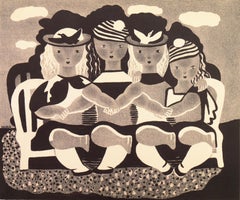
Girls Woodcut Print, Black and White, Signed, Circa 1927, Unframed

Girls Woodcut Print, Black and White, Signed, Circa 1927, Unframed

By Mino Maccari

Located in Roma, IT

Historical Scene is an original print realized by Mino Maccari in 1927. Beautiful black and white woodcut print on ivory-colored paper. Included a passport: 35 x 28 cm. Good condit...

Category

1920s Contemporary Figurative Prints

Materials

Woodcut