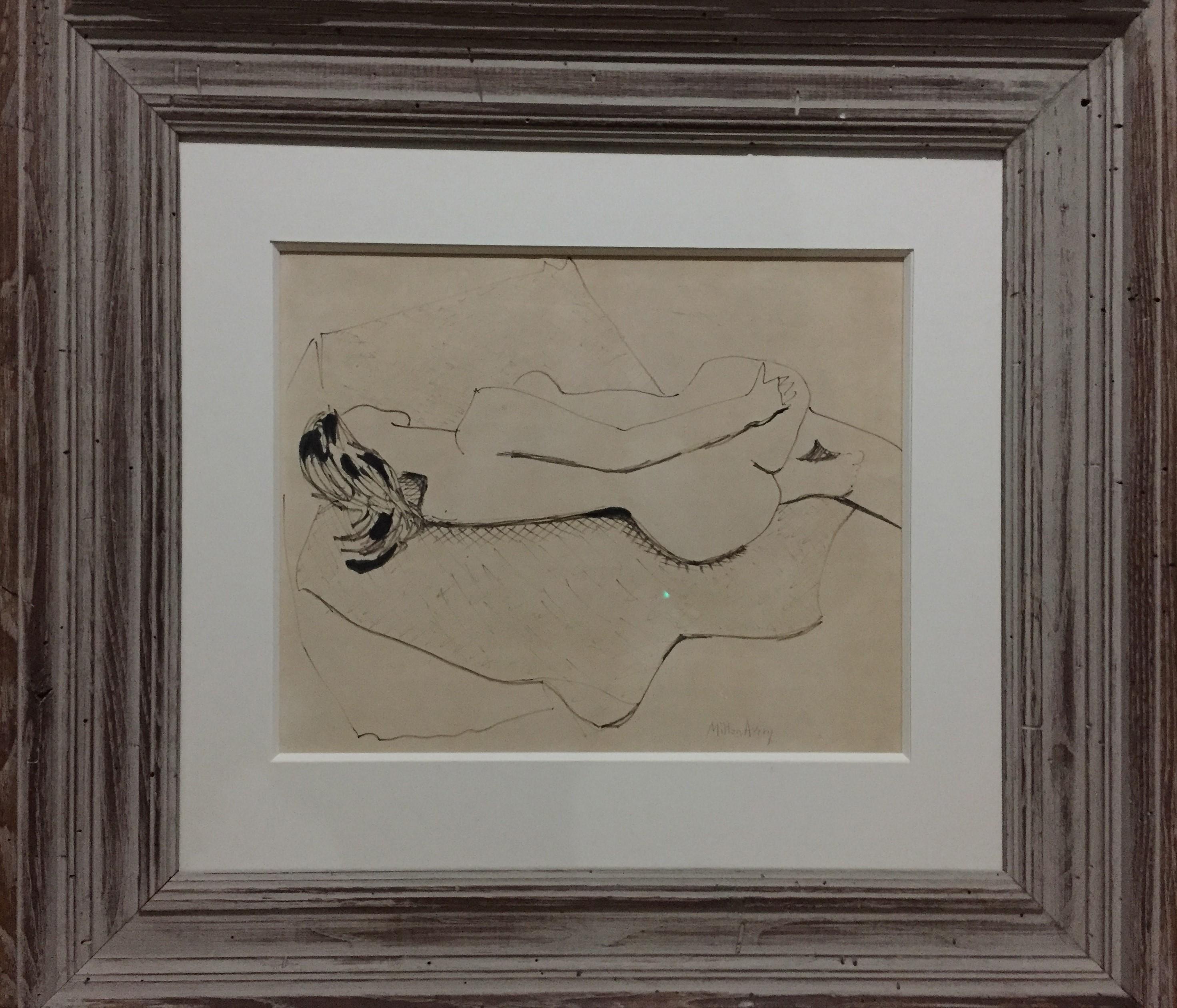
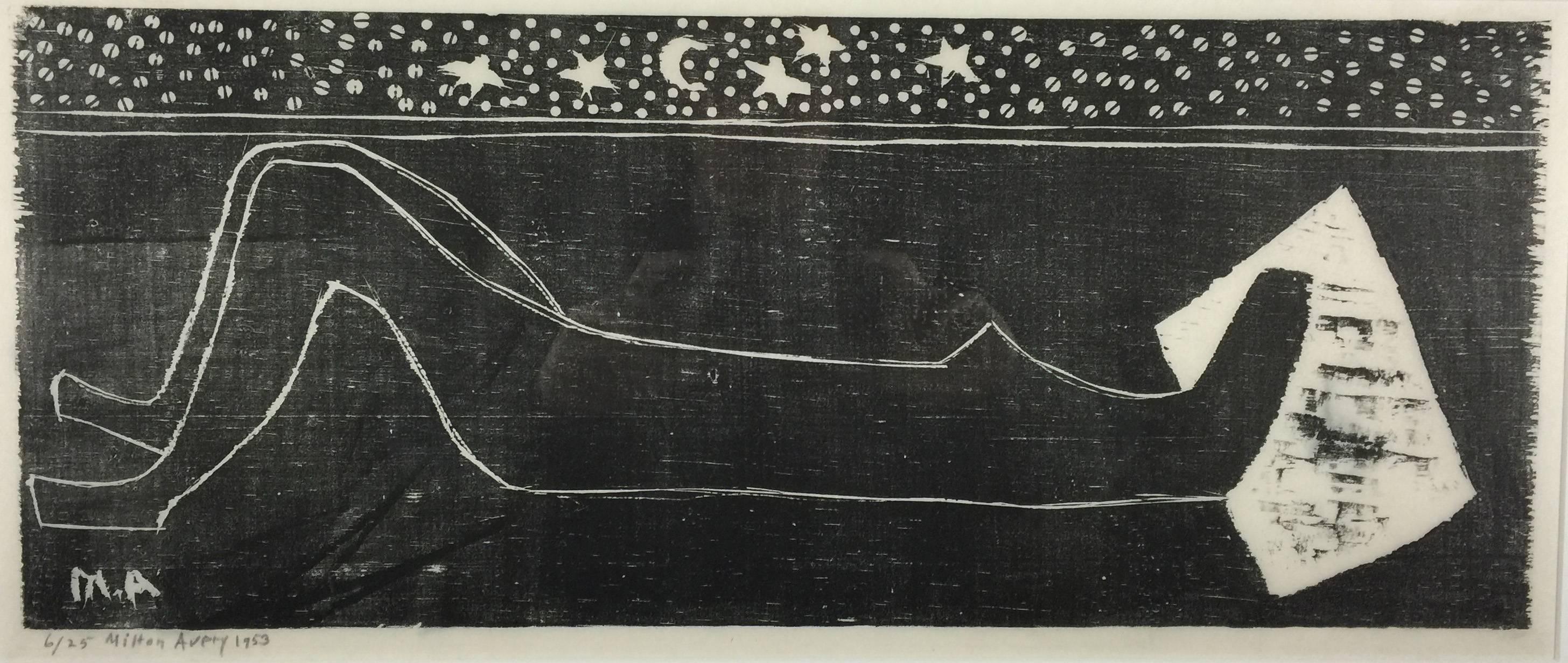
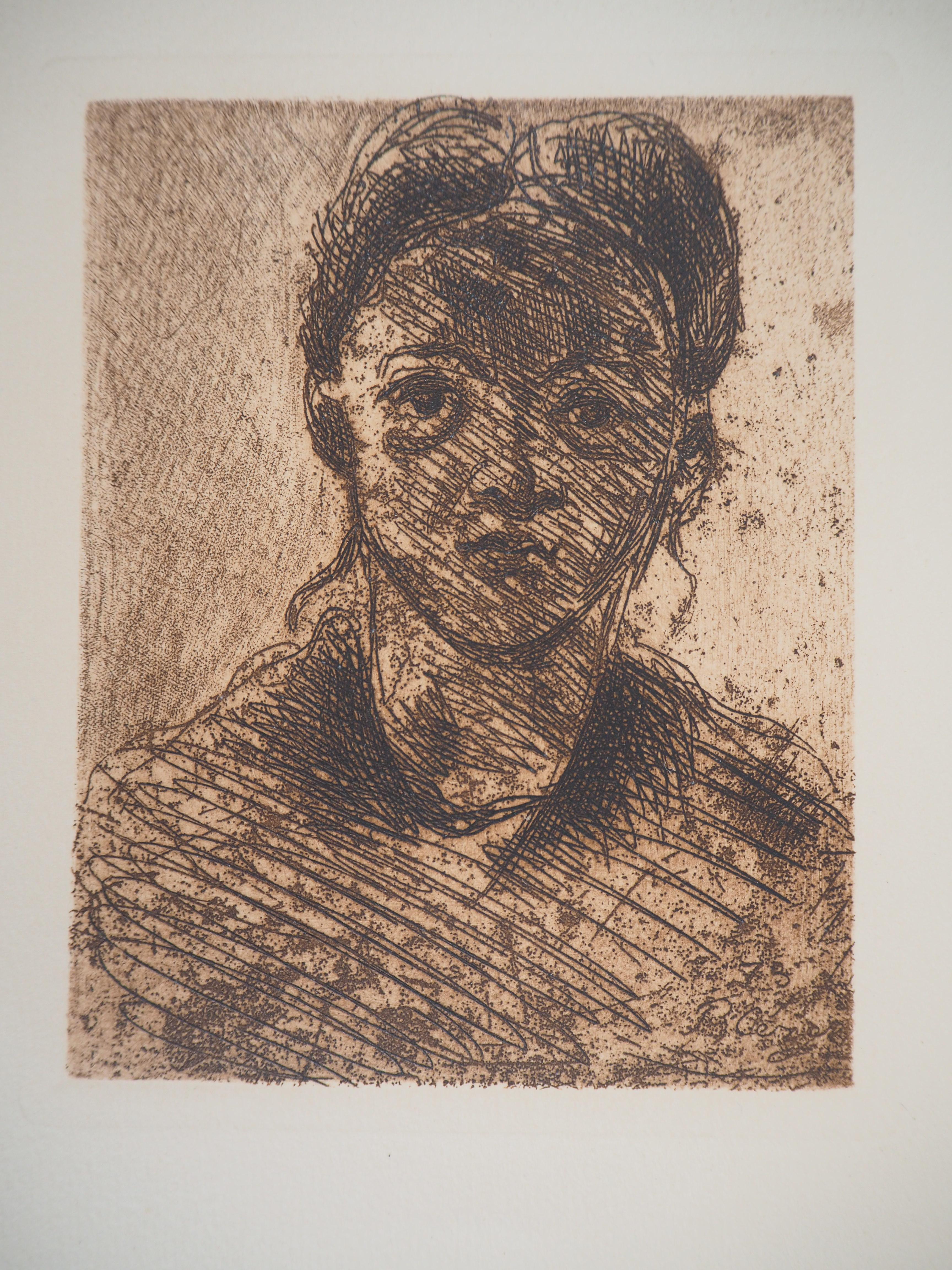
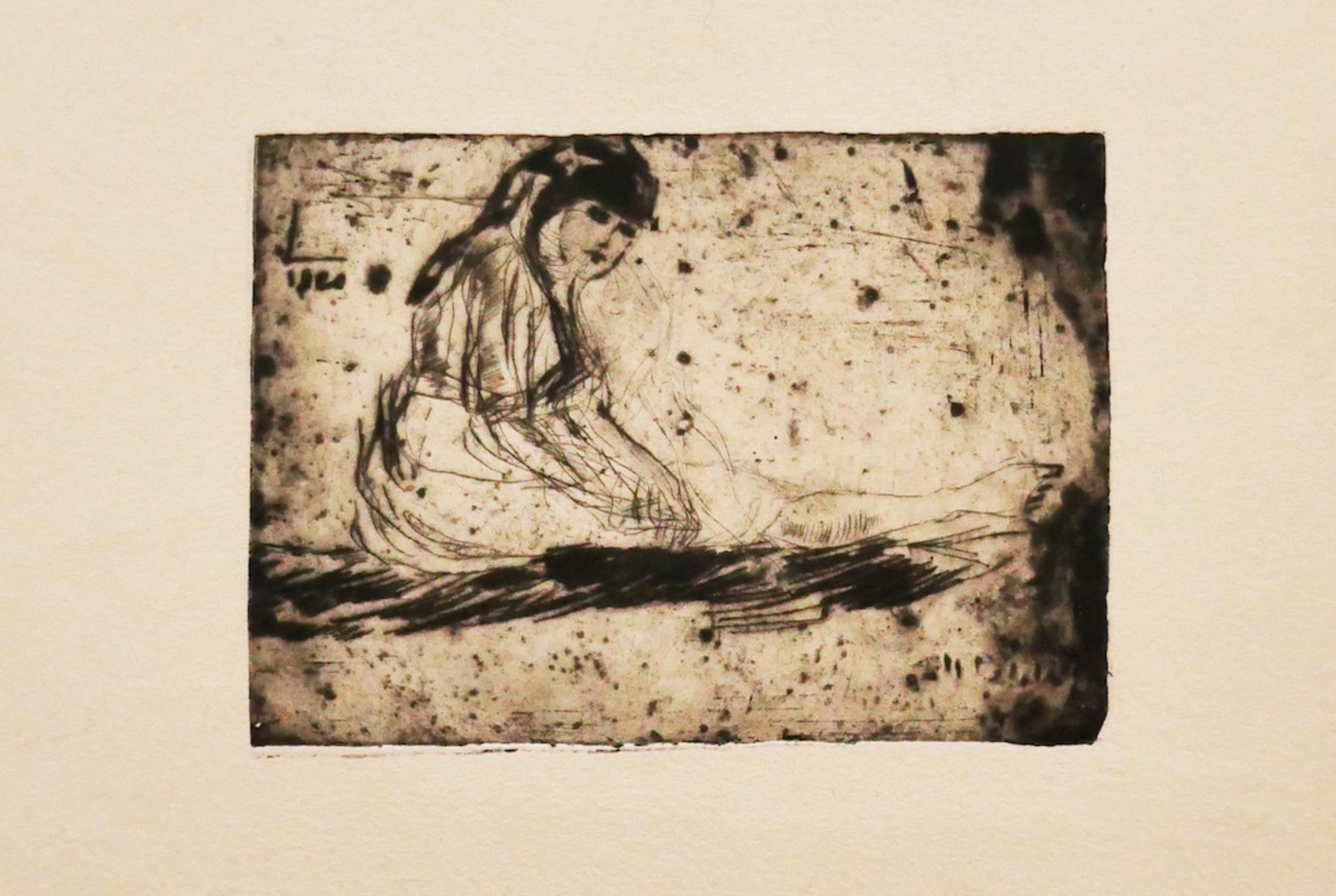
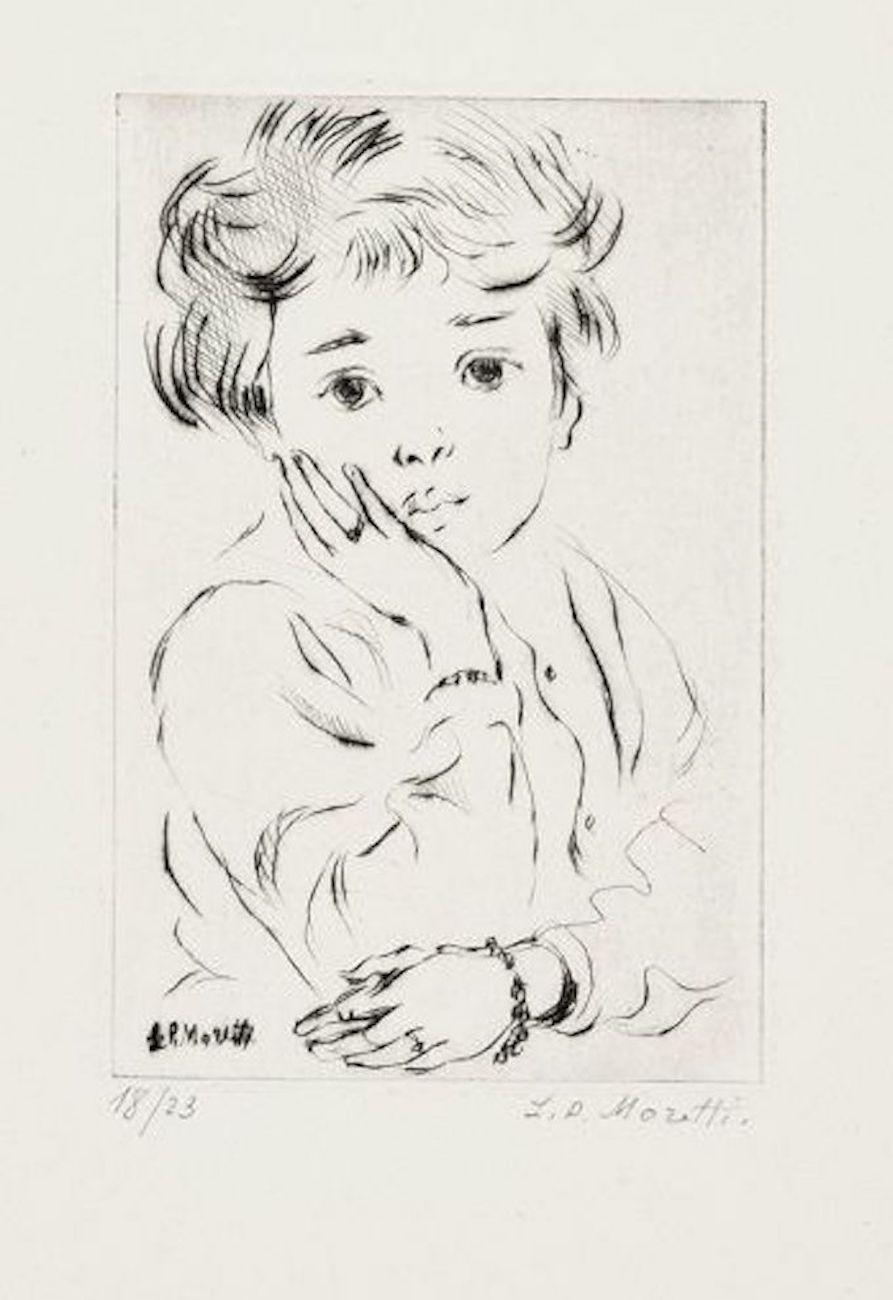
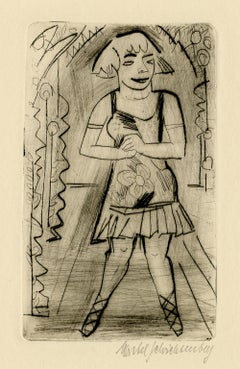
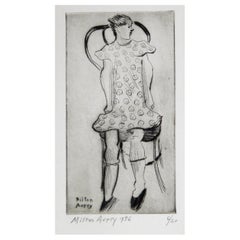
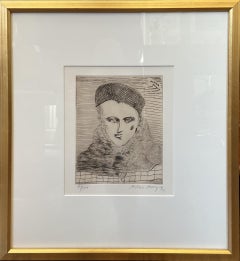
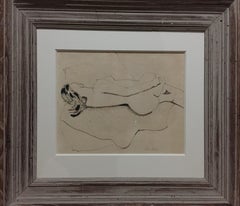
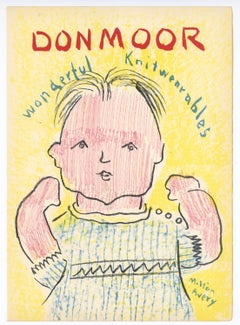
Milton Avery, 'Little Girl', drypoint, 1936, edition 60, Lunn 11. Signed, dated, and numbered '22/60' in pencil. A superb impression, in warm black ink with delicate overall plate tone, on off-white wove paper, with wide margins (2 5/8 to 4 1/8 inches); hinge stains on the top sheet edge, verso, otherwise in excellent condition. Matted to museum standards, unframed.
Image size 8 3/4 x 4 3/4 inches (222 x 121 mm); sheet size 14 7/8 x 13 1/8 inches (378 x 333 mm).
Collections: Cantor Arts Center, National Gallery of Art.
ABOUT THE ARTIST
"I never have any rules to follow; I follow myself."
"I paint not by sight but by faith. Faith gives you sight."
—Milton Avery
'His is the poetry of sheer loveliness.'
—Mark Rothko in his 1965 eulogy to Avery.
Milton Avery (1885-1965) is recognized as one of America's foremost modernist artists, renowned for his uniquely expressive style, evocative use of color, and captivating compositions.
Growing up in a working-class family in Altmar, New York, Avery's early life was marked by the struggles and realities of rural New York. Despite lacking formal artistic training, he displayed an innate talent for drawing from an early age. In 1905, his family relocated to Hartford, Connecticut, where he worked various odd jobs while developing his artistic skills through self-study and experimentation. In 1915, he enrolled at the Connecticut League of Art Students, where he received formal instruction and began to refine his distinctive style.
In 1918, Avery transferred to the School of the Art Society of Hartford and worked in the evenings so that he could paint during the day. He became a member of the Connecticut Academy of Fine Arts in 1924. That summer in Gloucester, Massachusetts, he met the artist Sally Michael, who became his wife in 1926. They moved to New York, and Avery attended evening drawing classes at the Art Students League several times a week while his wife worked as an artist for Progressive Grocer magazine to support him in painting full-time.
Throughout the 1920s and 1930s, Avery continued to develop his artistic style, experimenting with different techniques and subjects, ranging from landscapes and still lifes to portraits. His works during this period often depicted everyday scenes with a sense of calm and harmony, reflecting his belief in art's ability to capture the essence of the natural world.
In 1928, Avery showed two paintings in a group exhibition at the Opportunity Gallery. He created his first print in 1932–a drypoint incised into a copperplate matrix that had been discarded by the Progressive Grocer printer. Between 1933 and 1950, Avery intermittently made drypoints, most of which were not editioned until the early 1960s. In 1935, he had his first solo exhibition at the Valentine Gallery in New York.
The Phillips Memorial Gallery in Washington, DC, acquired one of Avery's works in 1929, making it the first museum to do so. In 1943, the gallery hosted his first solo museum exhibition. In 1948, the Laurel Gallery published a portfolio of five of his drypoints. After suffering a major heart attack in 1949, Avery created his last drypoint and began experimenting with monotypes during his recovery, producing over two hundred unique works in the next two years.
The 1940s marked a period of artistic maturity and recognition for Avery, with his paintings gaining widespread acclaim for their masterful use of color, light, and form. Despite the rise of abstract expressionism, Avery remained committed to figurative art, earning him the nickname "America's Matisse."
In 1950, Avery donated his work for a lithographic advertisement in the souvenir catalog of a fund-raising ball sponsored by the Artists Equity Association. He continued to create prints for the group until 1953, and they accounted for six of his oeuvre of eight lithographs. He began experimenting with woodcuts in 1952, producing twenty-one prints over three years.
A major retrospective of Avery’s paintings opened at the Baltimore Museum of Art in December 1952. Despite his declining health, Avery continued to work diligently and in 1960, the Whitney Museum of American Art organized a retrospective exhibition of his work.
Avery’s work is represented in many prominent museums and art institutions, including the Albright-Knox Art Gallery, The Art Institute of Chicago, Buffalo AKG Art Museum, The Cleveland Museum of Art, Crystal Bridges Museum of American Art, Dallas Museum of Art, Hirshhorn Museum and Sculpture Garden, The Metropolitan Museum of Art, The Museum of Modern Art, National Gallery of Art, Phillips Collection, Philadelphia Museum of Art, Portland Art Museum, Milwaukee Art Museum, Museum of Fine Arts Boston, Los Angeles County Museum of Art, The Phillips Collection, San Francisco Museum of Modern Art, Whitney Museum of American Art, Royal Academy of Arts (London), Tate Modern (London), and the Musée National d'Art Moderne (Centre Pompidou, Paris).