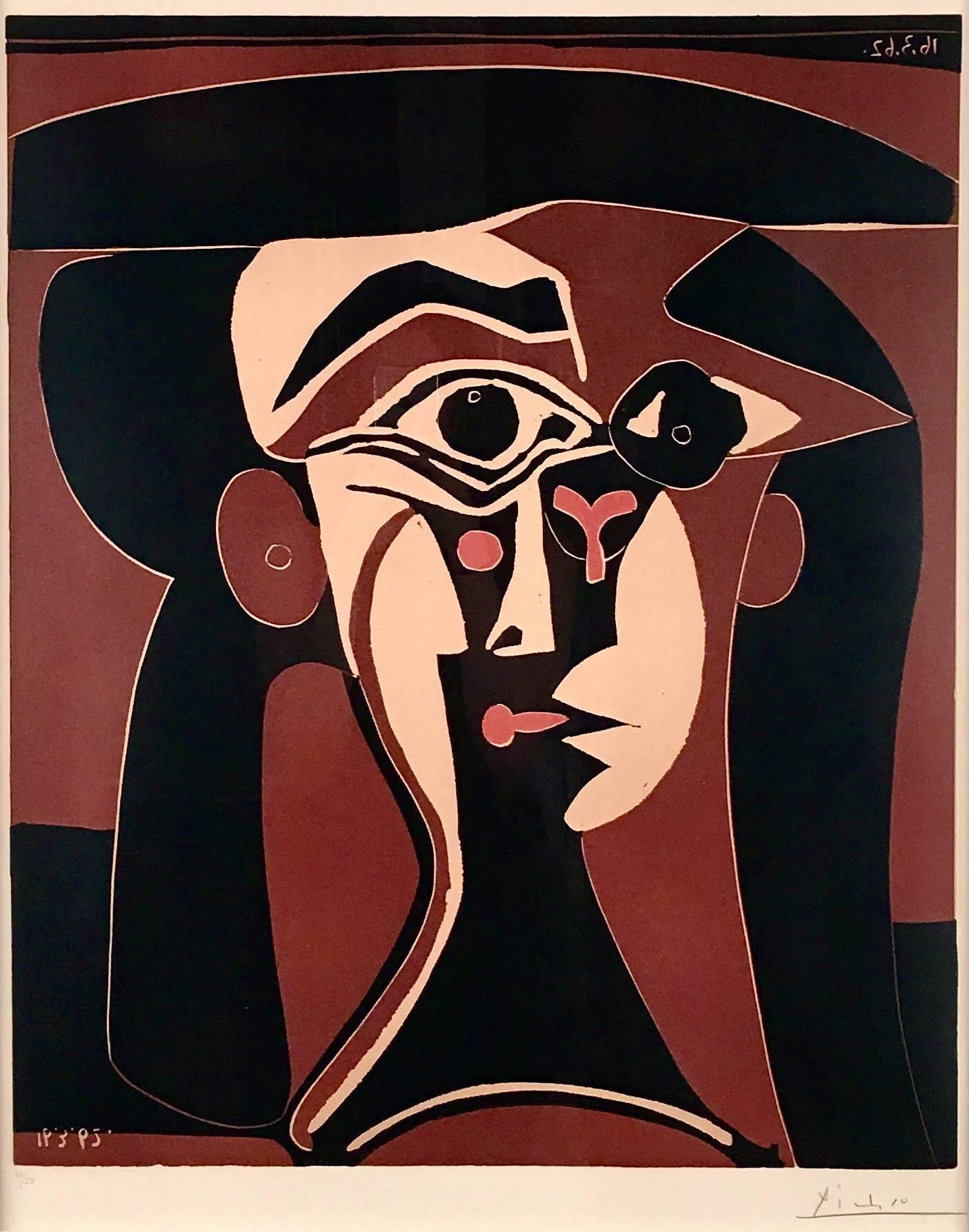
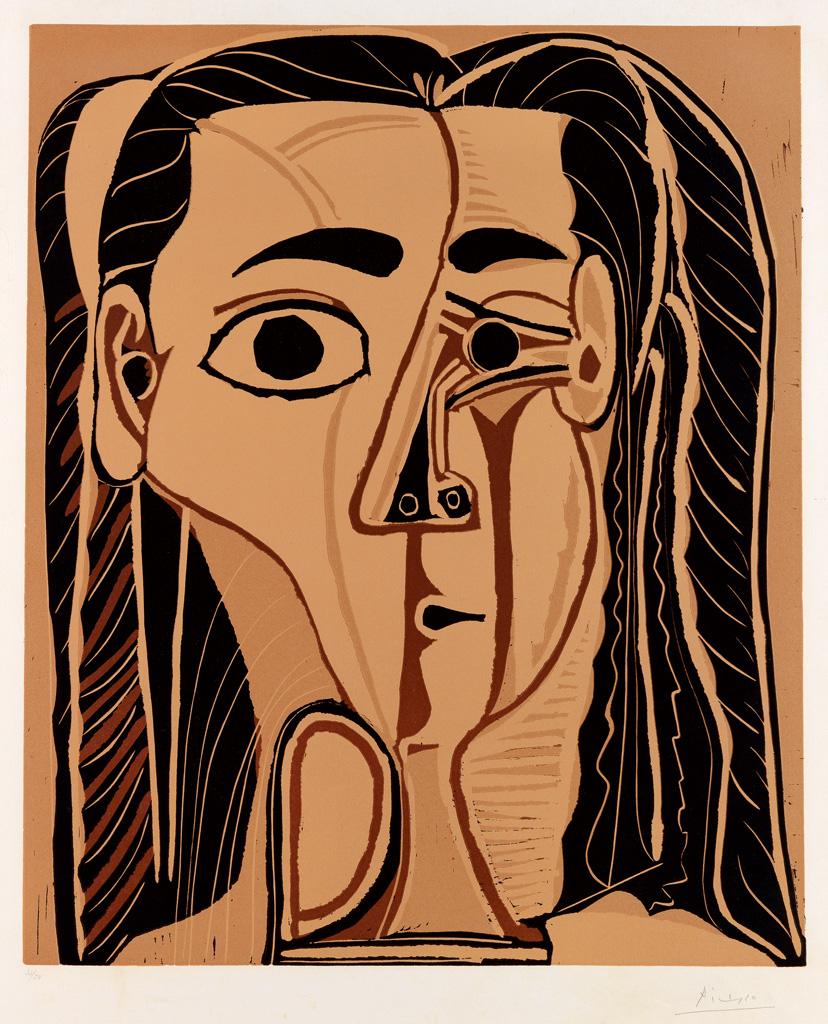
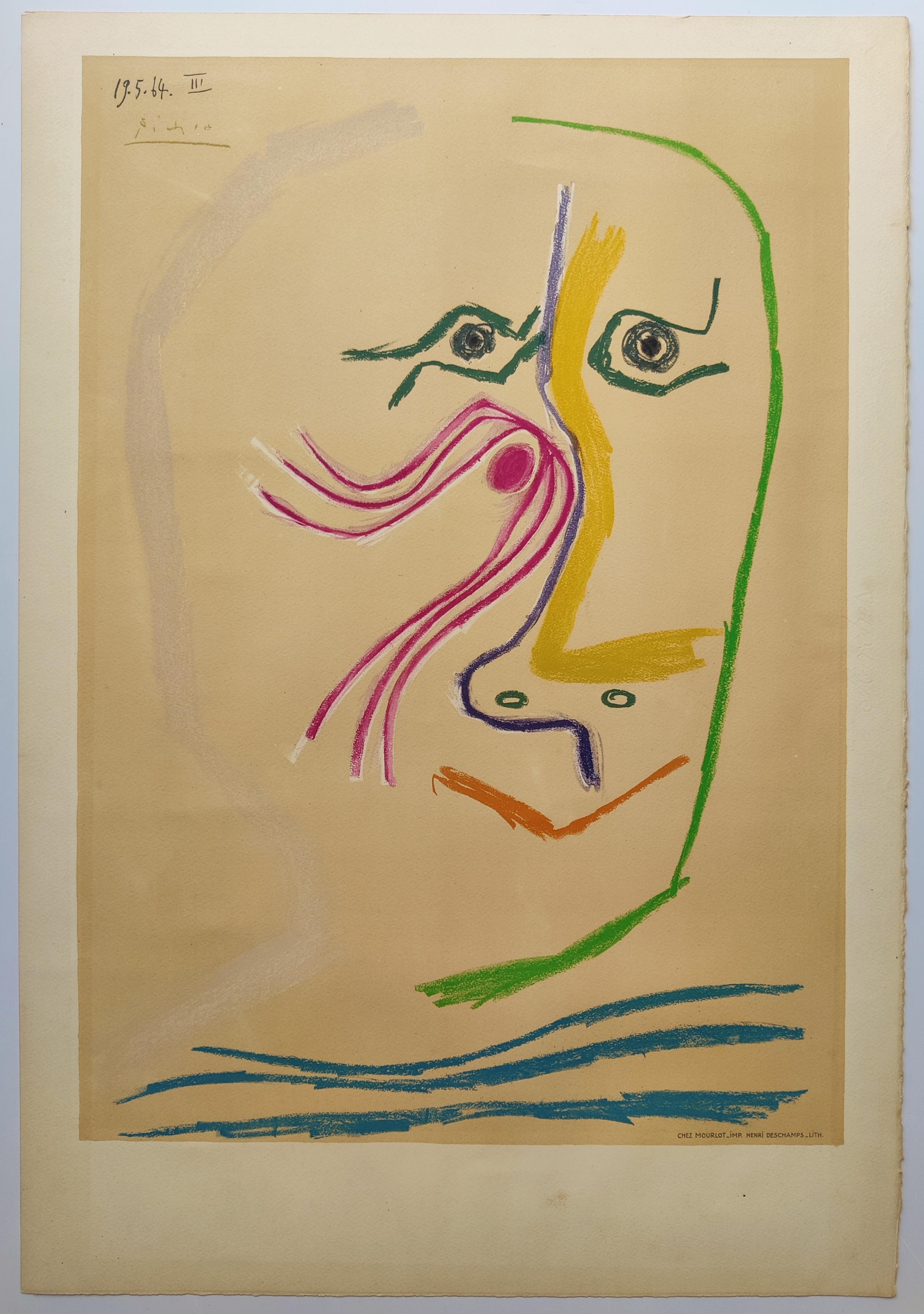
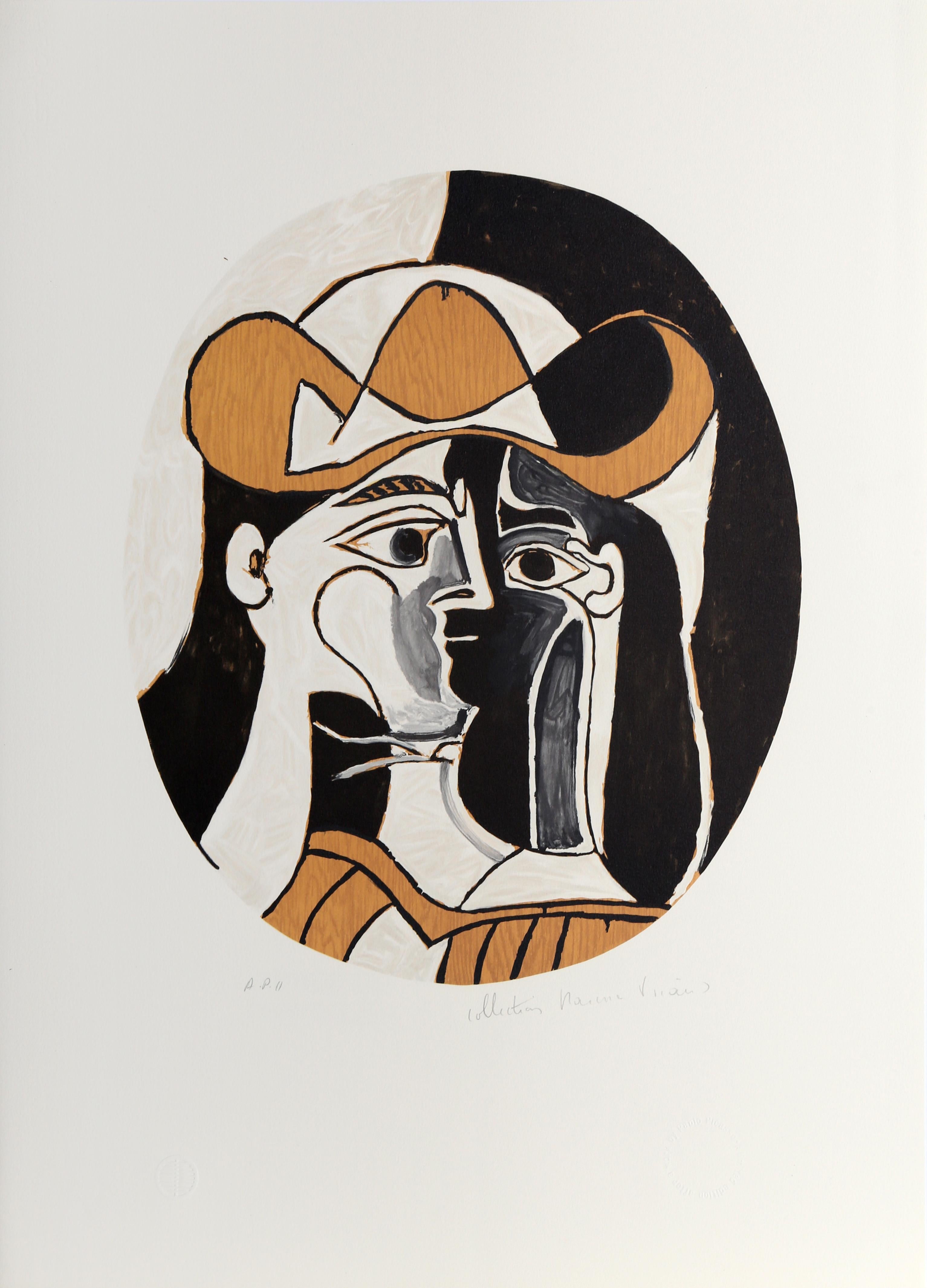
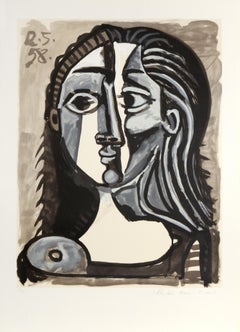
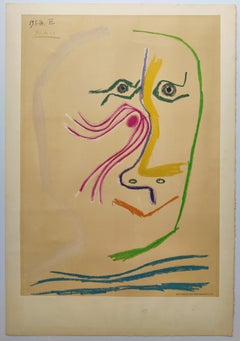
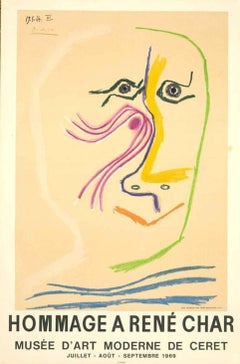
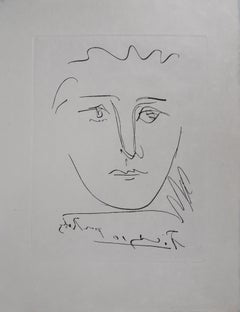
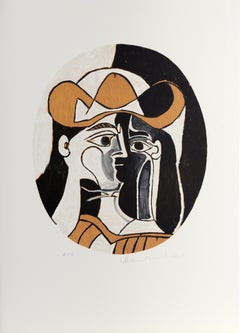
This exquisite lithograph by Pablo Picasso (1881–1973), titled Visage de la Paix (Face of Peace), from the album Le Visage de la Paix par Picasso et Eluard (The Face of Peace by Picasso and Eluard), originates from the 1951 edition published by Editions Cercle d'Art, Paris, and printed by Mourlot Freres, Paris, 1951. Visage de la Paix (Face of Peace) embodies Picasso’s postwar humanist vision, fusing poetic symbolism and serene composition to express his profound commitment to peace. Created in collaboration with the poet Paul Eluard, this lithograph portrays a face rendered in pure contour, radiating tranquility and universal compassion. The simplicity of its lines belies a deep spiritual resonance, exemplifying Picasso’s belief in art as a force for harmony and renewal following the devastation of war.
Executed as a lithograph on velin pur fil Johannot paper, this work measures 11.22 x 9.98 inches. Unsigned and unnumbered as issued. The edition exemplifies the refined craftsmanship of Mourlot Freres, Paris, under the direction of Editions Cercle d'Art, Paris.
Artwork Details:
Artist: Pablo Picasso (1881–1973)
Title: Visage de la Paix (Face of Peace), from the album Le Visage de la Paix par Picasso et Eluard (The Face of Peace by Picasso and Eluard), 1951
Medium: Lithograph on velin pur fil Johannot paper
Dimensions: 11.22 x 9.98 inches (28.5 x 25.35 cm)
Inscription: Unsigned and unnumbered as issued
Date: 1951
Publisher: Editions Cercle d'Art, Paris
Printer: Mourlot Freres, Paris
Catalogue raisonne references: Cramer, Patrick. Picasso: The Illustrated Books. Geneva: Patrick Cramer Publisher, 1983, illustration 62; Reusse, Hans. Picasso: Das Graphische Werk. Berlin: Rembrandt Verlag, 1981, illustration 587; Mourlot, Fernand. Picasso Lithographs. Boston Book and Art Publisher, 1970, illustration 203; Bloch, Georges. Pablo Picasso: Catalogue de l'oeuvre grave et lithographie. Editions Kornfeld, 1967, illustration 687; Horodisch, Abraham. Pablo Picasso: The Illustrated Books. Basilius Presse, 1956, illustration B16.
Condition: Well preserved, consistent with age and medium
Provenance: From the album Le Visage de la Paix par Picasso et Eluard, published by Editions Cercle d'Art, Paris, and printed by Mourlot Freres, Paris, 1951
Notes:
Excerpted from the album (translated from French): The present edition, drawn at MMCCL examples, includes CL examples on velin pur fil Johannot numbered in roman numerals from I to CL, and MMC examples on velin offset superieur including MM numbered from I to MM, and C examples of collaborators numbers from MMI to MMC. The examples on velin pur fil Johannot also includes an original lithography by Picasso.
About the Publication:
Le Visage de la Paix par Picasso et Eluard (The Face of Peace by Picasso and Eluard), published in 1951 by Editions Cercle d'Art, is one of the most historically and ideologically significant illustrated albums of the postwar era. Conceived in the spirit of humanism and reconciliation, the album unites the poetic voice of Paul Eluard with the visual genius of Pablo Picasso to celebrate peace as a universal ideal. Produced at Mourlot Freres, the lithographs in the volume reflect Picasso’s mature synthesis of simplicity and symbolism: minimal linear compositions conveying spiritual calm and moral strength. The text by Eluard, a close friend and collaborator of Picasso since the 1930s, complements the artist’s images with verses of empathy, renewal, and unity. Together, their collaboration served as both an artistic and political statement, reaffirming art’s role in promoting humanity after the traumas of World War II. The edition, printed on fine velin pur fil Johannot and velin offset superieur papers, exemplifies the exquisite craftsmanship of mid-century French livre d’artiste publishing. Le Visage de la Paix remains one of Picasso’s most celebrated artistic testaments to peace—its gentle contour and contemplative tone continuing to resonate across generations.
About the Artist:
Pablo Picasso (1881–1973) was a Spanish painter, sculptor, printmaker, and ceramicist whose extraordinary vision revolutionized modern art and defined the visual language of the 20th century. A child prodigy from Malaga, Spain, Picasso's career spanned more than seven decades and encompassed an astonishing range of styles and innovations—from the melancholic Blue and romantic Rose periods to his pioneering invention of Cubism with Georges Braque, which shattered conventional notions of perspective and form. Influenced by the bold expressiveness of El Greco, the structure of Cezanne, and the vitality of African and Iberian sculpture, Picasso became a central figure of the Paris avant-garde, working in creative dialogue with contemporaries such as Henri Matisse, Alexander Calder, Alberto Giacometti, Salvador Dali, Joan Miro, Wassily Kandinsky, Marcel Duchamp, and Man Ray. His insatiable experimentation extended across painting, drawing, printmaking, ceramics, and sculpture, forever expanding the boundaries of artistic expression. A master of reinvention, Picasso profoundly shaped generations of artists who followed—from Andy Warhol, Roy Lichtenstein, David Hockney, and Jean-Michel Basquiat to Jeff Koons and Banksy—cementing his status as a timeless cultural icon whose works remain among the most sought after worldwide. His landmark painting Les Femmes d'Alger (Version O) achieved a record-breaking sale of 179,365,000 USD at Christie's, New York, on May 11, 2015, affirming Picasso's enduring legacy as one of the most influential and valuable artists in history.
Pablo Picasso Visage de la Paix, Picasso Le Visage de la Paix, Picasso Mourlot Freres, Picasso Editions Cercle d'Art, Picasso lithograph, Picasso Eluard collaboration.