Want more images or videos?
Request additional images or videos from the seller
1 of 13

Sanzo Wada
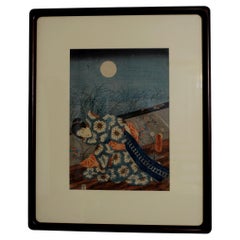
"The Fortune Teller" from Japanese Life and Customs - Shin-Hanga Woodblock Print

1952

$520
$65020% Off
£390.29
£487.8620% Off
€455.42
€569.2720% Off
CA$734.66
CA$918.3220% Off
A$736.55
A$920.6920% Off
CHF 426.82
CHF 533.5320% Off
MX$9,000.04
MX$11,250.0520% Off
NOK 4,946.29
NOK 6,182.8620% Off
SEK 5,050.99
SEK 6,313.7420% Off
DKK 3,404.13
DKK 4,255.1720% Off

About the Item

"The Fortune Teller" from Japanese Life and Customs - Shin-Hanga Woodblock Print Beautiful second edition woodblock print by prominent Japanese artist Sanzo Wada (b. 1883 d. 1967.) A man in western style dress and a woman wearing a kimono approach the fortune teller, an older gentleman seated at a table with signs advertising different services and products. The scene is rendered in deep grey wash colors, indicating the night time setting. The lantern on the fortune teller's table provides a warm, yellow light to the scene. A dog sleeps curled up near a wall in the background. Sanzo Wada originally created this scene for the series "Showa Shokugyo E-zukushi," or "Sketches of Occupations in the Showa Era." The first two series were printed from 1938 to 1943 by Nishinomiya Shoin but was ultimately stopped during WWII. The series was revived and re-named Japanese Life and Customs and printed by Kyoto Hanga-in using the original pre-war blocks in 1952. This impression comes from the 1952 print series. Frame size: 14" H x 18.75" W Image size: 10" H x 14" W Paper size: 13" H x 18" W Sanzo Wada was born on March 3, 1883 in the Hyogo prefecture of Japan. Wado was the son of a government-appointed physician and went against his families wishes to study art, leaving school at the age of 16 to take a mentorship to study Western-style painting under the painter Kuroda Seiki. Following this, Wada studied at Seiki’s White Horse Society School and then at the Tokyo School of Fine Arts. Wada graduated in 1904 and began to paint classical style oil paintings of Japanese life. From 1908 to 1914, he traveled and studied artists in Europe, initially under government sponsorship. He was introduced to the artist Yamamoto Kanae while in France, who introduced him to the process of woodblock printing. Wada enjoyed success after returning to Japan, settling in Tokyo and exhibiting extensively there as well as participating in state-sponsored shows in Bunten and Teiten. He began teaching at the Tokyo School of Fine Arts in 1927, the same year he was appointed to the Imperial Arts Academy. During this period, he also developed the Sanzo Wada Dictionary of Color Combinations. This color theory guide was upheld by the Japan Standard Color Association and is still used by the Japan Color Research Institute today. In the 1920s, Western-style painting began to fall out of fashion in Japan as the government pushed for increasingly nationalistic policies and art which would reflect that. Sanzo Wada began creating Japanese style art, including woodblocks, paintings, and illustrations. One of the most prominent of these being his depiction of occupations in the Showa era. These print series cemented Wada’s recognition as a woodblock artist, noted for his skill in creating prints which appeared as ink or watercolor paintings. In the 1950s, Wada began designing costumes for theatre and films. He designed the costumes for “Gates of Hell” in 1955, for which he received an American Motion Picture Academy Award. He received the order of Cultural Merit from the Japanese Government in 1958. He died on August 22, 1967. His work is now held in the collections of international museums such as Fukuoka Art Museum, Fukuoka, Japan; Hyogo Prefectural Museum of Art, Japan; Mizuta Museum of Art, Japan; The British Museum, London, UK; The National Museum of Modern Art, Tokyo, Japan; USC Pacific Asia Museum, University of Southern California, Los Angeles, USA.
  • Creator:
    Sanzo Wada (1883 - 1967)
  • Creation Year:
    1952
  • Dimensions:
    Height: 14 in (35.56 cm)Width: 18.75 in (47.63 cm)Depth: 0.75 in (1.91 cm)
  • Medium:
    Ink,Washi Paper,Woodblock
  • Movement & Style:
    Showa
  • Period:
  • Condition:
    Paper has some rippling from application of ink. Minor mat burn around edges from previous mounting. Frame is used and may have minor cosmetic defects, such as scuffing. Mat is new.
  • Gallery Location:
    Soquel, CA
  • Reference Number:
    Seller: JMA 101521stDibs: LU54218219632

More From This Seller

View All
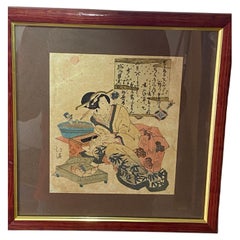
Scribe and Personal Assistant to the Shogun - Japanese Woodblock Print on Paper

Scribe and Personal Assistant to the Shogun - Japanese Woodblock Print on Paper

Located in Soquel, CA

Scribe and Personal Assistant to the Shogun - Japanese Woodblock Print on Paper Detailed woodblock print by an unknown artist, In the style of Suzuki Harunobu. There are two women i...

Category

19th Century Edo Figurative Prints

Materials

Paper, Ink, Woodcut

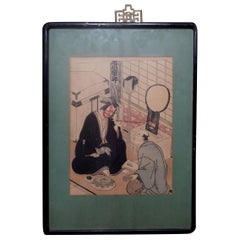
Japanese Artisans - Silk Dying -Japanese Woodblock Print

Japanese Artisans - Silk Dying -Japanese Woodblock Print

By Tosa Mitsuyoshi

Located in Soquel, CA

Japanese Artisans - Japanese Woodblock Print J Japanese woodblock depicting six women, all wearing vibrant kimonos, working on crafts by Tosa Mitsuoki (Japanese, 1617-1691). Japanese,c. 1600. Handcraft depiction (dye works).Section from a painted screen with presentations of handcraft.Kita-in, Saitama. Stamped lower left. Presented in a white mat and giltwood frame. Frame: 19"H x 14"W Mat: 18.25"H x 13.25"W Image: 14.5"H x 9.5"W Tosa Mitsuoki was a Japanese painter, reinvigorating the Yamato style of classical Japanese painting. Yamato-e originated from interest in reproducing early Tang dynasty paintings, and was later reinvented and further refined to fit Japanese cultural perceptions in the late Heian period. Yamato, sometimes referred to as wa or kazu had become synonymous with the Tosa-ha by the Muromachi period as a way for Japanese artist to distinguish their works from those of mainland Chinese paintings, kara-e. Yamato-e incorporated various visual and literary techniques for establishing narrative. Works were not always accompanied with text and may rely on heavily on period specific visual motifs, icons, and symbols to relay a story or theme. Tosa style by the time of Mitsuoki focused heavily on depicting themes of plants and nature, famous places, meisho, the four seasons, shik, bird-and-flower, kacho. Many of these popular symbols and icons from mimicking Chinese practices, treating the original Chinese masterwork as a sort of prototype to improve upon. Popular formats for Mitsuoki's pictures were wall scrolls kakemono, or handscrolls that would be read from right to left with the accompanied story, sliding doors fusuma and folding screen panels byobu that featured up to six panels. Mitsuoki's style incorporated the depth and calligraphy techniques of ink wash brushwork similar to Song dynasty and Yuan dynasty Chinese court paintings...

Category

1920s Edo Landscape Paintings

Materials

Paper, Ink, Woodcut

You May Also Like

Original Japanese Woodblock Print by Totoya Hokkei 19th Century

Original Japanese Woodblock Print by Totoya Hokkei 19th Century

By Totoya Hokkei

Located in Auribeau sur Siagne, FR

Rare, original Utagawa Hiroshige 19th century woodblock print. Beautiful Edo period print from the original publisher. Museum quality framed with con...

Category

Antique 19th Century Japanese Chinese Export Prints

Materials

Paper

F21 Japanese Art Shiro Kasamatsu Woodblock print [Kasuga Shrine]

F21 Japanese Art Shiro Kasamatsu Woodblock print [Kasuga Shrine]

Located in Niiza, JP

Print size: 245 x 370 mm Sheet size: 285 x 430 mm Frame size: 415 x 530 mm 1600 g Packing estimate size: 480 x 580 x 70 mm 5kg This woodblock print is a work by Shiro Kasamatsu, o...

Category

20th Century Japanese Prints

Materials

Paper

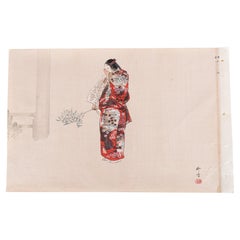
Original Woodblock print Japan (1925) by Tsukioka Kogyo (signed)

Original Woodblock print Japan (1925) by Tsukioka Kogyo (signed)

Located in Oostende, BE

Original Woodblock print Japan (1925) by Tsukioka Kogyo (signed). From the series ‘Noga Taikan’. Based on characters of Noh Plays.

Category

Vintage 1920s Japanese Prints

Materials

Paper

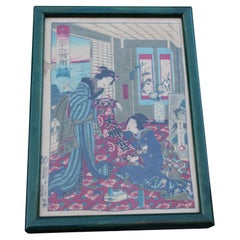
Print Toyohara Chikanobu Japan Woodcut 1880

Print Toyohara Chikanobu Japan Woodcut 1880

By Toyohara Chikanobu

Located in Palermo, Sicily

Print Toyohara Chikanobu Japan Woodcut 1880

Category

Antique 1880s Japanese Japonisme Decorative Art

Materials

Paper

Antique Japanese Woodblock Print by Utagawa Toyokuni III (1786~1964), 三代歌川豊国

Antique Japanese Woodblock Print by Utagawa Toyokuni III (1786~1964), 三代歌川豊国

Located in Norton, MA

A Japanese Woodblock A Young Woman in a Ruined House, print by Utagawa Toyokuni III (1786~1964), 三代歌川豊国. Dated: Aratame seal, 1855 Publisher: Yamada-ya ABOUT THE ARTIST Utagawa Kuni...

Category

Antique Mid-19th Century Japanese Prints

Materials

Paper