Want more images or videos?
Request additional images or videos from the seller
1 of 7

Sybil Andrews
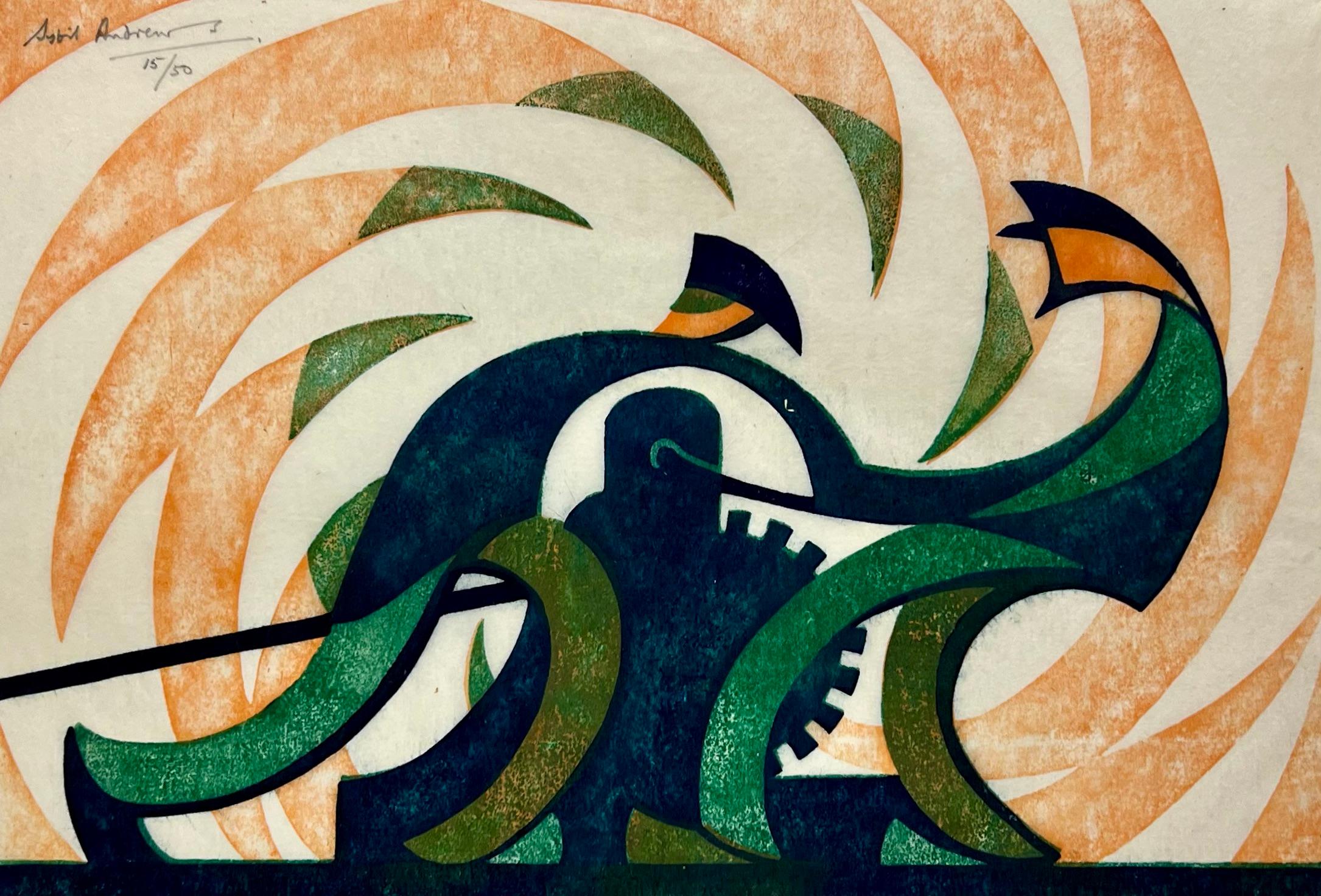
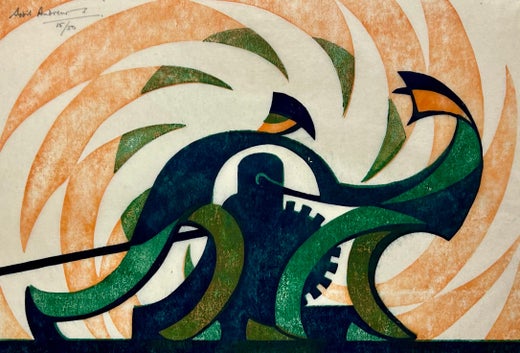
"Rush Hour" British Modern Mid 20th Century Vorticist European Vorticism Woman

1930

$44,000
£33,158.47
€38,741.40
CA$62,439.30
A$62,620.35
CHF 36,328.43
MX$764,512.85
NOK 420,785.90
SEK 430,646.04
DKK 289,628.59

About the Item

"Rush Hour" British Modern Mid 20th Century Vorticist European Vorticism Woman Sybil Andrews CPE (British/Canadian, 1898-1992) Rush Hour (Coppel SA 11) Linocut printed in Chinese orange, Chinese blue and black, 1930, on tissue thin oriental laid paper. Signed, titled and numbered 8/50 in pencil lower left, framed. Block 209 x 251mm (8 1/4 x 9 7/8in) Sheet 249 x 310mm (9 3/4 x 12 1/4in) Framed by Bark 14 1/2 x 16 inches BIO Sybil Andrews was a printmaker, painter, graphic artist and educator who was born in Bury St. Edmonds, Suffolk, England. She moved to London (England) in 1922. In 1947, she emigrated to Campbell River (Vancouver Island) British Columbia, Canada, where she worked, taught and lived for the rest of her life. She died at a hospital in Victoria (B.C.) Her mediums were the colour linocut (1) (most famous), etching, posters, pastels, ink, watercolour, monoprint and oil. Her subjects were human activity (at work, sports, travel, etc.), figures, animals, genre, allegory, architecture and landscape. Her style was Art Deco (see AskART styles), Futurism, Cubism and Vorticism (2). Her work is identified by a simple format, clean lines, distortion, vivid colours, drama and rhythm. Quote: "The colour linocut was just the medium for me, being interested in dynamics and ideas and patterns... It is impossible to be fussy with lines, you have to simplify, you are forced to simplify your idea to its fundamentals." Andrews produced 76 linocuts in her life, of which 43 were made from 1929 to 1939, which is considered to be her best period. John Hassall's art correspondence course (1918) was the beginning of her formal art education. She went from there to Heatherley's School of Fine Art (London/1922) where she studied under Henry Massey (see AskART) and met artistic partner Cyril Power (see AskART). At the same time, she studied independently with sculptor Henri Glicenstein (see AskART) who taught her drypoint etching and to draw from life. She also attended the Grosvenor School of Modern Art (1925). Iain McNab (1890-1967) was Principal and Claude Flight (3) (see AskART) an instructor who had a great influence on her choice of linocut as a primary medium. Some of his other students and her associates were Edith Lawrence (1890-1973), Lill Tschudi (1911-2001), Eileen Mayo (see AskART) and William Greengrass (1896-1970). After emigrating to Canada she taught art continuously until a month before her death. She was elected a member of the Canadian Painters - Etchers Society (after 1976 the Print and Drawing Council of Canada) in 1951. She began exhibiting her work in 1921.In 1929 she was included in "The First Exhibition of British Linocuts," at the Redfern Gallery, London and she continued exhibiting there until 1939. She has also been included in the "12th International Print Makers Exhibition," Los Angeles Museum, USA (1931); the"15th International Print Makers Exhibition," Los Angeles Museum (1934); "Two Hundred Years of British Graphic Art," (Prague, Vienna, Bucharest/1935); the "16th International Print Makers Exhibition," Los Angeles Museum (1935); the "17th International Print Makers Exhibition," Los Angeles Museum (1936); the "19th International Print Makers Exhibition," Los Angeles Museum (1938); the "Northwestern Printmakers Annual," Seattle Art Museum (1953); the "Modern Sacred Art" exhibition, sponsored by the Inter-American Congress of Religious History and Art, Museo Historico de la Iglesia de Argentina, Buenos Aires, Argentina (1954); the "Northwestern Printmakers Annual," Seattle Art Museum (1954); the "Northwestern Printmakers Annual," Seattle Art Museum (1955); "A Retrospect Into Canadian Printmaking," Toronto Public Reference Library (1958); "British Printmakers 1850-1940," P & D. Colnaghi & Co. Ltd., London (1975); "Futuristi Inglesi: Claude Flight & la Sua Cerchia," (Italian Tour includes, Genoa, Milan, Rome, Bologna, Brescia, Bolsano, Padua) under sponsorship of Compagnia del Disegno (1977 -1978); and in "The Society of Canadian Painter-Etchers and Engravers in Retrospect," organized for a national tour by the Art Gallery of Hamilton (Ontario/1981). In 1982-83 the Glenbow Museum, Calgary, Alberta organized a major retrospective of her work that toured Canada and in 1990 she contributed to the British Museum's "Avant-Garde British Printmaking 1914-1960" exhibition. The venues for other solo and group shows have been: the National Gallery of Canada (Ottawa/1935), the National Gallery of South Australia (Adelaide/1940), Gainsborough Gallery (Johannesburg, South Africa/1945), the Vancouver Art Gallery (B.C./1948/travelling), the Royal Ontario Museum (CPE Exhibition) (Toronto/ 1949, 50,51, 52, 53,54,56, 57, 58, 59, 60, 62, 64, 65, 69), the Edmonton Museum of Arts (Alberta/1951), and the Art Gallery of Greater Victoria (B.C./1976). In 2006 two of Andrews' most famous linocuts "Speedway" and "Racing" were exhibited at the Museum of Modern Art (NYC). Some of the public collections are the National Gallery of Canada (Ottawa), the Museum of Modern Art (NYC), the Victoria and Albert Museum (London), the National Gallery of Australia (Canberra), the Legion of Honor Museum (San Francisco), the Cleveland Museum of Art, the British Museum (London), the Art Gallery of Greater Victoria (B.C.), the Los Angeles County Museum of Art and many more. The Glenbow Museum in Calgary is a major centre for the study of her work with over 1000 examples including all of her famous colour linocuts, the original linoleum blocks, paintings in oil and watercolour, drawings, drypoint etchings, sketchbooks, and personal papers. The St. Edmundsbury Borough Council Heritage Service also has a very large collection housed at the Bury St Edmonds Art Gallery, Moyses Hall, Bury St Edmonds, Suffolk. As a prominent artist her work is discussed in many magazine and newspaper articles. She is also listed in A Dictionary of Canadian Artists (1974), by Colin S. MacDonald; The Collector's Dictionary of Canadian Artists at Auction (2001), by Anthony R. Westbridge and Diana L. Bodnar; Who's Who in American Art 15th Edition (1982); in Falk's Who Was Who in American Art; and in the Encyclopedia of British Columbia" (2000),. Her work is also illustrated and discussed in By A Lady - Celebrating Three Centuries of Art by Canadian Women (1992) by Maria Tippett; in Prints, Posters & Photographs (1993), by Susan Theran; and in Art BC: Masterworks from British Columbia (2000), by Ian Thom. She also wrote the book Artist's Kitchen (1985) published by R.K.Hudson.
  • Creator:
    Sybil Andrews (1898 - 1992, British)
  • Creation Year:
    1930
  • Dimensions:
    Height: 15 in (38.1 cm)Width: 16 in (40.64 cm)
  • Medium:
  • Movement & Style:
  • Period:
  • Condition:
  • Gallery Location:
    New York, NY
  • Reference Number:
    1stDibs: LU1156214186652

More From This Seller

View All
The New Cable British Modern Mid 20th Century Vorticist European Vorticism Woman

The New Cable British Modern Mid 20th Century Vorticist European Vorticism Woman

By Sybil Andrews

Located in New York, NY

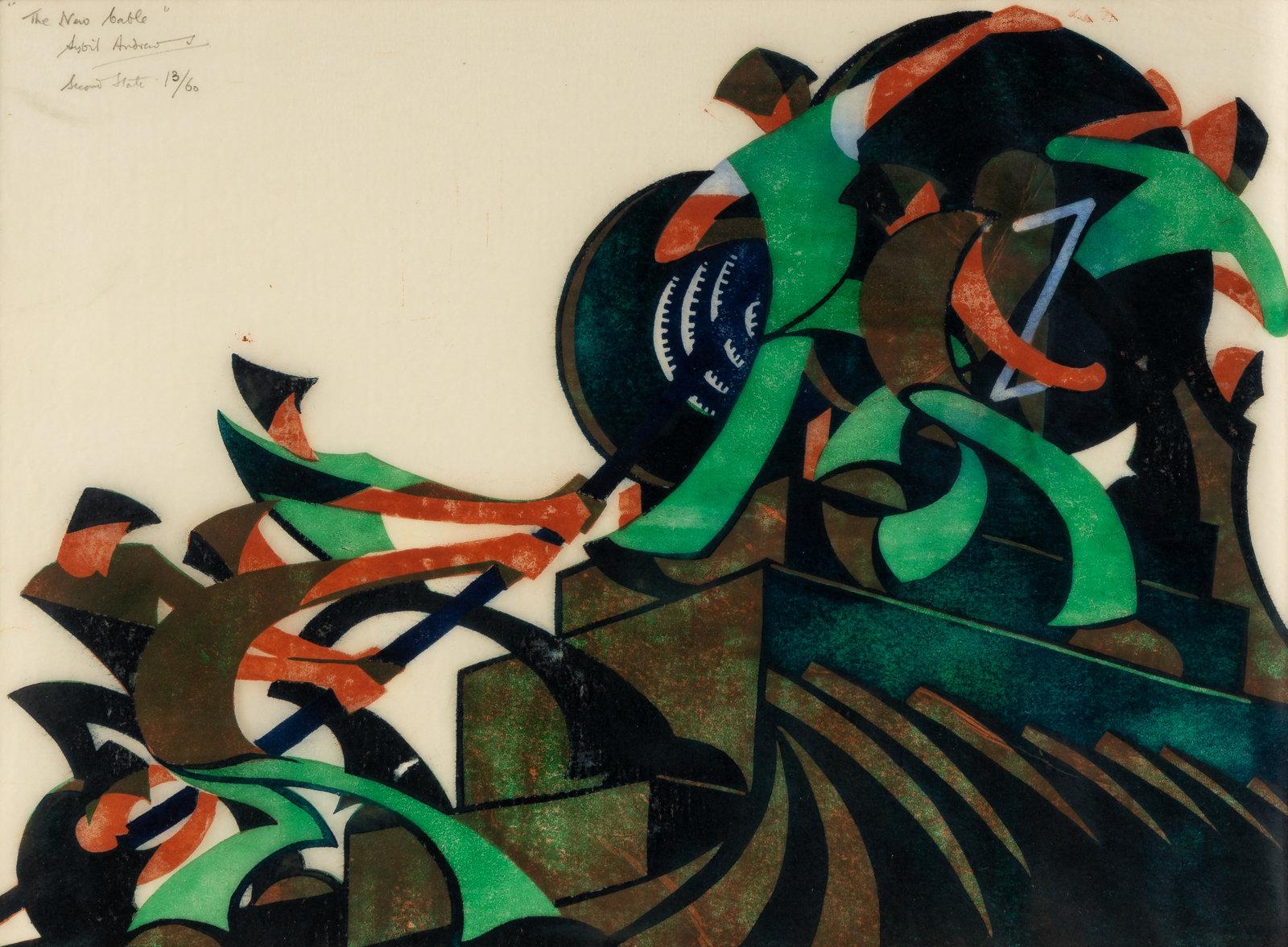
The New Cable British Modern Mid 20th Century Vorticist European Vorticism Woman Sybil Andrews CPE (British/Canadian, 1898-1992) "The New Cable," 1931 12 x 16 1/2 inches Color linocut Signed, titled, inscribed 'Second State', and numbered 13/60 in pencil Framed: 19 x 24 inches Literature: Coppel Sa17 Illustrated on page 10 of the catalog The proposed edition of the first state of the Giant Cable was 50, but only 30 impressions were pulled. Andrews removed the blue background for the second state, which was published under the title The New Cable in an edition of 60. BIO Sybil Andrews was a printmaker, painter, graphic artist and educator who was born in Bury St. Edmonds, Suffolk, England. She moved to London (England) in 1922. In 1947, she emigrated to Campbell River (Vancouver Island) British Columbia, Canada, where she worked, taught and lived for the rest of her life. She died at a hospital in Victoria (B.C.) Her mediums were the colour linocut (1) (most famous), etching, posters, pastels, ink, watercolour, monoprint and oil. Her subjects were human activity (at work, sports, travel, etc.), figures, animals, genre, allegory, architecture and landscape. Her style was Art Deco (see AskART styles), Futurism, Cubism and Vorticism (2). Her work is identified by a simple format, clean lines, distortion, vivid colours, drama and rhythm. Quote: "The colour linocut was just the medium for me, being interested in dynamics and ideas and patterns... It is impossible to be fussy with lines, you have to simplify, you are forced to simplify your idea to its fundamentals." Andrews produced 76 linocuts in her life, of which 43 were made from 1929 to 1939, which is considered to be her best period. John Hassall's art correspondence course (1918) was the beginning of her formal art education. She went from there to Heatherley's School of Fine Art (London/1922) where she studied under Henry Massey (see AskART) and met artistic partner Cyril Power (see AskART). At the same time, she studied independently with sculptor Henri Glicenstein (see AskART) who taught her drypoint etching and to draw from life. She also attended the Grosvenor School of Modern Art (1925). Iain McNab (1890-1967) was Principal and Claude Flight (3) (see AskART) an instructor who had a great influence on her choice of linocut as a primary medium. Some of his other students and her associates were Edith Lawrence (1890-1973), Lill Tschudi (1911-2001), Eileen Mayo (see AskART) and William Greengrass (1896-1970). After emigrating to Canada she taught art continuously until a month before her death. She was elected a member of the Canadian Painters - Etchers Society (after 1976 the Print and Drawing Council of Canada) in 1951. She began exhibiting her work in 1921.In 1929 she was included in "The First Exhibition of British Linocuts...

Category

1930s Modern Figurative Prints

Materials

Linocut

Abstract American Modernism Mid-Century WPA Era Drawing Woodstock 20th Century

Abstract American Modernism Mid-Century WPA Era Drawing Woodstock 20th Century

By Konrad Cramer

Located in New York, NY

Abstract American Modernism Mid-Century WPA Era Drawing Woodstock 20th Century, Sight size is 16 x 12 inches. Konrad Cramer (1888-1963) Abstract Mixed media on paper 17 x 12 inches ...

Category

1930s Abstract Abstract Drawings and Watercolors

Materials

Paper, Ink, Watercolor

Surreal Abstract Mid 20th Century American Modern Woman Artist Work on Paper 40s

Surreal Abstract Mid 20th Century American Modern Woman Artist Work on Paper 40s

By Juanita Guccione

Located in New York, NY

Surreal Abstract Mid 20th Century American Modern Woman Artist Work on Paper 40s Juanita Guccione (1904 - 1999) "Surreal Abstract" 11 1/2 x 18 12 inches Watercolor and mixed media o...

Category

1940s Abstract Abstract Drawings and Watercolors

Materials

Watercolor, Gouache, Paper

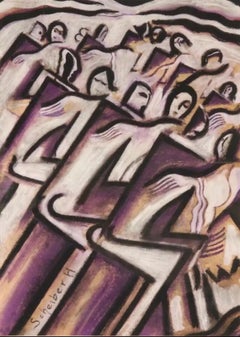
Deco Dancing Hungarian Expressionism European Drawing Modernism Figurative Dance

Deco Dancing Hungarian Expressionism European Drawing Modernism Figurative Dance

By Hugó Scheiber

Located in New York, NY

Deco Dancing Hungarian Expressionism European Drawing Modernism Figurative Dance. 22 1/2 x 16 inches. Signed lower left. Framed. BIO Hugó Scheiber was born in Budapest in 1873. At the age of eight, he moved with his family from Budapest to Vienna. In 1898, to help support his family after they had returned to Budapest. He started working during the day, attending painting classes at the Commercial Art School in the evening. In 1900, he completed his studies. Scheiber showed an early interest in German Expressionism and Futurism. In 1915 he met Marinetti, who invited him to join the Futurist movement. Because Scheiber's paintings conflicted with academic style of the Hungarian art establishment, his work was virtually ignored in his own country. In 1919, he and his friend Béla Kádár held an exhibition organized by Hévesy in Vienna, which was a great success, so much so that the Budapest Art Museum purchased two of his drawings. In 1920, Scheiber returned to Vienna. A turning point in his career came in 1921 when Herwarth Walden, founder of Germany's leading avant-garde periodical, Der Sturm...

Category

1920s Art Deco Figurative Drawings and Watercolors

Materials

Paper, Gouache

You May Also Like

Abstract Composition - Signed Painting Hungarian Cubism

Abstract Composition - Signed Painting Hungarian Cubism

By Alfred Reth

Located in London, GB

ALFRED RETH 1884-1966 Budapest 1884-1966 Paris (Hungarian/French) Title: Abstract Composition, 1939 Technique: Original Signed and Dated Oil and Mixed Technique painting on Board ...

Category

1930s Cubist Abstract Paintings

Materials

Oil

'Time Silhouette' —Mid-Century Modernism

'Time Silhouette' —Mid-Century Modernism

By Edward August Landon

Located in Myrtle Beach, SC

Edward Landon, 'Time Silhouette', color serigraph, 1969, edition 30, Ryan 201. Signed, titled, and annotated 'Edition 30' in pencil. A fine impression, with fresh colors, on cream wo...

Category

Mid-20th Century American Modern Abstract Prints

Materials

Screen