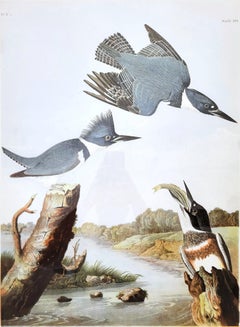
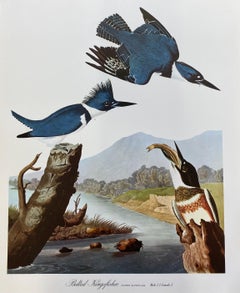
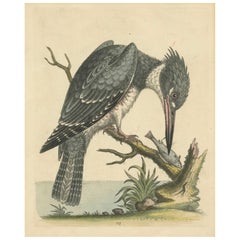
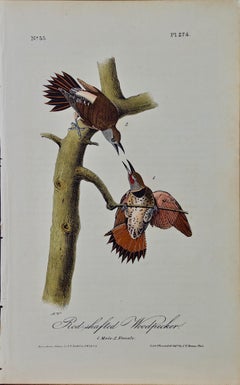
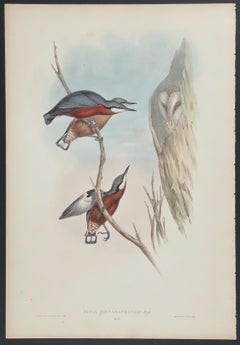
Original hand-colored antique bird print showing an American Kingfisher from the book "A Natural History of Uncommon Birds" (1743-1751) by George Edwards.
This hand-colored engraving showcases the bird perched on a branch, holding a fish in its beak.
The kingfisher is characterized by its distinctive plumage, with a slate-blue back and wings, a speckled tail, and a prominent crest on its head. Its body is white underneath with some pinkish hues near the breast. The bird's sharp beak is shown spearing a fish, emphasizing its hunting prowess. The surrounding environment includes a simple background with water and vegetation, highlighting the bird's natural habitat. This illustration is part of an increasingly rare and treasured collection of natural history artwork from the 18th century.
George Edwards (1694–1773) was an English naturalist and ornithologist who is often referred to as the "father of British ornithology." His most famous work, "A Natural History of Uncommon Birds" (1743-1751), and its continuation "Gleanings of Natural History" (1758-1764), contain detailed illustrations and descriptions of many bird species, many of which were little known or newly discovered at the time. Edwards' work is highly regarded for its accuracy, artistry, and contribution to the field of ornithology.
About George Edwards:
1. **Early Life and Career**:
- Born in Stratford, Essex, Edwards was apprenticed to a tradesman in London. However, he developed an interest in natural history and began studying birds, insects, and other animals.
- He spent some time traveling in Europe, studying various collections of natural history specimens.
2. **Publications**:
- **"A Natural History of Uncommon Birds" (1743-1751)**: This work is a collection of 210 hand-colored engravings of birds. It is known for its meticulous attention to detail and accuracy in depicting bird species.
- **"Gleanings of Natural History" (1758-1764)**: This series continued the work started in "A Natural History of Uncommon Birds" and included additional birds as well as other animals.
- His publications also included detailed observations and descriptions, making them valuable not only for their artistic merit but also for their scientific content.
3. **Artistic and Scientific Contributions**:
- Edwards was known for his ability to combine artistic skill with scientific precision. His illustrations often depicted birds in lifelike poses and settings, showing their natural behaviors.
- He collaborated with and was influenced by other naturalists and illustrators of his time, such as Carl Linnaeus and Mark Catesby.
- Edwards' works were used by Linnaeus in the development of his system of taxonomy.
4. **Legacy**:
- George Edwards' contributions to ornithology and natural history have had a lasting impact. His detailed and accurate illustrations helped to advance the study of birds and influenced subsequent generations of naturalists and artists.
- His books remain highly prized by collectors and are considered important historical documents in the field of natural history.
### "A Natural History of Uncommon Birds" and Its Importance:
- **Illustrations**: Each illustration in Edwards' work was carefully hand-colored, and the engravings were often accompanied by descriptive text that included observations about the birds' habitats, behaviors, and physical characteristics.
- **Scientific Accuracy**: Edwards took great care to ensure the accuracy of his depictions, often working from specimens he had observed firsthand.
- **Influence**: The work was well-received in its time and remains a significant reference for ornithologists and historians. It contributed to a greater understanding and appreciation of bird species from around the world.
Overall, George Edwards' work represents a critical intersection of art and science during the Enlightenment period, capturing the beauty and diversity of the natural world while contributing to the scientific knowledge of his time.
-------------
The bird depicted is a Belted Kingfisher...
Category
Antique 1740s Prints