Kawase Hasui
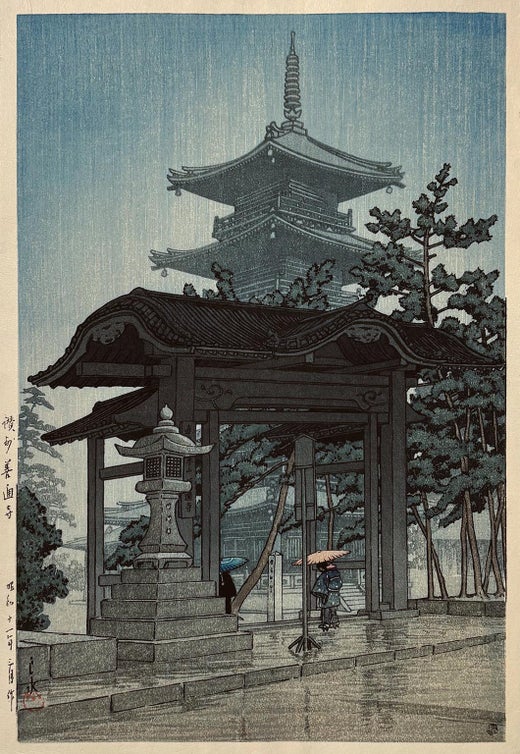
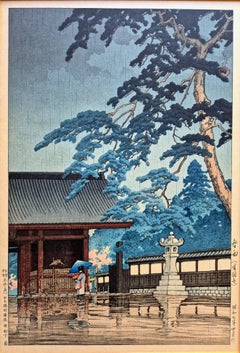
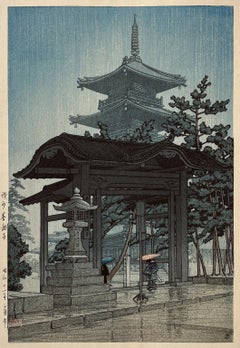
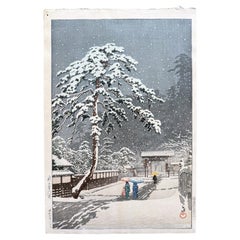
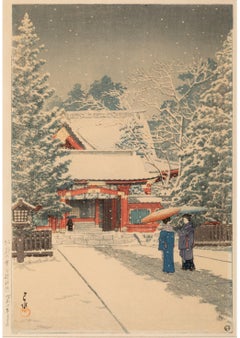
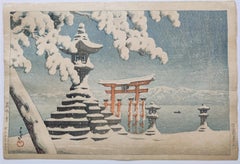
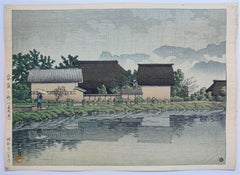
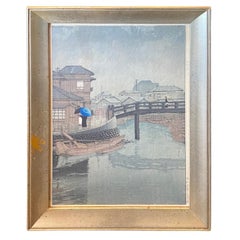
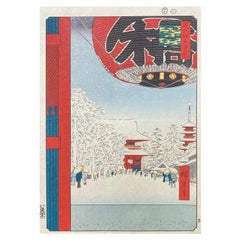
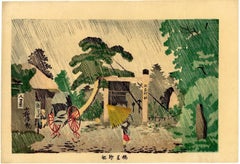
Hasui Kawase (Japanese, 1883 -1957) was an artist, one of modern Japan's most important and prolific printmakers. He was a prominent designer of the shin-hanga ("new prints") movement, whose artists depicted traditional subjects with a style influenced by Western art. Like many earlier ukiyo-e prints, Hasui's works were commonly landscapes, but displayed atmospheric effects and natural lighting. Hasui designed approximately 620 prints over a career that spanned nearly forty years. Towards the end of his life the government recognized him as a Living National Treasure for his contribution to Japanese culture. From youth Hasui dreamed of an art career. His maternal uncle was Kanagaki Robun (1829–94), a Japanese author and journalist, who produced the first manga magazine. Hasui went to the school of the painter Aoyagi Bokusen as a young man. He sketched from nature, copied the masters' woodblock prints, and studied brush painting with Araki Kanyu. His parents had him take on the family rope and thread wholesaling business, but its bankruptcy when he was 26 freed him to pursue art. He approached Kiyokata Kaburagi to teach him, but Kaburagi instead encouraged him to study Western-style painting, which he did with Okada Saburōsuke for two years. Two years later he again applied as a student to Kaburagi, who this time accepted him. Kiyokata bestowed the name Hasui upon him, which can be translated as "water gushing from a spring", and derives from his elementary school combined with an ideogram of his family name. Kawase studied ukiyo-e and Japanese style painting at the studio of Kiyokata Kaburagi. He mainly concentrated on making watercolors of actors, everyday life and landscapes, many of them published as illustrations in books and magazines in the last few years of the Meiji period and early Taishō period. Kawase worked almost exclusively on landscape and townscape prints based on sketches and watercolors he made in Tokyo and during travels around Japan. However, his prints are not merely meishō (famous places) prints that are typical of earlier ukiyo-e masters such as Hiroshige and Katsushika Hokusai (1760-1849). Kawase's prints feature locales that are tranquil and obscure in urbanizing Japan. Hasui Kawase's works are currently kept in several museums worldwide, including the British Museum, the Toledo Museum of Art, the Brooklyn Museum, the Indianapolis Museum of Art, the Museum of Fine Arts, Boston, the Metropolitan Museum of Art, the Portland Art Museum, the Los Angeles County Museum of Art, the University of Michigan Museum of Art, the Minneapolis Institute of Art, the Stanley Museum of Art, the Walters Art Museum, the Clark Art Institute, the Smart Museum of Art, the Nelson-Atkins Museum of Art, and the Virginia Museum of Fine Arts.