Paul Serrusier (1864-1927)
La Fin Du Jour (The End of the Day)
Color lithograph printed on canary yellow paper, 1893
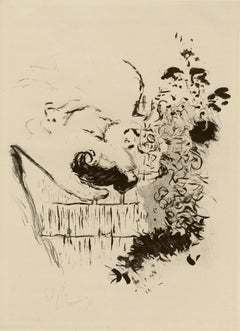
Signed and numbered in pencil lower left (see photo)
Edition 100, annotated "No. 89" in pencil
As publsihed in L'Estampe Originale, no. 2, 1893
Published by Andre Marty, Paris in L’Estampe originale, Album II, April–June 1893
Printed by Auguste Clot, Paris of Edward Ancourt
The use of the yellow paper is inspired by Gauguin's use of the same yellow paper for the zincographs of the Volpini album. In the artist's printing instructions, he ordered the use of a light green in the sky and fields.
Condition: Excellent color, sheet trimmed
Image size: 9 1/8 x 11 3/4 inches
Sheet size: Aprox. 13 x 15 3/4 Trimmed from original sheet suze as issued in L'E O
Frame size: 18 x 21 inches
Reference: Boyer and Cale 80
Stein and Karshan 80
Boyle-Turner, Caroline, The Prints of the Pont-Aven School, No. SR.2C
Provenance: Paul Proute, S.A.
Robert & Catherine Lichtenauer, Indianapolis
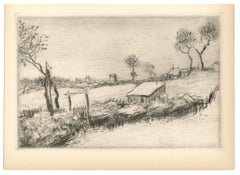
A solitary agricultural worker stands near the center of an undulating Breton field, his body bent slightly forward after the completion of the day’s labor. A spade or agricultural implement lies on the ground beside him. Behind the figure, a loosely constructed fence winds across the hillside, while a procession of pollarded and leafless trees follows the descending contour at right. A farmhouse or enclosed farm compound appears at the upper left, partially screened by a compact silhouette of trees. Although the subject is drawn from rural life, Sérusier has transformed the scene into a highly ordered arrangement of lines, planes and tonal contrasts.
The print’s original title appears to have been simply Paysage; the more descriptive La Fin du jour became attached to it through its imagery and subsequent cataloging. The work was published in April 1893 in the second installment of André Marty’s celebrated portfolio L’Estampe originale. It was printed in an edition of 100 by the Paris lithographic printer Edward Ancourt. The online catalogue raisonné of the Comité Sérusier records the work as H-1893-2.Pay., while the standard print reference is Stein and Karshan 80. The Comité gives the image dimensions as approximately 23 × 29.8 cm and confirms the use of yellow paper and an edition of 100. Comité Sérusier catalogue raisonné
The present impression is particularly desirable because it retains Sérusier’s pencil signature and its individual edition number, “no 89.” This number should be understood as the impression number—89 from the edition of 100—and not as an alternative catalogue number or title. Within the image, the abbreviated “P. Sér.” is printed from the lithographic stone.
Analysis
Sérusier constructs the landscape through a deliberately compressed perspective. The horizon is placed unusually high, leaving most of the composition to the sloping earth. Instead of opening a window onto deep space, he tips the fields upward toward the picture plane. The land becomes an almost continuous surface across which fences, furrows, paths and trees are drawn like calligraphic signs.
This compression reflects the lessons Sérusier learned from Paul Gauguin at Pont-Aven. Naturalistic modeling and conventional atmospheric perspective have been replaced by flattened shapes, rhythmic contours and broad tonal zones. The fence at left does not merely describe a rural boundary: it becomes a repeated decorative pattern, moving laterally across the print. The bare trees at right form an answering rhythm, their crooked trunks resembling pictographic or ideographic marks. The dark horizontal mass at the upper right anchors the otherwise open expanse of the hillside.
The central laborer is remarkably small in relation to the landscape. His bowed head and rounded shoulders suggest physical fatigue, while the discarded or resting spade reinforces the idea of work completed. Yet Sérusier avoids the social realism associated with artists such as Jean-François Millet. The worker is not individualized, and the scene does not function primarily as a narrative of poverty. He becomes instead a dark, concentrated sign placed within the larger rhythms of cultivated nature—a human presence temporarily at rest within an ancient agricultural cycle.
The title lends the scene a temporal and Symbolist dimension. “The end of the day” refers literally to the completion of work, but it also evokes transition: light yielding to darkness, activity to contemplation, and daily effort to silence. There is no spectacular sunset. Sérusier communicates evening through the worker’s posture, the empty fields and the subdued tonal relationships. The image is therefore less a record of a particular hour than an evocation of withdrawal and repose.
The importance of the yellow paper
The canary-yellow paper is not simply a neutral support. It constitutes one of the principal colors of the composition, filling the sky, fields and unprinted margins and unifying the entire image in an artificial golden light. Brown and green inks are placed over this colored ground, allowing Sérusier to achieve a surprisingly rich effect with only two printed colors.
The choice also constitutes a deliberate homage to Gauguin’s 1889 Volpini Suite, a series of zincographs likewise printed on vivid canary-yellow paper. The Comité Sérusier specifically notes this relationship, while the Cleveland Museum of Art describes Sérusier’s print as a response to the Volpini Suite. The colored support demonstrates a central principle of Synthetism: color need not reproduce local appearances but may organize and emotionally charge the entire composition. Cleveland Museum of Art
The Newfields/Indianapolis Museum of Art owns a trial proof bearing Sérusier’s instructions to the printer. According to the museum, he approved the proof as bon à tirer—ready for printing—but requested that the green be made lighter in the edition. This evidence confirms how carefully Sérusier controlled the interaction among the brown drawing, green tone and yellow sheet. Newfields
Sérusier, Pont-Aven and the Nabis
Born in Paris on November 9, 1864, Louis-Paul-Henri Sérusier was educated at the Lycée Condorcet before entering the Académie Julian in 1886. His academic training was disrupted decisively during a visit to Pont-Aven in Brittany in 1888. There he met Paul Gauguin, who encouraged him to paint according to the perceived intensity of color rather than the literal appearance of nature.
Under Gauguin’s direction, Sérusier painted the small panel now known as Le Talisman, l’Aven au Bois d’Amour. Its patches of yellow, green, blue and orange transformed a woodland landscape into an arrangement approaching abstraction. When Sérusier returned to Paris, he showed the panel to fellow Académie Julian students Maurice Denis, Pierre Bonnard, Paul Ranson and Henri-Gabriel Ibels. It became a foundational object for the group that called itself the Nabis—from the Hebrew word nabi, meaning prophet.
Sérusier thus occupied a crucial position between the Pont-Aven School and the Nabis. The Pont-Aven School was not a formal institution but a loosely associated community of artists working in and around Pont-Aven and Le Pouldu. Led intellectually by Gauguin and Émile Bernard, these artists rejected Impressionism’s concentration on fleeting optical effects. In its place they developed Synthetism: a synthesis of observed nature, the artist’s emotional response and the formal organization of color and line. Cloisonnism—the use of broad, flat color areas bounded by emphatic contours—was one of its characteristic visual languages.
Sérusier brought these principles back to Paris and helped translate Gauguin’s experiments into the theoretical foundation of Nabi art. Maurice Denis’s celebrated formulation—that a painting is, before representing any subject, a flat surface covered with colors assembled in a particular order—describes precisely the transformation visible in La Fin du jour. The print remains legible as a Breton landscape, but its expressive force arises from its flatness, patterned contours and carefully balanced shapes.
During the early 1890s, Sérusier repeatedly returned to Brittany, particularly Huelgoat. He regarded the region not simply as picturesque countryside but as a repository of archaic customs, spiritual traditions and a seemingly timeless relationship between people and the land. His Breton peasants are frequently generalized into monumental or symbolic presences. In La Fin du jour, that tendency is distilled into unusually economical graphic form.
Sérusier later studied aspects of medieval and Renaissance art, Catholic thought, esoteric philosophy and mathematical proportion. He taught at the Académie Ranson and gathered his theories in ABC de la peinture, published in 1921. His later work became increasingly governed by geometric structure and harmonious proportional systems. He died at Morlaix, Brittany, on October 7, 1927.
Importance of the print
La Fin du jour is important for several interconnected reasons. Sérusier produced relatively few prints, making this one of the clearest graphic statements of his mature Pont-Aven and Nabi aesthetic. It belongs to 1893, a central year in the development of French color lithography, when artists were exploiting printmaking as an independent creative medium rather than merely as a vehicle for reproducing paintings.
Its publication in L’Estampe originale also gave it a distinguished avant-garde context. André Marty’s portfolio, issued in nine installments between 1893 and 1895, brought original prints by artists including Toulouse-Lautrec, Gauguin, Pissarro, Renoir, Redon, Bonnard, Vuillard, Denis and Ranson to an international circle of subscribers. Each print was conceived as an original work and printed in a limited edition of 100. Sérusier’s inclusion placed him within the most experimental current of fin-de-siècle printmaking.
Finally, the print records the transmission of Gauguin’s Pont-Aven innovations into Nabi art. Its high horizon, tilted fields, serpentine fence, non-naturalistic yellow ground and simplified figure demonstrate how a recognizable landscape could be reorganized into a decorative and emotionally suggestive surface. The result anticipates later modernist efforts to reconcile representation with abstraction.
Confirmed museum holdings
Institutions holding an impression, proof or portfolio example of Paysage (La Fin du jour) include:
Cleveland Museum of Art, accession 2004.39: lithograph in green and brown on yellow wove paper; edition of 100; Stein and Karshan 80. Collection record
Van Gogh Museum, Amsterdam, accession p1093V2000: an edition impression, cataloged as a two-color lithograph on yellow wove paper, sheet 41.5 × 57.1 cm. The museum also holds a separate trial proof, accession p2451V2004. Edition impression and trial proof
Minneapolis Institute of Art, accession 2000.55.2: an impression from L’Estampe originale, Album II. Collection record
High Museum of Art, Atlanta, accession 1980.12: purchased with funds from the Lawrence and Alfred Fox Foundation for the Ralph K. Uhry Collection. Collection record
Newfields/Indianapolis Museum of Art, accession 1998.211: a trial proof formerly in the Samuel Josefowitz collection, containing Sérusier’s printing instructions. The museum appears also to catalog another impression under accession 2012.55. Collection record
Petit Palais, Musée des Beaux-Arts de la Ville de Paris, accession PPG4765: an impression from the second installment of L’Estampe originale, printed in brown on yellow wove paper. Paris Musées object information
Bibliothèque nationale de France, Paris: an impression from the second album of L’Estampe originale, cataloged as Paysage, dit aussi Paysage, La Fin du jour. BnF presentation
Conclusion
La Fin du jour is a particularly pure statement of Sérusier’s importance as the connecting figure between Gauguin’s Pont-Aven circle and the Parisian Nabis. Its rural subject remains immediately intelligible, but observation has been subordinated to design: the fields are flattened, trees become rhythmic signs, and yellow paper transforms the entire landscape into a field of expressive color. The worker’s small, weary presence gives the composition its human and poetic center. Numbered 89 from the edition of only 100 and retaining Sérusier’s pencil signature, the present impression represents one of the artist’s most important and institutionally well-represented graphic works.