By Paul Jeffay
Located in Soquel, CA
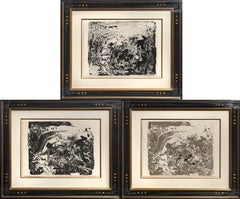
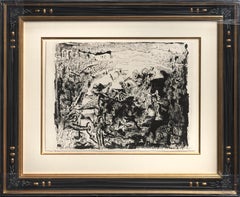
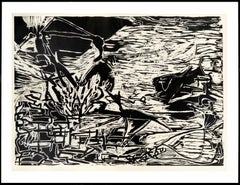
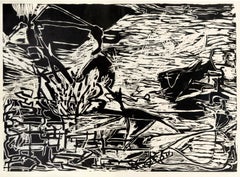
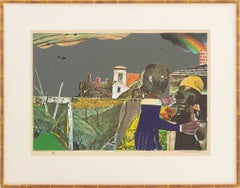
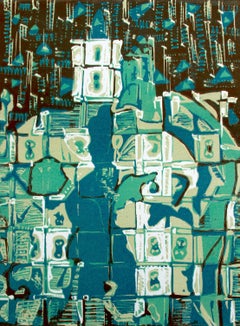
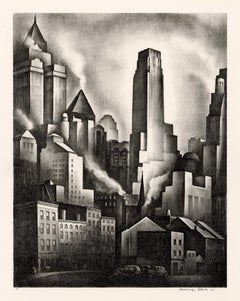
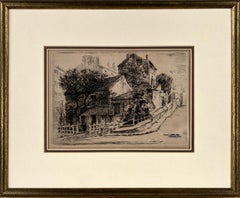
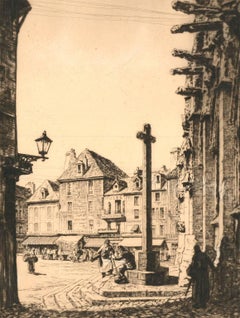
Caberet du Lapin Agile, Montmartre, Paris - 13/250
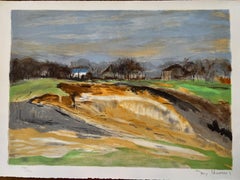
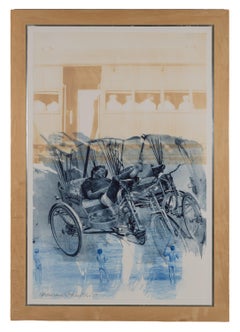
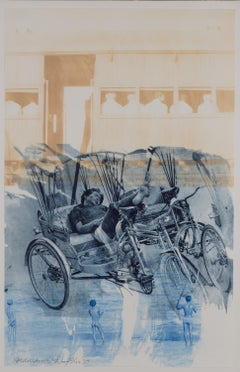
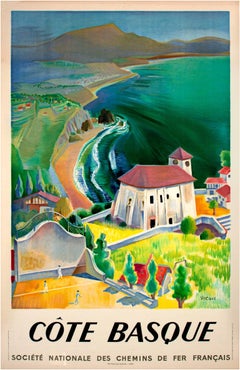
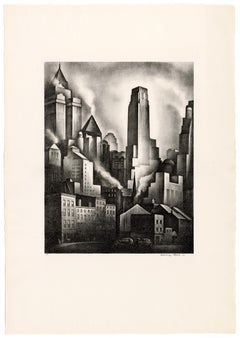
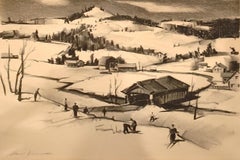
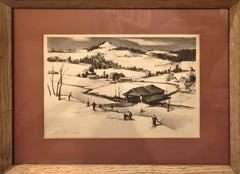
This charming etching depicts a French residential street scene by Saul Yaffie a.k.a., Paul Jeffay (Scotland, 1898–1957) in varying shades of lights and darks with intricately made hash marks.
Frame Size: 12.25"H x 14.88"W.
Image size: 6"H x 8.75"W.
Signed lower right Paul Jaffay and lower left "13 of 250" (impressions)
Saul Yaffie, a.k.a. Paul Jeffay, (1898–1957) was a Scottish Jewish artist. Known for his charming French street scenes as well as his Judaica work. Saul Yaffie is listed in the Glasgow School of Art's World War One Roll of Honor. After (1918) the armistice Saul returned briefly to Glasgow, before ‘try[ing] his luck in Paris’ (Schotz, pg. 64). It is around this time that Saul began to sign his work with the pseudonym ‘Paul Jeffay’.He later went by the name Paul Jeffay, and much of his work is signed under this name.
Saul Yaffie was born in Blythswood, Glasgow on 29 April 1898. His mother was Kate Yaffie (née Karkonoski), and his father, Bernard Yaffie, was a master tailor. Like many Russian Jews, Kate and Bernard Yaffie fled persecution in Russia during a wave of anti-Jewish pogroms triggered by the assassination of Tsar Alexander II in 1881. Saul's father was naturalised as a British citizen by the time that Saul himself was three; a Bernard Yaffie is recorded as living at Abbotsford Place in the old Gorbals, where the young Saul spent the early years of his childhood. The Yaffies were not unique in their situation: the Gorbals was the centre of Scotland's Jewish community and home to a large proportion of Glasgow's immigrants throughout the early 20th century. Over time, there was a movement to some of the more affluent communities in Glasgow, such as Pollokshields and Garnethill, as many Jewish families gradually improved their social and economic situation. Like these, the Yaffies also experienced a time of good fortune, moving to a more agreeable address on Sinclair Drive, Cathcart as Bernard's tailoring business prospered.
Saul attended day classes in drawing and painting, modelling, and life drawing at The Glasgow School of Art from 1912 to 1919. During the First World War, he was required to interrupt his studies to serve in the King's Own Scottish Borderers in 1916/17. Although subject to military conscription, Yaffie reached the rank of corporal during his service. Prior to his conscription Yaffie engaged in munitions work, something that was recorded in the GSA's student registers.
The post-war economic depression that affected the country during the 1920s, also affected the Yaffie family directly: Bernard Yaffie's business suffered greatly, and the family eventually emigrated to Canada. Saul did not emigrate with his family, choosing instead to stay in Europe, and relocate to jazz age Paris where he continued his artistic practice. Now married, Saul sought to escape persecution in Europe by returning to the UK before the Second World War with his wife, Estusia. The two settled in Manchester, but returned to France after the war.
In his memoires ‘Bronze in My Blood’, German-born sculptor Benno Schotz describes a Saul ‘Yaffe’, one of only three other Jewish students who attended The Glasgow School of Art at the time. (Schotz himself was exempt from joining the forces because he was ‘not yet a British subject’, and was engaged in war work in the drawing office of John Brown’s shipyards). On the outbreak of the war, Schotz writes, Yaffie won a poster competition to be displayed in Glasgow tramcars at the beginning of the 1914-18 war – his winning design depicted a woman with a child in her arms, fleeing from a fire behind her. While on leave from service, the young Saul told Schotz he had briefly been stationed in the same unit as Jewish American sculptor Jacob Epstein. This was most likely the 38th Battalion of the Royal Fusiliers...
Category
Mid-20th Century Post-War Landscape Prints
MaterialsEtching, Paper, Drypoint