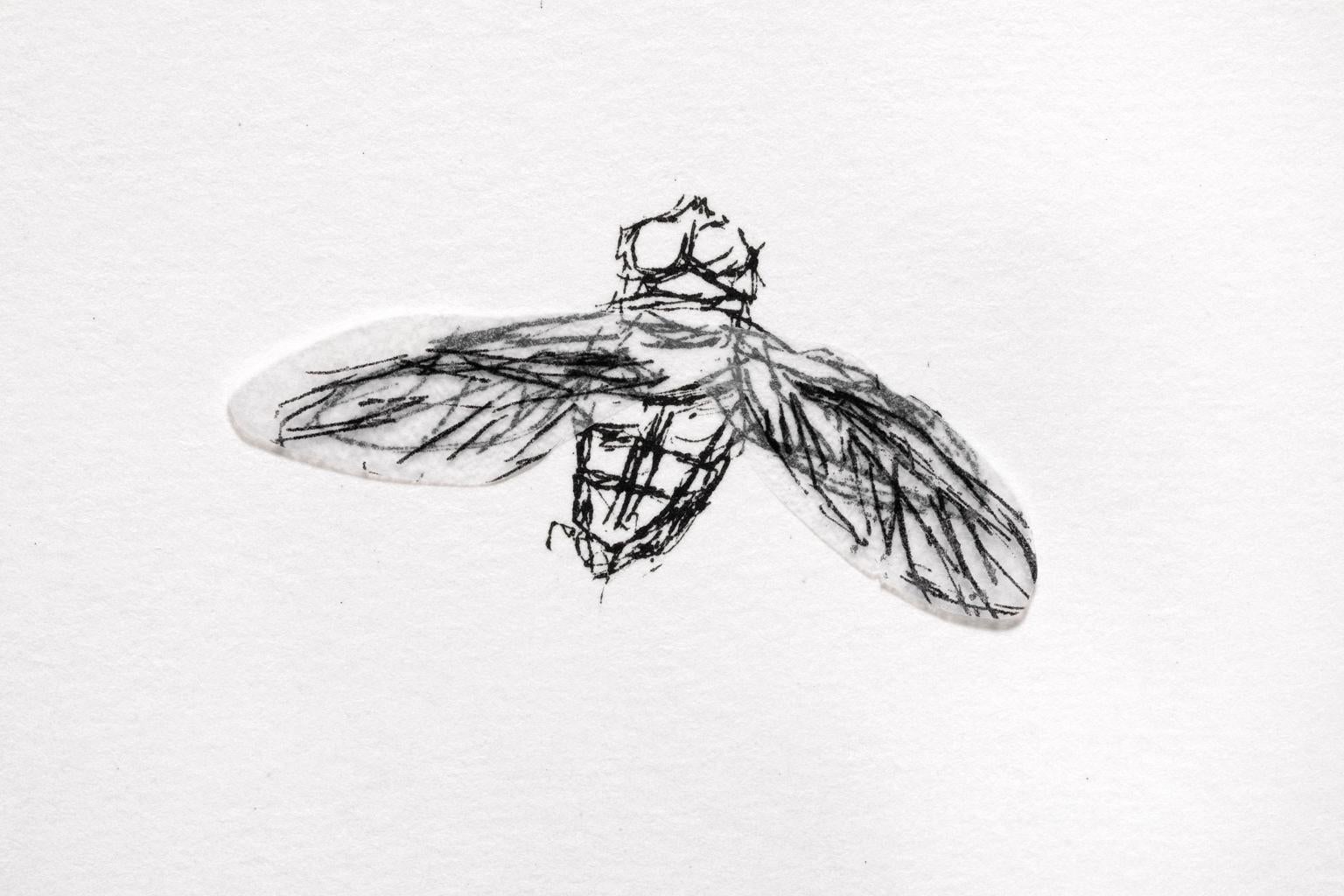
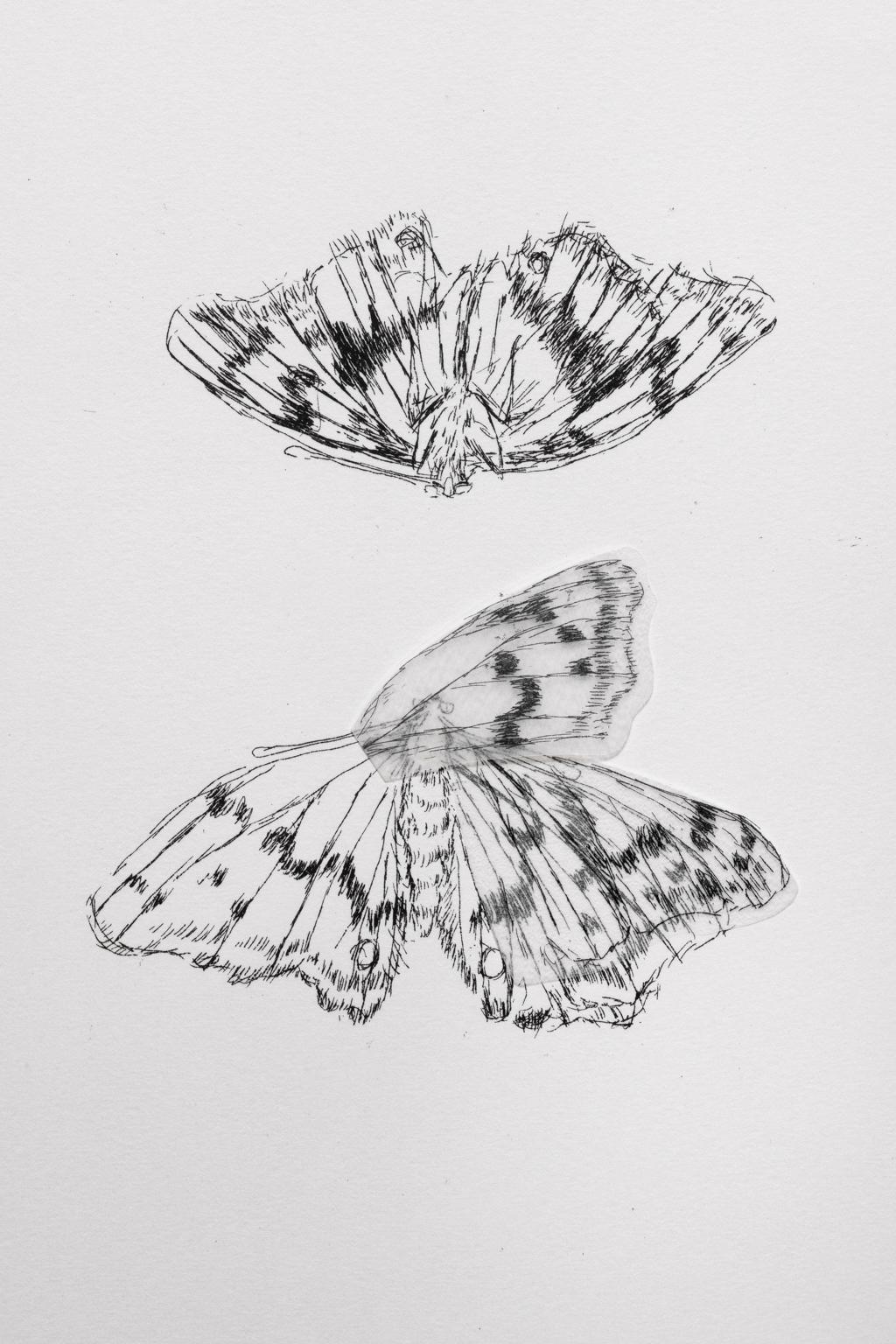
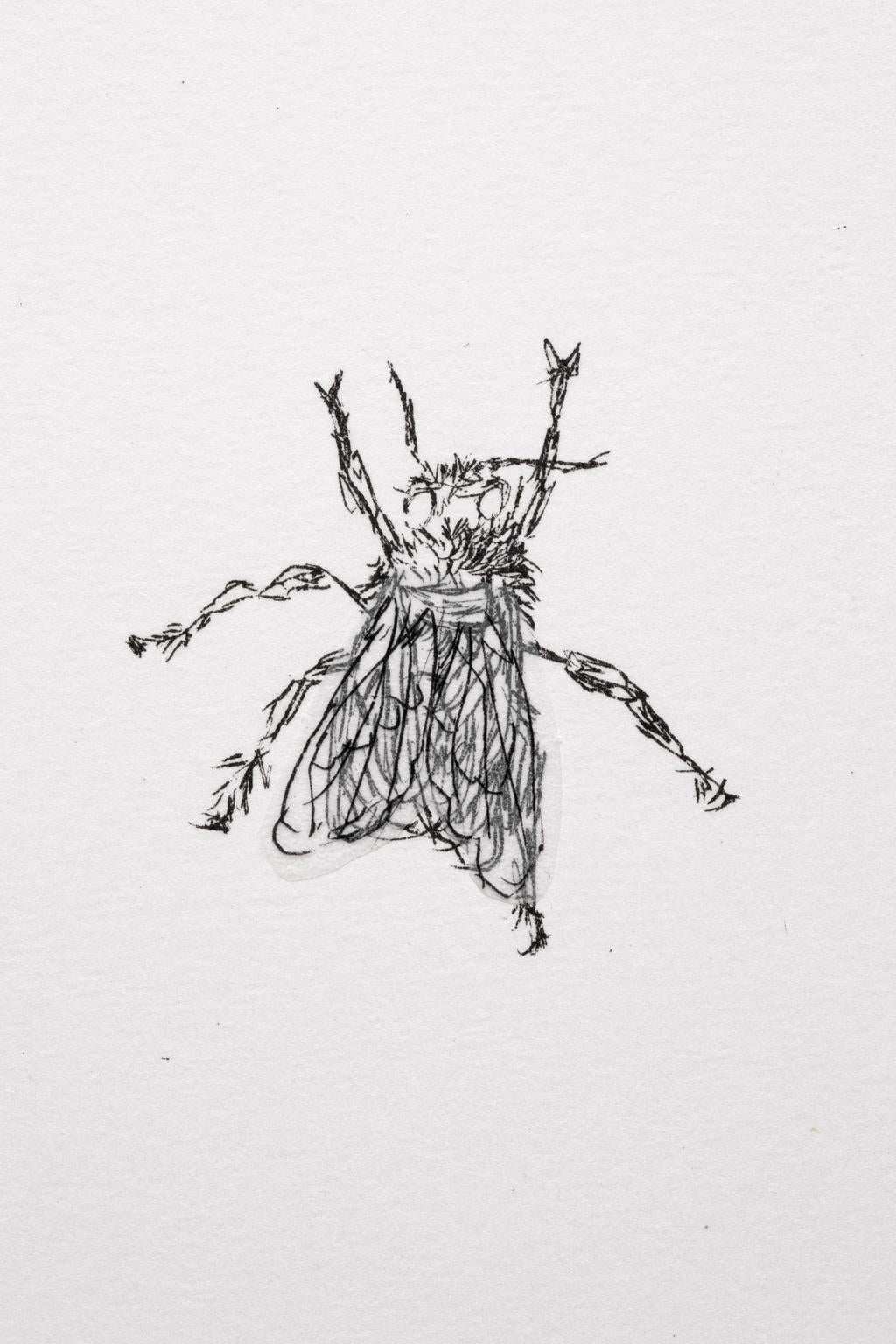
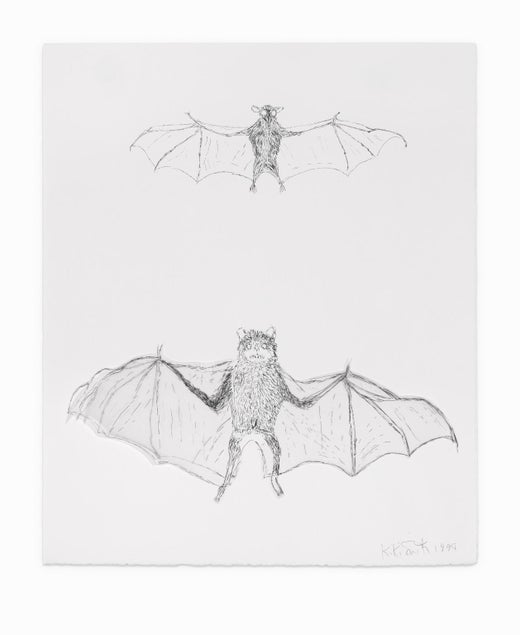
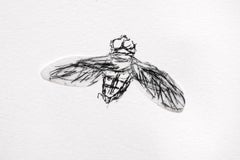
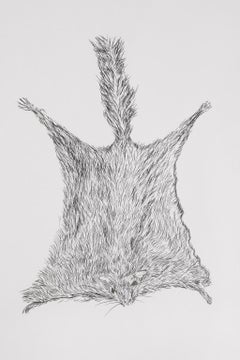
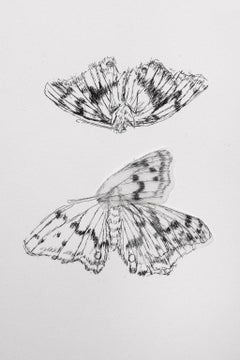
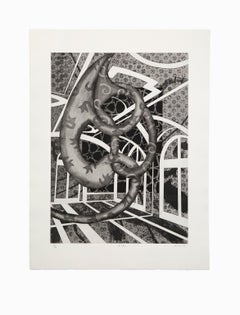
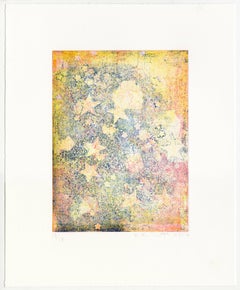
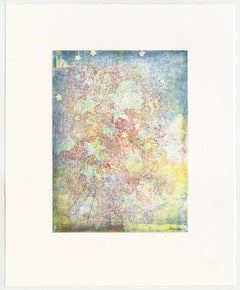
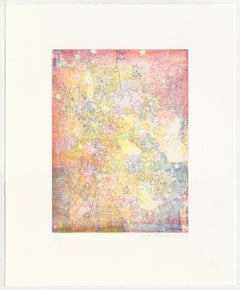
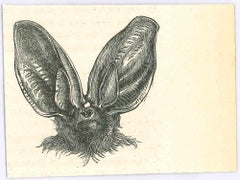
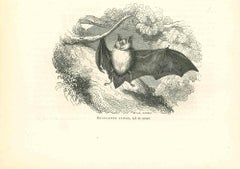
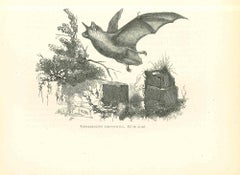
A collage lithograph from her series Various Flying Creatures by Kiki Smith titled: "bat." Smith has used one of her animal/insect iconic figures for this glassine paper and wove paper lithograph collage creating the bat close to life size and therefore causing the viewer to look very closely at the subject. This piece is signed and dated on the lower front. Wove paper size measures 19 3/4 x 16 1/2. It is #287 B6 marked on verso from a run of 300. Published by Griffel Kunst Association, Hamburg, Germany.
Kiki Smith (1954 - ) is a West German-born American artist. Her work encompasses many themes: sex, birth, regeneration and death along with personal investigation of her life and those of her family. Her figurative work of the late 1980s and early 1990s confronted subjects such as AIDS and gender. Her recent works have depicted the human condition in relationship to nature. Smith lives and works in New York City and the Hudson Valley, New York State.
Her father was sculpture artist, Tony Smith and her mother was actress and opera singer Jane Lawrence. Although Kiki's work takes a very different form than that of her parents, early exposure to her father's process of making geometric sculptures allowed her to experience formal craftsmanship firsthand.
Smith was enrolled at Hartford Art School in Connecticut for eighteen months from 1974 to 1975, then moved to New York City in 1976 and joined Collaborative Projects (Colab), an artist collective. The influence of this radical group's use of unconventional materials can be in seen in her work. For a short time in 1984, she studied to be an emergency medical technician and sculpted body parts, and by 1990, she began to craft human figures.
In addition to print making Kiki Smith has created in a number of different mediums such as film, sculpture, tapestries, books and the confines of commissions.
She experimented in a wide range of printmaking processes. Some of her earliest print works were screen-printed dresses, scarves and shirts, often with images of body parts. In association with Colab, Smith printed an array of posters in the early 1980s containing political statements or announcing Colab events. In 1988 she created "All Souls”, a fifteen-foot screen-print work featuring repetitive images of a fetus, an image Smith found in a Japanese anatomy book. Smith printed the image in black ink on 36 attached sheets of handmade Thai paper.
MoMA and the Whitney Museum both have extensive collections of Smith's prints. In the "Blue Prints" series, 1999, Kiki Smith experimented with the aquatint process. The "Virgin with Dove” was achieved with an airbrushed aquatint, an acid resist that protects the copper plate. When printed, this technique results in a halo around the Virgin Mary and Holy Spirit.
She has particular themes that she explores in all of her works and what is captured on a print will sometimes appear on a tapestry.
Smith's has received the Nelson A. Rockefeller Award from Purchase College School of the Arts (2010), Women in the Arts Award from the Brooklyn Museum (2009), the 50th Edward MacDowell Medal (2009), the Medal Award from the School of the Museum of Fine Arts, Boston (2006), the Athena Award for Excellence in Printmaking from the Rhode Island School of Design (2006), the Skowhegan Medal for Sculpture from the Skowhegan School of Painting and Sculpture, Maine (2000), and Time Magazine’s “Time 100: The People Who Shape Our World” (2006). Smith was elected a member of the American Academy of Arts and Letters, New York, in 2005.
In 2012, she received the U.S. State Department Medal of Arts from Hillary Clinton.Pieces by Smith adorn consulates in Istanbul and Mumbai. After being chosen speaker for the annual Patsy R. and Raymond D. Nasher Lecture Series in Contemporary Sculpture and Criticism in 2013, Smith became the artist-in-residence for the University of North Texas Institute for the Advancement of the Arts in the 2013–14 academic year. In 2016, Smith was awarded the International Sculpture Center’s Lifetime Achievement in Contemporary Sculpture Award.
Smith’s work can be found in hundreds of personal and corporate collections in addition to many national and international museum collections.