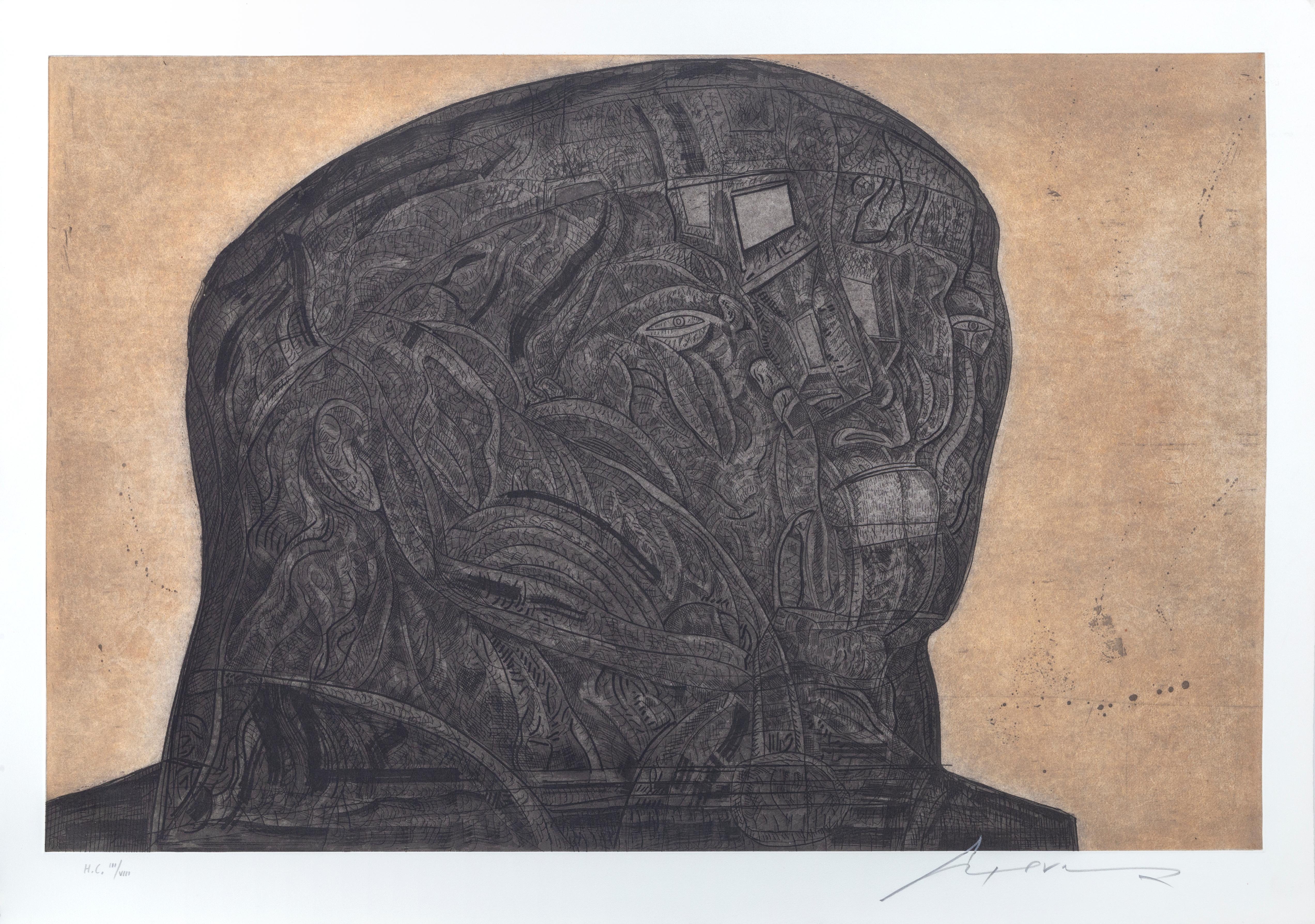
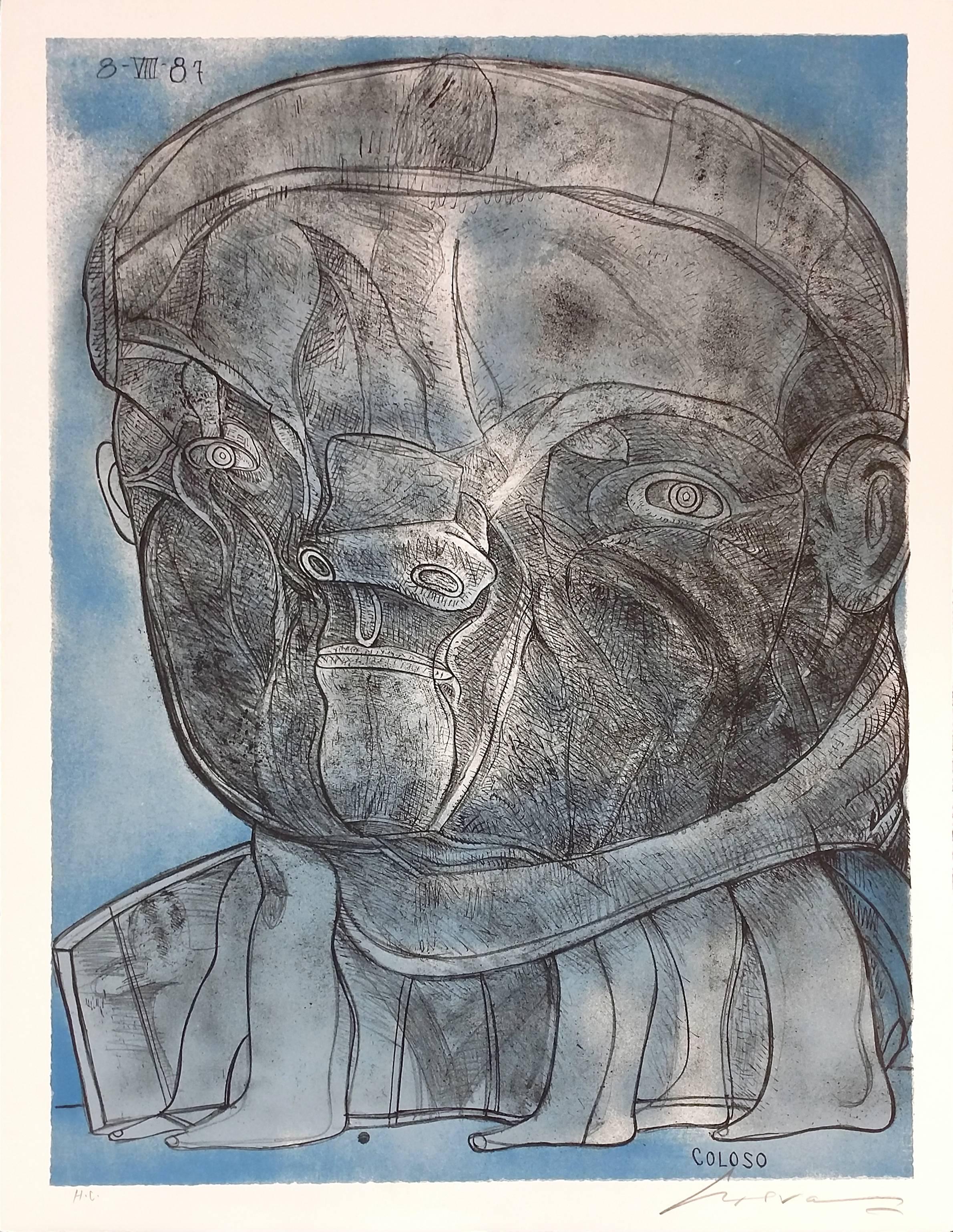
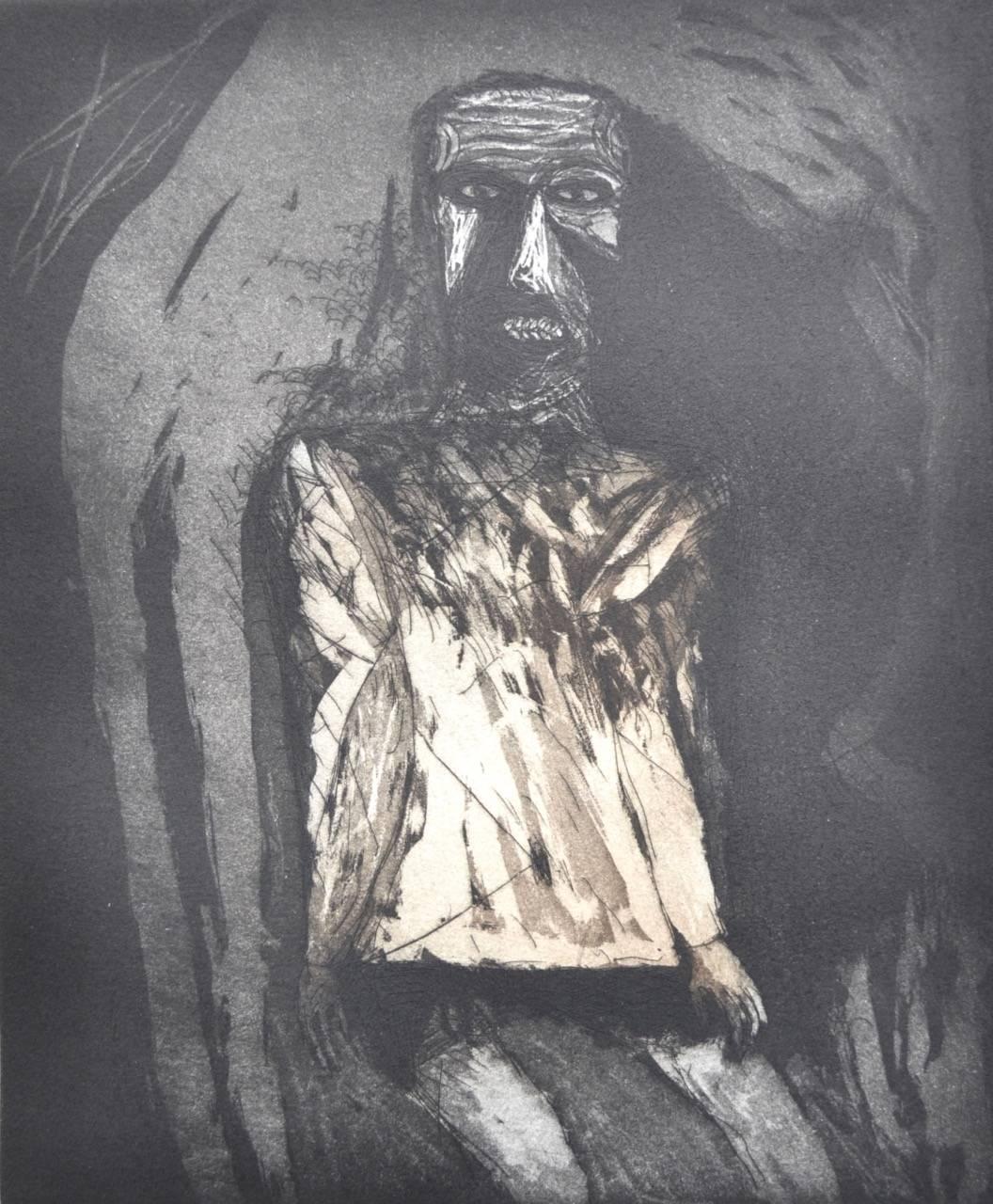
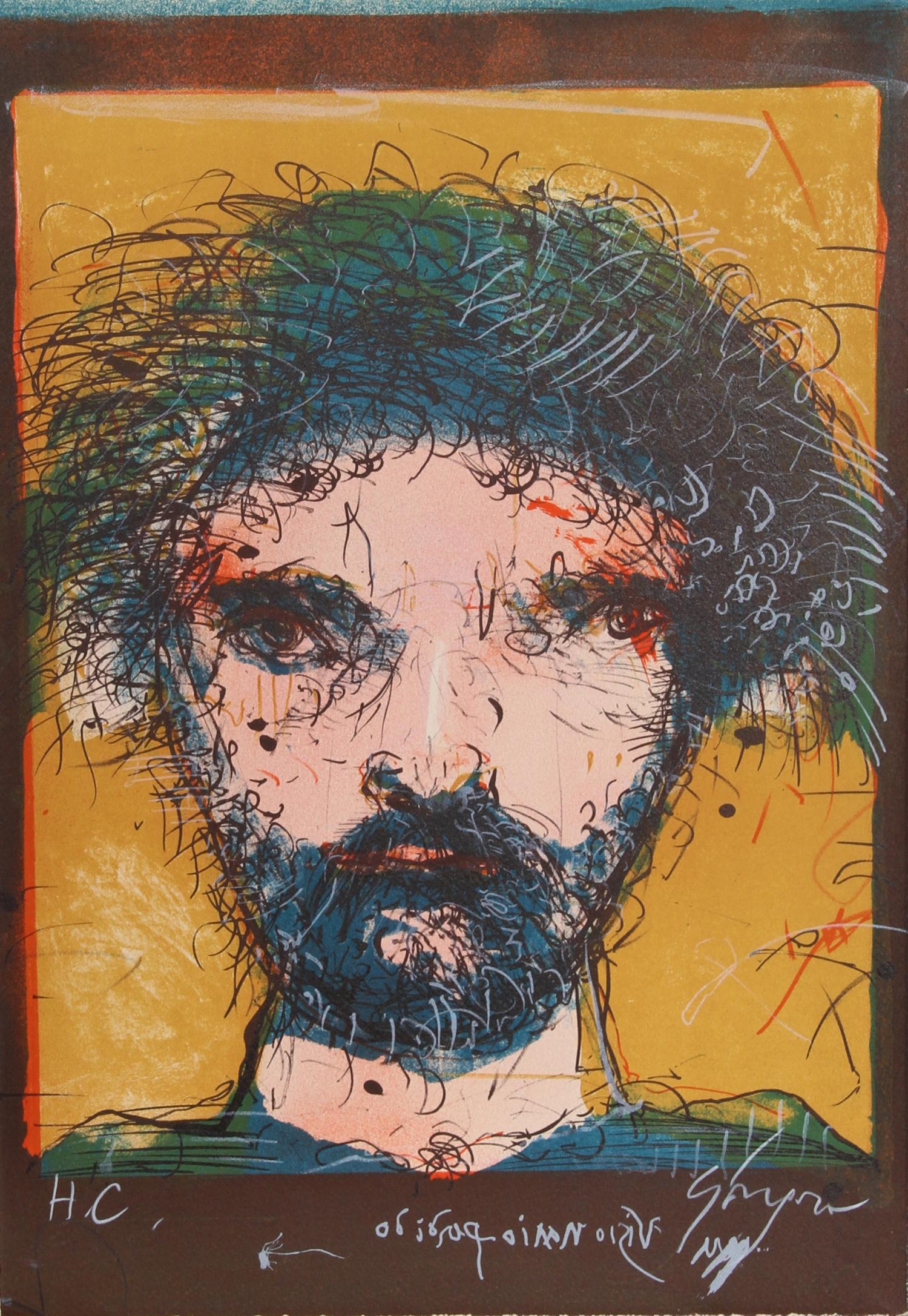
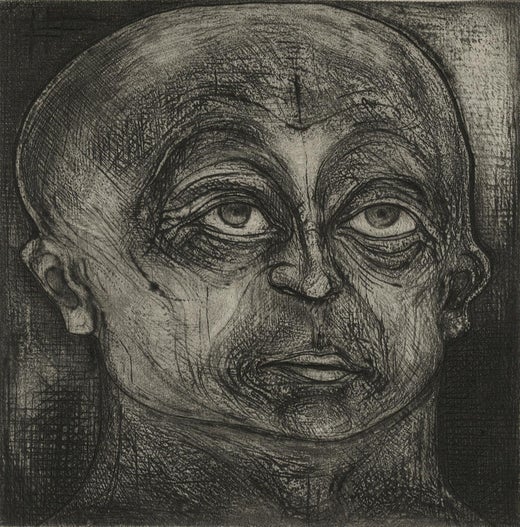
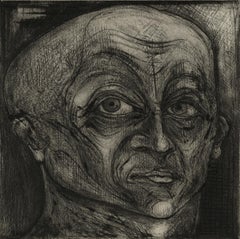
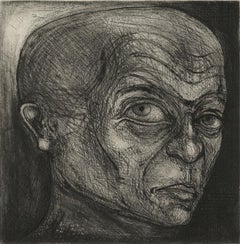
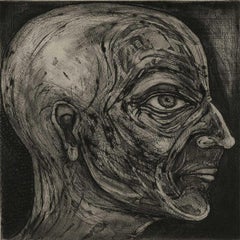
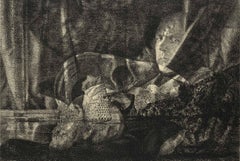
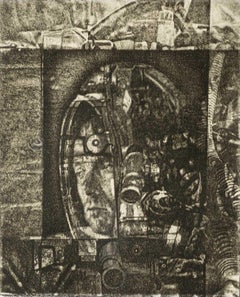
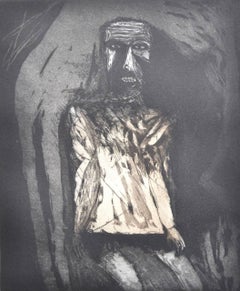
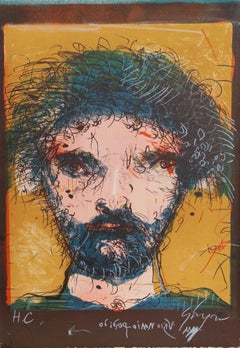
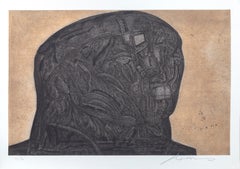
"Mr. Thirteen" is an etching, engraving and drypoint created in 1995, edition: 12 signed in pencil. The print has an embossed chop in the lower right corner, a capital P in a circle indicating that it was printed by Pratt Contemporary Art, Kent, England. This image was issued with a series of 12 small heads titled "One of Twelve". These intaglio prints are based on a sculpture featuring disembodied heads.
The Thirteenth creates a different proportional system and it is suggestive of the multitude, the plurality and the insignificance of the significant.
This is an installation of thirteen heads, twelve of which are identical in dimension and the thirteenth head is much larger. The installation is designed in accordance with geometrical rules. Twelve and the 13th began with twelve blocks of stone, identical in dimension. Within the square block exists a perfect sphere. The sphere, the desired sphere, it is the reflection of a point, a point with no dimension. The journey from one to twelve is an investigation into the desired Sphere. The possibilities of the form are investigated, the many faces of the sphere.
’O Lord how marvellous is Thy face
Thy face, which a young man, if he strove to imagine it, would conceive as a youth's; a full-grown man, as manly; an aged man as an aged man's! Who could imagine this sole pattern, most true and most adequate, of all faces - of all even as of each - this pattern so very perfectly of each as if it were of none other? He would have to go beyond all forms of faces, and all likenesses and all figures. And how could he imagine a face when he must go beyond all faces, and all likenesses and figures of all faces and all concepts which can be formed of a face, and all colour, adornment and beauty of all of all faces? Wherefore he that goeth forward to behold Thy face, so long as he formeth any concept, thereof, is far from Thy face. For all concept of a face falleth short, Lord, of Thy face, and all beauty which can be conceived is less than the beauty of Thy face; every face hath beauty yet none is beauty's self, but Thy face, Lord, hath beauty and this having is being. 'Tis therefore Absolute Beauty itself, which is the form that giveth being to every beautiful form. 0 face exceedingly comely, whose beauty all things to whom it is granted to behold it, suffice not to admire! In all faces is seen the Face of faces, veiled, and in a riddle; howbeit unveiled it is not seen, until above all faces a man enter into a certain secret and mystic silence where there is no knowledge or concept is the state below which Thy face entereth when he goeth beyond all knowledge or concept of a face. This mist, cloud, darkness, or ignorance into which he that seeketh Thy face 'entereth when he goeth beyond all knowledge or concept is the state below which Thy face cannot be found except veiled; but that very darkness revealeth Thy face there, beyond all veils.’²
Twelve is a number, perhaps of a significant value. Any given number is the smaller sum of its proceeding one. Twelve as significant as it may be, it is not more so than the thirteenth.
The shock of displacement was the driving force in Seyed Edalatpour's early work. He found the act of building on a shifting sand a bewildering experience. As a result he framed his practice as research-driven and project-based. The first instance was "Geographical Transformation" in 1987, which became a journey of discovery, gave birth to the idea of self-contained and informed him of the possibility of a path ahead. He then investigated the structure of such possibility in "Self-functional Architecture" where, by the process of de-construction and re-construction, he examined the cultural mechanism in the act of making. "Cannons of Gods", "Zekr", "Farsh", "Twelve and the 13th", " 99names of Gods", "Square" and "Cheheltan" were further studies where Edalatpour sought to strengthen the foundation of his practice. Since 2010, Edalatpour has been working predominantly with wood as a choice material, and examining the condition of man in his current post-existentialist status. In "Circus", Edalatpour's deep affection for man becomes apparent and indeed it is clear that such arrival is the result of his pervious quests but the man he portrays in "Circus" is far from the ancient gods he so admired. He is caught in between inevitabilities.