Want more images or videos?
Request additional images or videos from the seller
1 of 6

Rudolph Ackermann
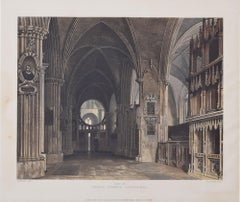
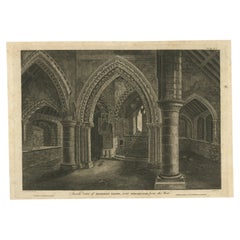
Crypt of St Peter's Church, Oxford engraving by Bluck after Nash for Ackermann

1813

$379.72
£275
€327.87
CA$527.18
A$536.88
CHF 308.19
MX$6,478.39
NOK 3,571.76
SEK 3,620.83
DKK 2,451.31

About the Item

To see our other Oxford and Cambridge pictures, including an extensive collection of works by Ackermann, scroll down to "More from this Seller" and below it click on "See all from this Seller" - or send us a message if you cannot find the view you want. John Bluck (early 19th century) after Frederick Nash (1782 - 1856) Crypt of St Peter's Church, Oxford (1813) Aquatint with original hand colouring 21 x 27 cm Published by Rudolph Ackermann (1764 - 1834). Frederick Nash was born in Lambeth. He studied architectural drawing under Thomas Malton and then enrolled at the Royal Academy of Arts. From 1801 to 1809 he worked with the antiquarians John Britton and Edward Wedlake Brayley, subsequently becoming a member of the Society of Painters in Watercolours - a group of painters who had left the Royal Academy following complaints of under-recognition of their works. Nash became primarily a landscape painter and toured the rivers of Germany. John Bluck was an aquatint engraver, mainly of topographical views, but also of marine and sporting subjects after his contemporaries. He produced plates for numerous publications. Rudolph Ackermann was an Anglo-German bookseller, inventor, lithographer, publisher and businessman. In 1795 he established a print-shop and drawing-school at 96 Strand. Here Ackermann set up a lithographic press and began a trade in prints. He later began to manufacture colours and thick carton paper for landscape and miniature painters. Within three years the premises had become too small and he moved to 101 Strand, in his own words "four doors nearer to Somerset House", the seat of the Royal Academy of Arts. Between 1797 and 1800 Ackermann rapidly developed his print and book publishing business, encompassing many different genres including topography, caricature, portraits, transparencies and decorative prints.
  • Creator:
    Rudolph Ackermann (1764 - 1834)
  • Creation Year:
    1813
  • Dimensions:
    Height: 8.27 in (21 cm)Width: 10.63 in (27 cm)
  • Medium:
  • Period:
  • Framing:
    Framing Options Available
  • Condition:
    Generally very good; trimmed close to platemark at bottom.
  • Gallery Location:
    London, GB
  • Reference Number:
    1stDibs: LU795315046742

More From This Seller

View All
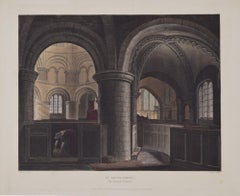
St Sepulchre, The Round Church, Cambridge interior after Pugin for Ackermann

St Sepulchre, The Round Church, Cambridge interior after Pugin for Ackermann

By Rudolph Ackermann

Located in London, GB

To see our other Oxford and Cambridge pictures, including an extensive collection of works by Ackermann, scroll down to "More from this Seller" and below it click on "See all from this Seller" - or send us a message if you cannot find the view you want. John Hill (1770 - 1850) after Augustus Charles Pugin (1762 - 1832) St Sepulchre's - The Round Church (1814) Aquatint with original hand colouring 24 x 29 cm Published by Rudolph Ackermann (1764 - 1834). An interior engraving of the Church of the Holy Sepulchre, Cambridge, the round shape of which is inspired by the rotunda in the church of the Holy Sepulchre, Jerusalem. John Hill was born in London in 1770, and was an engraver's apprentice. He worked in aquatint and largely produced book illustration aquatints. He went to America in 1816 and produced the notable Picturesque Views of American Scenery amongst other books of prints. Augustus Charles Pugin was an Anglo-French artist and architectural draughtsman. Pugin produced views of London, jointly creating the illustrations for the 'Microcosm of London' published by Rudolph Ackermann in 1811, followed by plates for Ackermann's books about Westminster Abbey, Oxford and Cambridge universities, and Winchester College. His later works included illustrations for Specimens of Gothic Architecture (1821–1823), The Royal Pavilion at Brighton (1826), Architectural Antiquities of Great Britain (1826), Specimens of the Architectural Antiquities of Normandy (1827), Illustrations of the Public Buildings of London (1825 to 1828), Paris and its Environs (1829 to 1831), and Examples of Gothic Architecture (1831). He also produced a book of furniture designs called Gothic Furniture, and assisted architects with detailing for their gothic designs. He ran a drawing school at his house in Bloomsbury. Ackermann was an Anglo-German bookseller, inventor, lithographer, publisher and businessman. He attended the Latin school in Stollberg, but his wish to study at the university was made impossible by lack of financial means, and he therefore became a saddler like his father. He worked as a saddler and coach-builder in different German cities, moved from Dresden to Basel and Paris, and then, 23 years old, settled in London. He established himself in Long Acre, the centre of coach-making in London and close to the market at Covent Garden. Ackermann then moved to Little Russell Street where he published Imitations of Drawings of Fashionable Carriages (1791) to promote his coach-making. Other publications followed. In 1795 he established a print-shop and drawing-school at 96 Strand. Here Ackermann set up a lithographic press and began a trade in prints. He later began to manufacture colours and thick carton paper for landscape and miniature painters. Within three years the premises had become too small and he moved to 101 Strand, in his own words "four doors nearer to Somerset House", the seat of the Royal Academy of Arts. Between 1797 and 1800 Ackermann rapidly developed his print and book publishing business, encompassing many different genres including topography, caricature, portraits, transparencies and decorative prints. During the Napoleonic wars, Ackermann was an energetic supporter of the Allied cause and made significant contributions to British propaganda through his publication of anti-Napoleonic prints...

Category

1810s Prints and Multiples
Materials

Aquatint

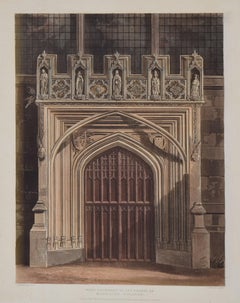
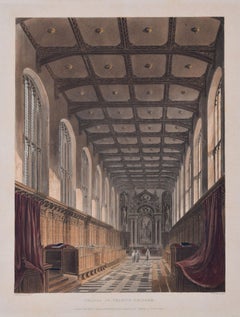
Chapel of Magdalen College, Oxford engraving by Havell for Ackermann

Chapel of Magdalen College, Oxford engraving by Havell for Ackermann

By Rudolph Ackermann

Located in London, GB

To see our other Oxford and Cambridge pictures, including an extensive collection of works by Ackermann, scroll down to "More from this Seller" and below it click on "See all from th...

Category

1810s Realist Prints and Multiples

Materials

Aquatint

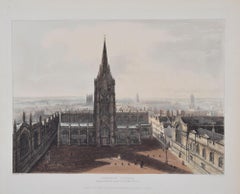
St Mary's Church, Oxford engraving by Lewis after Nash for Ackermann

St Mary's Church, Oxford engraving by Lewis after Nash for Ackermann

By Rudolph Ackermann

Located in London, GB

To see our other Oxford and Cambridge pictures, including an extensive collection of works by Ackermann, scroll down to "More from this Seller" and below it click on "See all from this Seller" - or send us a message if you cannot find the view you want. Frederick Christian Lewis (1779 - 1856) after Frederick Nash (1782 - 1856) St Mary's Church, Oxford (1813) Aquatint with original hand colouring 21 x 27 cm Published by Rudolph Ackermann (1764 - 1834). Frederick Nash was born in Lambeth. He studied architectural drawing under Thomas Malton and then enrolled at the Royal Academy of Arts. From 1801 to 1809 he worked with the antiquarians John Britton and Edward Wedlake Brayley, subsequently becoming a member of the Society of Painters in Watercolours - a group of painters who had left the Royal Academy following complaints of under-recognition of their works. Nash became primarily a landscape painter and toured the rivers of Germany. Frederick Christian Lewis was an English etcher, aquatint and stipple engraver, landscape and portrait painter. He studied under J. C. Stadler and in the schools of the Royal Academy and aquatinted most of Thomas Girtin's etchings of Paris...

Category

1810s Prints and Multiples
Materials

Aquatint

You May Also Like

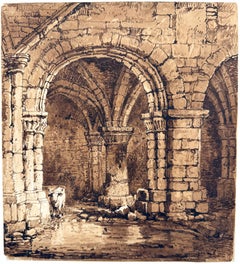
The Crypt at Kirkstall Abbey, Yorkshire

The Crypt at Kirkstall Abbey, Yorkshire

By Samuel Prout

Located in Middletown, NY

Pen and ink with black and brown ink and brown wash on buff wove paper, 10 3/8 x 9 3/8 inches (262 x 232 mm), the full sheet. Signed in brown ink in the lower right image area. In ve...

Category

Early 1800s English School Figurative Drawings and Watercolors

Materials

Ink, Watercolor, Handmade Paper

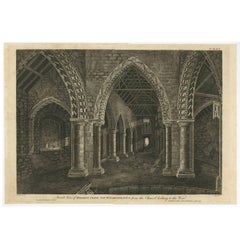
Antique Print with Inside View of Magdalen Chapel, Winchester, Hampshire, 1790

Antique Print with Inside View of Magdalen Chapel, Winchester, Hampshire, 1790

Located in Langweer, NL

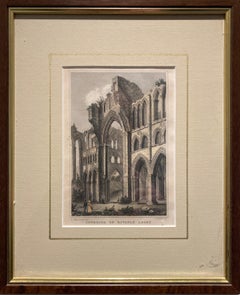
An antique line engraving by J. Basire after J. Schnebbelie, published in 1790. The Magdalen Chapel is located in the Cowgate in Edinburgh. The Chapel was built between 1541 and 1544 by Janet Rynd, widow of Michael MacQueen (died 1537), who had left money for this purpose. The building was to be the new chapel for the Incorporation of Hammermen and was to include accommodation for a chaplain and also an almshouse for seven Bedesmen (poor men) ‘who should continually pour forth prayers to Almighty God’.

Category

Antique Late 18th Century Prints

Materials

Paper

Inside View of Magdalen Chapel – Engraving of Medieval Gothic Interior, 1790

Inside View of Magdalen Chapel – Engraving of Medieval Gothic Interior, 1790

Located in Langweer, NL

Inside View of Magdalen Chapel – Engraving of Medieval Gothic Interior, 1790 This atmospheric antique engraving captures the interior of the Magdalen Chapel near Winchester, as view...

Category

Antique 18th Century English Prints

Materials

Paper

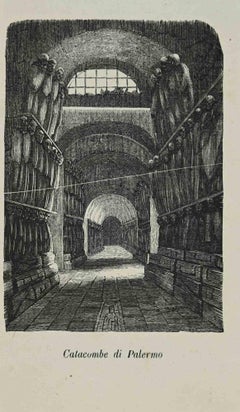
Catacombs of Palermo - Lithograph - 1862

Catacombs of Palermo - Lithograph - 1862

Located in Roma, IT

Catacombs of Palermo is a  lithograph realized in 1862. Good conditions. The artwork belongs to the Suite Uses and customs of all the peoples of the universe, or History of the gov...

Category

1840s Modern Figurative Prints

Materials

Lithograph