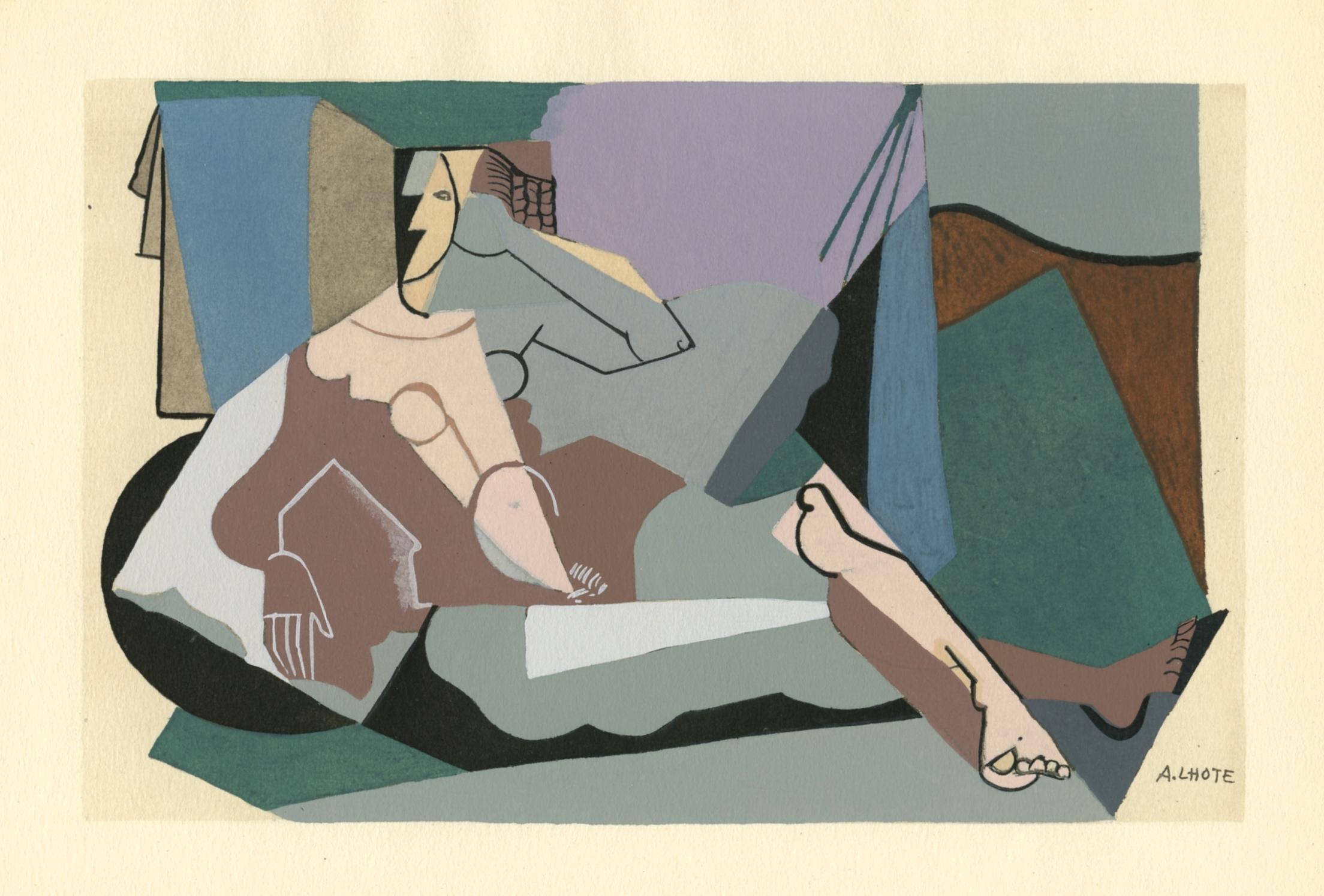
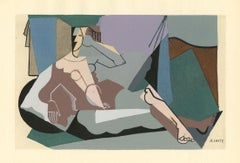
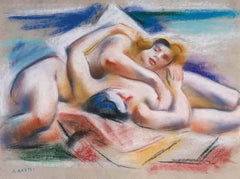
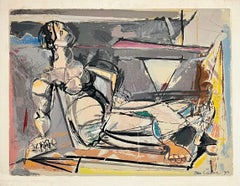
This exquisite lithograph and pochoir after Andre Lhote (1885–1962), titled Femme allongee (Reclining Woman), from the album L'Art Cubiste, Theories et Realisations, Etude Critique (Cubist Art, Theories and Achievements, Critical Study), originates from the 1929 edition published by Editions Charles Moreau, Paris, and printed by Atelier Daniel Jacomet, Paris, May 1929. Femme allongee (Reclining Woman) reflects Lhote’s synthesis of Cubist geometry and classical harmony, translating the human form into an architectural arrangement of rhythm and proportion. Through interlocking planes, subtle tonal transitions, and a restrained yet vibrant palette, Lhote reimagines the reclining nude as a symphony of balance and sensuality. The work exemplifies his lifelong pursuit of equilibrium between intellect and emotion, structure and grace, embodying the refined lyricism that distinguished his interpretation of Cubism.
Executed as a lithograph and pochoir on velin paper, this work measures 8.27 x 10.83 inches. Signed in the plate and unnumbered as issued. The edition exemplifies the exceptional craftsmanship of Atelier Daniel Jacomet, Paris, under the direction of Editions Charles Moreau, Paris.
Artwork Details:
Artist: After Andre Lhote (1885–1962)
Title: Femme allongee (Reclining Woman), from the album L'Art Cubiste, Theories et Realisations, Etude Critique (Cubist Art, Theories and Achievements, Critical Study), 1929
Medium: Lithograph and pochoir on velin paper
Dimensions: 8.27 x 10.83 inches (21 x 27.5 cm)
Inscription: Signed in the plate and unnumbered as issued
Date: May 1929
Publisher: Editions Charles Moreau, Paris
Printer: Atelier Daniel Jacomet, Paris
Condition: Well preserved, consistent with age and medium
Provenance: From the album L'Art Cubiste, Theories et Realisations, Etude Critique, published by Editions Charles Moreau, Paris, and printed by Atelier Daniel Jacomet, Paris, May 1929
Notes:
Excerpted from the album (translated from French): This album was composed in Didot Characters and completed to print in May 1929 by Ducros et Colas, Maitres-Imprimeurs in Paris. Boards have been executed by D. Jacomet in an edition of D examples, numbered on the colophons.
About the Publication:
L'Art Cubiste, Theories et Realisations, Etude Critique (Cubist Art, Theories and Achievements, Critical Study), published in 1929 by Editions Charles Moreau, is among the most important critical and artistic documents of the interwar period devoted to the Cubist movement. Conceived as both an analytical study and a visual anthology, the volume brought together theoretical texts and hand-colored plates representing works by the leading figures of Cubism, including Pablo Picasso, Georges Braque, Juan Gris, Fernand Leger, Albert Gleizes, and Andre Lhote. Each plate was reproduced in lithograph and finished by hand using the pochoir process under the supervision of master printer Daniel Jacomet, ensuring that the vivid tonal subtleties and compositional precision of the originals were preserved. The publication captures the movement’s intellectual ambition and its enduring impact on the evolution of modern art. Printed on fine velin paper in a limited edition, the album reflects the artisanal excellence of French art publishing during the 1920s and remains a landmark in the history of the illustrated art book. Today, it stands as a rare testament to Lhote’s disciplined yet poetic vision of Cubism and to Jacomet’s technical mastery in the pochoir printing tradition.
About the Artist:
Andre Lhote (1885–1962) was a French painter, sculptor, writer, and one of the most influential art theorists and teachers of the 20th century, celebrated for harmoniously merging the structure of Cubism with the classical ideals of balance and proportion. Born in Bordeaux, France, Lhote trained as a sculptor before turning to painting in 1905, drawing early inspiration from the vibrant colors of Fauvism and the compositional intelligence of Paul Cezanne, whose belief in the architecture of form profoundly shaped his philosophy. By 1910, he had emerged as a key figure in the Cubist movement alongside Pablo Picasso, Georges Braque, and Juan Gris, developing a lyrical and intellectual interpretation of Cubism that emphasized geometry, rhythm, and emotional restraint. His paintings—spanning nudes, landscapes, and cityscapes—reflected his pursuit of harmony between structure and feeling, intellect and emotion. A contemporary of Pablo Picasso, Alexander Calder, Alberto Giacometti, Salvador Dali, Joan Miro, Wassily Kandinsky, Marcel Duchamp, and Man Ray, Lhote shared their dedication to reinventing visual language while maintaining a profound respect for the continuity of tradition. His influence extended beyond his own painting through his role as a teacher and theorist: in 1922, he founded the Academie Andre Lhote in Montparnasse, Paris, which became one of the most important international art schools of the interwar period. His students—among them Henri Cartier-Bresson, Tamara de Lempicka, William Klein, Ellsworth Kelly, and Roger Hilton—absorbed his lessons on constructive composition, geometric unity, and the expressive power of line, applying them to diverse modern movements from abstract painting to photography and design. Through essays, lectures, and books such as Traite du paysage and Traite de la figure, Lhote championed a vision of modern art that fused intellect and sensuality, theory and grace. Exhibiting across Europe and teaching in Egypt, Lebanon, and Brazil, he became an ambassador of modernism whose principles resonated with movements from the Bauhaus to the Ecole de Paris. His works, housed in the Centre Pompidou, Musee d’Orsay, Tate Modern, and The Museum of Modern Art, demonstrate his enduring mastery of form, color, and balance. Revered for his ability to bridge the avant-garde and the classical, Lhote remains a pivotal figure in the evolution of 20th-century art, standing alongside Pablo Picasso, Alexander Calder, Alberto Giacometti, Salvador Dali, Joan Miro, Wassily Kandinsky, Marcel Duchamp, and Man Ray. The highest auction record for Andre Lhote was achieved by Femme nue assise (Seated Nude), which sold for $485,000 USD at Sotheby’s, New York, on November 5, 2009, affirming his lasting legacy as both a visionary artist and a foundational thinker in the modern era.
After Andre Lhote Femme allongee, Lhote L'Art Cubiste, Lhote Atelier Daniel Jacomet, Lhote Editions Charles Moreau, Lhote pochoir lithograph, Lhote Cubism.