Johannes and Lucas van Doetecum, after Cornelis Floris II
Modern Grotesque with Strapwork, 1557
Etching on laid paper
Approximately 30.5 × 20.6 cm (12 × 8⅛ in.)
Designed by Cornelis Floris II
Etched by Johannes van Doetecum I and Lucas van Doetecum
Published by Hieronymus Cock, Antwerp
From Veelderleij niewe inventien van antijcksche sepultueren … Libro secundo
New Hollstein 38 (Van Doetecum family; identification should be checked against the volume if preparing a formal inventory record)
Catalogue entry
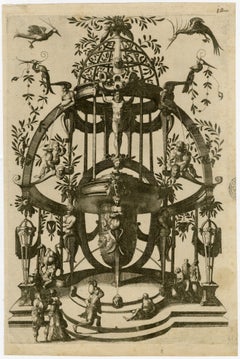
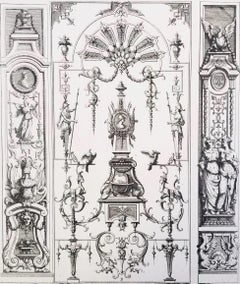
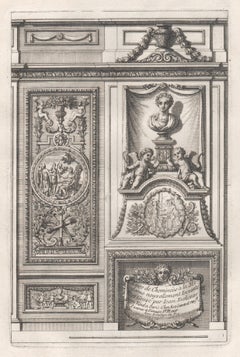
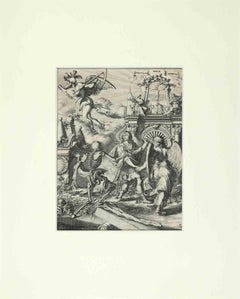
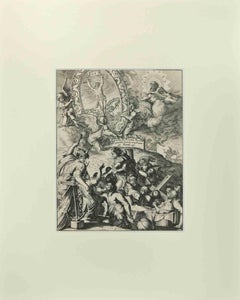
This exceptionally elaborate ornamental etching belongs to the great flowering of printed design in mid-sixteenth-century Antwerp. Although traditionally catalogued under the convenient English title Modern Grotesque with Strapwork, it was conceived not as an autonomous narrative image but as a repertory of ornamental inventions. Its interlocking framework, fantastic creatures, classical figures, plants, vases, masks, and miniature mythological scenes offered craftsmen a portable vocabulary adaptable to architecture, furniture, metalwork, carved wood, jewelry, textiles, and ephemeral festival decorations.
The composition was designed by the Antwerp architect and sculptor Cornelis Floris II and translated into etching by the brothers Johannes and Lucas van Doetecum. It was issued in Antwerp in 1557 by Hieronymus Cock, the most influential publisher of prints in the sixteenth-century Netherlands. The Metropolitan Museum of Art assigns the work jointly to the two Van Doetecum brothers, after Floris, and records Cock as its publisher. Its impression measures 30.6 × 20.8 cm and bears the accession number 26.57.61(11). Metropolitan Museum of Art
Composition and imagery
The print is organized around a rigid architectural skeleton, yet almost every part of that structure seems to mutate into something animate. Rectangular compartments expand into curved pediments; bands of strapwork bend as if made from cut leather; supports become female figures, hybrid beasts, birds, masks, and coiled serpents. The tension between architectural stability and organic metamorphosis is the governing principle of the design.
At the summit, two enormous circular bands of strapwork rise like handles or arches. Their surfaces are pierced by repeating geometric openings and threaded with foliage. Birds and insects occupy the surrounding space, introducing a playful naturalism into the otherwise artificial construction. Between the arches stands a fanciful shrine or canopy containing a seated female figure. Classical female supports flank this central structure, simultaneously functioning as bodies, columns, and ornamental brackets.
Two oval narrative medallions are embedded in the upper register. The left appears to involve a serpent raised upon a staff before an assembled group, possibly recalling the Brazen Serpent or a related scene of healing and deliverance. The right presents a ritual or sacrificial gathering around an elevated object. Because ornament books freely combined biblical, classical, allegorical, and purely invented motifs, these scenes should not necessarily be read as parts of a continuous narrative. Their principal function is to enrich the ornamental surface and provide designers with small-scale figural models.
The lower half is still more fantastic. Two large pendant structures contain bearded, partly nude figures whose torsos merge with suspended disks, drapery, birds, and mask-like forms. Beneath them crouch extraordinary hybrid creatures: human heads and torsos are joined to spreading wings or shell-like bodies supported on bird legs. At the center, a fruit-filled vessel hangs above a reclining group suggestive of a Bacchic or pastoral gathering. Birds, monkeys, reptiles, insects, grotesque masks, branches, fruit, and isolated fragments fill the surrounding compartments.
This accumulation does not represent disorder. Floris balances nearly every major motif across the vertical axis, but deliberately varies the small animals and subsidiary details. Symmetry establishes monumental coherence; asymmetry animates the surface. The eye is repeatedly drawn from the central architectural framework into unexpected incidents at its margins.
The “grotesque” and the Floris style
The term grotesque derives from the decorations discovered in the buried rooms—or grotte—of Nero’s Domus Aurea in Rome during the late fifteenth century. Renaissance artists studied the ancient paintings and transformed their weightless combinations of foliage, architecture, masks, animals, and hybrid bodies into a new ornamental language. Italian printmakers disseminated these inventions throughout Europe, where Northern artists made them increasingly dense, sculptural, and fantastic.
Cornelis Floris adapted this Italianate vocabulary to Netherlandish taste. His designs are characterized by thick, curling bands of strapwork, rolled edges, pierced compartments, masks, herms, fruit clusters, and hybrid figures. This became internationally known as the Floris style. It exercised a powerful influence on architectural and decorative design in the Netherlands, France, Germany, Scandinavia, England, and the Baltic region.
In the present sheet, strapwork is not merely applied to an architectural surface: it constitutes the architecture itself. The design continuously shifts between two and three dimensions. Flat bands appear to fold forward; human figures turn into structural supports; and architectural compartments become frames for miniature worlds. Such calculated instability is characteristic of Northern Mannerism.
The artists and publisher
Johannes van Doetecum I—also known as Jan van Doetechum the Elder—was born at Deventer around 1528–32 and died at Haarlem in 1605. Working frequently with his brother Lucas, he became one of the most accomplished etchers employed by Antwerp publishers during the middle decades of the sixteenth century. Their output included landscapes after Pieter Bruegel the Elder, architectural perspectives after Hans Vredeman de Vries, maps, biblical subjects, and extensive suites of ornament.
Lucas van Doetecum, active from 1554 until the early 1570s and dead before 1589, collaborated so closely with Johannes that separating their individual hands is often impossible. Modern museum catalogues therefore commonly attribute the prints to both brothers. Their technique combines the freedom of drawing with the clarity required of a practical design print. Fine parallel lines establish volume, while broad areas of closely worked hatching give the imaginary architecture a surprising density.
Cornelis Floris II—born in Antwerp shortly before 1514 and deceased there in 1575—was a sculptor, architect, and ornamental designer. His importance rests not only upon his surviving buildings and monuments but also upon the extraordinary geographical reach of his printed designs. Through Cock’s publishing enterprise, the Floris idiom became one of Antwerp’s most consequential artistic exports.
Hieronymus Cock operated the celebrated Antwerp publishing house Aux Quatre Vents—“At the Four Winds.” Cock brought designers, engravers, and an international market together. His publications after Floris, Bruegel, Frans Floris, and other leading artists helped make Antwerp a European center for the creation and distribution of printed imagery.
Series and function
The sheet formed part of Veelderleij niewe inventien van antijcksche sepultueren … Libro secundo, a suite devoted to surface decorations, grotesques, strapwork, cartouches, and funerary monuments. The British Museum describes the publication as a series of sixteen etchings, made by Johannes and Lucas van Doetecum after Cornelis Floris and published by Cock in Antwerp in 1557. British Museum
The phrase “new inventions” is significant. Although advertised through the authority of antiquity, these were not archaeological reconstructions. They were modern, highly imaginative syntheses of ancient Roman grotesques, Italian Mannerist ornament, and Netherlandish sculptural practice. The adjective “modern” in the museum title therefore recognizes the work as a consciously contemporary reinvention of the antique.
Such prints were functional objects. A goldsmith might extract a mask or pendant; a joiner could adapt a panel arrangement; a sculptor could reuse a herm or cartouche; and an architect might translate the entire composition into a wall, ceiling, screen, chimney piece, or temporary triumphal structure. The complete sheet consequently operates both as an integrated fantasy and as a collection of detachable motifs.
Museum holdings
Impressions of this design or closely corresponding sheets from the 1557 series are held by:
The Metropolitan Museum of Art, New York — Modern Grotesque with Strapwork, 1557, Harris Brisbane Dick Fund, 1926, accession no. 26.57.61(11). Collection record
The British Museum, London — the museum holds multiple impressions from the sixteen-plate series, catalogued under Veelderleij niewe inventien van antijcksche sepultueren … Libro secundo. Its records cite the Van Doetecum brothers, Cornelis Floris, Hieronymus Cock, and the standard references New Hollstein and Riggs. Series record
Blanton Museum of Art, University of Texas at Austin — Surface Decoration, Grotesque with Strapwork, 1557, accession no. 2002.2068; the Blanton also holds related Van Doetecum ornament and architectural sheets. Blanton collection
Comparable suites and individual sheets by the Van Doetecums after Floris are also represented in major European decorative-arts and print collections, including the Rijksmuseum and Victoria and Albert Museum.
Assessment
Modern Grotesque with Strapwork exemplifies the role of printmaking as an engine of artistic transmission. The sheet converts Floris’s sculptural imagination into a reproducible visual resource capable of crossing media and national borders. Its fantastic hybrids and impossible architectural transformations are entertaining, but they also demonstrate the Mannerist ideal of invenzione: the artist’s ability to generate forms that surpass ordinary nature.
The print is therefore more than an eccentric decorative fantasy. It is a document of Antwerp’s international publishing culture, a working pattern for Renaissance craftsmen, and a principal vehicle through which the Floris style entered the ornamental vocabulary of Northern Europe.