Want more images or videos?
Request additional images or videos from the seller
1 of 5

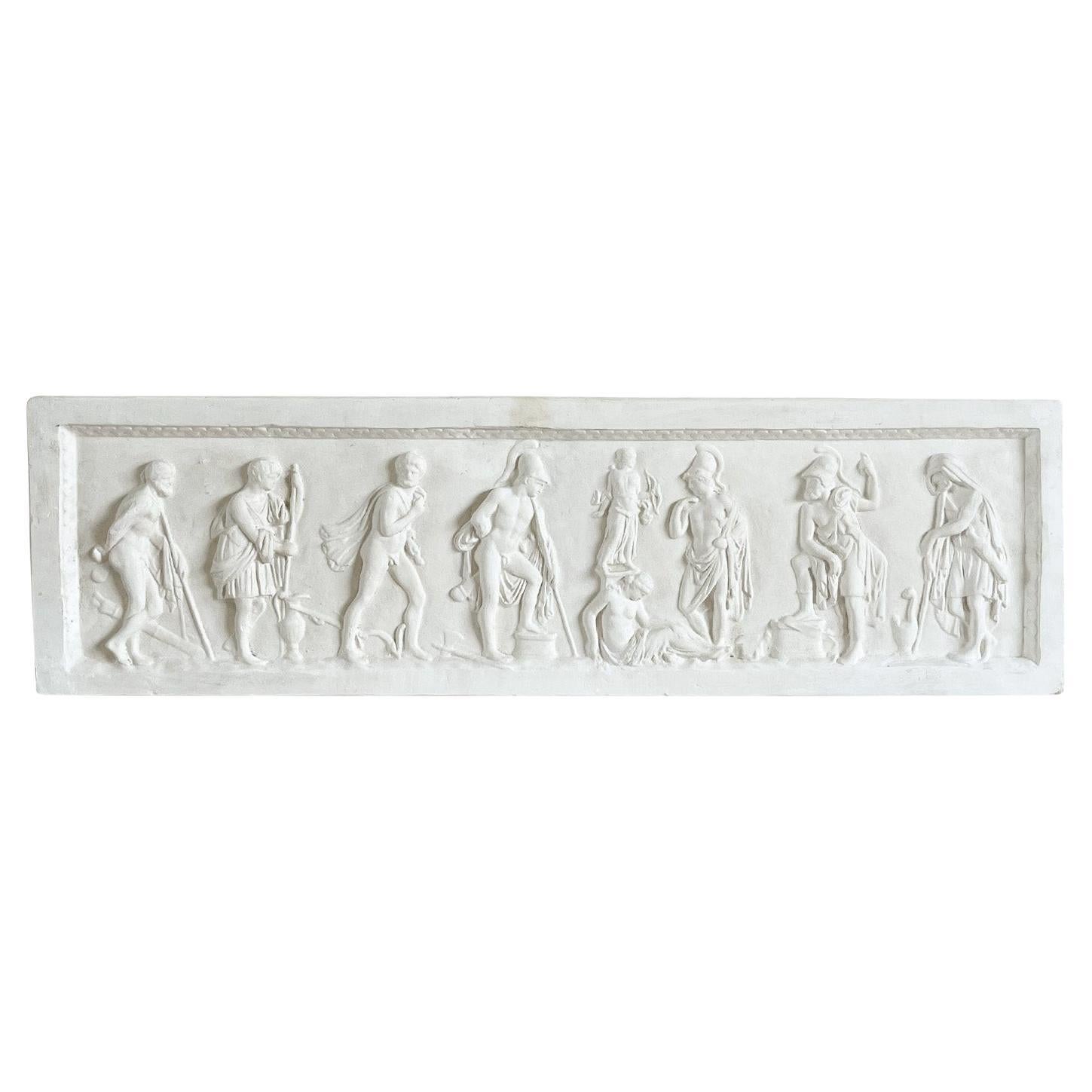
19th Century French School
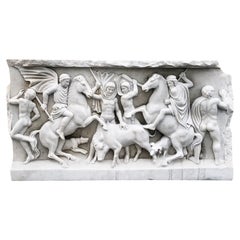
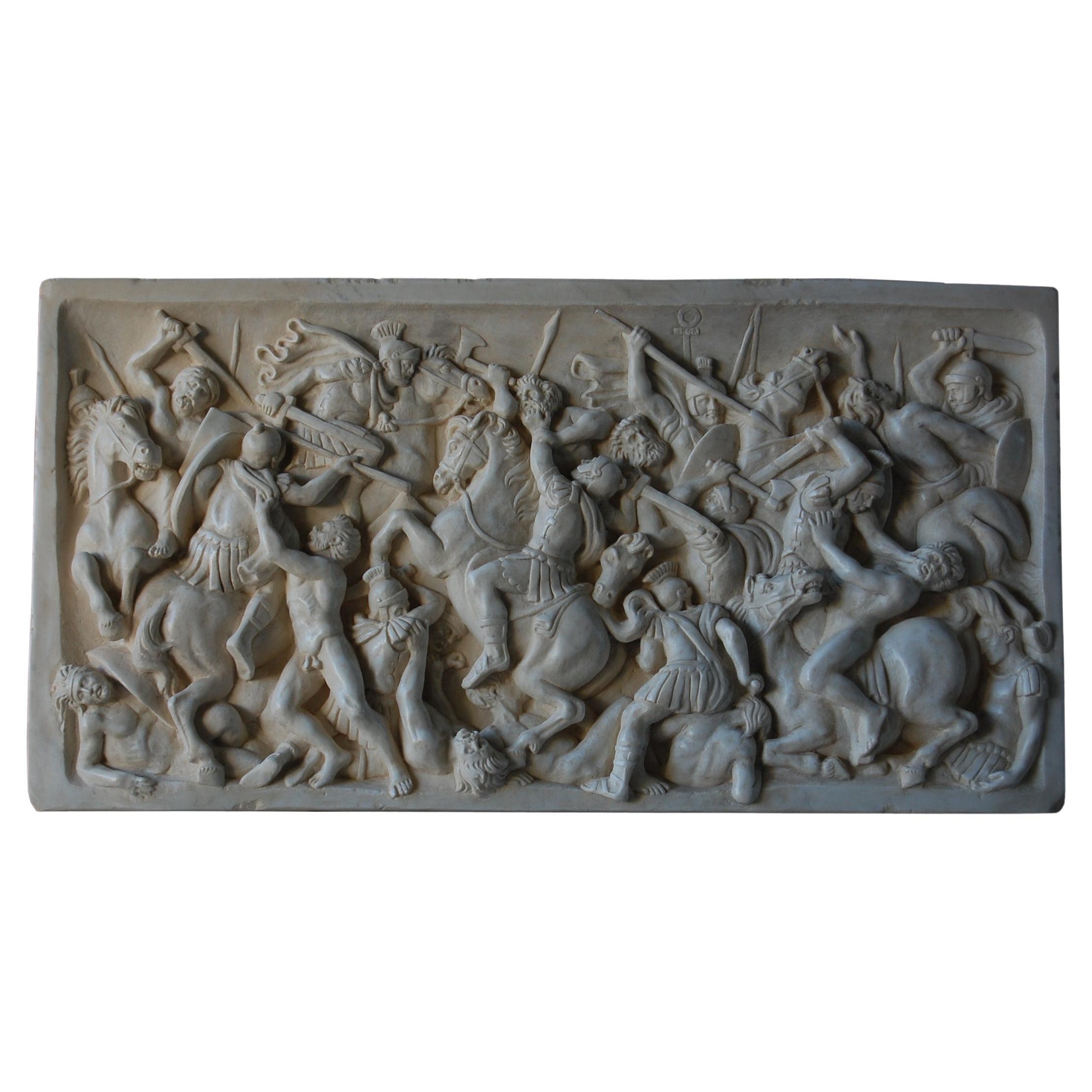
Amazonamachy: A Classical plaster figural frieze relief

$11,799.90
£8,575
€10,206.58
CA$16,461.45
A$16,699.55
CHF 9,534.56
MX$202,205.47
NOK 112,245.03
SEK 111,872.51
DKK 76,321.76

About the Item

19th century French School Amazonamachy: A Classical plaster figural frieze relief Amazonomachy represents the Greek ideal of civilization. The Amazons were portrayed as a savage and barbaric race, while the Greeks were portrayed as a civilized race of human progress. The original Roman marble sarcophagus, dating from 330-310BC, from which this cast is taken, was excavated in 1557 in the ancient royal city of Soloi, Cyprus. It was taken the following year to Venice. In 1567 it was acquired by the Fugger family and then in the 1st half of the 17th century purchased by the Hapsburgs. According to Bruno Snell’s view of Amazonomachy: “For the Greeks, the Titanomachy and the battle against the giants remained symbols of the victory which their own world had won over a strange universe; along with the battles against the Amazons and Centaurs they continue to signalize the Greek conquest of everything barbarous, of all monstrosity and grossness.” Amazonomachy is also seen as the rise of feminism in Greek culture. In Quintus Smyrnaeus’s The Fall of Troy, Penthesilea, an Amazonian queen, who joined on the side of the Trojans during the Trojan war, was quoted at Troy, saying: Not in strength are we inferior to men; the same our eyes, our limbs the same; one common light we see, one air we breathe; nor different is the food we eat. What then denied to us hath heaven on man bestowed? According to Josine Blok, Amazonachy provides two different contexts in defining a Greek hero. Either the Amazons are one of the disasters from which the hero rids the country after his victory over a monster; or they are an expression of the underlying Attis motif, in which the hero shuns human sexuality in marriage and procreation. “In the 5th century, the Achaemenid Empire of Persia began a series of invasions against Ancient Greece. Because of this, some scholars believe that on most 5th-century Greek art, the Persians were shown allegorically, through the figure of centaurs and Amazons.” The west metopes of the Parthenon depict a battle between Greeks and Amazons. Despite its mutilated state, scholars generally concur that the scene represents the Amazon invasion of Attica. The Bassae Frieze in the Temple of Apollo has different types of Amazonomachy depicted – Trojan/ Heraclean etc. – as does the Mausoleum at Halicarnassus. (Source: Wiki)
  • Creator:
    19th Century French School
  • Dimensions:
    Height: 32.67 in (82.99 cm)Width: 100.75 in (255.91 cm)
  • Medium:
  • Movement & Style:
  • Period:
  • Condition:
  • Gallery Location:
    London, GB
  • Reference Number:
    1stDibs: LU52417687632

More From This Seller

View All
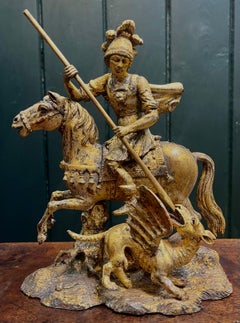
St George Slaying the Dragon

St George Slaying the Dragon

Located in London, GB

18th Century European School St George Slaying the Dragon Wood, gilded 8 inches in height, 6 3/4 x 4 inches base This 18th century carved and gilt wood statuette depicts the moment ...

Category

18th Century Figurative Sculptures

Materials

Wood

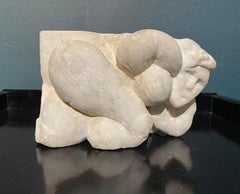
Reclining Figure  Carved Marble  Early 20th Century France

Reclining Figure Carved Marble Early 20th Century France

Located in London, GB

Circle of Henri-Gaudier-Breska 1891-1915 Reclining Figure Carved marble Height 5 inches Born Henri Alphonse Séraphin Marie Gaudier near Orléans in France, Gaudier-Brzeska started using his hyphenated name in 1910 when he met the Polish writer Sophie Brzeska. They moved to London together in January 1911 and adopted their new names and the identity of brother and sister in order to make their cohabitation respectable. Gaudier-Brzeska started to establish himself as a sculptor in 1912. Initially influenced heavily by Rodin, he later assimilated more influences from the modernist movement of cubism and from examples of non-European art he saw in London’s museums. He met the sculptor Jacob Epstein in June 1912, who further encouraged him to break with classical Greek tradition. While working from 25 Winthorpe Road in 1913–14, Gaudier-Brzeska became increasingly involved in London’s avant-garde art scene. He exhibited at the London Salon in July 1913, where he met the poet and arts patron Ezra Pound. Pound described Brzeska as ‘like a well-made young wolf or some soft-moving, bright-eyed wild thing’. Gaudier-Brzeska subsequently became associated with the vorticist movement led by Wyndham Lewis, contributing two important articles to Lewis’s magazine Blast and signing his name against the vorticist manifesto. He was also a founding member of the London Group, which formed when the all-male Camden Arts Group joined with independent artists to challenge the dominance of the Royal Academy of Arts. Other founding members included Walter Sickert, Robert Bevan and Spencer Gore...

Category

Early 20th Century Figurative Sculptures
Materials

Marble

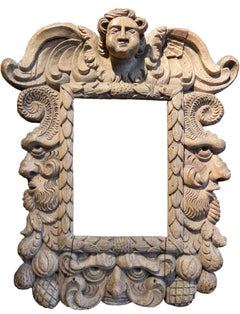
Carved Frame, 16th Century European School

Carved Frame, 16th Century European School

Located in London, GB

European School 16th Century Carved Frame Fruit wood Remnant's of pigment can be found on the carving.

Category

18th Century and Earlier More Art

Materials

Wood

The Scholar Red Clay Contemporary Sculpture

The Scholar Red Clay Contemporary Sculpture

By Christian Mizon

Located in London, GB

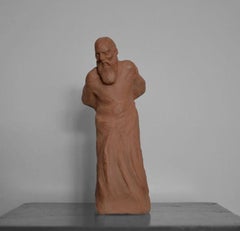
Christian Mizon Contemporary The Scholar Red Clay Height: 6 ¼ inches (16 cm) Stamped by artist Christian Mizon is a graduate of Camberwell College of A...

Category

21st Century and Contemporary Contemporary Nude Sculptures

Materials

Clay

You May Also Like

Antique Neoclassical Plaster Panel of Classical Figures

Antique Neoclassical Plaster Panel of Classical Figures

Located in Wormelow, Herefordshire

An antique neoclassical style plaster cast panel depicting a procession of classical figures, dating to the early 20th century. In a large landscape form, this handcrafted plaque sh...

Category

Early 20th Century English Neoclassical Decorative Art

Materials

Plaster

Hellenistic Relief Wall Art, Vintage Plaster, French, 29.5x8.5 Inches

Hellenistic Relief Wall Art, Vintage Plaster, French, 29.5x8.5 Inches

Located in West Palm Beach, FL

A long, rectangular vintage French wall mount Hellenistic relief molded in plaster from the Athenian Agora depicting the senate and ancient Greek warriors, in good condition. Not rec...

Category

Mid-20th Century French Decorative Art

Materials

Plaster

Renaissance Style Plaster Relief Sculpture After Luca della Robbia

Renaissance Style Plaster Relief Sculpture After Luca della Robbia

Located in Rio Vista, CA

A remarkable large-scale plaster relief sculpture cast after the marble reliefs Luca della Robbia carved for the Cantoria Frieze of Santa Maria del Fiore, Florence in 1431–1438 title...

Category

20th Century Italian Renaissance Figurative Sculptures
Materials

Wire

Hellenistic Relief Fragment, Vintage Plaster Wall Art, 29.5" x 8.5"

Hellenistic Relief Fragment, Vintage Plaster Wall Art, 29.5" x 8.5"

Located in West Palm Beach, FL

A long, rectangular vintage wall mount Hellenistic relief fragment molded in plaster from the Athenian Agora depicting the senate and ancient Greek warriors, in good condition. Not r...

Category

Mid-20th Century French Decorative Art

Materials

Plaster