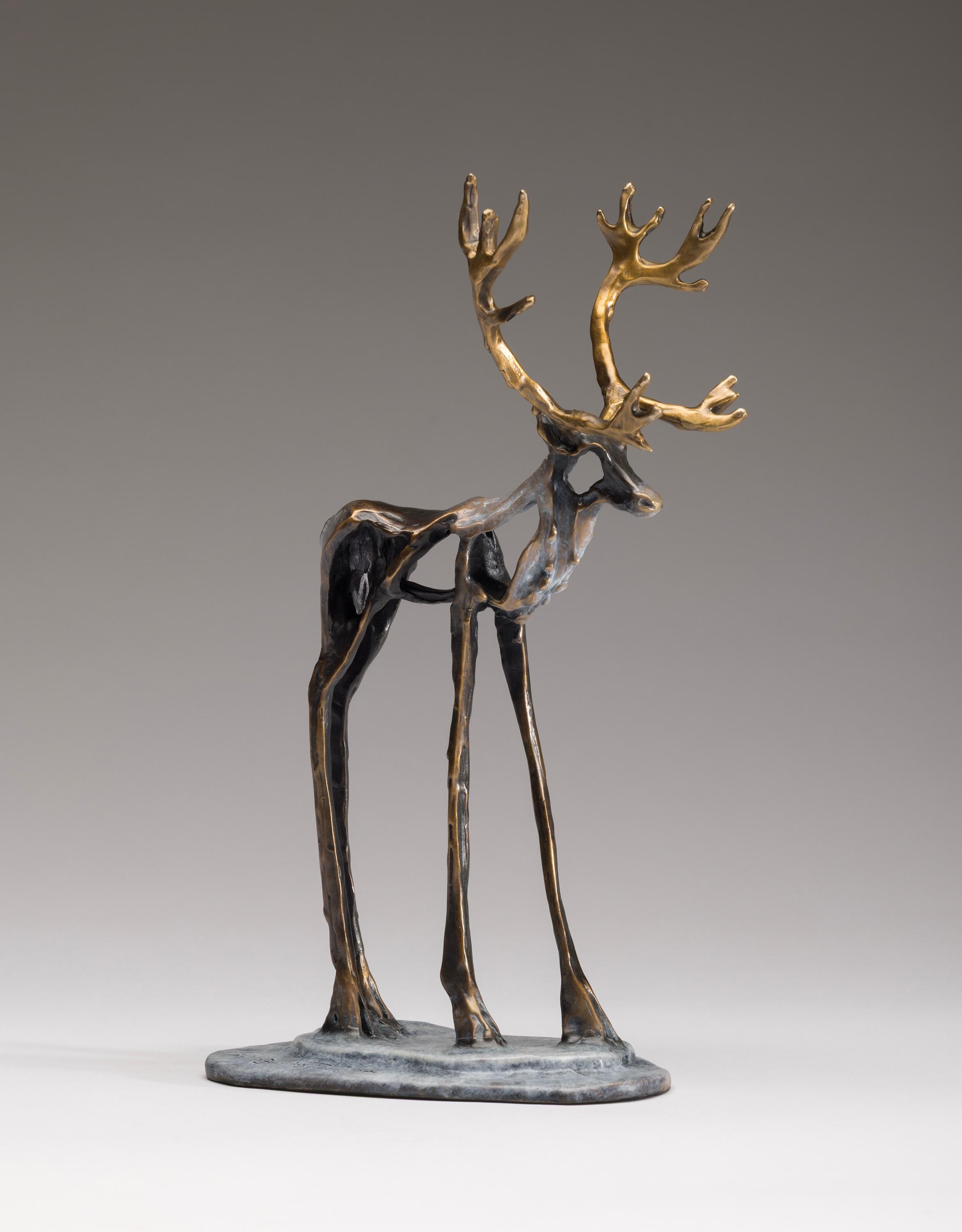
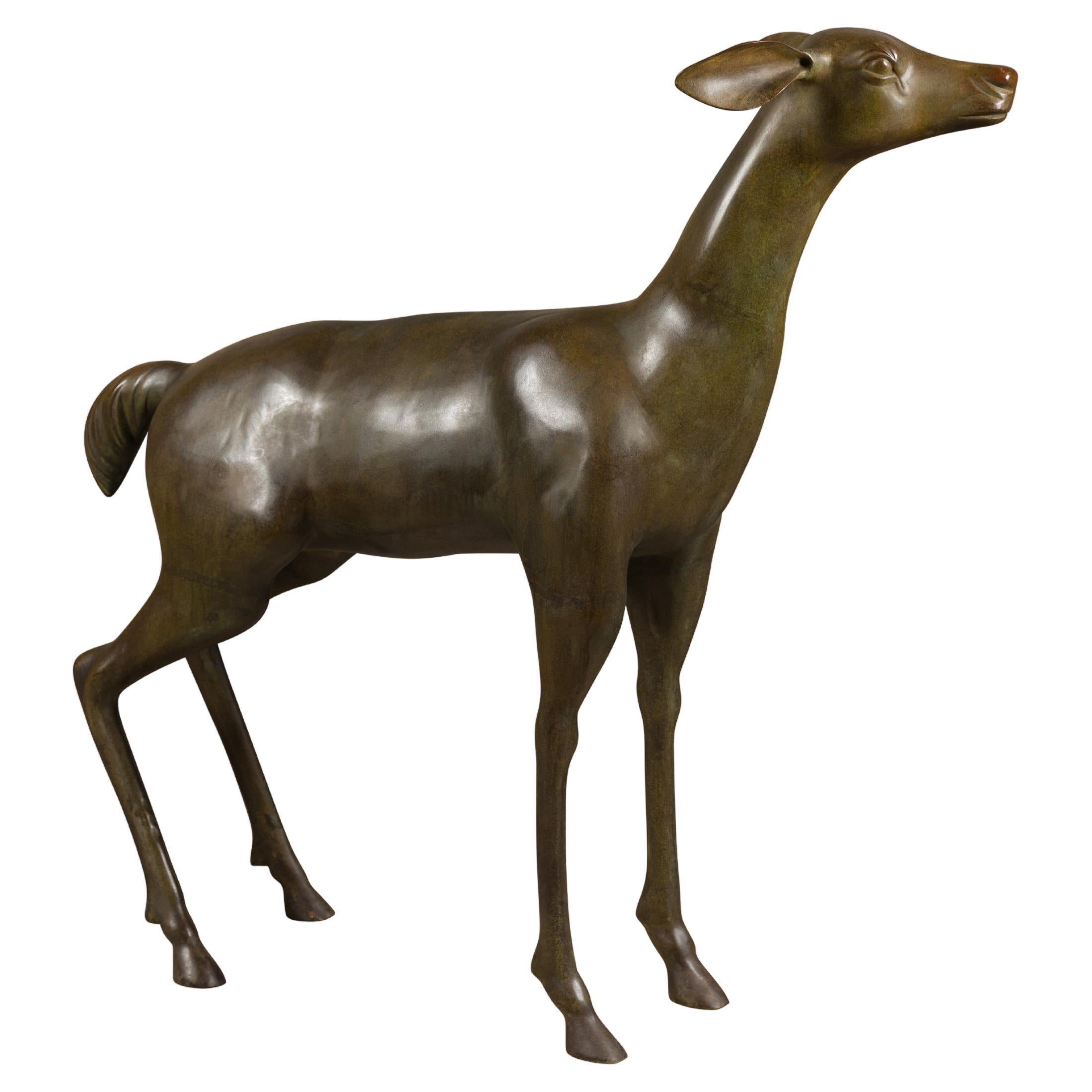
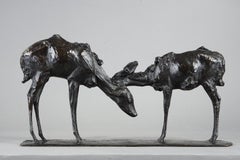
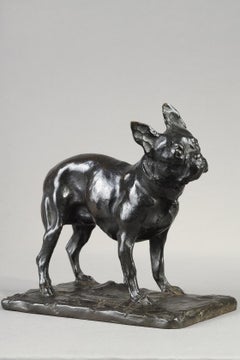
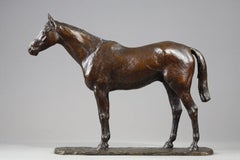
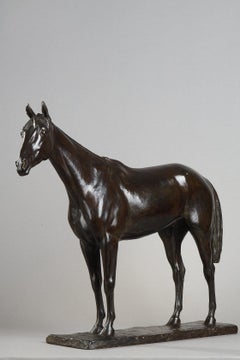
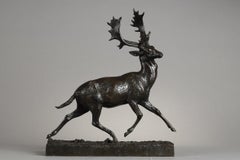
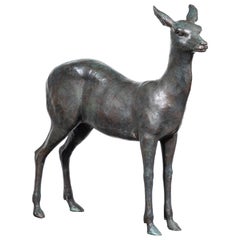
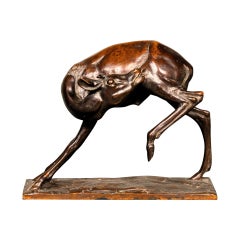
Small fawn Axis
by Rembrandt BUGATTI (1884-1916)
A bronze sculpture with a nuanced dark brown patina
Signed on the base "R.Bugatti"
A lost wax cast by "A.A. Hébrard" (with founder stamp)
and numbered "(C9)"
Model created in 1910
Cast before 1934
There are 35 known referenced casts of this model.
height 31,7 cm
length 26,6 cm
width 11 cm
Bibliography :
- Véronique Fromanger, "Rembrandt Bugatti sculpteur", répertoire monographique, Les éditions de l'Amateur, Paris, 2009, p.318, n°263.
Biography :
Rembrandt Annibale Bugatti, known as Rembrandt Bugatti (1884-1916) was an Italian animal sculptor. He was the younger brother of Ettore Bugatti, founder of the Bugatti automobile brand in 1909 and the son of the Italian designer Carlo Bugatti.
As a child, Rembrandt Bugatti began to sculpt, encouraged by the leader of the Lombard divisionist painters Giovanni Segantini and by Paul Troubetzkoy, a friend of the Bugatti family. In 1901, he created his first work during a stay in the mountains: "Ritorno dal pascolo" (four cows one behind the other guided by a young farmer). Its volume was modeled by free hand and the details are simply outlined to catch the light and fragment the surface into a multitude of planes revealing the bones and muscles.
In 1903, aged 19, Rembrandt Bugatti moved to Paris, and in 1904, he signed an exclusive contract with Adrien-Aurélien Hébrard, then one of the best founders of the time, as well as an art editor renowned with his art gallery located at 8 rue Royale in Paris. The young workshop manager Albino Palazzolo was his exclusive moulder-founder, helped in his beginnings, before 1908, by the famous Italian foundryman Marcello Valsuani, the father of Claude Valsuani.
A.A. Hébrard, as an editor and art dealer, imposed an original edition, strictly limited and numbered, of exceptional quality. Thus, every year, Hébrard exhibited new works by Bugatti in his gallery and every five years, he organized a retrospective and presented Rembrandt Bugatti in official Parisian salons (in the Italian Modern Art section) or abroad (Venice, Milan , Brussels, Berlin, Antwerp and New York).
Passionate about the animal world, Rembrandt Bugatti found the Jardin des Plantes zoo in Paris insufficient for his inspiration and his models and moved to Antwerp in Belgium where the management of the Antwerp Zoo was very welcoming towards artists. In 1906, the director of the Antwerp zoo, Michel L'Hoest, made a workshop available.
Rembrandt Bugatti often returned to Paris between 1906 and 1911 where he lived near the Ménagerie du Jardin des Plantes. He chose free-hand modeling without markings or measurements and without preparatory sketches.
During the First World War, Rembrandt Bugatti joined the Red Cross to support the wounded and became ill with tuberculosis. To help his family, then refugees in Italy, he left for Milan then decided to join the Italian army in August 1915. In Paris, orders and sales of sculptures collapsed, the Galerie Hébrard closed its doors. Rembrandt Bugatti, discharged, returned to Paris in December 1915. Rembrandt committed suicide in his Montparnasse workshop in January 1916. As a posthumous tribute, Ettore and his son Jean took his trained elephant (1904) to create the mascot for the radiator of the Bugatti Royale from 1926.