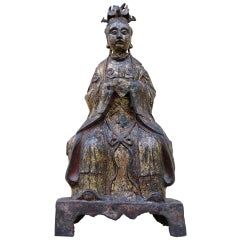
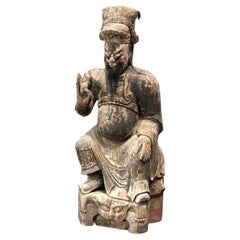
Rare Chinese Parcel-Gilt Bronze Figure of Lu Dongbin, Ming ca. 1600
Located in Nottingham, GB
From the Ming dynasty onwards, bronze figures of Daoist deities and immortals occupied an important place within the domestic interior. They appeared on household altars, scholar's desks, incense burners and ritual stands, serving both devotional and decorative purposes. Parcel gilding was frequently applied to emphasise significant details, creating a striking interplay between brilliant gold highlights and the darker bronze beneath. Among the most revered subjects were the Eight Immortals, whose distinctive attributes made them immediately recognisable and whose presence conveyed blessings of longevity, protection and prosperity.
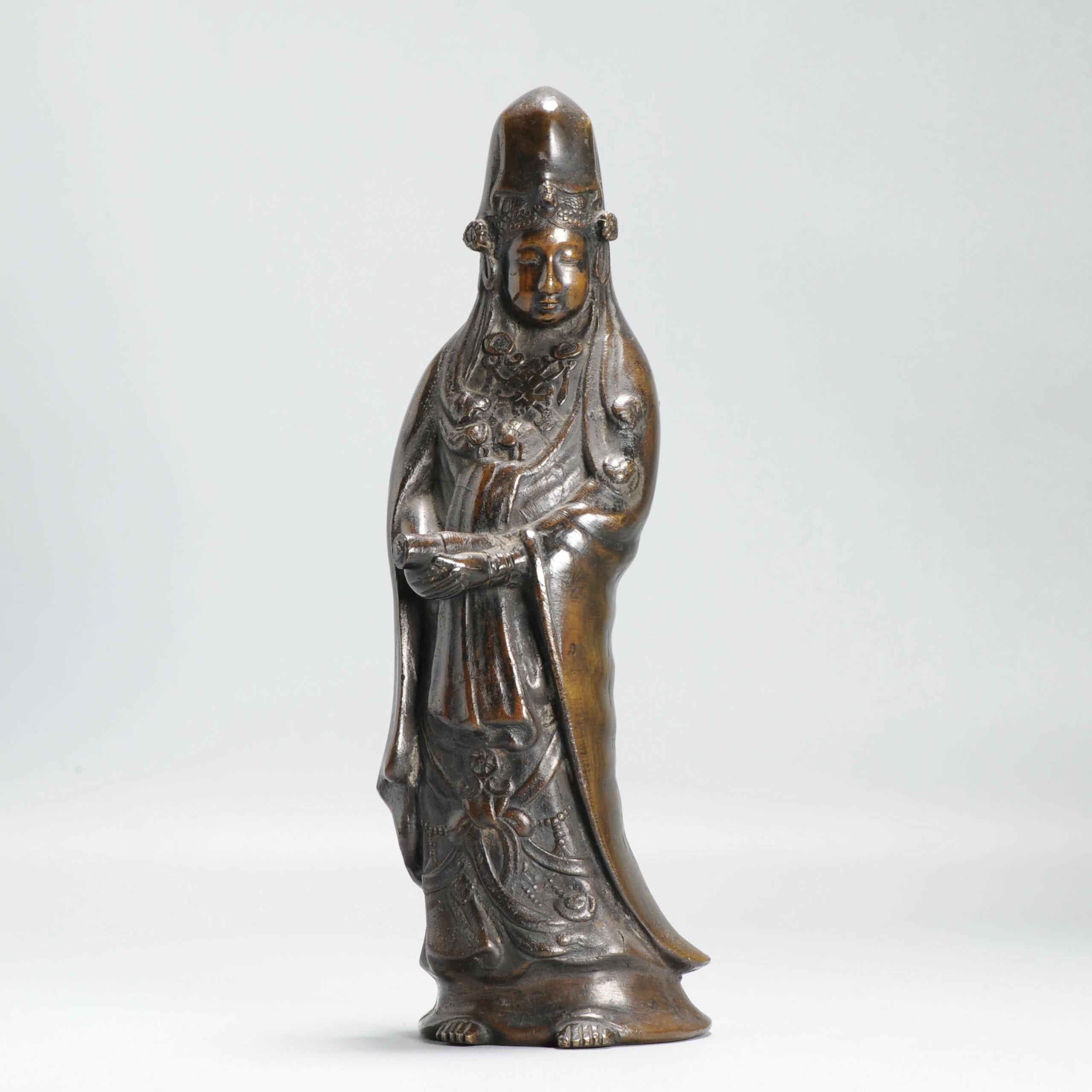
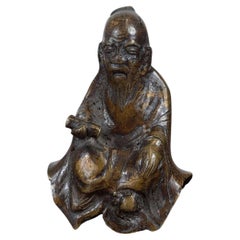
This finely cast figure represents Lu Dongbin, the scholar-swordsman and perhaps the most celebrated of the Eight Immortals. Associated with wisdom, self-cultivation and the triumph of virtue over temptation, Lu Dongbin remains one of the most enduring figures in Daoist tradition.
He is depicted seated in a contemplative pose, his ample robes gathered around him in deeply modelled folds that pool gracefully at the front of the composition. The torso leans slightly forward, lending the figure an engaging sense of immediacy and introspection. His hair is arranged in a high topknot, while a long flowing beard, articulated with finely incised striations, frames a dignified and authoritative expression.
Held delicately in his left hand is a rolled scroll, an attribute that reflects his scholarly nature and distinguishes him within the Daoist pantheon. His right hand is concealed within the sleeve of his robe in a gesture of restraint and quiet composure. Despite its compact scale, the figure possesses a remarkable sense of weight and presence, with refined modelling evident in the facial features, hands and drapery.
Traces of the original parcel gilding survive across the chest, sleeves and folds of the garment, providing flashes of luminosity against the rich brown patina acquired over centuries. To the reverse, an oval aperture and unfinished attachment points indicate that the figure was originally mounted to a larger object, most likely an incense burner, altar fitting or ritual stand. The open underside and visible casting pits are entirely consistent with workshop practices of the late Ming and early Qing periods, offering an appealing insight into the methods of manufacture.
Combining devotional significance, sculptural refinement and the atmospheric beauty of age, this early bronze is a compelling example of Chinese Daoist art...
Category
Antique Early 1600s Sculptures and Carvings