Want more images or videos?
Request additional images or videos from the seller
1 of 13

Unknown
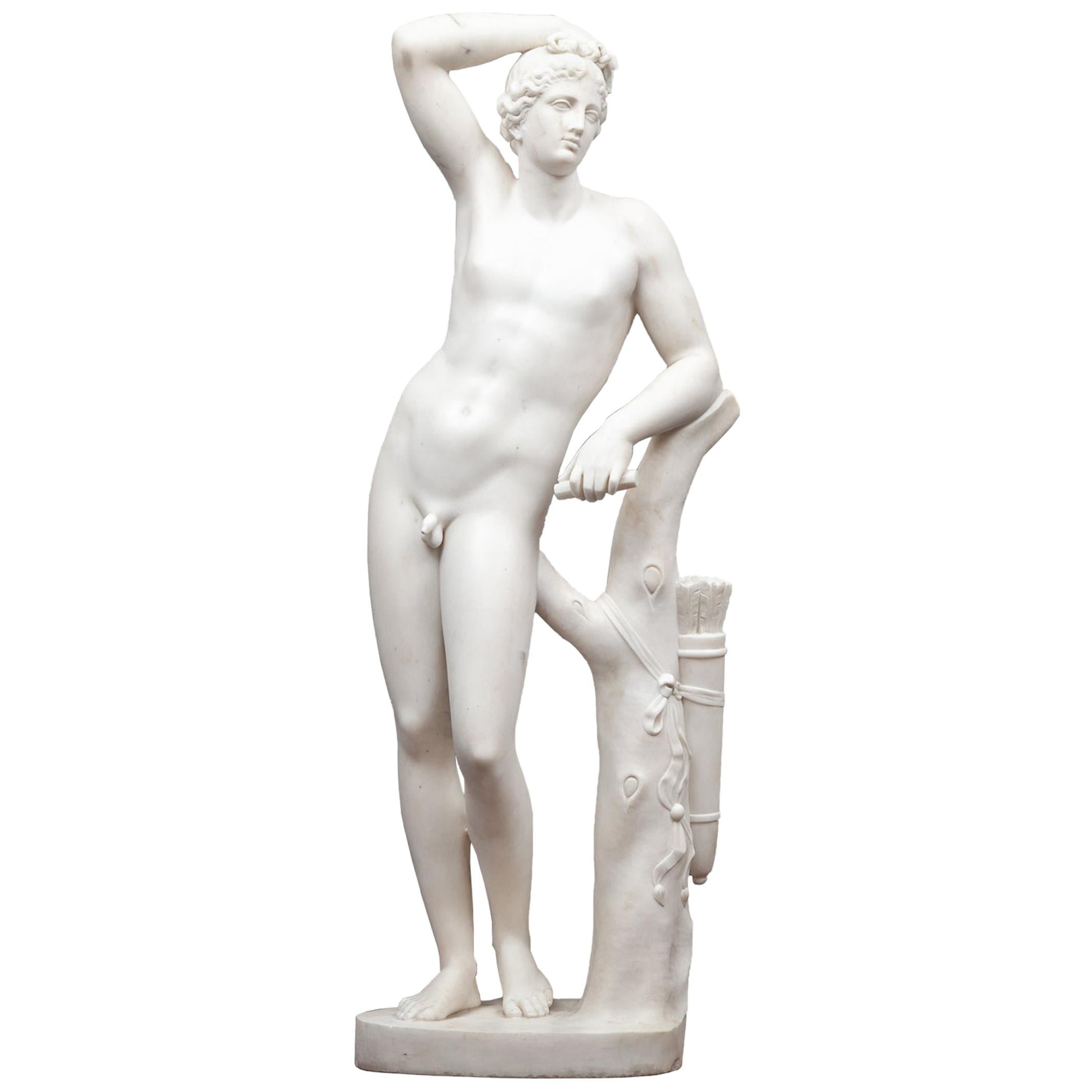
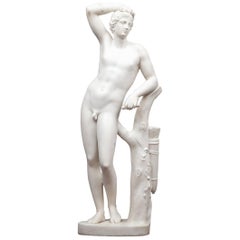
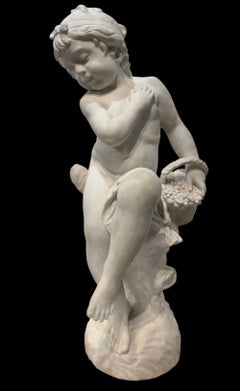
Neoclassical sculpture Ephebus Harpocratic in Marble Roman workshop 18th century

circa 1780

$6,464.65
£4,805.33
€5,500VAT Included
CA$9,062.57
A$9,202.30
CHF 5,253.16
MX$111,194.09
NOK 61,706.98
SEK 61,538.62
DKK 41,939.24

About the Item

Rare neoclassical white marble sculpture depicting an ephebe in the gesture of silence, also known as the gesture of Harpocrates, Rome, second half of the 18th century. Harpocrates, son of Isis and Serapis, corresponds to the infant Horus and is related to the rising sun. In Egyptian art he is depicted as a naked boy with a shaved skull, a side braid, and a finger to his mouth. The Greeks and Romans transformed him into an Eros-like child with wavy hair and a lotus flower on his head, like the Hadrian-era specimen preserved in the Capitoline Museums. Associated with the initiatory silentium in Gnostic philosophy, Harpocrates was also juxtaposed with Dionysus and Apollo. He often wears the nebride and leans on a vine trunk, symbols of fertility and rebirth. In some representations he holds a cornucopia, a sign of abundance. The gesture of Harpocrates was later taken up by many subsequent artists as an allegory of reserve, prudence and inner reflection. It also became a powerful emblem for protecting esoteric and philosophical knowledge from the profane and uninitiated connected with Hermeticism or Freemasonry. This 18th-century Roman depiction, from a stately palace on the Via del Corso and certainly made to order, could rather be described as a Harpocratic Ephebus: it depicts, in fact, a naked young man leaning against the trunk of a tree like the Louvre's Ephebus Narcissus; it differs from the latter in the position of his head, which, instead of looking down, shifts its gaze to the side bringing a finger to its mouth in the gesture of Harpocrates. In the 18th century, a passion for classical antiquity and archaeology (fueled by the excavations at Herculaneum and Pompeii) led the great master sculptors and Roman workshops to create works inspired by Greco-Roman statuary. The figure of Harpocrates, in particular, became highly sought after by collectors of the time and the Grand Tour, as he combined aesthetic elegance with strong symbolic appeal. Our statue, made of finely worked white marble, is characterized by a smooth surface, purity of line, and a careful study of anatomy. Measurements H cm 60 D base cm 20
  • Creation Year:
    circa 1780
  • Dimensions:
    Height: 23.63 in (60 cm)Width: 7.88 in (20 cm)
  • Medium:
  • Movement & Style:
  • Period:
  • Condition:
    Very good condition, small signs of time.
  • Gallery Location:
    Pistoia, IT
  • Reference Number:
    1stDibs: LU2746218122622

More From This Seller

View All
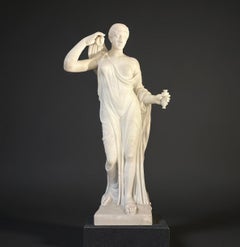
Imponente Scultura Neoclassica Italiana in Marmo Venere Genitrice XIX secolo

Imponente Scultura Neoclassica Italiana in Marmo Venere Genitrice XIX secolo

Located in Pistoia, IT

Imponente scultura neoclassica in marmo, modello conosciuto come Afrodite Louvre-Napoli o Venus Genitrix, bottega italiana, 19 secolo. La dea è raffigurata in piedi, al momento de...

Category

19th Century Academic Figurative Sculptures

Materials

Marble

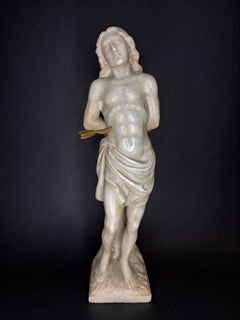
Marble sculpture St. Sebastian Italy 18th century

Marble sculpture St. Sebastian Italy 18th century

Located in Pistoia, IT

Marble sculpture in the round depicting St. Sebastian, Tuscan workshop, 18th century. The sculpture is taken from the fifteenth-century prototype by Benedetto da Maiano (Florence, 1...

Category

18th Century Italian School Figurative Sculptures

Materials

Marble

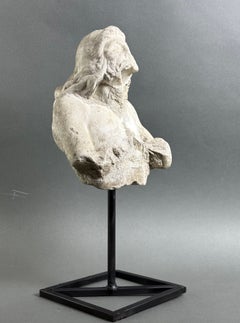
Triton in Marble Fragment of Baroque Sculpture Italy 17th century

Triton in Marble Fragment of Baroque Sculpture Italy 17th century

Located in Pistoia, IT

Marble sculpture depicting Triton, fragmentary, Italian Baroque, mid- XVIIth century. Coming almost certainly from a fountain, as evidenced by the presence of holes for the passage...

Category

17th Century Baroque Figurative Sculptures

Materials

Marble

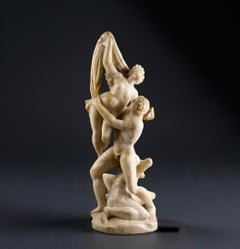
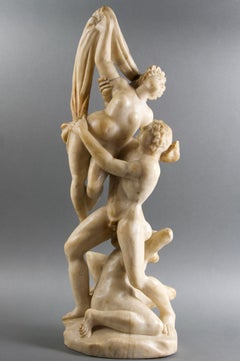
Italian Neoclassical Sculptural Group in Alabaster "The Rape of the Sabine Women" 18th

Italian Neoclassical Sculptural Group in Alabaster "The Rape of the Sabine Women" 18th

Located in Pistoia, IT

"The Rape of the Sabine Women," veined alabaster, large sculptural group with classical subject, Volterra manufacture, 18th century. The so-called Rape of the Sabine Women is a scu...

Category

Late 18th Century Italian School Figurative Sculptures

Materials

Alabaster

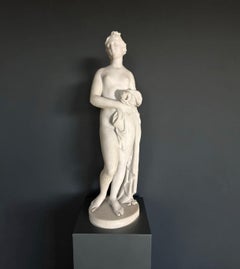
Atelier of John Gibson Venus in Marble Neoclassical Sculpture

Atelier of John Gibson Venus in Marble Neoclassical Sculpture

Located in Pistoia, IT

Large white marble sculpture depicting Venus, from the workshop of John Gibson, Rome, circa 1850. Known as Venus Verticordia or Venus Colored, its history is fascinating. John Gibson (June 19, 1790 - January 27, 1866) was a prominent Welsh neoclassical sculptor. He studied in Rome with Canova and opened his own workshop there, where he worked until his death. Born in Wales and raised in Liverpool, John Gibson had a brilliant career. After completing his apprenticeship at the age of 26, this ambitious Welshman arrived in London as a promising artist. He exhibited several times at the Royal Academy and, within two years, realized the dream of every young sculptor of his time: to study in Rome. The next two years spent with Canova shaped his career and sculptural approach. Gibson also studied with Bertel Thorvaldsen and, at the age of 31, opened his workshop on Via della Fontanella, near Piazza del Popolo. John Gibson's workshop was one of the largest in Rome during his lifetime; it was an essential stop on the circuit of Roman sculptors' workshops, as described in Hawks Le Grice's famous 1840 manual. He employed specialized modelers, sculptors, and trainers and counted among his students several promising artists, such as Harriet Hosmer...

Category

Mid-19th Century English School Figurative Sculptures
Materials

Marble

You May Also Like

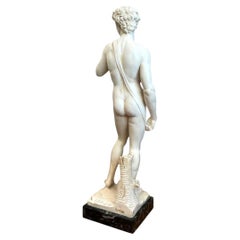
Vintage Italian Marble David Sculpture

Vintage Italian Marble David Sculpture

Located in West Palm Beach, FL

Capturing the timeless grandeur of Renaissance artistry, this vintage Italian sculpture is a finely detailed reproduction of Michelangelo’s iconic "David." Masterfully carved from fi...

Category

20th Century Italian Renaissance Figurative Sculptures

Materials

Stone, Marble

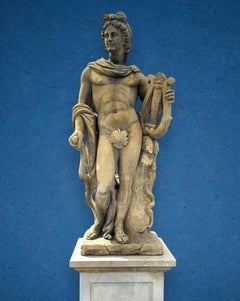
Italian Stone Garden Sculptures of Roman Mythological subject of Apollo

Italian Stone Garden Sculptures of Roman Mythological subject of Apollo

Located in Rome, IT

Finely carved mythological subject in Vicenza limestone of Apollo in Excellent condition from an estate of Veneto. Timeless decoration for your interior or garden. Measurements: St...

Category

20th Century Academic Figurative Sculptures

Materials

Limestone

Antique Neoclassical Statuary Marble Statue

Antique Neoclassical Statuary Marble Statue

Located in Tyrone, Northern Ireland

A beautifully carved antique statuary Carrara marble statue of Adonis. The male figure is depicted in the nude leaning against a tree. Adonis was the mortal lover of the goddess Aph...

Category

Antique Late 19th Century Italian Neoclassical Figurative Sculptures
Materials

Carrara Marble

Putto

Putto

Located in New York, NY

Italian Marble Putto Sculpture att. Cesare Lapini (1848–1893) A dynamic antique Italian white marble statue of a putto att. Cesare Lapini. Soulful and captivating, seated on a tree...

Category

Late 19th Century Naturalistic Figurative Sculptures
Materials

Marble