Want more images or videos?
Request additional images or videos from the seller
1 of 7

Spanish Colonial (Peruvian)
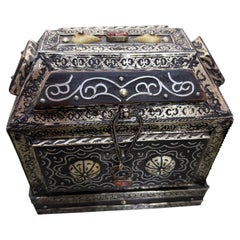
Silver and Transitional Andean Textile Casket

ca. 17th/18th Century

$76,000
£58,307.29
€68,018.06
CA$109,250.10
A$111,583.92
CHF 63,409.34
MX$1,352,684.62
NOK 750,010.88
SEK 751,022.36
DKK 508,427.87

About the Item

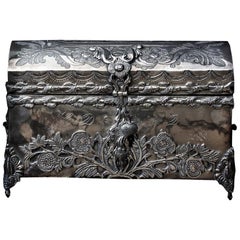
Silver was the material of choice for both ecclesiastical and domestic vessels in the New World, not only for its status as a precious metal, but also because of its abundance and durability. Silver caskets were common in Peru—a clear indication of their popularity and desirability—but caskets including textile elements are of extreme rarity. Andean Colonial textiles of the 17th and 18th centuries are generally called Transitional style, as they combine indigenous techniques and imagery with those brought to the New World. Here, the double-headed eagle surmounted with a crown (a Spanish imperial symbol) on the lid is seen alongside diminutive birds and geometric motifs along the sides of the casket, which relate to pre-conquest indigenous textile designs.

More From This Seller

View All
Cuzco School Baptismal Dish

Cuzco School Baptismal Dish

By Spanish Colonial (Peruvian)

Located in New York, NY

Provenance: Manuel Ortíz de Zevallos y García, Peru; and by descent in the family to: Private Collection, New York. This impressive baptismal dish is an example of eighteenth-cent...

Category

18th Century Old Masters Sculptures

Materials

Silver

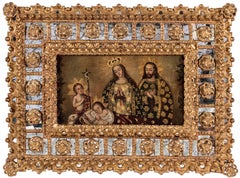
A Magnificent Gilt Wood Mirrored Frame

A Magnificent Gilt Wood Mirrored Frame

Located in New York, NY

Provenance: Private Collection, Argentina; there acquired by Mr. and Mrs. Ernest T. Harper, New York, by 1960; by descent to: Mr. and Mrs. Alan Harper, New York, until 2024. This extraordinary mirrored frame is an exuberant and nearly perfectly preserved example of Andean 18th-century decorative art. Pierced mirrored rosettes surrounding floral motifs are set against mirrored surrounds along a broad frieze bordered within and without by elaborate raised moldings, inlaid by small, shaped mirrors. Repeating ornamental motifs reflecting both Spanish and indigenous designs surround both the inside panel and the exterior perimeter, the four corners of which are punctuated by mirrored rosettes. Glass mirrors were unknown to the indigenous population of the Americas prior to the arrival of Europeans (obsidian mirrors...

Category

18th Century Old Masters Figurative Paintings

Materials

Canvas, Mirror, Wood, Oil

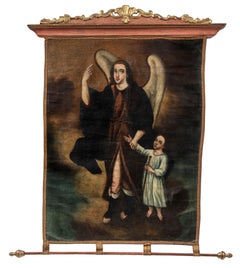
A Guardian Angel Leading a Child

A Guardian Angel Leading a Child

Located in New York, NY

Provenance: Private Collection, Argentina; there acquired by Mr. and Mrs. Ernest T. Harper, New York, by 1960; by descent to: Mr. and Mrs. Alan Harper, New York, until 2024. This s...

Category

18th Century Old Masters Figurative Paintings

Materials

Canvas, Oil

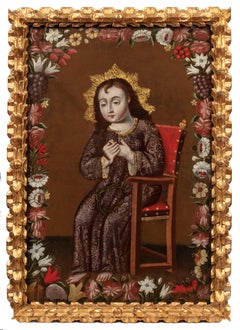
Young Christ Pricked by a Thorn (Niño de la Espina)

Young Christ Pricked by a Thorn (Niño de la Espina)

Located in New York, NY

Provenance: Private Collection, Paraguay, for at least the last 80 years Painted in the Viceroyalty of Peru during the 18th century, the present work depicts the young Christ as the Niño de la Espina—a devotional representation of Christ as he looks down at his bleeding finger, which has been pricked by the crown of thorns resting on his lap. The subject of the Young Christ Pricked by a Thorn was especially popular in Cuzco, and the rich details and decorative elements of our work perfectly capture the essence and style of the Cuzco School of painting. In our painting, Christ wears an intricately patterned floor-length robe trimmed with gilded cuffs and a gilded collar. The delicate gilding, including the halo of golden rays emanating from his head, are executed in brocateado, an ornamental over-gilding technique that is characteristic of the Cuzco School. The red chair on which Christ sits also includes brocateado in the decorative gilt elements. The form of the chair takes inspiration from those commonly used by friars both in Spain and the Andes, known as silla frailera or sillon frailero, and was also frequently employed in related depictions of the Virgin Mary Spinning. Here the young Christ is rendered with soft, elongated features that reflect the influence of the Italian Mannerist painters who were pivotal to the formation of the Cuzco School, including the Jesuit friar Bernardo Bitti and Matteo Pérez del Alesio. Additionally, while its origins can be traced to Northern European pictorial traditions, the lush flower garland that frames the work is a signature feature of Cuzqueño painting...

Category

18th Century Old Masters Figurative Paintings
Materials

Canvas, Oil

You May Also Like

Viceregal Chiseled Silver Casket, Decorated with Organic Motifs

Viceregal Chiseled Silver Casket, Decorated with Organic Motifs

Located in Mexico City, MX

This incredible piece is made of silver embossed in the form of floral ornaments. These pieces belonged to prominent members of the nobility. In addition to their shape and possible...

Category

Antique 1750s Mexican Spanish Colonial Decorative Boxes

Materials

Silver

Silver Chest, After 17th Century Models, circa 20th Century

Silver Chest, After 17th Century Models, circa 20th Century

Located in Madrid, ES

Arquette inspired by 17th century models. Silver, Spain, 20th century Rectangular casket made of silver in its color, with four legs in the corners in the form of roll and finished ...

Category

20th Century European Other Decorative Boxes

Materials

Silver, Other

Antique 19th Century Indian Kutch Solid Silver Casket c.1890

Antique 19th Century Indian Kutch Solid Silver Casket c.1890

Located in Royal Tunbridge Wells, Kent

Antique 19th Century Indian Kutch solid silver casket. Richly decorated throughout with dense repoussé and chased floral ornament. The rectangular form is covered with scrolling foli...

Category

Antique 19th Century Indian Other Decorative Boxes

Materials

Silver

Silver box in the shape of a chest w/ Turkish-style engravings & a hinged lid

Silver box in the shape of a chest w/ Turkish-style engravings & a hinged lid

Located in Porto, PT

Description: Silver box in the shape of a chest with Turkish-style engravings and a hinged lid. Metal: Silver. Origin: Turkish. Hallmark: Absent. Weight: 170.03 grams. Dimensions: 9c...

Category

20th Century European Decorative Boxes

Materials

Silver

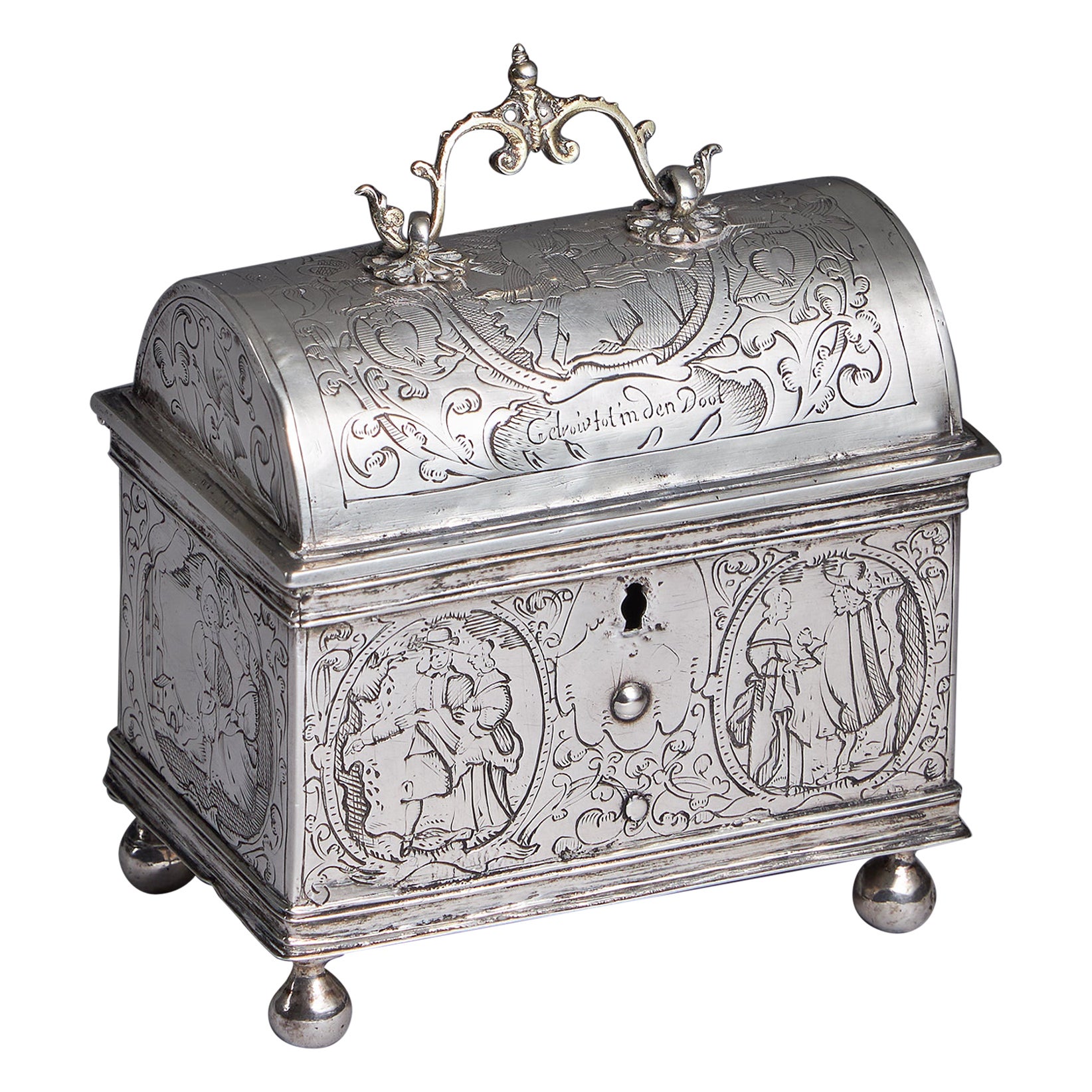
Mid 17th Century Dutch Engraved Silver Wedding Casket or knottekist, Circa 1660

Mid 17th Century Dutch Engraved Silver Wedding Casket or knottekist, Circa 1660

Located in Oxfordshire, United Kingdom

A museum-grade mid-17th century Dutch silver marriage casket or knottekistje, circa 1660. Raised on solid silver bun feet the miniature casket is profusely engraved to all faces depicting a courting couple and architecture entwined in scrolling foliage. The reverse of the casket depicts the last supper, however, if you look closely, you can see a boy stealing food or wine from underneath! Possibly, this is the courting gentleman showing that he had a sense of humour. The scratch lined moulded top is surmounted with an intricate handle (once gilt) and floral patera to the centre. There are two inscriptions each within a cartouche 'In Lÿfde Beltact het al' and 'Getrouw tot in den doot' which loosely translates to 'faithful until the death' and 'love is everything'. Wedding caskets...

Category

Antique 17th Century Dutch Baroque Decorative Boxes

Materials

Silver