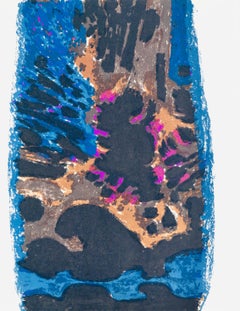
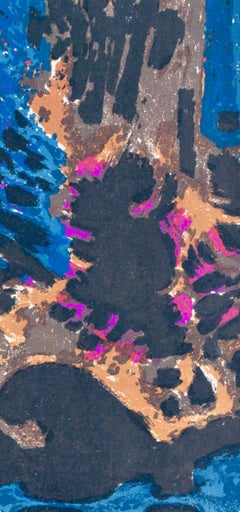
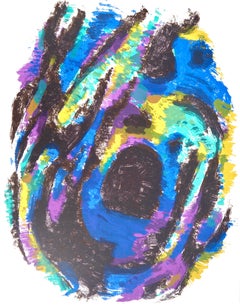
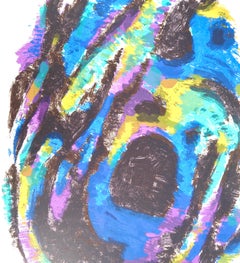
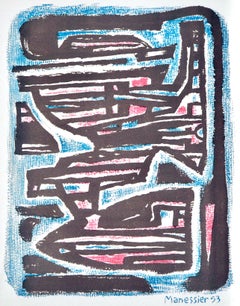
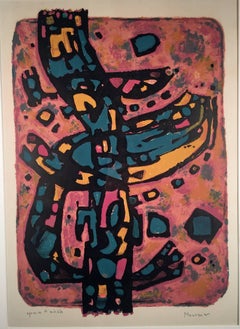
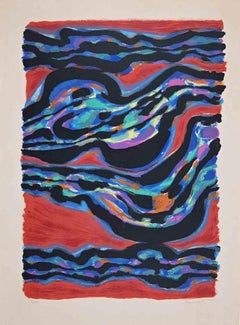
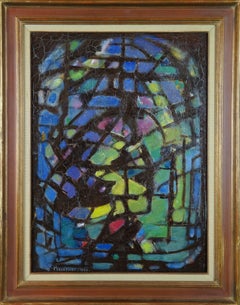
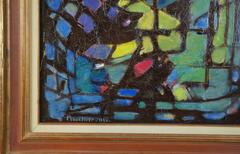
Alfred Manessier was born on 5 December 1911 in Saint-Ouen in the Somme. Trained at the Ecole des Beaux-Arts in Amiens (1924 - 1929), he completed his training at the Ecole des Beaux-Arts in Paris and spent a brief period in the studio of the painter Roger Bissière, who introduced him to frescoes and to whom he took refuge in Boissiérettes in the Lot at the beginning of the war.
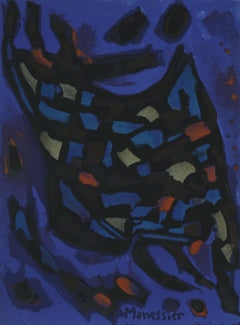
From 1947 onwards, stained glass occupied a large part of his work, which was now based on abstraction. He carried out about twenty projects in France, including the stained glass windows for the church of Saint-Michel des Bréseux (Doubs), his first commission (1948 - 1950), those in the church of Saint-Pierre de Trinquetaille in Arles (1953), and the chapel of Sainte-Thérèse de l'Enfant Jésus et de la Sainte Face in Hem (Nord - 1957). The stained glass windows of the Church of the Holy Sepulchre in Abbeville, one of his last commissions carried out between 1982 and 1993, are considered his masterpiece. He also executed a dozen stained glass projects in Switzerland, Germany and Spain.
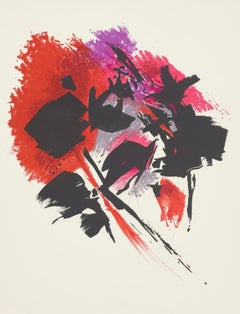
As an abstract painter of the Ecole de Paris, Manessier frequently tackled subjects related to the Catholic religion. His paintings are often inspired by the landscapes of Northern France, but also by his travels. From 1956 onwards, he produced a large number of political paintings entitled "Hommage", which echoed the violence in the world.
The dissemination of his artworks in the public space through these stained glass windows gave him great notoriety during his lifetime, and his paintings were awarded numerous international prizes (such as the Grand Prix of the Venice Biennale, which he received in 1962, alongside Albert Giacometti, who received the Grand Prix for sculpture).
He died on 1er August 1993 as a result of a car accident, shortly after the completion of the stained glass windows in Abbeville.
Explore a vast range of abstract prints on 1stDibs to find a piece to enhance your existing collection or transform a space.
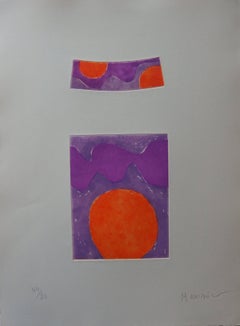
Unlike figurative paintings and other figurative art, which focuses on realism and representational perspectives, abstract art concentrates on visual interpretation. An artist may use a single color or simple geometric forms to create a world of depth. Printmaking has a rich history of abstraction. Through materials like stone, metal, wood and wax, an image can be transferred from one surface to another.
During the 19th century, iconic artists, including Edvard Munch, Paul Cézanne, Georgiana Houghton and others, began exploring works based on shapes and colors. This was a departure from the academic conventions of European painting and would influence the rise of 20th-century abstraction and its pioneers, like Pablo Picasso and Piet Mondrian.
Some leaders of European abstraction, including Franz Kline, were influenced by the gestural shapes of East Asian calligraphy. Calligraphy interprets poetry, songs, symbols or other means of storytelling into art, from works on paper in Japan to elements of Islamic architecture.
Bold, daring and expressive, abstract art is constantly evolving and dazzling viewers. And entire genres have blossomed from it, such as Color Field painting and Minimalism.
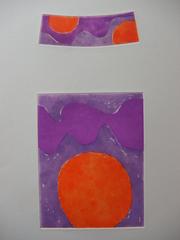
The collection of abstract art prints on 1stDibs includes etchings, lithographs, screen-prints and other works, and you can find prints by artists such as Joan Miró, Alexander Calder and more.