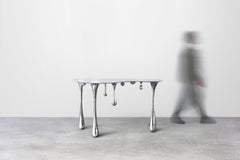
Find many varieties of an authentic dripping console table available at 1stDibs. A dripping console table — often made from
metal,
stainless steel and
wood — can elevate any home. If you’re shopping for a dripping console table, we have 4 options in-stock, while there are 7 modern editions to choose from as well. There are many kinds of the dripping console table you’re looking for, from those produced as long ago as the 18th Century to those made as recently as the 21st Century. A dripping console table made by
modern designers — as well as those associated with
neoclassical — is very popular. You’ll likely find more than one dripping console table that is appealing in its simplicity, but
Zhipeng Tan,
Sergio Villa and
Agnès Debizet produced versions that are worth a look.
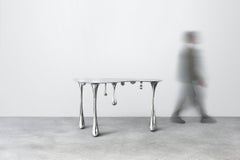
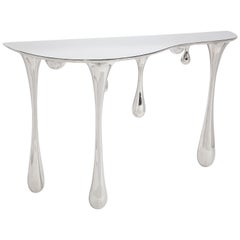
Zhipeng Tan creates provocative furniture with metal alloys that merges abstraction and Pop art with forms inspired by the natural world. The contemporary Chinese designer’s chairs and stools are topped with seats that mimic the shapes of flower petals, while the graceful legs of his audacious polished brass side tables and dining tables resemble molten gold.
Tan graduated from the China Academy of Art in Hangzhou with a degree in industrial design. Enamored with the organic silhouettes that populate the great outdoors, he grew increasingly interested in sculpture and drew on natural forms in his work, with molded brass as his vehicle for expression. Tan employs the ancient technique of lost-wax casting, which sees metal objects and furnishings cast from wax models. He then trims, welds and polishes the parts to craft tables and seating that are distinctive and unconventional works of art-furniture that are wholly sculptural but serve a functional purpose in one’s living room. In 2015, Tan cofounded the Shanghai-based Mán-Mán Studio with Daishi Luo, a furniture designer and sculptor who studied metal art at Huafan University in Taiwan.
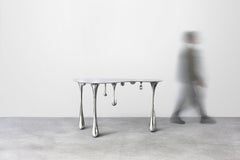
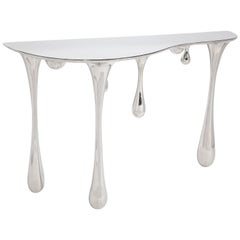
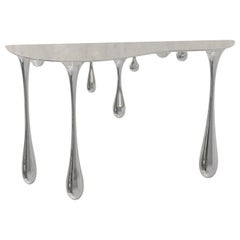
Tan is known for his brass 33 Step chair, which draws heavily on the human anatomy and is named for the 33 vertebrae found in the human spine. Many of his console and coffee tables appear as though the metal table top has reverted to its molten state, with a range of droplet-shaped brass forms at each corner serving as table legs, while smaller elements are “suspended” inches above the floor along the table's underside, creating a striking visual effect.
Many have suggested that Tan’s influences include English sculptor Henry Moore, Catalan artist Joan Miró and Japanese Pop artist Takashi Murakami. Notable firms such as Martyn Lawrence Bullard, Ingrao Inc. and David Scott Interiors have purchased his semi-abstract creations, and Tan’s work can be found in the collections of the Columbus Museum of Art, the HE Art Museum and the Centre Pompidou.
Find Zhipeng Tan furniture on 1stDibs.
Few pieces of furniture are celebrated for their functionality as much as their decorative attributes in the way that console tables are. While these furnishings are not as common in today’s interiors as their coffee-table and side-table counterparts, console tables are stylish home accents and have become more prevalent over the years.
The popularity of wood console tables took shape during the 17th and 18th centuries in French and Italian culture, and were exclusively featured in the palatial homes of the upper class. The era’s outwardly sculptural examples of these small structures were paired with mirrors or matching stools and had tabletops of marble. They were most often half-moon-shaped and stood on two scrolled giltwood legs, and because they weren’t wholly supported on their two legs rather than the traditional four, their flat-backed supports were intended to hug the wall behind them and were commonly joined by an ornate stretcher. The legs were affixed or bolted to the wall with architectural brackets called console brackets — hence, the name we know them by today — which gave the impression that they were freestanding furnishings. While console tables introduced a dose of drama in the foyer of any given aristocrat — an embodiment of Rococo-style furniture — the table actually occupied minimal floor space (an attractive feature in home furniture). As demand grew and console tables made their way to other countries, they gained recognition as versatile additions to any home.
Contemporary console tables comprise many different materials and are characterized today by varying shapes and design styles. It is typical to find them made of marble, walnut or oak and metal. While modern console tables commonly feature four legs, you can still find the two-legged variety, which is ideal for nestling behind the sofa. A narrow console table is a practical option if you need to save space — having outgrown their origins as purely ornamental, today’s console tables are home to treasured decorative objects, help fill empty foyers and, outfitted with drawers or a shelf, can provide a modest amount of storage as needed.
The rich collection of antique, new and vintage console tables on 1stDibs includes everything from 19th-century gems designed in the Empire style to unique rattan pieces and more.