Sir Peter Lely Portrait Paintings

Dutch, 1618-1680
Sir Peter Lely (1618-1680) was born in Germany at Soest in Westphalia in 1618. Though his family name was van der Faes, he assumed the name Lely after the lily that was carved on the gable of his father’s home in The Hague. He moved to England in 1641, the year that Van Dyck died, and succeeded Van Dyck. He was court painter to Kind Charles I and King Charles II. By working for many of the patrons of the late van Dyck, Lely rapidly established himself as one of the country’s most important portrait painters.
to
1
2
1
Overall Width
to
Overall Height
to
4
3
4
2
2
2
1
1
4
4
2
2
4
281
108
81
69
2
4
Artist: Sir Peter Lely
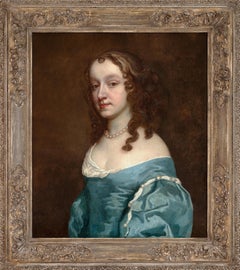
Portrait of young Lady, c. 1656-58

Portrait of young Lady, c. 1656-58

By Sir Peter Lely

Located in Henley-on-Thames, England

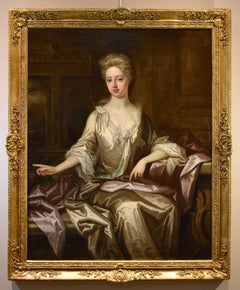
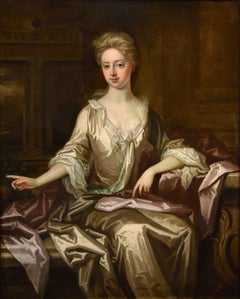
Sir Peter Lely (Soest 1618-London 1680) Portrait of young Lady, c. 1656-58 Half-length, wearing pearls and a blue dress, with her shirt revealed Formerly identified as Elizabeth Clay...

Category

1650s Old Masters Sir Peter Lely Portrait Paintings

Materials

Oil

Portrait of Lady Diana Bruce in Blue Dress & Cut Sleeves c.1660-1670, Peter Lely

Portrait of Lady Diana Bruce in Blue Dress & Cut Sleeves c.1660-1670, Peter Lely

By Sir Peter Lely

Located in London, GB

Portrait of Lady Diana Bruce in a Blue Dress with Cut Sleeves c.1660-1670 Circle of Sir Peter Lely (1616-1680) Presented by Titan Fine Art is a captivating portrait of the noble Lad...

Category

17th Century Old Masters Sir Peter Lely Portrait Paintings

Materials

Oil, Canvas

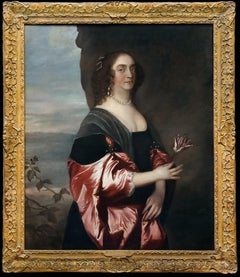
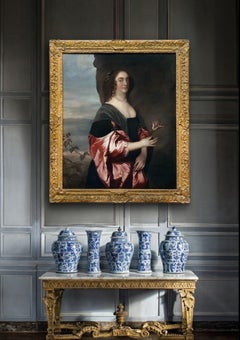
Portrait of a Lady, in Black Dress with Red Satin Sleeves and Pearls c.1660-1680

Portrait of a Lady, in Black Dress with Red Satin Sleeves and Pearls c.1660-1680

By Sir Peter Lely

Located in London, GB

Portrait of a Lady, in a Black Dress with Red Satin Sleeves and Pearls English School c.1660–1680 Circle of Sir Peter Lely (1618-1680) This striking portrait is a compelling exampl...

Category

17th Century Old Masters Sir Peter Lely Portrait Paintings

Materials

Canvas, Oil

Related Items
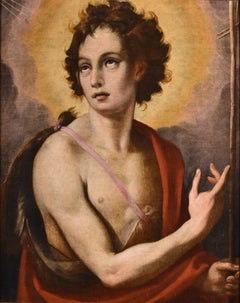
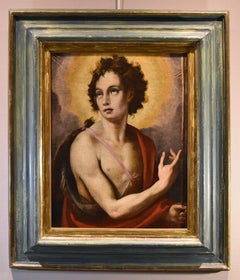
Saint John Baptist 16/17th Century Paint OIl on canvas Old master Tuscany school

Saint John Baptist 16/17th Century Paint OIl on canvas Old master Tuscany school

Located in Riva del Garda, IT

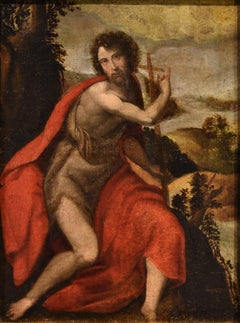
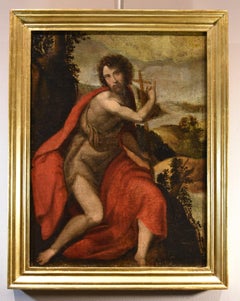
Florentine painter, 16th-17th century Saint John the Baptist Oil on canvas 67 x 56 cm - In frame 98 x 83 cm In bringing out the sculptural figure of this young Saint John the...

Category

17th Century Old Masters Sir Peter Lely Portrait Paintings

Materials

Oil

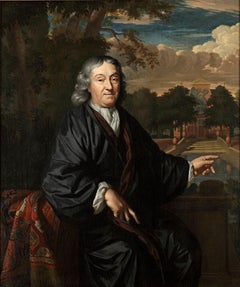
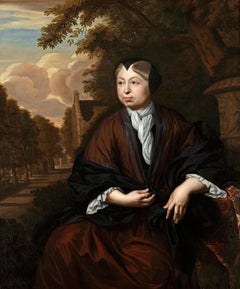
Male and female portrait, both in silk kimono, possibly textile dealers

Male and female portrait, both in silk kimono, possibly textile dealers

By Christoffel Lubieniecki

Located in Amsterdam, NL

CHRISTOFFEL LUBIENIECKI (1659-1729) Pair of portraits of a gentleman and a lady, both in silk kimono, before a country house (circa 1680) Indistinctly signed “C.......” on a box under the man’s left hand Oil on canvas, 79.5 x 67 cm each Both sitters are portrayed wearing a silk “Japanese” coat. During the second half of the seventeenth the Japanese silk coat, an adapted Japanese kimono, became a real vogue in the Dutch elite. The exclusive Dutch trade contacts with Japan can explain the popularity of the kimono-style silk coats in the Netherlands. Everybody who could afford one, dressed in such a fashionable and comfortable coat and, like the present sitters, some proud owners had themselves portrayed in a “Japanese” coat often together with an oriental carpet to underline their standing and international connections. These portraits are the work of the Polish-born portraitist Christoffel Lubieniecki (also known as Lubienitski, Lubinitski or Lubiniecki) Lubieniecki was first trained in Hamburg under Julian Stuhr and after 1675 in Amsterdam under Adriaen Backer and Gerard de Lairesse. He specialized in landscapes, generally of an Italianate character, and in portraits. The loving execution of these contented burghers, enjoying the garden vistas of their country house, places him alongside Amsterdam portraitists such as Constantijn Netscher and Michiel van Musscher...

Category

1680s Old Masters Sir Peter Lely Portrait Paintings

Materials

Canvas, Oil

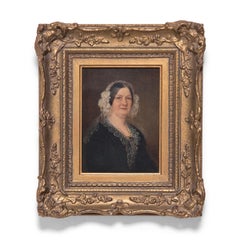
Oil Portrait of a Victorian Lady, c. 1850

Oil Portrait of a Victorian Lady, c. 1850, c. 1850

$1,480

H 13.75 in W 11.5 in D 1.75 in

Oil Portrait of a Victorian Lady, c. 1850

Located in Chicago, IL

Painted in the 19th century, this exquisite miniature portrait wonderfully exemplifies realism in traditional oil painting. The small artwork is painted in the conventional portraiture style of the Old Masters, and achieves soft realism with fine brushwork and a subdued, neutral palette. The half length portrait depicts a fine Victorian woman dressed in all black with a delicate lace collar and bonnet. She wears a ruby broach...

Category

Mid-19th Century Old Masters Sir Peter Lely Portrait Paintings

Materials

Oil

Portrait Noblewoman Kneller 17/18th Century Paint Oil on canvas Old master Art

Portrait Noblewoman Kneller 17/18th Century Paint Oil on canvas Old master Art

Located in Riva del Garda, IT

Godfrey Kneller (Lübeck 1646 – London 1723) Portrait of an English noblewoman, presumably Mary Capel, Countess of Essex (1679–1726) Oil on canvas 128 x 104 cm. In frame 146 x...

Category

17th Century Old Masters Sir Peter Lely Portrait Paintings

Materials

Oil

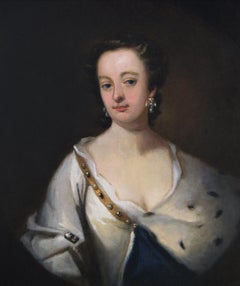
18th Century portrait oil painting of a lady in an ermine trimmed cloak

18th Century portrait oil painting of a lady in an ermine trimmed cloak

By Sir Godfrey Kneller

Located in Nr Broadway, Worcestershire

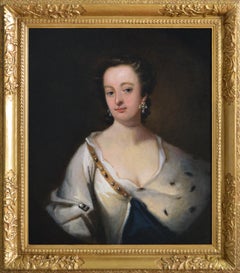
Circle of Sir Godfrey Kneller Dutch, (1646-1723) Portrait of a Lady in an Ermine Trimmed Cloak Oil on canvas Image size: 26.5 inches x 22.5 inches Size including frame: 33.5 inches x 29.5 inches A well-executed half-length portrait of a lady painted in a feigned oval, circle of Sir Godfrey Kneller. The use of a feigned oval was a device used in portraiture to give a sense of depth and add an intimacy to the painting, drawing your attention to the sitter. The subject, posed without her wig in the undressed fashion of the day, wears a blue ermine trimmed blue cloak over a white silk robe...

Category

18th Century Old Masters Sir Peter Lely Portrait Paintings

Materials

Canvas, Oil

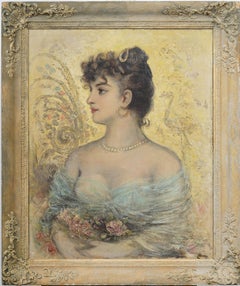
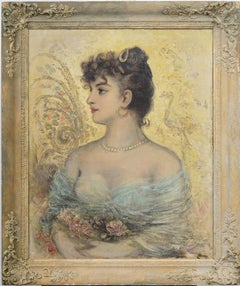
Antique European Impressionist Elegant Young Woman Portrait Framed Oil Painting

Antique European Impressionist Elegant Young Woman Portrait Framed Oil Painting

Located in Buffalo, NY

Antique European impressionist portrait oil painting . Oil on canvas. Signed. Framed. Measuring: 26 by 32 inches overall, and 21.5 by 26.5 painting alone. Handsomely framed in a gi...

Category

1890s Impressionist Sir Peter Lely Portrait Paintings

Materials

Oil, Canvas

Conversion Saint Paul Antonio Tempesta Paint 17th Century Oil on canvas Italy

Conversion Saint Paul Antonio Tempesta Paint 17th Century Oil on canvas Italy

Located in Riva del Garda, IT

Antonio Tempesta (Florence 1555 - Rome 1630) Circle The Conversion of Saint Paul on the Road to Damascus Oil on canvas 112 x 102 cm Framed 125 x 114 cm The scene depicts the e...

Category

17th Century Old Masters Sir Peter Lely Portrait Paintings

Materials

Oil

Saint John Baptist Venusti Paint 16th Century Oil on canvas Old master Italy Art

Saint John Baptist Venusti Paint 16th Century Oil on canvas Old master Italy Art

Located in Riva del Garda, IT

Marcello Venusti (Mazzo di Valtellina 1510 - Rome 1579) workshop/circle Saint John the Baptist Oil on canvas (65 x 50 cm. -  In frame 74 x 58 cm.) The work depicts Saint John...

Category

16th Century Old Masters Sir Peter Lely Portrait Paintings

Materials

Oil

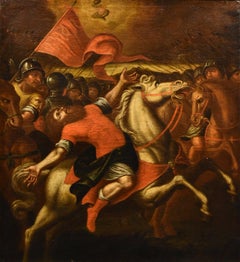
Saint James Religious Tempesta Paint 17th Century OIl on canvas Old master Italy

Saint James Religious Tempesta Paint 17th Century OIl on canvas Old master Italy

Located in Riva del Garda, IT

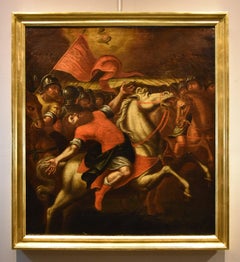
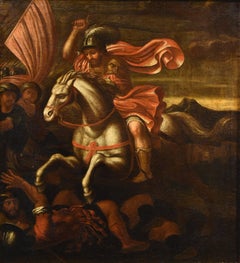
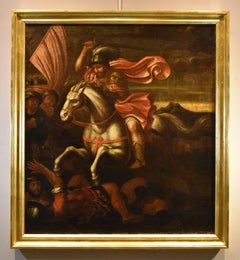
Antonio Tempesta (Florence 1555 - Rome 1630) Circle Saint James defeating the Moors in battle Oil on canvas 112 x 102 cm - Framed 125 x 114 cm A valiant knight with his sword...

Category

17th Century Old Masters Sir Peter Lely Portrait Paintings

Materials

Oil

Copy of "Portrait of Beatrice dʼEste" by Leonardo da Vinci created 15th Century

Copy of "Portrait of Beatrice dʼEste" by Leonardo da Vinci created 15th Century

Located in New York, NY

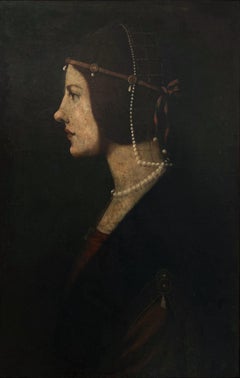
A masterful copy by an unknown artist, after the portrait of "Beatrice d'Este" by Leonardo Da Vinci also known as ‘Portrait of a Lady’ or ‘La Dama con la reticella di perle (The Lady With a Pearl Hairnet)’. The original work originally created in the 15th Century is currently on display in the Pinacoteca Ambrosiana Museum of Milan. Beatrice d'Este was the Duchess of Bari/Milan and was believed to be one of the most attractive princesses of the Renaissance. Her impeccable style won her many admirers throughout Italy and France, and she became a trendsetter of the highest order. This copy of the original painting, is an oil on canvas done in the 18th Century, and in this exquisite portrait, the artist has masterfully depicted the fine details with draped hair, pearls, royal dress, ornate headgear and sumptuous jewelry in front of a dark background. Once again, capturing the imagination with another enigmatic smile. It comes housed in an elegant period giltwood frame with ebonized trims and ready to be displayed with hanging wire on verso. Art measures 28 x 18 inches Frame measures 34.5 x 24.5 inches There is much debate and controversy over who actually painted the "Beatrice d'Este" was it Leonardo da Vinci (1452–1519), or Giovanni Ambrogio de Predis (1455–1508). So we may never know who executed the original portrait which hangs in the museum, but that need not deter from an appreciation of its singularity. Following the portraiture convention established by painters of the Quattrocentro, the artist has chosen to portray his sitter in profile. In doing so, he magnificently captures the essence of his sitter, a girl on the threshold of womanhood. Bedecked in the adornments—silk, velvet, pearls and embroidery (brocade) crafted of spun gold threads—afforded her by birthright and marriage, Beatrice looks forward in noble serenity. And at the same time her profile with its upturned nose and slight smile betrays an innocence that must have been the basis of the oft-repeated epithet: la più zentil donna in Italia” (“the sweetest lady in Italy”). It is believed the lady is Beatrice d'Este (1475-1497), duchess of Bari and later of Milan, the wife of Ludovico Sforza (known as "il Moro"). One of the most beautiful princesses of the Italian Renaissance, she was known for her good taste in fashion. Beatrice was a member of the Este-Sforza family, which joined by marriage two of the oldest reigning and already powerful houses in Italy. The house of Este, which held court in Ferrara, traced its lineage to the 11th century Dukes of Saxony and Bavaria. Beatriceʼs father, Ercole I ruled the Ferrara commune for 34 years, catapulting the city-state (and the Estes with it) to an unmatched level of economic prosperity and cultural prominence. The family was renowned for its love of letters and patronage of the arts. The first time Leonardo da Vinci’s name resounded in the Ambrosiana, it was through the pen of its founder, Cardinal Federico Borromeo, who attributed this little panel to the great Master, describing it as “A portrait of a Duchess of Milan, by the hand of Leonardo”. Following the Cardinal’s statement, the portrait was for long assumed to depict Beatrice d’Este, the wife of Ludovico il Moro. However, scholars have recently been more cautious and vague in their statements, with regard to both the artist (anonymous Lombard or Emilian...

Category

18th Century Northern Renaissance Sir Peter Lely Portrait Paintings

Materials

Canvas, Oil

Portrait of Lady, Mary Hammond, Oil on Panel c.1618-22, Manor House Provenance

Portrait of Lady, Mary Hammond, Oil on Panel c.1618-22, Manor House Provenance

By Cornelius Johnson

Located in London, GB

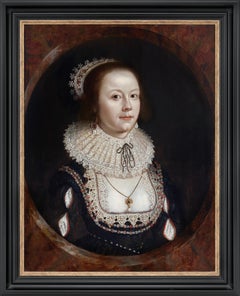
Portrait of Mary Hammond in Sumptuous Attire, Jewels and Lace c.1618-22 Circle of Cornelius Johnson (1593-1661) This portrait of a lady, presented by Titan Fine Art, is an exquisite example of early seventeenth-century portraiture, remarkable both for the lavishness of its subject’s attire and for the distinguished provenance that has accompanied it across four centuries that adds a rich layer of historical significance. It was once part of the notable collection of Sir William Temple, 1st Baronet (1628–1699) at Moor Park, a stately mansion in Hertfordshire. Temple was a diplomat, essayist, philosopher, and the patron of Jonathan Swift. He was a key participate at an important period in English history, helping not only to negotiate the Triple Alliance, but also the marriage between William of Orange and Princess Mary. His collection at Moor Park was well known in its day, reflecting both his cultivated taste in art and literature and his international connections. Its fabulous attire, rendered with almost microscopic attention, is not merely decorative but emblematic of a world in which visual display was a language of power. Its provenance, stretching from the English country house and Enlightenment scholarship to modernist circles, forms a microcosm of cultural exchange across four centuries. Thus, the portrait of Mary Hammond stands as both a masterpiece of early seventeenth-century craftsmanship and a witness to the grand narrative of collecting and connoisseurship—a testament to the enduring fascination of beauty, status, and history intertwined. By tradition the portrait depicts Mary Hammond (born c.1602), who was Sir William Temple’s mother, and the daughter of the royal physician who served James I, Dr John Hammond (c.1555–1617) and whose family owned Chertsey Abbey in Surrey. The woman appears between 18 and 25 years old, and Mary would be about 18–20 when the portrait was painted circa 1620, therefore this matches the apparent age of the sitter and the fashion perfectly. Mary stood at the intersection of learned/courtly and gentry worlds. On 22 June 1627 she married her first cousin (a common practice for consolidating family wealth and influence during that era.) Sir John Temple (1600-1677) at St Michael, Cornhill in the City of London. The couple resided nearby, at Blackfriars. Her marriage to Sir Temple placed her at the heart of the social and political circles that shaped British history. The couple had at least five children, and they became highly significant historical figures: The eldest son, Sir William Temple, 1st Baronet, became a distinguished diplomat, statesman, and essayist, famous for his role in the Triple Alliance and as a patron and mentor to the writer Jonathan Swift – our portrait was in his collection. Their daughter, Martha Temple, later Lady Giffard, was a notable figure in her own right. She became her brother William's first biographer and a respected letter-writer, providing a rare female perspective on the events and high society of the time. Another son, also named Sir John Temple, became Attorney General for Ireland and was involved in the turbulent politics surrounding the English Civil War and the Act of Settlement in Ireland. Mary died in November 1638 after giving birth to twins and was buried at Penshurst, Kent. The family's connection to Penshurst Place is a major point of interest as this historic manor was the seat of the Sidney family, a major aristocratic and literary dynasty. The portrait was in the collection of the Mary’s son, Sir William Temple. From there it descended to his daughter, and then to her nephew, the Reverend Nicholas Bacon of Spixworth Park, Norfolk (his mother was Dorothy Temple who died in 1758). Indeed, by this time, many Temple relics were in the collection at Spixworth including the engagement ring of the illustrious Dorothy Osborne, Lady Temple, wife of Sir William Temple. The portrait thus linked two prominent English families—the Temples and the Bacons—for generations. It is listed in a Spixworth Park inventory of 27 October 1910 by the local collector and art historian, Prince Duleep Singh. He described it with characteristic precision as: “No. 69. Lady Half Length, body and face turned towards the sinister, hazel eyes upwards to the dexter, red hair dressed low and over the ears, a jewelled coronet behind, pearl ear-rings tied with black strings. Dress: black, bodice cut low and square, with lace all round the opening and over shoulders, sleeves with double slashes showing red lining and lace under, falling thin pleated lace collar, black strings tied behind it, a jewel suspended on a black string round the neck, and a double row of agate and silver beads all round to the shoulders. M. In brown veined stone frame. Age 30. Date c.1620. It is called ‘Dutch portrait from Moor Park, mentioned by Nicholas Bacon of Coddenham and Shrubland as a very valuable painting.’ A few years later, when Robert Bacon Longe’s executors sold the contents of Spixworth Park (19–22 May 1912), the portrait appeared as lot 262, described as: “A very valuable half-length portrait on panel, ‘Dutch Lady, with deep lace collar and pearl and amethyst necklace, pendant, and ear-rings, and auburn hair, with coronet’ Early Dutch School 1620.” Following this sale the painting entered the collection of David and Constance Garnett, prominent literary figures of the early twentieth century, before being gifted to Andre Vladimervitch Tchernavin by 1949, and subsequently passed by him to the present owners in 1994. The two great houses associated with the painting, Moor Park and Spixworth Park, further underscore its pedigree. Moor Park, in Hertfordshire, was among the grandest country estates of seventeenth-century England—its gardens famously redesigned by Sir William Temple himself and later influencing landscape design across Europe. Sir William's Temple's secretary was Jonathan Swift, who lived at Moor Park between 1689 and 1699. Swift began to write "A Tale of the Tub" and "The Battle of the Books" at Moor Park. Spixworth Park, near Norwich, was an Elizabethan country house in Spixworth, Norfolk, located just north of the city of Norwich. It was home to successive generations of the Bacon family, one of Norfolk’s most distinguished dynasties (later, the Bacon Longe family), who were considerable land owners (owning Reymerston Hall, Norfolk, Hingham Hall, Norfolk, Dunston Hall, Norfolk, Abbot's Hall, Stowmarket, and Yelverton Hall, Norfolk). Spixworth Hall and the surrounding parkland remained in the Longe family for 257 years until 1952, when it was demolished. Rendered with meticulous precision and sumptuous detail, the painting depicts an elegantly dressed woman—her poise, costume, and jewels all communicating a message of wealth, refinement, and social rank. Every brushstroke conveys an artist deeply attuned to the textures of luxury and the nuances of feminine dignity. The sitter’s attire is nothing short of magnificent. Her bodice and sleeves are fashioned from the finest black silk or satin, the fabric absorbing and reflecting light in equal measure, suggesting both depth and lustre. Around her shoulders lies an opulent lace ruff—a deep, radiating lace collar worked in such intricate detail that it testifies to both the artist’s technical skill and the sitter’s extravagant taste. Lace of this quality, especially Venetian or Flemish bobbin lace, was one of the costliest materials available in early seventeenth-century Europe, its weight worth more than gold, and was a marker of prestige that rivalled jewels in value. The painter has taken great care to delineate every loop and scallop of the lace, achieving an almost tactile realism. Pale skin was also a desired beauty standard, sometimes accentuated with contrasting black ribbons or strings. Her jewels amplify this display of affluence. Matching earrings and a delicate coronet or jewelled hair ornament with a feather adorn her hair, which is styled in the modest yet fashionable manner of the time. These details are far from decorative excess—they serve as visual emblems of social standing, refinement, and lineage. Portraits of this kind were statements of both identity and aspiration, intended to project a family’s prosperity and moral virtue to posterity. The portrait was most likely painted in London around 1618-1622. The low-cut, décolletage-revealing neckline was fashionable in the courts of England and France during the late Elizabethan and Jacobean eras (c. 1590s-1610s), this style did not prevail in the public fashion of the Low Countries at this time. This style of lace ruff — delicate needle lace with geometric openwork — was fashionable from c.1615 to 1622, and the jewelled caul (hair net) and lace edging over a stiffened coif are consistent with high-status English women’s portraiture between 1610–1620. The puffed sleeve slash and the use of pink satin beneath black velvet belong squarely to the late Jacobean...

Category

17th Century Old Masters Sir Peter Lely Portrait Paintings
Materials

Oil, Panel

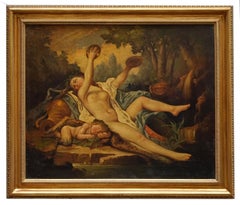
ALLEGORICAL SCENE - Giovanni Faliero - Italy  Oil on Canvas Painting

ALLEGORICAL SCENE - Giovanni Faliero - Italy Oil on Canvas Painting

By Giovanni Faliero

Located in Napoli, IT

Allegorical Scene - Giovanni Faliero Italia 2009 - Oil on canvas cm. 90x110. This beautiful oil on canvas is the personal reinterpretation of the magnificent painting “Bacchant playing the Cymbals” by Jean-Simon Berthélemy, a French painter of the 18th century. Here we admire a mythological scene showing a naked bacchant playing cymbals next to a wooded stream, with a small sleeping faun...

Category

Early 2000s Old Masters Sir Peter Lely Portrait Paintings
Materials

Canvas, Oil

Previously Available Items
Portrait of Lady, Elizabeth Wriothesley, Countess of Northumberland, Peter Lely

Portrait of Lady, Elizabeth Wriothesley, Countess of Northumberland, Peter Lely

By Sir Peter Lely

Located in London, GB

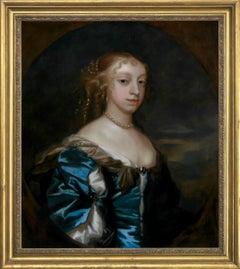
Portrait of Elizabeth Wriothesley, Countess of Northumberland (1646-1690) (later Duchess of Montagu) c.1665-1669 Studio of Peter Lely (1618-1680) This exemplary three-quarter-length...

Category

17th Century Old Masters Sir Peter Lely Portrait Paintings
Materials

Canvas, Oil

Portrait of Bridget Drury Lady Shaw, formerly Viscountess Kilmorey

Portrait of Bridget Drury Lady Shaw, formerly Viscountess Kilmorey

By Sir Peter Lely

Located in London, GB

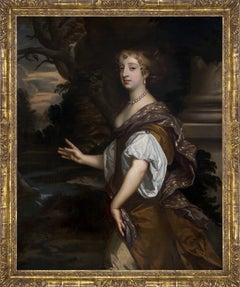
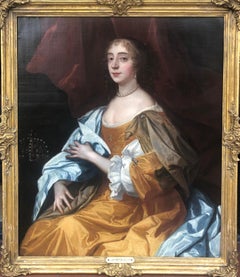
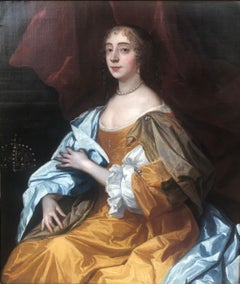
Sir Peter Lely (Soest 1618 – 1680 London) Portrait of lady with a crown, possibly Bridget Drury Lady Shaw, formerly Viscountess Kilmorey, later Lady Baber (d.1696) c.1665 Oil on canvas 46 1/2 x 40 3/4 inches, Framed 42 1/4 x 36 1/4 inches, Unframed Inscribed left [……….]Isabella James Mulraine wrote the following for this piece: This portrait dates to the middle of the 1660s, the decade when Lely’s career took off as successor to Sir Anthony van Dyck. At the Restoration Charles II had appointed him Principal Painter to the King and paid a pension £200 per annum ‘as formerly to Sr. Vandyke...’1 Lely had trained in Haarlem and he was in his early twenties when he came to London in 1643. He was an astute businessman and a wise courtier. In 1650 he painted a portrait of Oliver Cromwell (Birmingham Museum and Art Gallery) while maintaining links with the Royalist exiles through the 1650s. He had arrived in England as a painter of small-scale portraits and lush scenes of nymphs in landscapes in a Dutch style. His experience of Van Dyck in English collections transformed his painting. His lavish and alluring vision of Arcadia exactly captured the spirit of the Court and as Principal Painter he dominated English portraiture for the next twenty years. Lely ran a highly efficient studio along Netherlandish lines, employing a team of specialists like the drapery painter John Baptist Gaspars and young artists-in-training like Nicolas de Largilliere. He had numerous rivals during that period, and by 1670 he had introduced numbered standard poses to speed up production, while collaborating with printmakers for further revenue and advertising. He died in 1680 of a stroke while painting, working to the last. The portrait, painted at a date when Lely’s poses and execution were still individual and inventive shows a lady sitting at three-quarter length facing away from the viewer. She has begun to turn towards the viewer, a pose with a long pedigree in art, first used by Leonardo da Vinci in the Mona Lisa (Louvre). She steadies her blue drapery where it might slip from her arm with the movement, a flash of realism beautifully captured. Like Van Dyck, Lely painted his female sitters in a timeless costume rather than contemporary fashion, showing a loose gown and floating silk draperies. It presented the sitter as a classical ideal. The portrait would not date. The saffron dress may be the work of a drapery painter but the brown scarf must be by Lely himself, and appears unfinished, broadly sketched in behind the shoulder. The delicate blue glaze and nervous highlights suggest shimmering translucence. Lely was a master of painting hands – his hand studies are marvels of drawing – and the lady’s hands are superb, exactly drawn, delicately modelled and expressive. The fidgety gestures, clutching the gown, fiddling with the edge of the scarf, give the portrait psychological bite, suggesting the personality behind the calm courtier’s expression, adding to the sense shown in the look of the eyes and mouth that the lady is about to speak. The portrait’s language is Vandykian. The inspiration comes directly from Van Dyck’s English portraits of women. Lely owned Van Dyck’s Portrait of Lady Elizabeth Thimbleby and Dorothy Viscountess Andover (National Gallery, London) and the sitter’s costume quotes Lady Andover’s saffron dress and brown scarf. But Lely paints a generation who sat nearer to the ground and through a dialogue of expression and gesture he shows sitters who are more flesh and blood than Van Dyck’s. The background with a column and curtain is different to those shown in most of Lely’s portraits of women. They tend to include trees or fountains, with a glimpse of landscape. But there are other examples. A portrait of the King’s reigning mistress, Barbara Villiers Duchess of Cleveland...

Category

1660s Sir Peter Lely Portrait Paintings
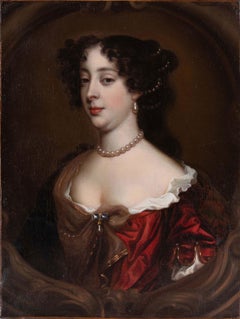
Materials

Oil

Sir Peter Lely portrait paintings for sale on 1stDibs.

Find a wide variety of authentic Sir Peter Lely portrait paintings available for sale on 1stDibs. You can also browse by medium to find art by Sir Peter Lely in oil paint, paint, canvas and more. Not every interior allows for large Sir Peter Lely portrait paintings, so small editions measuring 21 inches across are available. Customers who are interested in this artist might also find the work of and Suzi Fadel Nassif. Sir Peter Lely portrait paintings prices can differ depending upon medium, time period and other attributes. On 1stDibs, the price for these items starts at $11,379 and tops out at $83,120, while the average work can sell for $29,710.
Questions About Sir Peter Lely Portrait Paintings
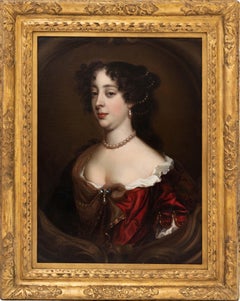
  • 1stDibs ExpertJanuary 19, 2025
    Sir Peter Blake was famous for his influence on the art world. He is widely regarded as the godfather of British Pop art and the Young British Artists (YBA) movement. Blake created paintings, collages and prints that blended modernity and nostalgia. Though best known for designing the album cover for the Beatles’s Sgt. Pepper’s Lonely Hearts Club Band, he considered painting to be central to his oeuvre. While celebrity figures such as Marilyn Monroe informed Blake's work, folk art, fairground signs and an overall sense of nostalgia also influenced his style. On 1stDibs, explore an assortment of Peter Blake art.