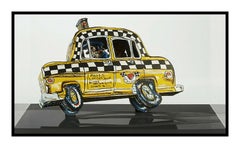
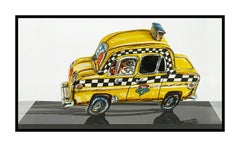
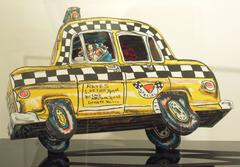
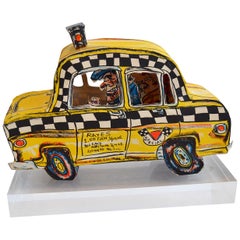
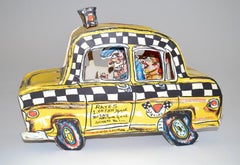
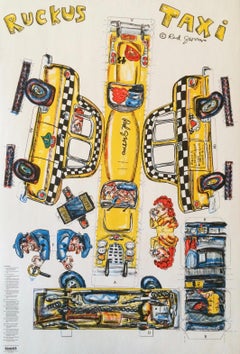
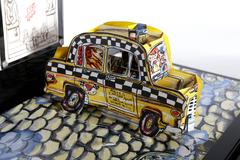
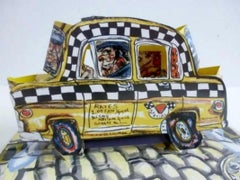
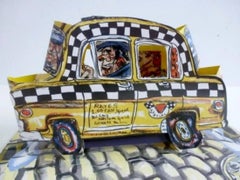
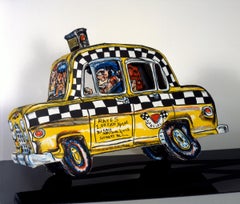
Red Grooms Ruckus Taxi For Sale on 1stDibs
On 1stDibs, you can find the most appropriate red grooms ruckus taxi for your needs in our varied inventory. Making the right choice when shopping for a red grooms ruckus taxi may mean carefully reviewing examples of this item dating from different eras — you can find an early iteration of this piece from the 20th Century and a newer version made as recently as the 20th Century. When looking for the right red grooms ruckus taxi for your space, you can search on 1stDibs by color — popular works were created in bold and neutral palettes with elements of
beige,
gray and
black. These artworks were handmade with extraordinary care, with artists most often working in
lithograph and
monoprint.
How Much is a Red Grooms Ruckus Taxi?
The average selling price for a red grooms ruckus taxi we offer is $6,000, while they’re typically $1,000 on the low end and $12,000 for the highest priced.
Red Grooms for sale on 1stDibs
Charles Roger Grooms was born in 1937 in Nashville, Tennessee, a city that, with its lively honky-tonk scene and the theatricality of the historic Grand Ole Opry, would later influence much of his work. Nicknamed for his ginger hair, Red enrolled at the Art Institute of Chicago in 1955. A self-proclaimed “restless and undisciplined student,” Grooms spent the next few years moving between schools and cities, including the New School in New York, Peabody College (now part of Vanderbilt University) in Nashville, and Hans Hofmann’s summer school in Provincetown, Massachusetts. Frustrated with the academic track and anxious to enter the New York art scene, Grooms abandoned formal education to focus exclusively on creating art and securing exhibition opportunities in his Chelsea neighborhood. There, he found quick success and a supportive circle of artists that became close friends and collaborators.
From the start of his career, Grooms has worked in multiple media, from painting, printmaking, and sculpture, to installation art, filmmaking, and theatrical experiences known as “Happenings.” Much of his art blurs the boundaries between these different forms, such as his large-scale, carefully-crafted environments he calls “sculpto-pictoramas,” and smaller objects like Dalí Salad. In this example, Grooms combines silkscreened and lithographic elements with a wooden base and acrylic dome to create a three-dimensional portrait of the famous Surrealist artist.
Grooms is perhaps best known for his colorful and comedic commentary on the culture, politics, and figures associated with the American urban environment and art historical traditions. Relying on satire and caricature, Grooms’ art has paid homage to a wide range of artists including Rembrandt, Auguste Rodin, Thomas Eakins, and Benjamin West, as well as national icons like Thomas Jefferson and Chuck Berry. Grooms’ disparate output is so difficult to classify that he has been compared to the influential Dada artist, Marcel Duchamp. Like Duchamp, Grooms often deliberately confronts the art world establishment, noting in 1974 that “it’s good to have . . . something to go against.”
Despite his affinity for defying the mainstream, Grooms is routinely cited by scholars as one of the leading American artists of his generation and was honored with the National Academy of Design’s Lifetime Achievement Award in 2003. The subject of a 1984 mid-career retrospective exhibition held at the Pennsylvania Academy of the Fine Arts, the artist’s work can be found in public collections across the United States, including the Metropolitan Museum of Art, the Whitney Museum of American Art, and the Hirshhorn Museum and Sculpture Garden, as well as in many international museums.
- The Johnson Collection, Spartanburg, South Carolina