(after) Alexander Calder Figurative Prints

American, b. 1898
Combining abstract surrealism and biomorphic imagery into a distinctive style, Calder has become one of the 20th Century’s most iconic and important artists. Besides sculptures, Calder was also prolific in other art forms. He produced jewelry, tapestry and stage designs, as well as drawings, oil paintings, water colors, etchings, lithographs and serigraphs. Born in Philadelphia in 1898 Alexander Calder (1898 – 1976) was a monumental artist. He invented the mobile, and airy, hanging structure connected by wires that are set in motion by the wind. These mobiles tremendously influenced the art world. Calder’s versions celebrated form and color, with simplicity and profundity. As a trained engineer, began to practice as a freelance artist after attending New York’s Art Students League. Calder was strongly inspired circus spectacle, and thus constructed entertaining mobiles often accompanied by music. Producing dynamic yet playful mobile sculptures, Calder dismissed the formal structures of art and redefined its infinite possibilities.
to
8
1
1
Overall Width
to
Overall Height
to
8
2
35
719
420
384
370
10
6
1
2
7
3
2
1
1
1
1
1
1
1
1
1
1
1
1
1
1
10
1
1
9
1
Artist: (after) Alexander Calder
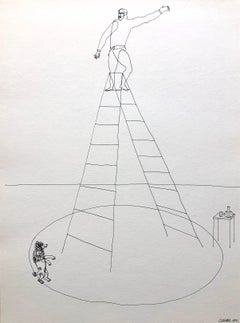
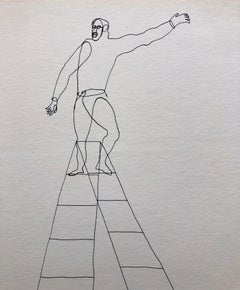
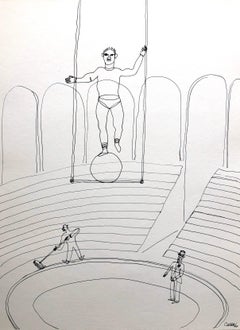
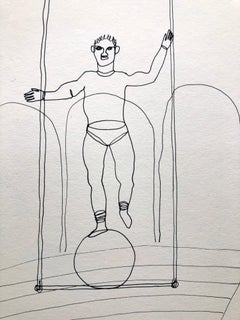
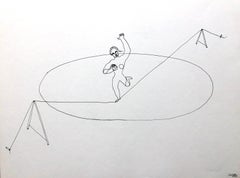
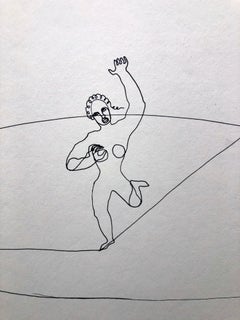
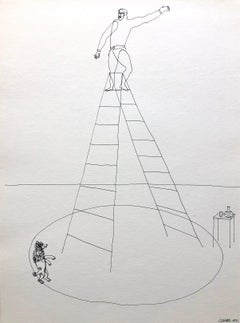
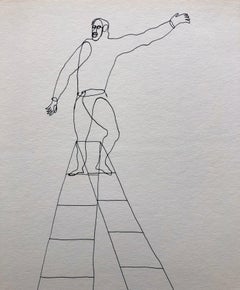
Alexander Calder Circus Reproduction Lithograph After a Drawing

Alexander Calder Circus Reproduction Lithograph After a Drawing

By (after) Alexander Calder

Located in Surfside, FL

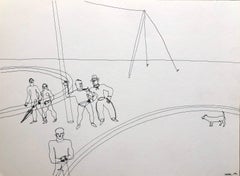
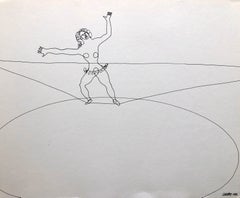
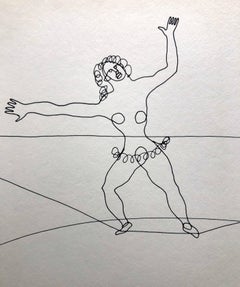
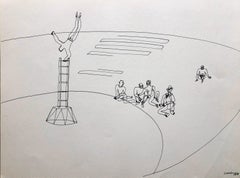
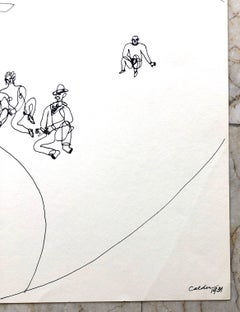
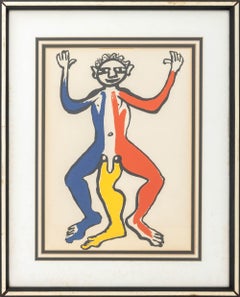
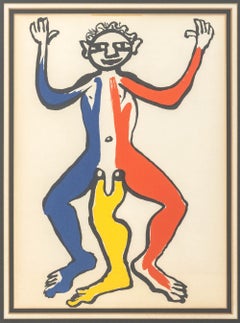
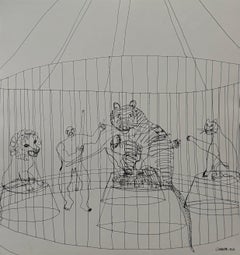
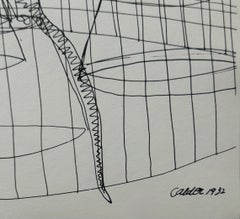
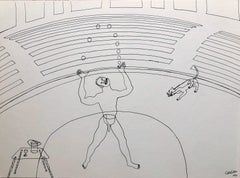
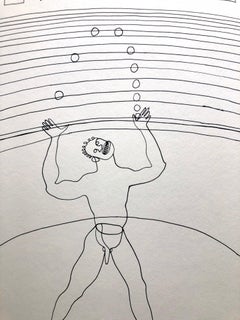
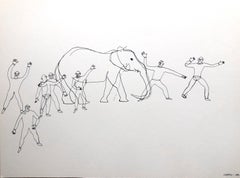
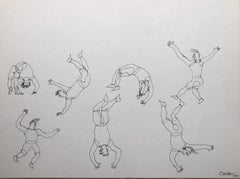
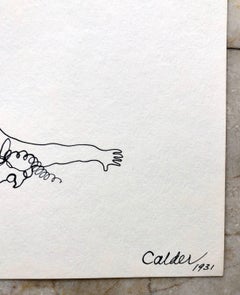
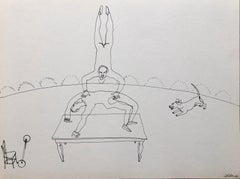
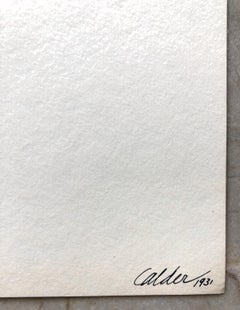
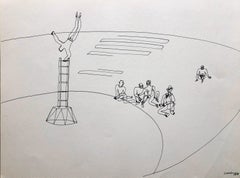
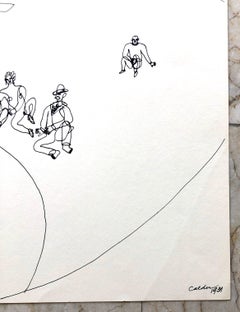
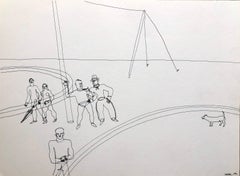
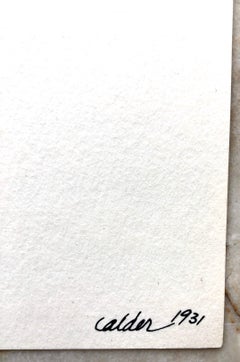
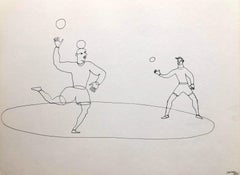
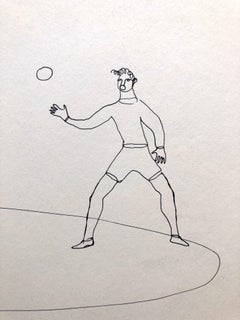
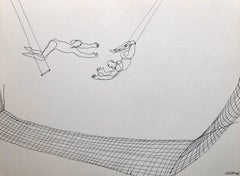
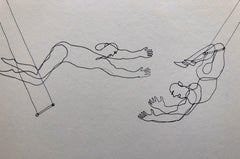
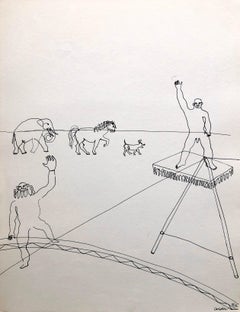
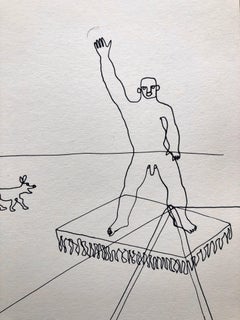
(after) Alexander Calder "Calder's Circus" offset lithograph on wove paper after drawings by the artist Published by Art in America and Perls gallery in 1964 (from drawings done in the 1930's) these range slightly in size but they are all about 13 X 17 inches (with minor variations in size as issued.) These have never been framed. The outer folio is not included just the one lithograph. James Sweeny from the introduction “The fame of Calder’s circus spread quickly between the years 1927 and 1930. All the Paris art world came to know it. It brought him his first great personal success. But what was more important, the circus also provided the first steps in Calder’s development as an original sculptor” Clive Gray wrote ”A visit to the studio of Alexander Calder led to the chance discovery of some hundred masterful circus drawings completed over thirty years ago. We publish, for the first time, a choice of sixteen from that group.” With signed introduction by Miro. These whimsical drawings, done in the style of wire sculpture, include acrobats, clowns, jugglers, trapeeze artists, an elephant, dog and lion. they are great. Alexander Calder is widely considered to be one of the most important American sculptors of the 20th century. He is best known for his colorful, whimsical abstract public sculptures and his innovative mobiles, kinetic sculptures powered by motors or air currents, which embraced chance in their aesthetic. Born into a family of accomplished artists, Calder's work first gained attention in Paris in the 1930s and was soon championed by the Museum of Modern Art in New York, resulting in a retrospective exhibition in 1943. Major retrospectives were also held at the Solomon R. Guggenheim Museum (1964) and the Museum of Contemporary Art, Chicago (1974). Calder’s work is in many permanent collections, most notably in the Whitney Museum of American Art, but also the Guggenheim Museum; the Museum of Modern Art; the National Gallery of Art, Washington, D.C.; and the Centre Georges Pompidou. He produced many large public works, including .125 (at JFK Airport, 1957), Pittsburgh (Carnegie International prize winner 1958, Pittsburgh International Airport) Spirale (UNESCO in Paris, 1958), Flamingo and Universe (both in Chicago, 1974), and Mountains and Clouds (Hart Senate Office Building, Washington, D.C., 1976). Although primarily known for his sculpture, Calder was a prodigious artist with a restless creative spirit, whose diverse practice included painting and printmaking, miniatures (such as his famous Cirque Calder), children’s book illustrations, theater set design, jewelry design, tapestry and rug works, and political posters. Calder was honored by the US Postal Service with a set of five 32-cent stamps in 1998, and received the Presidential Medal of Freedom, posthumously in 1977, after refusing to receive it from Gerald Ford one year earlier in protest of the Vietnam War. Calder moved to New York and enrolled at the Art Students League, studying briefly with Thomas Hart Benton, George Luks, Kenneth Hayes Miller, and John Sloan. While a student, he worked for the National Police Gazette where, in 1925, one of his assignments was sketching the Ringling Bros. and Barnum & Bailey Circus. Calder became fascinated with the action of the circus, a theme that would reappear in his later work. In 1926, Calder moved to Paris, enrolled in the Académie de la Grande Chaumière, and established a studio at 22 rue Daguerre in the Montparnasse Quarter. In June 1929, while traveling by boat from Paris to New York, Calder met his future wife, Louisa James (1905-1996), grandniece of author Henry James and philosopher William James. They married in 1931. While in Paris, Calder met and became friends with a number of avant-garde artists, including Fernand Léger, Jean Arp, and Marcel Duchamp. Cirque Calder (on view at the Whitney Museum of American Art at present) became popular with the Parisian avant-garde. He also invented wire sculpture, or "drawing in space," and in 1929 he had his first solo show of these sculptures in Paris at Galerie Billiet. Hi! (Two Acrobats) in the collection of the Honolulu Museum of Art is an early example of the artist's wire sculpture. The painter Jules Pascin, a friend of Calder's from the cafes of Montparnasse, wrote the preface to the catalog. A visit to Piet Mondrian's studio in 1930, where he was impressed by the environment-as-installation, "shocked" him into fully embracing abstract art, toward which he had already been tending. Dating from 1931, Calder’s sculptures of discrete movable parts powered by motors were christened “mobiles” by Marcel Duchamp, a French pun meaning both "motion" and "motive." At the same time, Calder was also experimenting with self-supporting, static, abstract sculptures, dubbed "stabiles" by Jean Arp in 1932 to differentiate them from mobiles. Public commissions increasingly came his way in the 1960s. Notable examples are .125 for JFK Airport in 1957, Spirale for UNESCO in Paris 1958 and Trois disques, commissioned for Expo 67 in Montreal, Quebec, Canada. Calder's largest sculpture at 25.7 meters high was El Sol Rojo, constructed outside the Aztec Stadium for the 1968 Summer Olympics "Cultural Olympiad" events in Mexico City. Many of his public works were commissioned by renowned architects; I.M. Pei commissioned his La Grande Voile (1966), a 25-ton, 40-foot high stabile for the Massachusetts Institute of Technology. Part of Calder's repertoire includes pivotal stage sets for more than a dozen theatrical productions, including Nucléa, Horizon, and most notably, Martha Graham’s Panorama (1935), a production of the Erik Satie symphonic drama Socrate (1936), and later, Works in Progress (1968). In addition to sculptures, Calder painted throughout his career, beginning in the early 1920s. He picked up his study of printmaking in 1925, and continued to produce illustrations for books and journals.As Calder’s professional reputation expanded in the late 1940s and 1950s, so did his production of prints. Masses of lithographs based on his gouache paintings hit the market, and deluxe editions of plays, poems, and short stories illustrated with fine art prints by Calder became available for sale. One of Calder's most celebrated and unconventional undertakings was a commission from Dallas-based Braniff International Airways to paint a full-size Douglas DC-8-62 four-engined jet as a "flying canvas." Calder created over 2,000 pieces of jewelry over the course of his career, many of them as gifts for friends and relatives. For his lifelong friend Joan Miró, he set a shard of a broken porcelain vessel in a brass ring. Peggy Guggenheim received enormous silver mobile earrings and later commissioned a hammered silver headboard...

Category

1930s American Modern (after) Alexander Calder Figurative Prints

Materials

Lithograph

Alexander Calder Circus Reproduction Lithograph After a Drawing

Alexander Calder Circus Reproduction Lithograph After a Drawing

By (after) Alexander Calder

Located in Surfside, FL

(after) Alexander Calder "Calder's Circus" offset lithograph on wove paper after drawings by the artist Published by Art in America and Perls gallery in 1964 (from drawings done in t...

Category

1930s American Modern (after) Alexander Calder Figurative Prints

Materials

Lithograph

Alexander Calder Circus Reproduction Lithograph after a Drawing

Alexander Calder Circus Reproduction Lithograph after a Drawing

By (after) Alexander Calder

Located in Surfside, FL

(after) Alexander Calder "Calder's Circus" offset lithograph on wove paper reproduction after drawings by the artist Published by Art in America and Perls gallery in 1964 (from drawi...

Category

1930s American Modern (after) Alexander Calder Figurative Prints

Materials

Lithograph

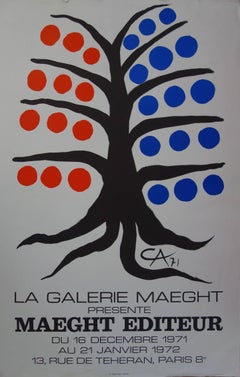
Tree with Blue and Red Fruits - Lithograph - Maeght 1971

Tree with Blue and Red Fruits - Lithograph - Maeght 1971

By (after) Alexander Calder

Located in Paris, IDF

Alexander CALDER (after) Tree with Blue and Red Fruits Lithograph poster Printed signature in the plate 80 x 50 cm (c. 32 x 20 in) INFORMATION : Lithograph created for the Calder e...
Category

1970s American Modern (after) Alexander Calder Figurative Prints

Materials

Lithograph
Alexander Calder Circus Reproduction Lithograph After a Drawing
Alexander Calder Circus Reproduction Lithograph After a Drawing
By (after) Alexander Calder

Located in Surfside, FL

(after) Alexander Calder "Calder's Circus" offset lithograph on wove paper after drawings by the artist Published by Art in America and Perls gallery in 1964 (from drawings done in t...
Category

1930s American Modern (after) Alexander Calder Figurative Prints

Materials

Lithograph
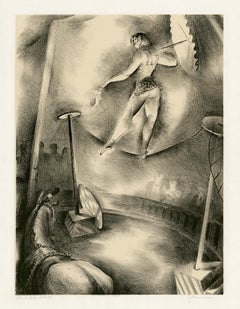
Alexander Calder Circus Reproduction Lithograph of a Drawing
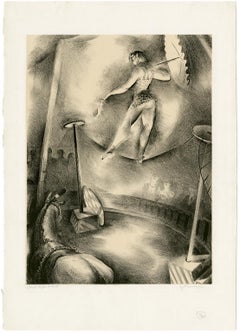
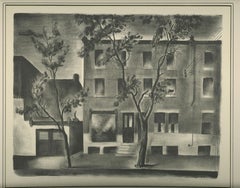
Alexander Calder Circus Reproduction Lithograph of a Drawing
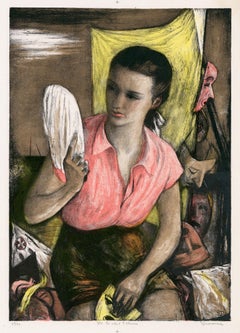
By (after) Alexander Calder

Located in Surfside, FL

(after) Alexander Calder "Calder's Circus" offset lithograph on wove paper a reproduction lithograph after the drawings by the artist Published by Art in America and Perls gallery in 1964 (from drawings done in the 1930's) these range slightly in size but they are all about 13 X 17 inches (with minor variations in size as issued.) These have never been framed. The outer folio is not included just the one lithograph. James Sweeny from the introduction “The fame of Calder’s circus spread quickly between the years 1927 and 1930. All the Paris art world came to know it. It brought him his first great personal success. But what was more important, the circus also provided the first steps in Calder’s development as an original sculptor” Clive Gray wrote ”A visit to the studio of Alexander Calder led to the chance discovery of some hundred masterful circus drawings completed over thirty years ago. We publish, for the first time, a choice of sixteen from that group.” With signed introduction by Miro. These whimsical drawings, done in the style of wire sculpture, include acrobats, clowns, jugglers, trapeeze artists, an elephant, dog and lion. they are great. Alexander Calder is widely considered to be one of the most important American sculptors of the 20th century. He is best known for his colorful, whimsical abstract public sculptures and his innovative mobiles, kinetic sculptures powered by motors or air currents, which embraced chance in their aesthetic. Born into a family of accomplished artists, Calder's work first gained attention in Paris in the 1930s and was soon championed by the Museum of Modern Art in New York, resulting in a retrospective exhibition in 1943. Major retrospectives were also held at the Solomon R. Guggenheim Museum (1964) and the Museum of Contemporary Art, Chicago (1974). Calder’s work is in many permanent collections, most notably in the Whitney Museum of American Art, but also the Guggenheim Museum; the Museum of Modern Art; the National Gallery of Art, Washington, D.C.; and the Centre Georges Pompidou. He produced many large public works, including .125 (at JFK Airport, 1957), Pittsburgh (Carnegie International prize winner 1958, Pittsburgh International Airport) Spirale (UNESCO in Paris, 1958), Flamingo and Universe (both in Chicago, 1974), and Mountains and Clouds (Hart Senate Office Building, Washington, D.C., 1976). Although primarily known for his sculpture, Calder was a prodigious artist with a restless creative spirit, whose diverse practice included painting and printmaking, miniatures (such as his famous Cirque Calder), children’s book illustrations, theater set design, jewelry design, tapestry and rug works, and political posters. Calder was honored by the US Postal Service with a set of five 32-cent stamps in 1998, and received the Presidential Medal of Freedom, posthumously in 1977, after refusing to receive it from Gerald Ford one year earlier in protest of the Vietnam War. Calder moved to New York and enrolled at the Art Students League, studying briefly with Thomas Hart Benton, George Luks, Kenneth Hayes Miller, and John Sloan. While a student, he worked for the National Police Gazette where, in 1925, one of his assignments was sketching the Ringling Bros. and Barnum & Bailey Circus. Calder became fascinated with the action of the circus, a theme that would reappear in his later work. In 1926, Calder moved to Paris, enrolled in the Académie de la Grande Chaumière, and established a studio at 22 rue Daguerre in the Montparnasse Quarter. In June 1929, while traveling by boat from Paris to New York, Calder met his future wife, Louisa James (1905-1996), grandniece of author Henry James and philosopher William James. They married in 1931. While in Paris, Calder met and became friends with a number of avant-garde artists, including Fernand Léger, Jean Arp, and Marcel Duchamp. Cirque Calder (on view at the Whitney Museum of American Art at present) became popular with the Parisian avant-garde. He also invented wire sculpture, or "drawing in space," and in 1929 he had his first solo show of these sculptures in Paris at Galerie Billiet. Hi! (Two Acrobats) in the collection of the Honolulu Museum of Art is an early example of the artist's wire sculpture. The painter Jules Pascin, a friend of Calder's from the cafes of Montparnasse, wrote the preface to the catalog. A visit to Piet Mondrian's studio in 1930, where he was impressed by the environment-as-installation, "shocked" him into fully embracing abstract art, toward which he had already been tending. Dating from 1931, Calder’s sculptures of discrete movable parts powered by motors were christened “mobiles” by Marcel Duchamp, a French pun meaning both "motion" and "motive." At the same time, Calder was also experimenting with self-supporting, static, abstract sculptures, dubbed "stabiles" by Jean Arp in 1932 to differentiate them from mobiles. Public commissions increasingly came his way in the 1960s. Notable examples are .125 for JFK Airport in 1957, Spirale for UNESCO in Paris 1958 and Trois disques, commissioned for Expo 67 in Montreal, Quebec, Canada. Calder's largest sculpture at 25.7 meters high was El Sol Rojo, constructed outside the Aztec Stadium for the 1968 Summer Olympics "Cultural Olympiad" events in Mexico City. Many of his public works were commissioned by renowned architects; I.M. Pei commissioned his La Grande Voile (1966), a 25-ton, 40-foot high stabile for the Massachusetts Institute of Technology. Part of Calder's repertoire includes pivotal stage sets for more than a dozen theatrical productions, including Nucléa, Horizon, and most notably, Martha Graham’s Panorama (1935), a production of the Erik Satie symphonic drama Socrate (1936), and later, Works in Progress (1968). In addition to sculptures, Calder painted throughout his career, beginning in the early 1920s. He picked up his study of printmaking in 1925, and continued to produce illustrations for books and journals.As Calder’s professional reputation expanded in the late 1940s and 1950s, so did his production of prints. Masses of lithographs based on his gouache paintings hit the market, and deluxe editions of plays, poems, and short stories illustrated with fine art prints by Calder became available for sale. One of Calder's most celebrated and unconventional undertakings was a commission from Dallas-based Braniff International Airways to paint a full-size Douglas DC-8-62 four-engined jet as a "flying canvas." Calder created over 2,000 pieces of jewelry over the course of his career, many of them as gifts for friends and relatives. For his lifelong friend Joan Miró, he set a shard of a broken porcelain vessel in a brass ring. Peggy Guggenheim received enormous silver mobile earrings and later commissioned a hammered silver headboard...
Category

1930s American Modern (after) Alexander Calder Figurative Prints

Materials

Lithograph

Alexander Calder Circus Reproduction Lithograph After a Drawing

Alexander Calder Circus Reproduction Lithograph After a Drawing

By (after) Alexander Calder

Located in Surfside, FL

(after) Alexander Calder "Calder's Circus" offset lithograph on wove paper after drawings by the artist Published by Art in America and Perls gallery in 1964 (from drawings done in the 1930's) these range slightly in size but they are all about 13 X 17 inches (with minor variations in size as issued.) These have never been framed. The outer folio is not included just the one lithograph. James Sweeny from the introduction “The fame of Calder’s circus spread quickly between the years 1927 and 1930. All the Paris art world came to know it. It brought him his first great personal success. But what was more important, the circus also provided the first steps in Calder’s development as an original sculptor” Clive Gray wrote ”A visit to the studio of Alexander Calder led to the chance discovery of some hundred masterful circus drawings completed over thirty years ago. We publish, for the first time, a choice of sixteen from that group.” With signed introduction by Miro. These whimsical drawings, done in the style of wire sculpture, include acrobats, clowns, jugglers, trapeeze artists, an elephant, dog and lion. they are great. Alexander Calder is widely considered to be one of the most important American sculptors of the 20th century. He is best known for his colorful, whimsical abstract public sculptures and his innovative mobiles, kinetic sculptures powered by motors or air currents, which embraced chance in their aesthetic. Born into a family of accomplished artists, Calder's work first gained attention in Paris in the 1930s and was soon championed by the Museum of Modern Art in New York, resulting in a retrospective exhibition in 1943. Major retrospectives were also held at the Solomon R. Guggenheim Museum (1964) and the Museum of Contemporary Art, Chicago (1974). Calder’s work is in many permanent collections, most notably in the Whitney Museum of American Art, but also the Guggenheim Museum; the Museum of Modern Art; the National Gallery of Art, Washington, D.C.; and the Centre Georges Pompidou. He produced many large public works, including .125 (at JFK Airport, 1957), Pittsburgh (Carnegie International prize winner 1958, Pittsburgh International Airport) Spirale (UNESCO in Paris, 1958), Flamingo and Universe (both in Chicago, 1974), and Mountains and Clouds (Hart Senate Office Building, Washington, D.C., 1976). Although primarily known for his sculpture, Calder was a prodigious artist with a restless creative spirit, whose diverse practice included painting and printmaking, miniatures (such as his famous Cirque Calder), children’s book illustrations, theater set design, jewelry design, tapestry and rug works, and political posters. Calder was honored by the US Postal Service with a set of five 32-cent stamps in 1998, and received the Presidential Medal of Freedom, posthumously in 1977, after refusing to receive it from Gerald Ford one year earlier in protest of the Vietnam War. Calder moved to New York and enrolled at the Art Students League, studying briefly with Thomas Hart Benton, George Luks, Kenneth Hayes Miller, and John Sloan. While a student, he worked for the National Police Gazette where, in 1925, one of his assignments was sketching the Ringling Bros. and Barnum & Bailey Circus. Calder became fascinated with the action of the circus, a theme that would reappear in his later work. In 1926, Calder moved to Paris, enrolled in the Académie de la Grande Chaumière, and established a studio at 22 rue Daguerre in the Montparnasse Quarter. In June 1929, while traveling by boat from Paris to New York, Calder met his future wife, Louisa James (1905-1996), grandniece of author Henry James and philosopher William James. They married in 1931. While in Paris, Calder met and became friends with a number of avant-garde artists, including Fernand Léger, Jean Arp, and Marcel Duchamp. Cirque Calder (on view at the Whitney Museum of American Art at present) became popular with the Parisian avant-garde. He also invented wire sculpture, or "drawing in space," and in 1929 he had his first solo show of these sculptures in Paris at Galerie Billiet. Hi! (Two Acrobats) in the collection of the Honolulu Museum of Art is an early example of the artist's wire sculpture. The painter Jules Pascin, a friend of Calder's from the cafes of Montparnasse, wrote the preface to the catalog. A visit to Piet Mondrian's studio in 1930, where he was impressed by the environment-as-installation, "shocked" him into fully embracing abstract art, toward which he had already been tending. Dating from 1931, Calder’s sculptures of discrete movable parts powered by motors were christened “mobiles” by Marcel Duchamp, a French pun meaning both "motion" and "motive." At the same time, Calder was also experimenting with self-supporting, static, abstract sculptures, dubbed "stabiles" by Jean Arp in 1932 to differentiate them from mobiles. Public commissions increasingly came his way in the 1960s. Notable examples are .125 for JFK Airport in 1957, Spirale for UNESCO in Paris 1958 and Trois disques, commissioned for Expo 67 in Montreal, Quebec, Canada. Calder's largest sculpture at 25.7 meters high was El Sol Rojo, constructed outside the Aztec Stadium for the 1968 Summer Olympics "Cultural Olympiad" events in Mexico City. Many of his public works were commissioned by renowned architects; I.M. Pei commissioned his La Grande Voile (1966), a 25-ton, 40-foot high stabile for the Massachusetts Institute of Technology. Part of Calder's repertoire includes pivotal stage sets for more than a dozen theatrical productions, including Nucléa, Horizon, and most notably, Martha Graham’s Panorama (1935), a production of the Erik Satie symphonic drama Socrate (1936), and later, Works in Progress (1968). In addition to sculptures, Calder painted throughout his career, beginning in the early 1920s. He picked up his study of printmaking in 1925, and continued to produce illustrations for books and journals.As Calder’s professional reputation expanded in the late 1940s and 1950s, so did his production of prints. Masses of lithographs based on his gouache paintings hit the market, and deluxe editions of plays, poems, and short stories illustrated with fine art prints by Calder became available for sale. One of Calder's most celebrated and unconventional undertakings was a commission from Dallas-based Braniff International Airways to paint a full-size Douglas DC-8-62 four-engined jet as a "flying canvas." Calder created over 2,000 pieces of jewelry over the course of his career, many of them as gifts for friends and relatives. For his lifelong friend Joan Miró, he set a shard of a broken porcelain vessel in a brass ring. Peggy Guggenheim received enormous silver mobile earrings and later commissioned a hammered silver headboard...

Category

1930s American Modern (after) Alexander Calder Figurative Prints

Materials

Lithograph

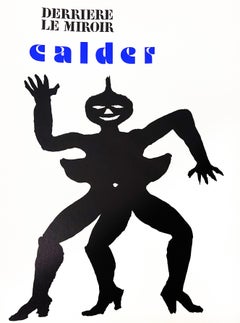
1970's Alexander Calder lithographic cover (from Derrière le miroir)

1970's Alexander Calder lithographic cover (from Derrière le miroir)

By (after) Alexander Calder

Located in NEW YORK, NY

Alexander Calder Lithographic cover c. 1975 from Derrière le miroir: Lithographic cover in colors; 11 x 15 inches. Very good overall vintage condition. Unsigned from an edition of u...

Category

1970s Contemporary (after) Alexander Calder Figurative Prints

Materials

Lithograph

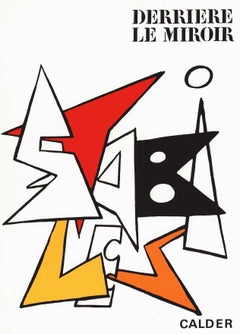
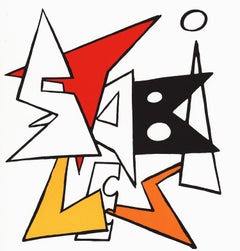
1960's Alexander Calder lithographic cover (from Derrière le miroir)

1960's Alexander Calder lithographic cover (from Derrière le miroir)

By (after) Alexander Calder

Located in NEW YORK, NY

Alexander Calder Lithographic cover c. 1963 from Derrière le miroir: Lithographic cover page in colors; 11 x 15 inches. Very good overall vintage condition. Unsigned from an edition...

Category

1960s Contemporary (after) Alexander Calder Figurative Prints

Materials

Lithograph

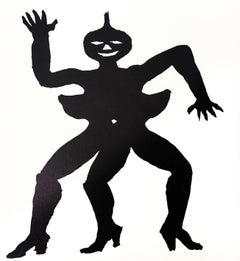
Alexander Calder "Three Legged Man" Lithograph

Alexander Calder "Three Legged Man" Lithograph

By (after) Alexander Calder

Located in Astoria, NY

After Alexander Calder (American, 1898-1976), "Three Legged Man" Lithograph in Colors on paper, apparently unsigned, ebonized wood frame. Image: 14.5" H x 10.5" W; frame: 21.25" H x...

Category

Late 20th Century Modern (after) Alexander Calder Figurative Prints

Materials

Paper, Lithograph

Related Items
Original Spokane (WA.) Colorful Capital Fun Map vintage poster

Original Spokane (WA.) Colorful Capital Fun Map vintage poster

Located in Spokane, WA

Original Spokane (Washington), The Colorful Capital of the Inland Empire vintage travel fun map. Printed in 1971, this seldom if ever found original map is archival linen backed an...

Category

1970s American Modern (after) Alexander Calder Figurative Prints

Materials

Lithograph

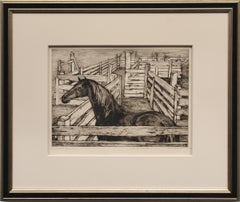
Ethel Magafan “Corralled Horse” 1940s WPA-Era Modernist Etching, Artist’s Proof

Ethel Magafan “Corralled Horse” 1940s WPA-Era Modernist Etching, Artist’s Proof

By Ethel Magafan

Located in Denver, CO

Corralled Horse is a rare WPA-era modernist etching by acclaimed American artist Ethel Magafan, created in the 1940s. This artist’s proof depicts a lone dark horse within a wooden co...

Category

1940s American Modern (after) Alexander Calder Figurative Prints

Materials

Etching

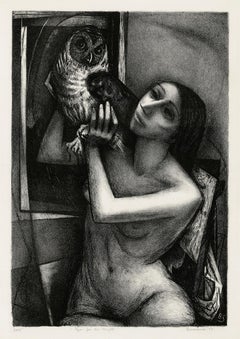
'Eyes for the Night' — Mid-century American Surrealism

'Eyes for the Night' — Mid-century American Surrealism

By Benton Murdoch Spruance

Located in Myrtle Beach, SC

Benton Spruance, 'Eyes for the Night', lithograph, 1947, edition 35, Fine and Looney 260. Signed, dated, titled, and annotated 'Ed 35' in pencil. A fine impression, on heavy, cream ...

Category

1940s American Modern (after) Alexander Calder Figurative Prints

Materials

Lithograph

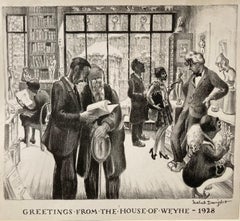
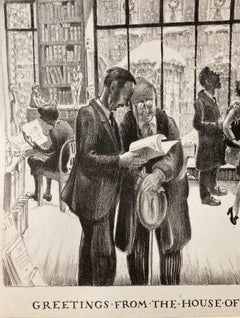
GREETINGS FROM THE HOUSE OF WEYHE. Many Known Artists Inside the Gallery

GREETINGS FROM THE HOUSE OF WEYHE. Many Known Artists Inside the Gallery

Located in Santa Monica, CA

MAYBEL DWIGHT (1875 - 1955) GREETINGS FROM THE HOUSE OF WEYHE, 1928 Lithograph, signed in the plate. Image 7 1/8 x 8 3/8” + printed title. Sheet 8 ¼ x 9” as issued. Xmas card iss...

Category

1920s American Modern (after) Alexander Calder Figurative Prints

Materials

Lithograph

Original "Wonderful Copenhagen" vintage travel poster

Original "Wonderful Copenhagen" vintage travel poster

Located in Spokane, WA

Original vintage poster: WONDERFUL COPENHAGEN created by the artist Viggo Vagnby. This antique poster is archival linen-backed, in excellent condition, and ready to frame. No da...

Category

1950s American Modern (after) Alexander Calder Figurative Prints

Materials

Lithograph

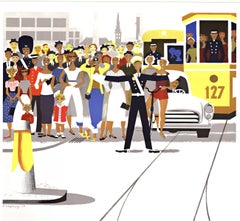
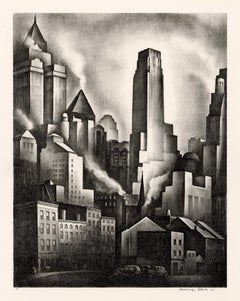
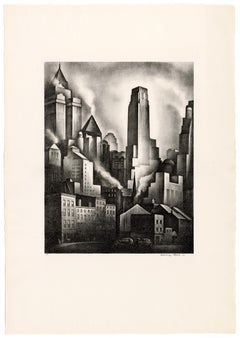
'Financial District', New York City — American Modernism

'Financial District', New York City — American Modernism

By Howard Norton Cook

Located in Myrtle Beach, SC

Howard Cook, 'Financial District', lithograph, 1931, edition 75, Duffy 155. A fine, richly-inked impression, on cream wove paper, the full sheet with wide margins (2 3/4 to 5 5/8 inches), in excellent condition. Image size 13 5/16 x 10 3/8 inches (338 x 264 mm); sheet size 23 x 16 inches (584 x 406 mm). Matted to museum standards, unframed. Literature: 'American Master Prints from the Betty and Douglas Duffy Collection', the Trust for Museum Exhibitions, Washington, D.C., 1987. Collections: Crystal Bridges Museum of American Art, Library of Congress, Metropolitan Museum of Art, Philadelphia Museum of Art, Smithsonian American Art Museum. ABOUT THE ARTIST Howard Norton Cook (1901-1980) was one of the best-known of the second generation of artists who moved to Taos. A native of Massachusetts, he studied at the Art Students League in New York City and at the Woodstock Art Colony. Beginning his association with Taos in 1926, he became a resident of the community in the 1930s. During his career, he received two Guggenheim Fellowships and was elected an Academician in the National Academy of Design. He earned a national reputation as a painter, muralist, and printmaker. Cook’s work in the print mediums received acclaim early in his career with one-person exhibitions at the Denver Art Museum (1927) and the Museum of New Mexico (1928). He received numerous honors and awards over the years, including selection in best-of-the-year exhibitions sponsored by the American Institute of Graphics Arts, the Brooklyn Museum, the Society of American Etchers, and the Philadelphia Print Club. His first Guggenheim Fellowship took him to Taxco, Mexico in 1932 and 1933; his second in the following year enabled him to travel through the American South and Southwest. Cook painted murals for the Public Works of Art Project in 1933 and the Treasury Departments Art Program in 1935. The latter project, completed in Pittsburgh, received a Gold Medal from the Architectural League of New York. One of his most acclaimed commissions was a mural in the San Antonio Post Office in 1937. He and Barbara Latham settled in Talpa, south of Taos, in 1938 and remained there for over three decades. Cook volunteered in World War II as an Artist War Correspondent for the US Navy, where he was deployed in the Pacific. In 1943 he was appointed Leader of a War Art Unit...

Category

1930s American Modern (after) Alexander Calder Figurative Prints

Materials

Lithograph

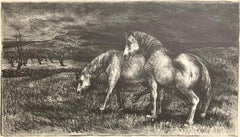
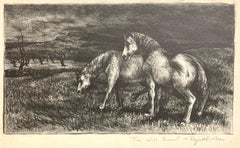
Reginald Wilson, Horses

Reginald Wilson, Horses

By Reginald Wilson

Located in New York, NY

Although this work is titled Horses. It nice to think it could be (Horses in a Field in Woodstock, NY), but it was printed by Will Barnet at the Art Students League, about 1938, and Wilson, who visited Woodstock with Arnold Blanche...

Category

1930s American Modern (after) Alexander Calder Figurative Prints

Materials

Lithograph

Slack Rope Artist
Slack Rope Artist

Slack Rope Artist

By Benton Murdoch Spruance

Located in Myrtle Beach, SC

Benton Spruance, 'Slack Rope Artist', lithograph, 1930, edition 30, Fine and Looney 35. Signed and titled in pencil. Numbered '2' in the bottom right margin. A fine impression, with ...

Category

1930s American Modern (after) Alexander Calder Figurative Prints

Materials

Lithograph

Cat and Busybody

Cat and Busybody

By Benton Murdoch Spruance

Located in Middletown, NY

A 1933 lithograph on cream wove paper 14 x 18 inches (354 x 452mm), full margins. Signed, titled, and numbered 17/33 in pencil, lower margin. Minor mat tone around the perimeter of t...

Category

1930s American Modern (after) Alexander Calder Figurative Prints

Materials

Lithograph

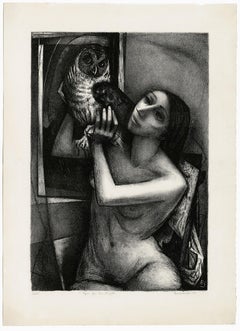
'I'll Be What I Choose'  — Mid-century American Surrealism

'I'll Be What I Choose' — Mid-century American Surrealism

By Benton Murdoch Spruance

Located in Myrtle Beach, SC

'I'll Be What I Choose: Vanity of Ambition', color lithograph, 1949, edition 40, Fine and Looney 281. Signed, titled, and numbered '23/40' in pencil. Initialed in the stone, lower ri...

Category

1940s American Modern (after) Alexander Calder Figurative Prints

Materials

Lithograph

Morningside Park and St. Luke's Hospital

Morningside Park and St. Luke's Hospital

By Charles Frederick William Mielatz

Located in Middletown, NY

A bucolic late 19th century image of upper Manhattan. New York: 1898. Lithograph on tissue-thin Japon paper with a deckle edge, 14 1/8 x 10 inches (357 x 252 mm), the full sheet. Tit...

Category

Late 19th Century American Modern (after) Alexander Calder Figurative Prints

Materials

Lithograph, Handmade Paper

'Tanks #1' — American Precisionism

'Tanks #1' — American Precisionism

By Louis Lozowick

Located in Myrtle Beach, SC

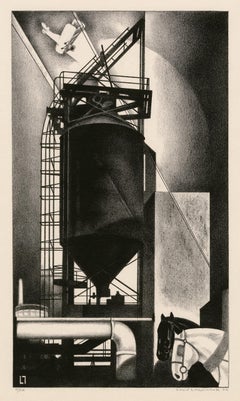
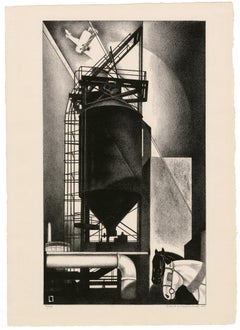
Louis Lozowick, 'Tanks #1', lithograph, 1929, edition 50, Flint 39. Signed, titled, and numbered '11/50' in pencil. Signed with the artist's monogram in the stone, lower left. A superb, richly-inked impression, on cream wove paper, the full sheet with margins (3/4 to 1 7/8 inches), in excellent condition. Matted to museum standards. Image size 13 15/16 x 8 1/16 inches (355 x 204 mm), sheet size 15 3/4 x 11 1/4 inches (400 x 286 mm). Exhibited: 'The American Scene: Prints from Hopper to Pollock', Stephen Coppel, The British Museum, 2008. Literature: 'Prints and Their Creators, A World History', Carl Zigrosser, Crown Publishers Inc, 1974; 'American Lithographers...

Category

1920s American Modern (after) Alexander Calder Figurative Prints

Materials

Lithograph

Previously Available Items
Alexander Calder Circus Reproduction Lithograph After a Drawing

Alexander Calder Circus Reproduction Lithograph After a Drawing

By (after) Alexander Calder

Located in Surfside, FL

(after) Alexander Calder "Calder's Circus" offset lithograph on wove paper after drawings by the artist Published by Art in America and Perls gallery in 1964 (from drawings done in t...

Category

1930s American Modern (after) Alexander Calder Figurative Prints

Materials

Lithograph

Alexander Calder Circus Reproduction Lithograph After a Drawing

Alexander Calder Circus Reproduction Lithograph After a Drawing

By (after) Alexander Calder

Located in Surfside, FL

(after) Alexander Calder "Calder's Circus" offset lithograph on wove paper after drawings by the artist Published by Art in America and Perls gallery in 1964 (from drawings done in the 1930's) these range slightly in size but they are all about 13 X 17 inches (with minor variations in size as issued.) These have never been framed. The outer folio is not included just the one lithograph. James Sweeny from the introduction “The fame of Calder’s circus spread quickly between the years 1927 and 1930. All the Paris art world came to know it. It brought him his first great personal success. But what was more important, the circus also provided the first steps in Calder’s development as an original sculptor” Clive Gray wrote ”A visit to the studio of Alexander Calder led to the chance discovery of some hundred masterful circus drawings completed over thirty years ago. We publish, for the first time, a choice of sixteen from that group.” With signed introduction by Miro. These whimsical drawings, done in the style of wire sculpture, include acrobats, clowns, jugglers, trapeeze artists, an elephant, dog and lion. they are great. Alexander Calder is widely considered to be one of the most important American sculptors of the 20th century. He is best known for his colorful, whimsical abstract public sculptures and his innovative mobiles, kinetic sculptures powered by motors or air currents, which embraced chance in their aesthetic. Born into a family of accomplished artists, Calder's work first gained attention in Paris in the 1930s and was soon championed by the Museum of Modern Art in New York, resulting in a retrospective exhibition in 1943. Major retrospectives were also held at the Solomon R. Guggenheim Museum (1964) and the Museum of Contemporary Art, Chicago (1974). Calder’s work is in many permanent collections, most notably in the Whitney Museum of American Art, but also the Guggenheim Museum; the Museum of Modern Art; the National Gallery of Art, Washington, D.C.; and the Centre Georges Pompidou. He produced many large public works, including .125 (at JFK Airport, 1957), Pittsburgh (Carnegie International prize winner 1958, Pittsburgh International Airport) Spirale (UNESCO in Paris, 1958), Flamingo and Universe (both in Chicago, 1974), and Mountains and Clouds (Hart Senate Office Building, Washington, D.C., 1976). Although primarily known for his sculpture, Calder was a prodigious artist with a restless creative spirit, whose diverse practice included painting and printmaking, miniatures (such as his famous Cirque Calder), children’s book illustrations, theater set design, jewelry design, tapestry and rug works, and political posters. Calder was honored by the US Postal Service with a set of five 32-cent stamps in 1998, and received the Presidential Medal of Freedom, posthumously in 1977, after refusing to receive it from Gerald Ford one year earlier in protest of the Vietnam War. Calder moved to New York and enrolled at the Art Students League, studying briefly with Thomas Hart Benton, George Luks, Kenneth Hayes Miller, and John Sloan. While a student, he worked for the National Police Gazette where, in 1925, one of his assignments was sketching the Ringling Bros. and Barnum & Bailey Circus. Calder became fascinated with the action of the circus, a theme that would reappear in his later work. In 1926, Calder moved to Paris, enrolled in the Académie de la Grande Chaumière, and established a studio at 22 rue Daguerre in the Montparnasse Quarter. In June 1929, while traveling by boat from Paris to New York, Calder met his future wife, Louisa James (1905-1996), grandniece of author Henry James and philosopher William James. They married in 1931. While in Paris, Calder met and became friends with a number of avant-garde artists, including Fernand Léger, Jean Arp, and Marcel Duchamp. Cirque Calder (on view at the Whitney Museum of American Art at present) became popular with the Parisian avant-garde. He also invented wire sculpture, or "drawing in space," and in 1929 he had his first solo show of these sculptures in Paris at Galerie Billiet. Hi! (Two Acrobats) in the collection of the Honolulu Museum of Art is an early example of the artist's wire sculpture. The painter Jules Pascin, a friend of Calder's from the cafes of Montparnasse, wrote the preface to the catalog. A visit to Piet Mondrian's studio in 1930, where he was impressed by the environment-as-installation, "shocked" him into fully embracing abstract art, toward which he had already been tending. Dating from 1931, Calder’s sculptures of discrete movable parts powered by motors were christened “mobiles” by Marcel Duchamp, a French pun meaning both "motion" and "motive." At the same time, Calder was also experimenting with self-supporting, static, abstract sculptures, dubbed "stabiles" by Jean Arp in 1932 to differentiate them from mobiles. Public commissions increasingly came his way in the 1960s. Notable examples are .125 for JFK Airport in 1957, Spirale for UNESCO in Paris 1958 and Trois disques, commissioned for Expo 67 in Montreal, Quebec, Canada. Calder's largest sculpture at 25.7 meters high was El Sol Rojo, constructed outside the Aztec Stadium for the 1968 Summer Olympics "Cultural Olympiad" events in Mexico City. Many of his public works were commissioned by renowned architects; I.M. Pei commissioned his La Grande Voile (1966), a 25-ton, 40-foot high stabile for the Massachusetts Institute of Technology. Part of Calder's repertoire includes pivotal stage sets for more than a dozen theatrical productions, including Nucléa, Horizon, and most notably, Martha Graham’s Panorama (1935), a production of the Erik Satie symphonic drama Socrate (1936), and later, Works in Progress (1968). In addition to sculptures, Calder painted throughout his career, beginning in the early 1920s. He picked up his study of printmaking in 1925, and continued to produce illustrations for books and journals.As Calder’s professional reputation expanded in the late 1940s and 1950s, so did his production of prints. Masses of lithographs based on his gouache paintings hit the market, and deluxe editions of plays, poems, and short stories illustrated with fine art prints by Calder became available for sale. One of Calder's most celebrated and unconventional undertakings was a commission from Dallas-based Braniff International Airways to paint a full-size Douglas DC-8-62 four-engined jet as a "flying canvas." Calder created over 2,000 pieces of jewelry over the course of his career, many of them as gifts for friends and relatives. For his lifelong friend Joan Miró, he set a shard of a broken porcelain vessel in a brass ring. Peggy Guggenheim received enormous silver mobile earrings and later commissioned a hammered silver headboard...

Category

1930s American Modern (after) Alexander Calder Figurative Prints

Materials

Lithograph

Alexander Calder Circus Reproduction Lithograph after a Drawing

Alexander Calder Circus Reproduction Lithograph after a Drawing

By (after) Alexander Calder

Located in Surfside, FL

(after) Alexander Calder "Calder's Circus" offset lithograph on wove paper reproduction of a drawing by the artist Published by Art in America and Perls gallery in 1964 (from drawings done in the 1930's) these range slightly in size but they are all about 13 X 17 inches (with minor variations in size as issued.) These have never been framed. The outer folio is not included just the one lithograph. James Sweeny from the introduction “The fame of Calder’s circus spread quickly between the years 1927 and 1930. All the Paris art world came to know it. It brought him his first great personal success. But what was more important, the circus also provided the first steps in Calder’s development as an original sculptor” Clive Gray...

Category

1930s American Modern (after) Alexander Calder Figurative Prints

Materials

Lithograph

Alexander Calder Circus Reproduction Lithograph After a Drawing

Alexander Calder Circus Reproduction Lithograph After a Drawing

By (after) Alexander Calder

Located in Surfside, FL

(after) Alexander Calder "Calder's Circus" offset lithograph on wove paper after drawings by the artist Published by Art in America and Perls gallery in 1964 (from drawings done in the 1930's) these range slightly in size but they are all about 13 X 17 inches (with minor variations in size as issued.) These have never been framed. The outer folio is not included just the one lithograph. James Sweeny from the introduction “The fame of Calder’s circus spread quickly between the years 1927 and 1930. All the Paris art world came to know it. It brought him his first great personal success. But what was more important, the circus also provided the first steps in Calder’s development as an original sculptor” Clive Gray wrote ”A visit to the studio of Alexander Calder led to the chance discovery of some hundred masterful circus drawings...

Category

1930s American Modern (after) Alexander Calder Figurative Prints

Materials

Lithograph

Alexander Calder Circus Reproduction Lithograph After a Drawing

Alexander Calder Circus Reproduction Lithograph After a Drawing

By (after) Alexander Calder

Located in Surfside, FL

(after) Alexander Calder "Calder's Circus" offset lithograph on wove paper after drawings by the artist Published by Art in America and Perls gallery in 1964 (from drawings done in the 1930's) these range slightly in size but they are all about 13 X 17 inches (with minor variations in size as issued.) These have never been framed. The outer folio is not included just the one lithograph. James Sweeny from the introduction “The fame of Calder’s circus spread quickly between the years 1927 and 1930. All the Paris art world came to know it. It brought him his first great personal success. But what was more important, the circus also provided the first steps in Calder’s development as an original sculptor” Clive Gray wrote ”A visit to the studio of Alexander Calder led to the chance discovery of some hundred masterful circus drawings...

Category

1930s American Modern (after) Alexander Calder Figurative Prints

Materials

Lithograph

Alexander Calder Circus Reproduction Lithograph After a Drawing

Alexander Calder Circus Reproduction Lithograph After a Drawing

By (after) Alexander Calder

Located in Surfside, FL

(after) Alexander Calder "Calder's Circus" offset lithograph on wove paper after drawings by the artist Published by Art in America and Perls gallery in 1964 (from drawings done in the 1930's) these range slightly in size but they are all about 13 X 17 inches (with minor variations in size as issued.) These have never been framed. The outer folio is not included just the one lithograph. James Sweeny from the introduction “The fame of Calder’s circus spread quickly between the years 1927 and 1930. All the Paris art world came to know it. It brought him his first great personal success. But what was more important, the circus also provided the first steps in Calder’s development as an original sculptor” Clive Gray wrote ”A visit to the studio of Alexander Calder led to the chance discovery of some hundred masterful circus drawings...

Category

1930s American Modern (after) Alexander Calder Figurative Prints

Materials

Lithograph

Alexander Calder Circus Reproduction Lithograph After a Drawing

Alexander Calder Circus Reproduction Lithograph After a Drawing

By (after) Alexander Calder

Located in Surfside, FL

(after) Alexander Calder "Calder's Circus" offset lithograph on wove paper after drawings by the artist Published by Art in America and Perls gallery in 1964 (from drawings done in the 1930's) these range slightly in size but they are all about 13 X 17 inches (with minor variations in size as issued.) These have never been framed. The outer folio is not included just the one lithograph. James Sweeny from the introduction “The fame of Calder’s circus spread quickly between the years 1927 and 1930. All the Paris art world came to know it. It brought him his first great personal success. But what was more important, the circus also provided the first steps in Calder’s development as an original sculptor” Clive Gray...

Category

1930s American Modern (after) Alexander Calder Figurative Prints

Materials

Lithograph

Alexander Calder Circus Reproduction Lithograph After a Drawing

Alexander Calder Circus Reproduction Lithograph After a Drawing

By (after) Alexander Calder

Located in Surfside, FL

(after) Alexander Calder "Calder's Circus" offset lithograph on wove paper after drawings by the artist Published by Art in America and Perls gallery in 1964 (from drawings done in the 1930's) these range slightly in size but they are all about 13 X 17 inches (with minor variations in size as issued.) These have never been framed. The outer folio is not included just the one lithograph. James Sweeny from the introduction “The fame of Calder’s circus spread quickly between the years 1927 and 1930. All the Paris art world came to know it. It brought him his first great personal success. But what was more important, the circus also provided the first steps in Calder’s development as an original sculptor” Clive Gray...

Category

1930s American Modern (after) Alexander Calder Figurative Prints

Materials

Lithograph

Alexander Calder Circus Reproduction Lithograph After a Drawing

Alexander Calder Circus Reproduction Lithograph After a Drawing

By (after) Alexander Calder

Located in Surfside, FL

(after) Alexander Calder "Calder's Circus" offset lithograph on wove paper after drawings by the artist Published by Art in America and Perls gallery in 1964 (from drawings done in the 1930's) these range slightly in size but they are all about 13 X 17 inches (with minor variations in size as issued.) These have never been framed. The outer folio is not included just the one lithograph. James Sweeny from the introduction “The fame of Calder’s circus spread quickly between the years 1927 and 1930. All the Paris art world came to know it. It brought him his first great personal success. But what was more important, the circus also provided the first steps in Calder’s development as an original sculptor” Clive Gray...

Category

1930s American Modern (after) Alexander Calder Figurative Prints

Materials

Lithograph

Alexander Calder Circus Reproduction Lithograph After a Drawing

Alexander Calder Circus Reproduction Lithograph After a Drawing

By (after) Alexander Calder

Located in Surfside, FL

(after) Alexander Calder "Calder's Circus" offset lithograph on wove paper after drawings by the artist Published by Art in America and Perls gallery in 1964 (from drawings done in the 1930's) these range slightly in size but they are all about 13 X 17 inches (with minor variations in size as issued.) These have never been framed. The outer folio is not included just the one lithograph. James Sweeny from the introduction “The fame of Calder’s circus spread quickly between the years 1927 and 1930. All the Paris art world came to know it. It brought him his first great personal success. But what was more important, the circus also provided the first steps in Calder’s development as an original sculptor” Clive Gray...

Category

1930s American Modern (after) Alexander Calder Figurative Prints

Materials

Lithograph

Alexander Calder Circus Reproduction Lithographic After a Drawing

Alexander Calder Circus Reproduction Lithographic After a Drawing

By (after) Alexander Calder

Located in Surfside, FL

(after) Alexander Calder "Calder's Circus" offset lithograph on wove paper after drawings by the artist Published by Art in America and Perls gallery in 1964 (from drawings done in the 1930's) these range slightly in size but they are all about 13 X 17 inches (with minor variations in size as issued.) These have never been framed. The outer folio is not included just the one lithograph. James Sweeny from the introduction “The fame of Calder’s circus spread quickly between the years 1927 and 1930. All the Paris art world came to know it. It brought him his first great personal success. But what was more important, the circus also provided the first steps in Calder’s development as an original sculptor” Clive Gray...

Category

1930s American Modern (after) Alexander Calder Figurative Prints

Materials

Lithograph

(after) Alexander Calder figurative prints for sale on 1stDibs.

Find a wide variety of authentic (after) Alexander Calder figurative prints available for sale on 1stDibs. You can also browse by medium to find art by (after) Alexander Calder in lithograph and more. Much of the original work by this artist or collective was created during the 20th century and is mostly associated with the modern style. Not every interior allows for large (after) Alexander Calder figurative prints, so small editions measuring 11 inches across are available. (after) Alexander Calder figurative prints prices can differ depending upon medium, time period and other attributes. On 1stDibs, the price for these items starts at $125 and tops out at $1,200, while the average work can sell for $383.
Questions About (after) Alexander Calder Figurative Prints
  • 1stDibs ExpertApril 5, 2022
    Alexander Calder’s artwork has found its home in many museums and art galleries around the world, including the Museum of Modern Art and the Guggenheim Museum. Shop a selection of Alexander Calder’s pieces from some of the world’s top art dealers on 1stDibs.
  • 1stDibs ExpertApril 5, 2022
    The American sculptor Alexander Calder invented the mobile, a moving artwork composed of delicately balanced sculptural forms suspended from the ceiling. His mobiles were an innovative feat and initially used motors for movement, which he later abandoned for air currents alone. Calder was also a pioneer of wire sculptures. Shop a selection of Alexander Calder pieces from some of the world’s top art dealers on 1stDibs.
  • 1stDibs ExpertAugust 15, 2024
    Alexander Calder was famous for his work as an artist. The American sculptor is known as the father of the mobile, a moving artwork composed of delicately balanced sculptural forms suspended from the ceiling. He also created large-scale sculptures that frequently involved kinetic elements. Some of his best-known works include Mobile (Arc of Petals), Cirque Calder, Josephine Baker (III), Fish and A Universe. On 1stDibs, explore a selection of Alexander Calder art.
  • 1stDibs ExpertOctober 15, 2024
    Most artists consider Alexander Calder to be a Kinetic artist rather than a Surrealist. The American sculptor is known as the father of the mobile, a moving artwork composed of delicately balanced sculptural forms usually suspended from the ceiling. Calder also pioneered a new art form with wire sculptures, which he described as “drawings in space.” Like his famous mobiles, the wire sculptures were suspended so that they turned with any air movement, presenting different forms when viewed from different angles. Explore a diverse assortment of Alexander Calder art on 1stDibs.
  • 1stDibs ExpertOctober 12, 2021
    The American sculptor Alexander Calder is known as the father of the mobile, a moving artwork composed of delicately balanced sculptural forms suspended from the ceiling. On 1stDibs, find a variety of vintage Alexander Calder drawings and other sculptures.
  • 1stDibs ExpertApril 5, 2022
    American artist Alexander Calder is best known for his work in sculpture, particularly his monumental sculptures and innovative ‘mobiles’ in the tradition of kinetic art. Shop a collection of authentic Alexander Calder pieces from some of the world’s top art dealers on 1stDibs.
  • 1stDibs ExpertMay 3, 2024
    Alexander Calder mostly made sculptures, although he also worked in printmaking, painting, performance and other media. He is known as the father of the mobile, a moving artwork composed of delicately balanced sculptural forms suspended from the ceiling. Some of his most famous works include Cirque Calder, A Universe, Josephine Baker (III), Mobile (Arc of Petals), Devil Fish, Romulus and Remus and Fish. On 1stDibs, find a variety of Alexander Calder art.
  • 1stDibs ExpertApril 5, 2022
    Alexander Calder's mobiles were revolutionary because he largely pioneered the art form of creating hanging sculptures that were able to move freely in response to airflow. Calder was a prolific artist believed to have produced more than 22,000 works during his life. Shop a variety of Alexander Calder art on 1stDibs.
  • 1stDibs ExpertMarch 22, 2022
    Alexander Calder is best known for his sculptures. He produced large, playful freestanding and hanging works in vibrant colors. Examples include Mobile-Stabile, Lobster Trap and Fish Tail and Flying Dragon. On 1stDibs, you can shop a selection of Alexander Calder art.
  • 1stDibs ExpertOctober 24, 2024
    How much an Alexander Calder mobile is worth depends on its historical significance, size, condition and other factors. In 2012, his 1945 piece Lily of Force sold for $18.5 million at auction in New York City. The American sculptor is known as the father of the mobile, a moving artwork composed of delicately balanced sculptural forms suspended from the ceiling. Always interested in putting forms in motion, Calder also pioneered a new art form called “wire sculptures,” which he described as “drawings in space.” Like his famous mobiles, the wire sculptures were suspended so that they turned with any movement of the air, presenting different forms when viewed from different angles. If you're in possession of a Calder mobile, a certified appraiser or knowledgeable art dealer can help you determine how much it may be worth. On 1stDibs, explore a range of Alexander Calder art.
  • 1stDibs ExpertApril 16, 2024
    Alexander Calder used many of the elements of art when producing his works. The American sculptor is known as the father of the mobile, a moving artwork composed of delicately balanced sculptural forms suspended from the ceiling. These kinetic pieces use color, shape and space to convey a sense of unity, and the form of the art allows it to interact with its environment. Find a variety of Alexander Calder art on 1stDibs.
  • 1stDibs ExpertMay 3, 2024
    The art movement that Alexander Calder was connected to was kinetic art. The term refers to art that moves or has the appearance of movement. With their ability to sway and turn once suspended, Calder's mobiles are often referenced as examples of kinetic art. On 1stDibs, find a selection of Alexander Calder art.
  • 1stDibs ExpertApril 3, 2024
    Alexander Calder invented the mobile, a moving artwork composed of delicately balanced sculptural forms suspended from the ceiling. The revered American sculptor's mobiles were an innovative feat and initially used motors for movement, which he later abandoned for air currents alone. Calder was also a pioneer of wire sculptures. (He was a celebrated modernist printmaker, too, and while jewelry was a secondary métier for him, interest in his wearable art has accelerated in recent years.)

    For Calder, the fascinating moment of artistic alchemy comes sometime between his representational canvases of the late 1920s and 1931, the year of his first show of abstract sculpture. Moving to Paris helped spur his creativity, as it did for so many artists and writers. The moment Calder arrived, he began working on one of his most seminal pieces, Cirque Calder (1931), his delightful distillation of the circus into what are essentially three-dimensional line drawings made with wire. 

    Shop authentic Alexander Calder prints, sculptures and other art from some of the world’s top art dealers on 1stDibs.
  • 1stDibs ExpertApril 5, 2022
    The term ‘mobile’, which was coined by Marcel Duchamp, was used to describe Alexander Calder’s work, as Calder’s sculptures often moved with the help of motors or wind. ‘Mobiles’ was a French pun which meant ‘motion’. On 1stDibs, find a variety of original artwork from Alexander Calder.
  • 1stDibs ExpertApril 5, 2022
    There are several interpretations of how to describe the characteristics of Alexander Calder’s sculptures. Some say they are abstract, with life-like elements, others say they are flat, simplified shapes that intersect at opposing angles. See the magic for yourself — shop a selection of Alexander Calder pieces from some of the world’s top art dealers on 1stDibs.
  • 1stDibs ExpertMarch 13, 2024
    Alexander Calder produced more than 22,000 works of art during his lifetime. The prolific artist made paintings, drawings, prints, tapestries, stage sets, jewelry and other types of art. Some of his most famous pieces include Cirque Calder, Josephine Baker (III), A Universe, Mobile (Arc of Petals) and Devil Fish. Shop a diverse assortment of Alexander Calder art on 1stDibs.
  • 1stDibs ExpertApril 5, 2022
    Like all meaningful works of art, the mood that best describes American artist Alexander Calder’s sculptures is subject to interpretation. Common descriptors for his abstract work include “playful” or “whimsical.” Calder is best known as the father of the mobile, a moving artwork composed of delicately balanced sculptural forms suspended from the ceiling. Shop a selection of Alexander Calder pieces from some of the world’s top art dealers on 1stDibs.
  • 1stDibs ExpertNovember 2, 2021
    A “Calder mobile” refers to a moving artwork created by American sculptor Alexander Calder composed of delicately balanced sculptural forms suspended from the ceiling. Calder worked a number of jobs, including as a hydraulic engineer and draftsman for the New York Edison Company, before deciding to pursue an artistic career. He never abandoned his engineering background, however, applying his understanding of gears and moving parts in all his artworks, from mechanical toys like the Cirque Calder (1931) and his revered prints to his free-standing abstract sculptures, called stabiles. Find a collection of original Alexander Calder art on 1stDibs.
  • 1stDibs ExpertMarch 13, 2024
    The story of how Calder became an artist begins with his parents. Both artists themselves, they did not want him to suffer the hardships of trying to make a living in art, so they encouraged the young Alexander Calder to study mechanical engineering at the Stevens Institute of Technology in Hoboken, New Jersey. He subsequently worked a number of jobs, including as a hydraulic engineer and draftsman for the New York Edison Company, before deciding to pursue an artistic career. He applied his engineering background to his artwork, such as his understanding of gears and moving parts for kinetic sculptures like Cirque Calder (1931) and free-standing abstract sculptures he called “stabiles.” Explore a selection of Alexander Calder art on 1stDibs.
  • 1stDibs ExpertMarch 22, 2022
    Alexander McQueen is a luxury fashion brand founded by a designer by the same name. The fashion house designs haute couture and prêt-à-porter clothing for men and women, as well as shoes, handbags, accessories and jewelry. Shop a large selection of Alexander McQueen on 1stDibs.