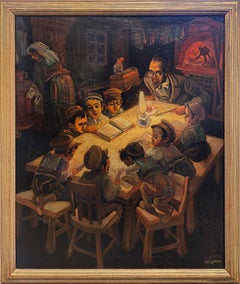
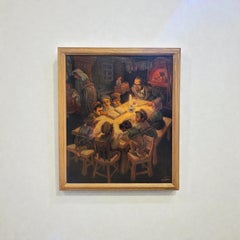
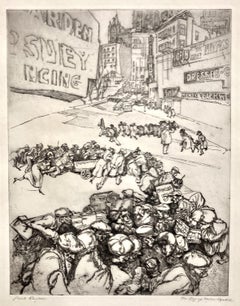
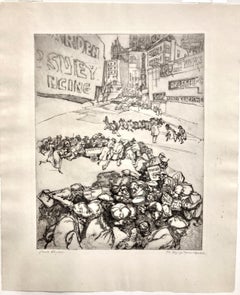
By Saul Raskin
Located in Surfside, FL
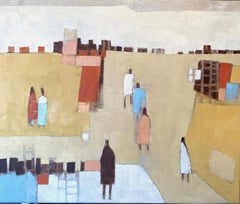
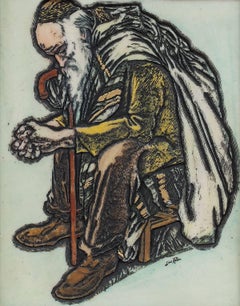
Genre: Judaica
Subject: Figures
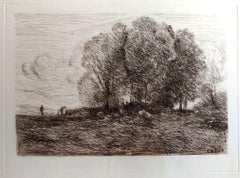
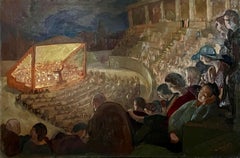
Medium: Other, Etching (carved ivorine plaque)
Country: United States
Dimensions: 12" x 10" x 3/4"
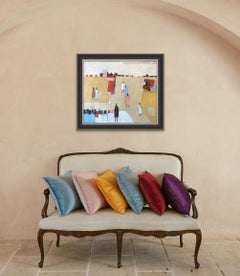
Dimensions w/Frame: 18" x 15 1/2"
Artist and critic Saul Raskin was steadfast in his mission to highlight the importance of Jewish Art and champion its recognition as a distinct genre. Throughout his long career, Raskin examined and discussed the pertinent themes explored by Jewish artists of the time and contributed his own paintings, cartoons, and illustrations to the history of the craft. In print and practice, he worked hard to break down the barriers of the exclusive art world to make room for an underrepresented area of expression.
Born in 1878, Raskin grew up in Norgaisk, Russia which later became Prymorsk, Ukraine. Before his immigration to the United States in 1904, Raskin studied Lithography in Odessa, Russia and attended art schools in Germany, France, Italy, and Switzerland. When he arrived in the States, Raskin became fluent in Yiddish which helped him land significant work with New York's Yiddish publications. His cartoons often examined the contrasts between Jewish life in Europe and the United States. For a 1909 satirical cartoon that appeared in the Der Groyser Kundes publication, he explored the role of Jewish cantors in Europe and America; in their native country, a cantor would serve to provide music for religious services from village to village; however, while in America, that same Jewish cantor would likely work as an opera tenor because there wouldn't be a place for a cantor in the States.
Aside from his cartoon work, Raskin wrote extensive art criticism for Yiddish Publications and socialist journals including Tsayat-gayst, Freie Arbeiter Stimme and Die Zukunft. In 1911, he wrote an important piece for Dos Naye Land in which he promoted the need to organize and produce Jewish art exhibitions. However, his suggestion was dismissed by fellow critics who didn't see the value in Jewish art that Raskin described.
Even though Raskin greatly concerned himself with the promotion of Jewish art and appreciation, he was also a prominent artist himself, and his artistic endeavors didn't end with his Yiddish publication cartoons. In fact, as an artist, he was highly praised for his attention to detail, attributed to his work as a draftsman and lithographer. Like his contemporaries, Raskin's Judaic paintings were centered around everyday Jewish life and culture. Often, his work focused on the Lower East side in New York city, Old Testament scenes, and other captures of life. In 1922, he began to exhibit his pieces where he worked as an art director and instructor, and by the 1930s, his works found their way into the Brooklyn Museum, The National Academy of Art and Design, and the Baltimore Museum.
In 1947, Raskin published Land of Palestine, a book containing over 300 drawings and paintings inspired by Jewish life in Palestine. These works garnered him both critical and public acclaim, and they adorned the lobbies of Yiddish theaters...
Category
Mid-20th Century Folk Art Saul Raskin Art