Want more images or videos?
Request additional images or videos from the seller
1 of 8

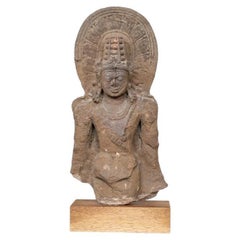
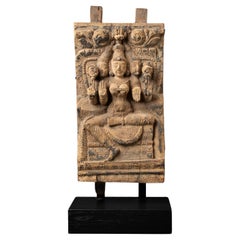
Ancient Indian Pala Schist Relief of Vishnu, 12th Century AD

$18,000
£13,597.32
€15,855.05
CA$25,549.19
A$25,712.30
CHF 14,923.30
MX$312,240.72
NOK 171,421.04
SEK 176,939.45
DKK 118,521.14

About the Item

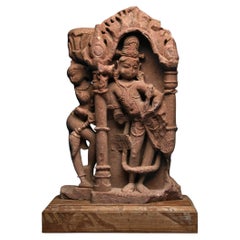
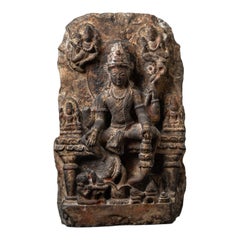
A classic representation of the god standing on a blooming lotus. With his four hands he holds the club (gada), the disk (cakra), the conch (sanka), and makes the gesture of giving (varada mudrâ). He is flanked by two female deities, one holding a fly whisk, the other a musical instrument. The lower register is occupied by the representations of the probable donors. The back of the composition is treated in the manner of classic throne backsplashes from the Pâla period, with superimposed elephants, vyala, makara, and flying deities. A dedicatory inscription is engraved under the lotus. Notes In this sculpture, the Hindu goddesses Lakshmi and Sarasvati flank the deity Vishnu, Preserver of the Universe. Along with Brahma and Shiva, he is seen as one of the three aspects of the embodiment of ultimate reality, but is also worshipped alone as the ultimate deity by some believers. When viewed as the Preserver, he operates alongside Shiva, who destroys the universe, and Brahma, who creates it. Here, Vishnu is presented in a full-frontal pose wearing the traditional adornments of a king. In his four hands, he holds his traditional primary attributes, a jewel, a conch, a flaming wheel, and a mace. The conch is a symbol of creation, the wheel symbolizes the cosmic law, and the mace symbolizes the power of the law. The jewel is a symbol of the fulfillment of the law, and this hand is extended in the wish-fulfilling gesture. Lakshmi holds a fly whisk while in her left hand, now lost, she probably held a lotus flower. Sarasvati plays a lute. This stele is Bengali in style, and would have originally been an independent element forming part of the architectural structure of a temple in eastern India. It would either have been set in a niche, or used as the main image of veneration. The iconographic features of the statue are standard for representations of Vishnu in the guise of Trivikrama, one of his twenty-four forms. The dwarf Vamana won back the universe from King Bali by transforming into Trivikrama and crossing the universe in three giant steps. Provenance China and India Company, Paris, 1994. Private French Collection. Cornette De Saint Cyr Paris, March 23, 2021. Private Collection, Beverly Hills California.
  • Dimensions:
    Height: 22 in (55.88 cm)Width: 10.5 in (26.67 cm)Depth: 5 in (12.7 cm)
  • Materials and Techniques:
  • Place of Origin:
  • Period:
  • Date of Manufacture:
    12th Century AD
  • Condition:
    Wear consistent with age and use. Visible accidents and losses to both the crown and face, the mace head, both lower arms, and lotus pedestal base. Large chip to proper lower right hand side of the stele border. Crisp details maintained throughout with some surface wear to background.
  • Seller Location:
    Beverly Hills, CA
  • Reference Number:
    Seller: HQ.00581stDibs: LU10743248130892

More From This Seller

View All
Ancient Indian Red Sandstone Relief depicting Shiva

Ancient Indian Red Sandstone Relief depicting Shiva

Located in Beverly Hills, CA

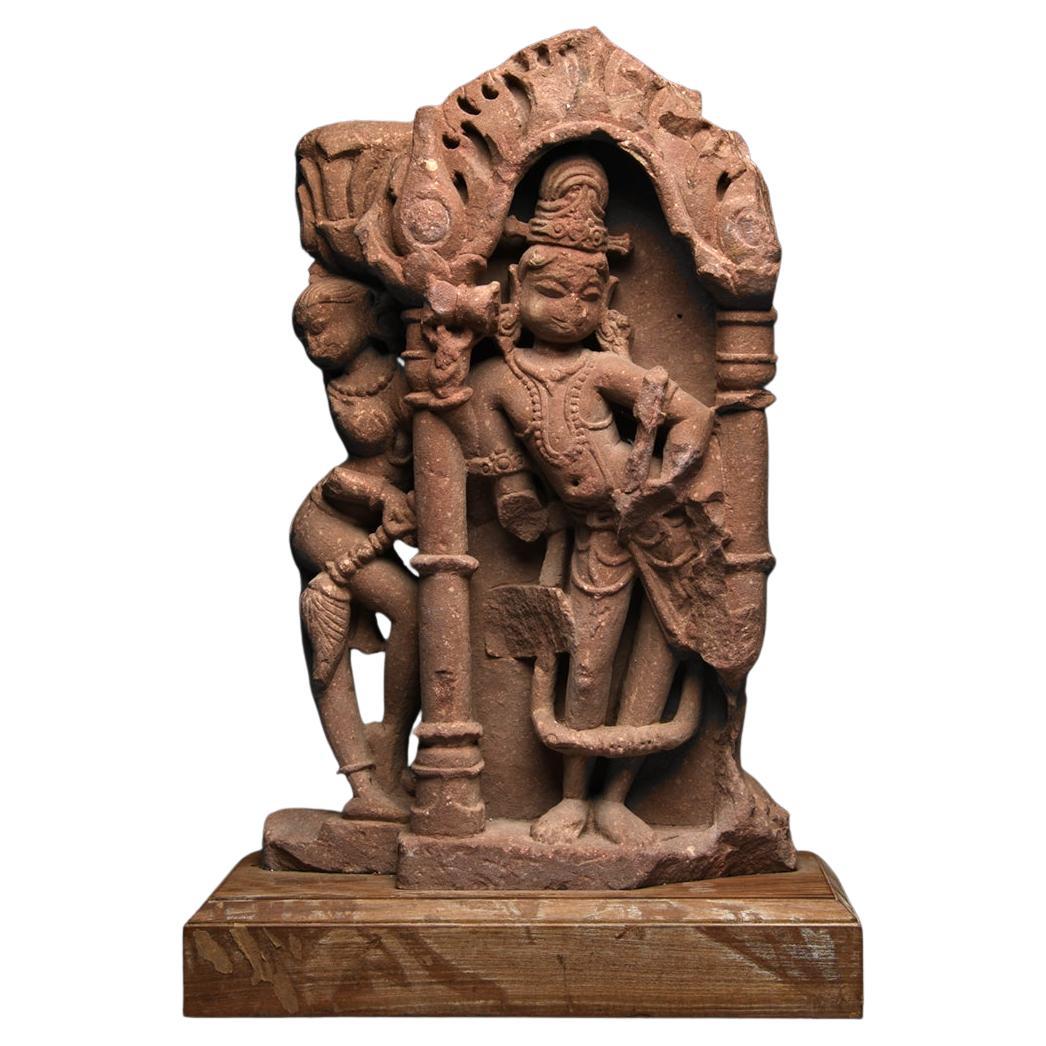
Originating in medieval Madhya Pradesh or Rajasthan, this is a superb example of classical Indian temple sculpture. A lively and dynamic composition, this red sandstone relief shows...

Category

Antique 15th Century and Earlier Indian Antiquities

Materials

Sandstone

Ancient Indian Red Sandstone Salabhanjika Figure, 10th-11th Century

Ancient Indian Red Sandstone Salabhanjika Figure, 10th-11th Century

Located in Beverly Hills, CA

This superbly carved female figure stands in graceful tribhanga pose clutching the branches of the tree above with both hands. She is clad in a sheer dhoti and generously adorned wit...

Category

Antique 15th Century and Earlier Indian Antiquities

Materials

Sandstone

Gupta Period Sandstone Buddha Sculpture in Hellenistic Pose, India

Gupta Period Sandstone Buddha Sculpture in Hellenistic Pose, India

Located in Beverly Hills, CA

This Gupta period sculpture of a Buddha seated in front of a tiered stupa is as exceptional as it is rare. Finely carved, we see the Buddha seated in ‘Hellenistic pose’ on a lotus ba...

Category

Antique 15th Century and Earlier Indian Antiquities

Materials

Sandstone

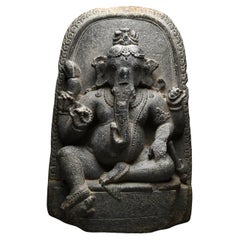
Pala Black Stone Ganesha Stele, 10th Century AD, India

Pala Black Stone Ganesha Stele, 10th Century AD, India

Located in Beverly Hills, CA

Seated in lalitasana with his pendant foot resting on the rat, Ganesh is seen here holding a mala, a radish, and a bowl of sweets in three of his hands while the fourth comfortably r...

Category

Antique 15th Century and Earlier Indian Antiquities

Materials

Stone

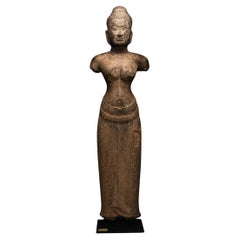
Khmer Sandstone Figure of Uma, Baphuon Style, 11th Century

Khmer Sandstone Figure of Uma, Baphuon Style, 11th Century

Located in Beverly Hills, CA

Of elegant elongated proportion, with broad rounded shoulders and a pinched waist, this exceptional statuesque figure of the Goddess Uma represents Baphuon style at it's finest. Our...

Category

Antique 15th Century and Earlier Cambodian Classical Roman Sculptures an...

Materials

Sandstone

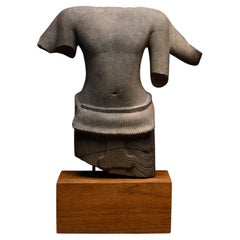
Ancient Khmer Sandstone Torso of a Four Armed Deity, 12th Century AD

Ancient Khmer Sandstone Torso of a Four Armed Deity, 12th Century AD

Located in Beverly Hills, CA

This impressive broad chested Khmer torso likely depicts Lokesvara, the famous bodhisattva of compassion in Buddhism. Our deity is seen wearing a pleated ...

Category

Antique 15th Century and Earlier Cambodian Antiquities

Materials

Sandstone

You May Also Like

17th century Antique Indian stone relief of Avalokiteshvara (Padmapani) from Ind

17th century Antique Indian stone relief of Avalokiteshvara (Padmapani) from Ind

Located in DEVENTER, NL

This antique Indian stone relief of Avalokiteshvara (Padmapani) is a striking example of 17th-century Buddhist art from India. Carved from solid sandstone, the relief depicts Avaloki...

Category

Antique 17th Century Indian Sculptures and Carvings

Materials

Sandstone

18th century Antique wooden Indian temple panel from India

18th century Antique wooden Indian temple panel from India

Located in DEVENTER, NL

This antique wooden Indian temple panel, originating from a temple chariot in India, stands at an impressive height of 64 cm. Dating back to the 18th century, this piece is a testame...

Category

Antique 18th Century Indian Sculptures and Carvings

Materials

Wood

11-13th century Rare antique sandstone Chaumukha altar sculpture from India

11-13th century Rare antique sandstone Chaumukha altar sculpture from India

Located in DEVENTER, NL

This rare antique sandstone Chaumukha altar sculpture is an extraordinary example of 11th–13th century Indian temple art, originating from India. Carved from solid sandstone, the scu...

Category

Antique 15th Century and Earlier Burmese Sculptures and Carvings

Materials

Sandstone

18th century Antique wooden Indian temple panel from India

18th century Antique wooden Indian temple panel from India

Located in DEVENTER, NL

This antique wooden Indian temple panel is a rare and exquisite 18th-century artifact originating from an antique temple chariot in India. Expertly carved from high-quality wood, thi...

Category

Antique 18th Century Burmese Sculptures and Carvings

Materials

Wood

19th century Antique wooden Indian temple panel from India

19th century Antique wooden Indian temple panel from India

Located in DEVENTER, NL

This antique wooden Indian temple panel is an exceptional 18th-century artifact, originally part of a traditional temple chariot used in sacred processions. Expertly hand-carved from...

Category

Antique 19th Century Indian Sculptures and Carvings

Materials

Wood