Want more images or videos?
Request additional images or videos from the seller
1 of 5

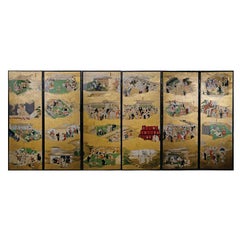
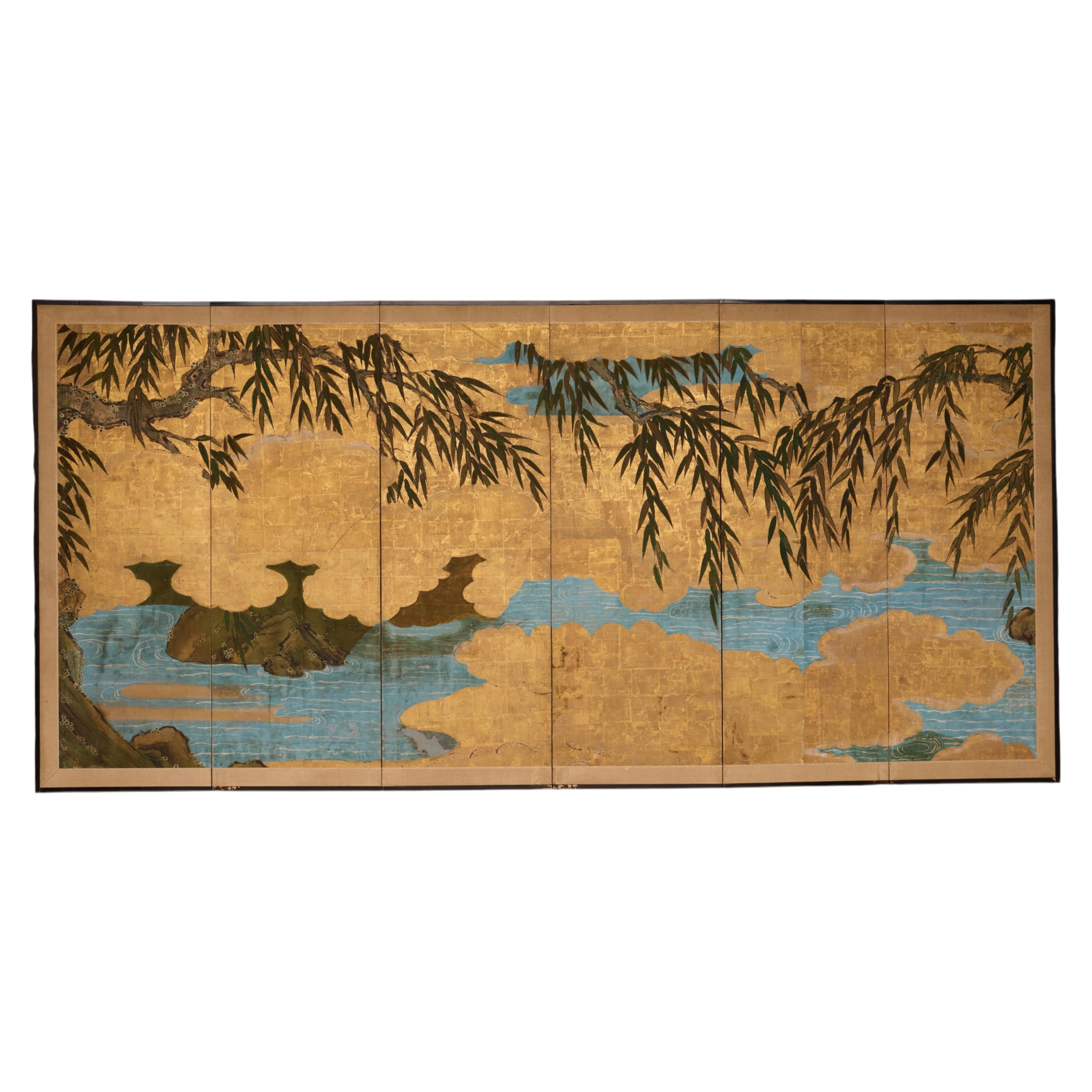
Japanese Screen Painting, Circa 1700 'Tales of Ise' by Tosa Mitsusuke

$24,500
£18,495.95
€21,521.64
CA$34,577.96
A$34,686.82
CHF 20,256.69
MX$422,322.13
NOK 232,604.35
SEK 239,546.37
DKK 160,869.08

About the Item

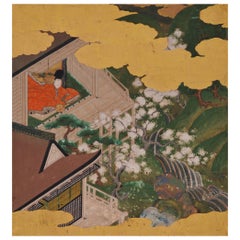
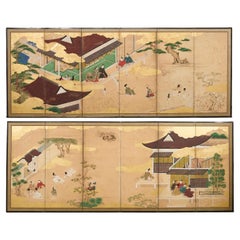
A six-fold Japanese screen by Tosa Mitsusuke (1675-1710), Japan 17th-18th century, Edo period. The signature reads Shoroku-i ge Tosa sa Konoe Shogen Mitsusuke Hiitsu. The seal is illegible. Ink, pigments and gold-leaf on paper. This small screen displays seven narratives of the Tale of Ise, each meticulously brushed with rich pigments on a gold-leaf background. Artists of the Tosa school painted for the imperial court and aristocratic patrons, their subject matter most commonly based on themes from Japanese literature. There is no set order for reading the screen. Rather, the viewer is encouraged to wander at leisure, recalling the scenes pictured and the sentiments they evoke. The Tales of Ise are presumed to detail episodes in the life of Ariwara no Narihira (825-880), a celebrated poet and nobleman of early Heian court society. First appearing in the tenth century, the Tales are a compilation of more than one hundred brief episodes that culminate in one or more poems. Poetry was central to the cultural life of Japanese aristocracy and its influence peaked in the Heian period. In the Tales of Ise, the prose is designed primarily to provide settings for the poems, which are characterised by an appreciation of nature’s beauty and a pervasive awareness of life’s impermanence. Tosa Mitsusuke was the 18th head of the Tosa school. He is the son of Tosa Mitsunari (1646-1710). Successive heads of the Tosa school served the emperors as Edokoro-Azukari (official painters for the Imperial Palace). This title was passed to Mitsusuke, from his father, in 1696. In 1709, it is recorded that Mitsusuke, with Kano Tsunenobu, painted sliding doors in the Imperial Palace and the Sento Palace. Dimensions: Screen – H. 28” x W. 91” (66 cm by 232 cm).
  • Creator:
    Tosa Mitsusuke 1 (Artist)
  • Dimensions:
    Height: 28 in (71.12 cm)Width: 91 in (231.14 cm)Depth: 1 in (2.54 cm)
  • Style:
    Edo (Of the Period)
  • Materials and Techniques:
  • Place of Origin:
  • Period:
    Late 17th Century
  • Date of Manufacture:
    circa 1700
  • Condition:
    Refinished. Wear consistent with age and use. Conservation and full re-mounting undertaken in Kyoto utilizing traditional techniques and craftsmen.
  • Seller Location:
    Kyoto, JP
  • Reference Number:
    1stDibs: LU247236417133

More From This Seller

View All
Japanese Painting, 17th Century, Tale of Genji, Tosa School

Japanese Painting, 17th Century, Tale of Genji, Tosa School

Located in Kyoto, JP

Illustration to an unidentified chapter of the Tale of Genji (Genji Monogatari) Tosa School (second half of the 17th Century) Ink, pigment, gofun and...

Category

Antique Late 17th Century Japanese Edo Paintings and Screens

Materials

Gold Leaf

19th Century Japanese Screen for Tea-Ceremony, Ink Bamboo and Plum on Gold Leaf

19th Century Japanese Screen for Tea-Ceremony, Ink Bamboo and Plum on Gold Leaf

Located in Kyoto, JP

Three Friends of Winter Nakajima Raisho (1796-1871) Late Edo period, circa 1850 Ink and gold leaf on paper. This is a double-sided Japanese Furosaki or tea-ceremony screen from the mid 19th century; bamboo and plum on the front, young pines the back. It by Nakajima Raisho, a master painter of the Maruyama school in the late Edo and early Meiji periods. In this work Raisho combines exquisite ink brushwork with large open spaces of brilliant gold-leaf to inspire the viewers imagination. Rather than naturalism, he is searching for the phycological impression of the motifs, resulting in abstraction and stylization. His simplification of the motifs the result of looking to capture the inner nature of the objects. This art motif is known as Sho Chiku Bai, or the Three Friends of Winter. Evergreen pine connotes steadfastness, bamboo suggests both strength and flexibility, while plum blossoms unfurling on snow-laden branches imply hardiness. Combined, this trio is emblematic of Japanese new year. Chinese literati were the first to group the three plants together due to their noble characteristics. Like these resilient plants flowering so beautifully in winter, it was expected of the scholar-gentleman to cultivate a strong character with which he would be able to show the same degree of perseverance and steadfastness even during times of adverse conditions. The screen would have been placed near the hearth of a room used for the Japanese tea ceremony, shielding the fire from draughts and also forming a stimulating and decorative backdrop behind the tea utensils. It would have been used in the Hatsugama, or first tea-ceremony of the new year. Nakajima Raisho (1796-1871) originally studied under Watanabe Nangaku before entering the school of Maruyama Ozui. He was the highest ranking Maruyama school painter at the end of the Edo period and was known as one of the ‘Four Heian Families’ along with Kishi...

Category

Antique Mid-19th Century Japanese Edo Paintings and Screens
Materials

Gold Leaf

1838 Japanese Screen Pair. Flowers & Grasses of the Four Seasons.

1838 Japanese Screen Pair. Flowers & Grasses of the Four Seasons.

Located in Kyoto, JP

Maruyama Oshin (1790-1838) Flowers and grasses of the four seasons: dated 1838 Pair of eight-panel Japanese screens; ink, color and gold leaf on silk Dimensions: each (2) H. 38.5 cm...

Category

Antique 1830s Japanese Edo Paintings and Screens

Materials

Silk

17th Century Japanese Screen. Flowers & Birds of Winter and Early Spring.

17th Century Japanese Screen. Flowers & Birds of Winter and Early Spring.

Located in Kyoto, JP

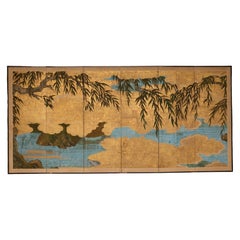
Signed Unkoku Toyu (1660-1716) Flowers & Birds of Winter and Early Spring A Six-panel Japanese Screen. Ink, color and gold leaf on paper. This later 17th century Japanese screen is signed Unkoku Tōyū (1660–1716), a leading figure of the Unkoku school in the early Edo period. Tōyū was the eldest son of Unkoku Tōji, and he carried forward a lineage that deliberately anchored itself in the authority of Sesshū Tōyō. The mood of the scene is observational and seasonal, not emblematic of power as were many screens from the more wide-spread Kano school. The composition is unified by wind and atmosphere. Everything — bamboo, plum, reeds, water, birds — participates in a single directional force moving from left to right. Unlike certain later screens that flatten elements across the surface, this composition preserves a sense of depth. Yet the recession is moderated by gold clouds and frontal placement of forms. The result is a balanced tension between depth and surface. The compositional structure — with its expansive sweep across the panels — reflects the decorative ambition of Momoyama screen...

Category

Antique Late 17th Century Japanese Edo Paintings and Screens

Materials

Gold Leaf

Late 17th Century Japanese Screen. Puppy and Kittens on Gold Leaf.

Late 17th Century Japanese Screen. Puppy and Kittens on Gold Leaf.

Located in Kyoto, JP

Anonymous Late 17th century Puppy & Kittens A six-panel Japanese screen. Ink, color, gofun, gold-leaf and gold-fleck on paper. A medium sized late 17th century Japanese screen fe...

Category

Antique Late 17th Century Japanese Edo Paintings and Screens
Materials

Gold Leaf

You May Also Like

Japanese 18th Century Tsukinami-e 6 Panel Floor Screen, Edo Period

Japanese 18th Century Tsukinami-e 6 Panel Floor Screen, Edo Period

Located in Norton, MA

A Japanese 18th Century Tsukinami-e 6 Panel Floor Screen depicts the Activities of the Twelve Months of the Year, mineral pigments on gold leaf, mounted on wood panels with 6 frames...

Category

Antique 18th Century Japanese Edo Decorative Boxes

Materials

Gold Leaf

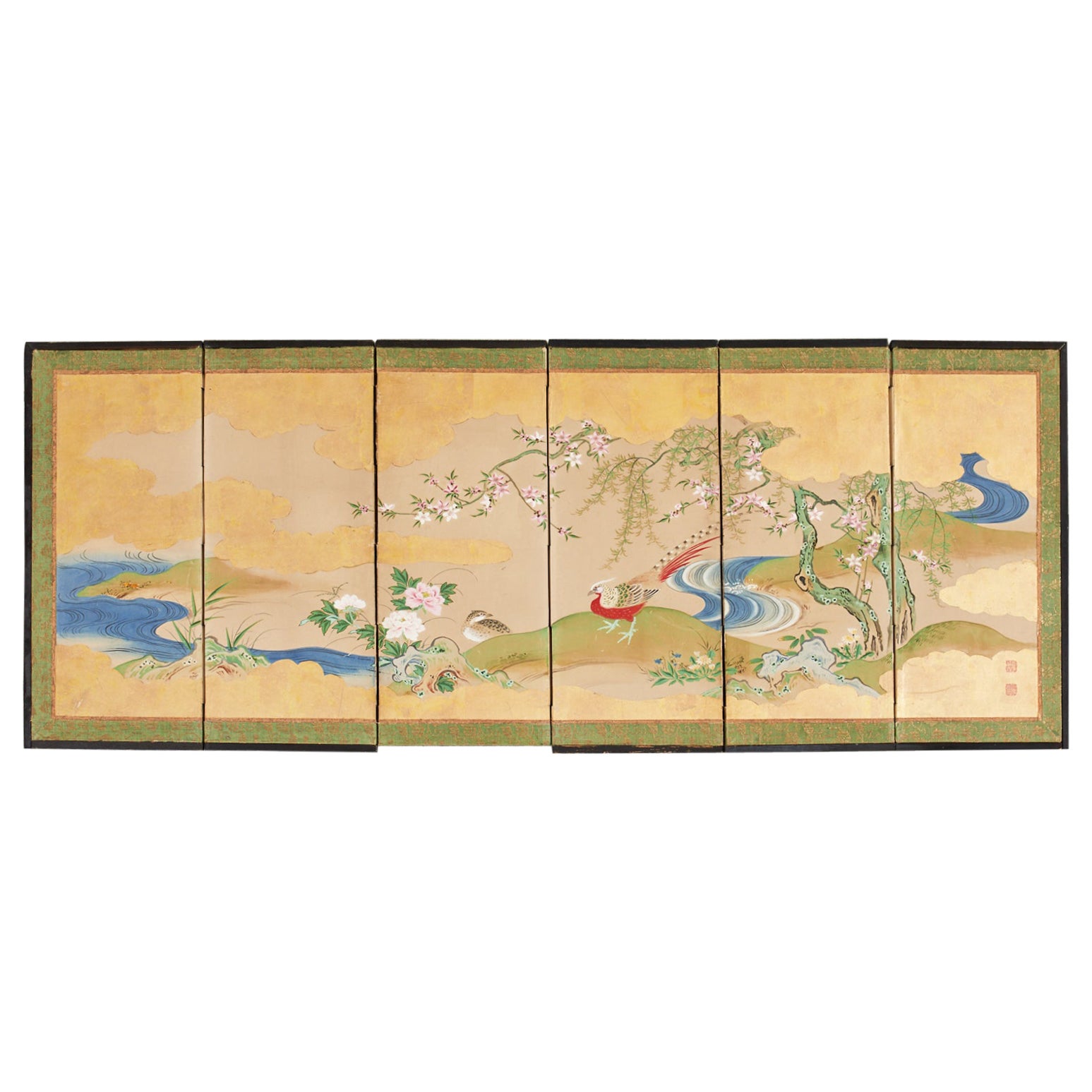
19th Century Japanese Edo Screen Kano School Garden Terrace

19th Century Japanese Edo Screen Kano School Garden Terrace

Located in Rio Vista, CA

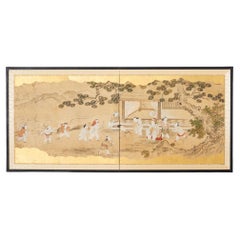
Fantastic 19th century Japanese Edo/Tokugawa period two-panel byobu screen featuring Chinese children frolicking on a garden terrace with a pavilion and large pine tree. Made in the ...

Category

Antique 19th Century Japanese Edo Paintings and Screens
Materials

Brass, Gold Leaf

Pair Japanese Edo Six Panel Screens Legend of Minamoto

Pair Japanese Edo Six Panel Screens Legend of Minamoto

Located in Rio Vista, CA

Fascinating pair of large Japanese 19th century Edo period six-panel folding byobu screens depicting the legend of Minamoto No Yorimasa (Japanese Samurai 1106-1180). The pair of pain...

Category

Antique 19th Century Japanese Edo Paintings and Screens
Materials

Brass, Gold Leaf

17th Century Japanese Edo Four Panel Screen Hotei with Chinese Sages

17th Century Japanese Edo Four Panel Screen Hotei with Chinese Sages

Located in Rio Vista, CA

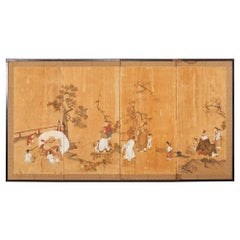
Beautifully weathered late 17th/early 18th century Japanese edo period four panel byobu screen depicting hotei (fat monk) in a treed landscape with Chinese sages engaged in leisurely...

Category

Antique 17th Century Japanese Edo Paintings and Screens
Materials

Brass