Want more images or videos?
Request additional images or videos from the seller
1 of 15

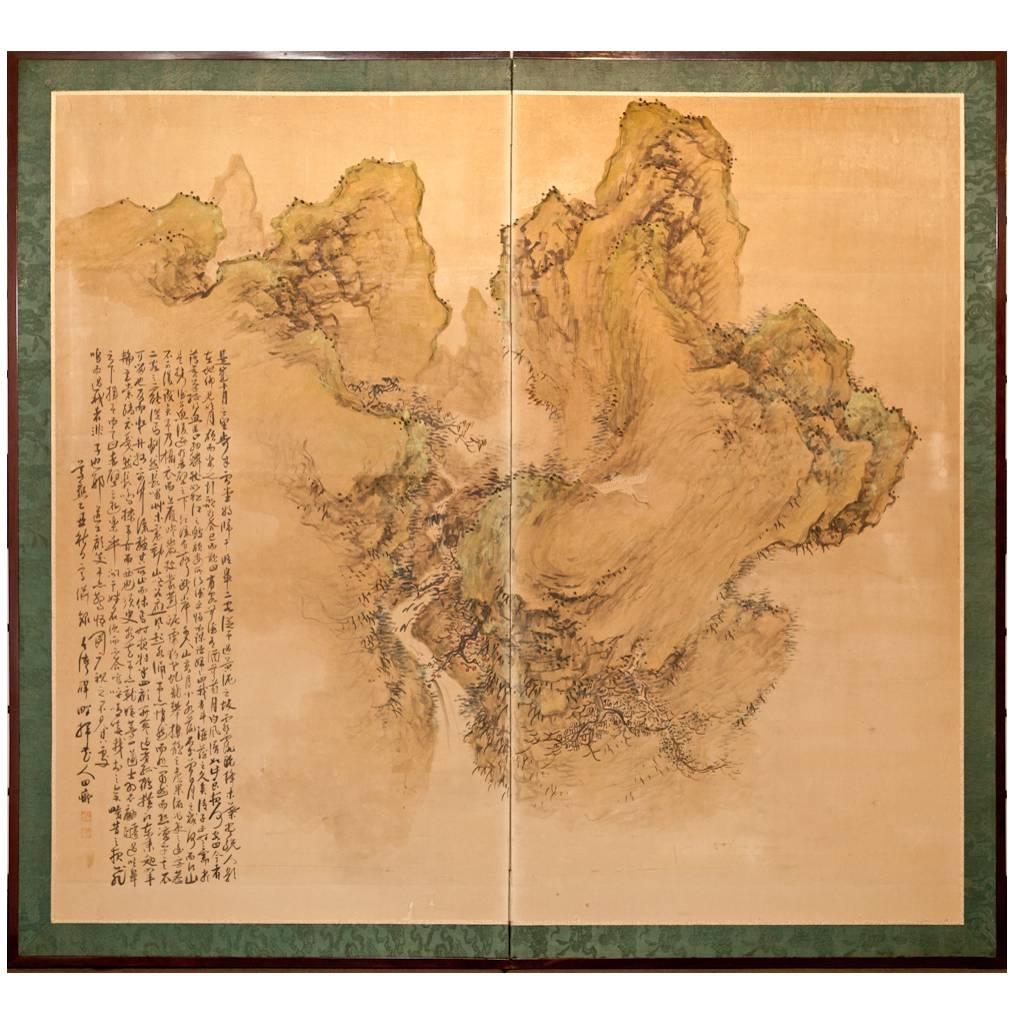
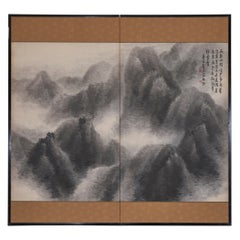
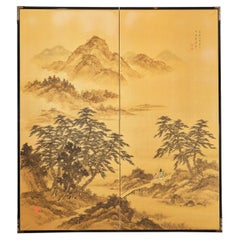
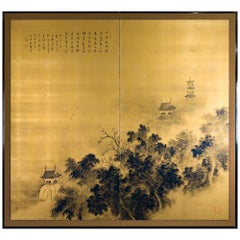
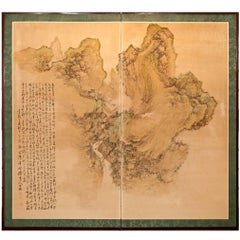
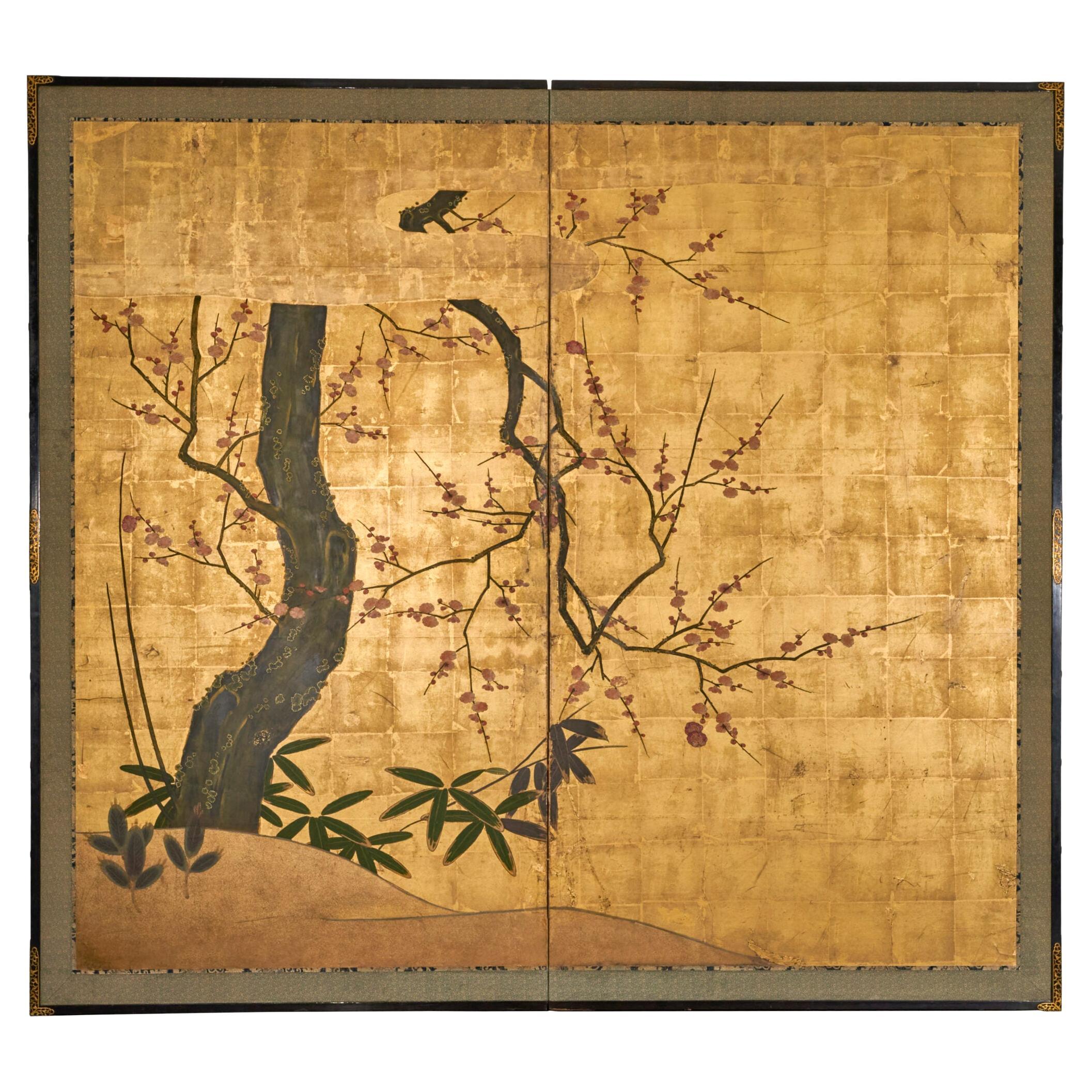
Japanese Two Panel Screen: Mountains in the Mist

$20,350
£15,335.46
€17,935.25
CA$28,795.67
A$29,222.33
CHF 16,846.05
MX$353,831.40
NOK 195,529.45
SEK 197,620.73
DKK 134,077.56

About the Item

Chinese School landscape ink painting on gilded silk by Yukimatsu Shunpo, signed and dated 1924. Yukimatsu Shunpo was born in Oita in 1897 and studied under Himejima Chikugai in Osaka. He exhibited with the Teiten (future Nitten) many times and received grand prize in 1926 and 1927. Reading of the calligraphy, "January's steady rain. Today, who we are going to meet? Spring will come, flowers will bloom." (In ancient times, January was part of spring.) One of a pair, sold separately.
  • Dimensions:
    Height: 67.75 in (172.09 cm)Width: 73 in (185.42 cm)Depth: 0.75 in (1.91 cm)
  • Style:
    Taisho (Of the Period)
  • Materials and Techniques:
  • Place of Origin:
  • Period:
  • Date of Manufacture:
    1924
  • Condition:
    Most items that are 100 years old have been cleaned or polished in their lifetime. More involved restorations are mentioned in the above description. For a detailed condition report and a video of this item please contact us directly. -Naga Antiques.
  • Seller Location:
    Hudson, NY
  • Reference Number:
    Seller: S17471stDibs: LU855123305152

More From This Seller

View All
Japanese Two Panel Screen: Sumi-e Mountain Landscape

Japanese Two Panel Screen: Sumi-e Mountain Landscape

Located in Hudson, NY

Ink on mulberry paper with silk brocade border and black lacquer trim. Signature and seal read: Sagawa Kakoku. Poem on upper right reads: Sounds of cicadas, in mountain valleys and t...

Category

Antique Late 19th Century Japanese Paintings and Screens

Materials

Brocade, Silk, Lacquer, Paper

Japanese Two Panel Screen: Rural Mountain Landscape

Japanese Two Panel Screen: Rural Mountain Landscape

Located in Hudson, NY

Dating to circa 1880, this Japanese two-panel screen presents an idealized mountain landscape inspired by the classical Chinese painting tradition, a style long embraced by Japanese ...

Category

Antique 19th Century Japanese Paintings and Screens

Materials

Gold, Pewter

Japanese Two-Panel Screen Temples Through Misty Forest

Japanese Two-Panel Screen Temples Through Misty Forest

Located in Hudson, NY

Japanese two-panel screen: Temples Through Misty Forest. Chinese School landscape ink painting on gilded silk by Yukimatsu Shunpo, signed and dated 1924. Yukimatsu Shunpo was born in...

Category

Vintage 1920s Japanese Taisho Paintings and Screens

Materials

Silk, Wood

Japanese Two Panel Screen: Mountain Landscape with Calligraphy

Japanese Two Panel Screen: Mountain Landscape with Calligraphy

Located in Hudson, NY

Japanese Two Panel Screen: Mountain Landscape with Calligraphy. Late Edo (c. 1850) painting of a dramatic mountainside carved by a waterfall with a crane flying in the foreground an...

Category

Antique Mid-19th Century Japanese Edo Paintings and Screens

Materials

Silk, Wood, Paper

Japanese Two Panel Screen Suiboku Landscape in Sesshu Style

Japanese Two Panel Screen Suiboku Landscape in Sesshu Style

Located in Hudson, NY

Suiboku is a style of ink painting that is reminicent of the way calligraphers paint. Masterfully painted Muromachi Period (1336-1573) painting, unique in style and strength for the period with very bold lines. Sesshu Toyo...

Category

Antique 16th Century Japanese Paintings and Screens

Materials

Silk, Paper

Japanese Two Panel Screen: Chinese Mountain Landscape

Japanese Two Panel Screen: Chinese Mountain Landscape

Located in Hudson, NY

A craggy mountain landscape with lake side pavilions. Mineral pigments, ink and gold leaf clouds and gold dust on mulberry paper. Fabric border with black lacquer trim.

Category

Antique 19th Century Japanese Paintings and Screens

Materials

Gold Leaf

You May Also Like

Japanese Taisho Two-Panel Landscape Screen Traveler Waystation

Japanese Taisho Two-Panel Landscape Screen Traveler Waystation

Located in Rio Vista, CA

An important and finely executed Japanese two-panel folding byōbu screen crafted in the Nihonga tradition, depicting a traveler’s waystation set within a mist-laden mountain landscap...

Category

Early 20th Century Japanese Taisho Paintings and Screens

Materials

Wood, Paper, Silk

Lovely Japanese 18/19th c Edo Scroll Kano Osanobu Nihonga Painting Mountain

Lovely Japanese 18/19th c Edo Scroll Kano Osanobu Nihonga Painting Mountain

Located in Amsterdam, Noord Holland

Kano Osanobu (狩野養信) Osanobu Kano (born August 18, 1796; died June 12, 1846) was the ninth painter of the Kobikicho Kano School in the Edo period. His common name was Shozaburo. His father was Naganobu KANO, and Tadanobu KANO was his son. His Go (pen name) was Osanobu Seisenin, Kaishinsai, and Gyokusen. Brief Personal History He was born the eldest son of Naganobu ISENIN during the Edo period. He was first sent to serve at Edo Castle at the age of 15, and it appears that he was apparently pushed by his father to perform various public tasks for the Kanon School. He kept a diary for 36 years, starting from the day before he first went into service at Edo Castle until the day before he died. The diary is entitles "Official Service Diary" (it consists of 52 volumes that are maintained at the Tokyo National Museum, and 4 volumes that are separately maintained at the different families), and have become the focus of a lot of attention in recent years for the detailed information they present on the daily life and work of a prestigious official painter. The reading of the characters of his name was originally "Takenobu"; however, with the birth of the first son of the Shongun Ieyoshi TOKUGAWA in 1813, whose name was Takechiyo, having a sylable with the same pronunciation of "Take"was deemed to be inappropriate, and was therefore changed to "Osanobu". Because Takenobu died the following year, after which he was referred to as Gyokujuin, Osanobu changed his pen name Gyokusen he had used until that point to Seisenin, in order to avoid using the same Chinese charcter pronounced alike. In 1819, he attained the second highest rank for a Buddhist priest, Hogen, and assumed the role of head of the family after his father passed away in 1828. In 1834 he attained the highest rank for a Buddhist priest, Hoin. He oversaw the rennovation of the wall paintings of Nishinomaru Palace of Edo Castle from 1838 to 1839, and Honmaru Palace of it from 1844 to 1846. It is thought that Osanobu later died due to the fatigue...

Category

Antique 18th Century Edo Paintings

Materials

Silk

Lovely Nihonga Scene Meiji/Taisho Period Scroll Japan Artist Landscape Miyahara

Lovely Nihonga Scene Meiji/Taisho Period Scroll Japan Artist Landscape Miyahara

Located in Amsterdam, Noord Holland

It is a work drawn by Miyahara Yanagi as you can see. It is a pine tree drawing of Karasaki that has a unique presence, and it is very attractive as it goes well with smoke. ¦ S...

Category

Antique 19th Century Japanese Meiji Paintings and Screens

Materials

Silk

Antique Japanese 18th c Edo Scroll Rosetsu Nagasawa Nihonga Landscape Painting

Antique Japanese 18th c Edo Scroll Rosetsu Nagasawa Nihonga Landscape Painting

Located in Amsterdam, Noord Holland

The following is a work of art depicting the ``Horai Landscape,'' a land of peach, created by the master artist [Rosetsu Nagasawa] A painter from the late Edo period. There are conf...

Category

Antique 18th Century Edo Paintings
Materials

Silk

Japanese Nihonga Painting 1900 Meiji/Taisho Scroll  Shûseki, Okutani Landscape

Japanese Nihonga Painting 1900 Meiji/Taisho Scroll Shûseki, Okutani Landscape

Located in Amsterdam, Noord Holland

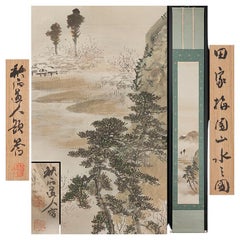
Susheki Okutani "Takaya Plum Garden Landscape" Silk, Colored, Authentic, Hanging Scroll, , Double Box size Axis: Height 206.5cm Width 29.3cm Drawing…Height 126.7cm Width 19.5cm *There may be slight differences in dimensions. Thank you for your understanding. situation It is in good condition, but please note that there are some light stains. Please check the image for details. Thank you for your support. Biography Akishi Okutani Japanese painter. Born in Osaka. His name is Tsunejiro. He studied under Kansai Mori. From an early age, he exhibited his works at the Japan Painting Association and the Young People's Painting Association, which was led by Gaho Hashimoto and Gyokusho Kawabata, and won numerous awards. He also opened a private school...

Category

20th Century Taisho Paintings

Materials

Silk

Mountain Scene Showa Period Scroll Japan 20c Artist Kohiro Sato Nihonga Style

Mountain Scene Showa Period Scroll Japan 20c Artist Kohiro Sato Nihonga Style

Located in Amsterdam, Noord Holland

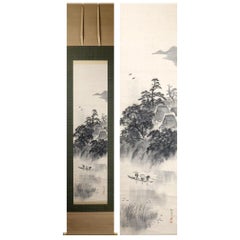
As you can see, it is a work drawn by Kohiro Sato. It is a simple but unique presence of a river boat, and it is a very tasty work combined with the scenery reflected on the surface ...

Category

20th Century Japanese Showa Paintings and Screens

Materials

Silk