Want more images or videos?
Request additional images or videos from the seller
1 of 8

Paravent - A six-fold Japanese screen with grape vines - 17th/18th century, Edo

$106,331.96
£78,560.71
€95,400VAT Included
CA$147,934.35
A$148,384.02
CHF 86,071.15
MX$1,811,311.84
NOK 996,947.23
SEK 1,020,308.36
DKK 686,202.70

About the Item

A six-fold paper screen painted in ink and colour on a gold ground with grape vines hanging from a pergola and woven fence amongst golden clouds, the details in gin-sunago (cut silver leaf) and moriage (raised design). The metal mounts are decorated with cloisonné enamel, a special detail rarely seen on screen mounts. Japan, 17th/18th century, Edo period. Grapes represent the autumn season and have been regarded as an auspicious symbol of fertility and prosperity since ancient times. Also the Japanese word of grape ‘budō’ is the same word for martial arts. Often paired with squirrels (‘risu’ in Japanese meaning, to follow discipline), the subject was a favourite of the samurai class. Designs incorporating grape vines have been used for ceramic and lacquer works as well as paintings from early times and screens depicting this subject matter seem to have been particularly popular in the early Edo period, however only a few examples are known today. These known examples depicting grape vines are rendered in a similar manner using gold leaf and moriage (raised design): A pair of screens from the Kano School housed in the Tokyo Fuji Art Museum (17th century, Momoyama period) A pair in the Gardner collection (17th century, accession no. P14e3) There are another comparable pair of 17th-century screens housed in the Okura Museum of Art, Tokyo and there are a pair of sugido (cedar wood doors) with the same subject housed in the Nagoya Castle, Aichi prefecture. Paravent à six volets peint à l'encre et à la couleur sur fond doré, représentant des vignes suspendues à une pergola et une clôture tressée parmi des nuages dorés, avec des détails en gin-sunago (feuille d'argent découpée) et moriage (motifs en relief). Les montures métalliques sont décorées d'émail cloisonné, un détail particulier rarement vu sur les montures de paravents. Japon, XVIIe/XVIIIe siècle, période Edo. Les raisins représentent la saison automnale et sont considérés depuis l'Antiquité comme un symbole propice de fertilité et de prospérité. De plus, le mot japonais « budō », qui désigne le raisin, est le même que celui qui désigne les arts martiaux. Souvent associé aux écureuils (« risu » en japonais, qui signifie « suivre la discipline »), ce sujet était très apprécié de la classe des samouraïs. Les motifs incorporant des vignes ont été utilisés dès les temps anciens pour les céramiques, les laques et les peintures. Les paravents représentant ce sujet semblent avoir été particulièrement populaires au début de la période Edo, mais seuls quelques exemples sont connus aujourd'hui. Ces exemples connus représentant des vignes sont rendus de manière similaire à l'aide de feuilles d'or et de moriage (motif en relief) : Une paire de paravents de l'école Kano est conservée au Tokyo Fuji Art Museum (XVIIe siècle, période Momoyama). Une paire dans la collection Gardner (XVIIe siècle, n° d'inventaire P14e3). Il existe une autre paire d'écrans comparables du XVIIe siècle conservée au musée d'art Okura de Tokyo, ainsi qu'une paire de sugido (portes en bois de cèdre) sur le même thème conservée au château de Nagoya, dans la préfecture d'Aichi.
  • Dimensions:
    Height: 60.83 in (154.5 cm)Width: 142.92 in (363 cm)Depth: 0.79 in (2 cm)
  • Style:
    Edo (Of the Period)
  • Materials and Techniques:
  • Place of Origin:
  • Period:
    Late 17th Century
  • Date of Manufacture:
    17th-18th Century
  • Condition:
    Repaired: The screen has several old minor tears which have been repaired. There are a few imperfections around the hinge areas due to old damage and wear commensurate with age. Le paravent présente plusieurs petites déchirures anciennes qui ont été réparées. Wear consistent with age and use. Minor losses. A full condition report is available upon request. Un rapport de condition détaillé est disponible sur demande.
  • Seller Location:
    Brussels, BE
  • Reference Number:
    Seller: 77501stDibs: LU10843249045352

More From This Seller

View All
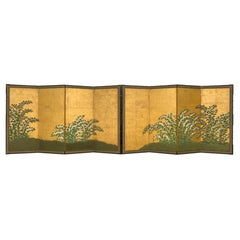
Paravent japonais- A pair of six-fold Japanese screens with clematis- Edo period

Paravent japonais- A pair of six-fold Japanese screens with clematis- Edo period

Located in Brussels, BE

A pair of six-fold Japanese screens depicting white and bluish-purple clematis on trellises behind woven fences and beside a stream, against an abundance of golden clouds. Ink, colo...

Category

Antique 17th Century Japanese Edo Paintings and Screens

Materials

Gold Leaf

Paravent - A pair of four-fold screens with Japanese chestnut - Edo period

Paravent - A pair of four-fold screens with Japanese chestnut - Edo period

Located in Brussels, BE

A pair of four-fold Japanese screens painted in ink and colour on a gold ground with kuri (Japanese chestnut) flowers on a knoll. Japan, 17th/18th century, Edo period . Dimensions...

Category

Antique Late 17th Century Japanese Edo Paintings and Screens

Materials

Gold Leaf

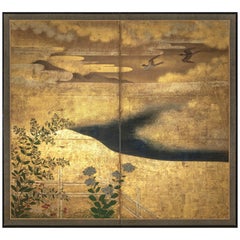
Paravent japonais - A two-fold Japanese screen with nightingales - Edo period

Paravent japonais - A two-fold Japanese screen with nightingales - Edo period

Located in Brussels, BE

A two-fold Japanese paper screen, painted in ink and colour on a buff and gold ground, with a mountainous river landscape. The scene depicts two nightingales in flight amongst hazy ...

Category

Antique 18th Century Japanese Edo Paintings and Screens

Materials

Gold Leaf

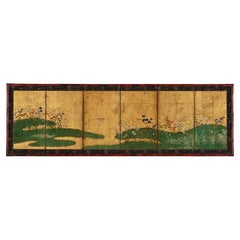
Paravent - A small six-fold Japanese screen with autumn flowers - Edo period

Paravent - A small six-fold Japanese screen with autumn flowers - Edo period

Located in Brussels, BE

A six-fold paper screen painted in ink and colour on a gold ground with autumn flowers and grasses. Japan, 17th century, Edo period. Not only the changing colours of autumn leaves ...

Category

Antique 17th Century Japanese Edo Paintings and Screens

Materials

Gold Leaf

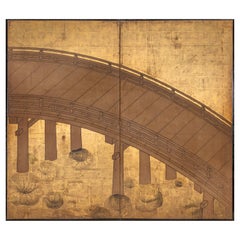
Paravent - A two-fold screen with the Uji Bridge - Rimpa school, 17th Century

Paravent - A two-fold screen with the Uji Bridge - Rimpa school, 17th Century

Located in Brussels, BE

A two-fold Japanese paper screen painted in ink and colour on a gold ground with the Uji River and lotus beneath its renowned bridge. Rimpa School, Japan 17th century, Edo period. ...

Category

Antique 17th Century Japanese Other Paintings and Screens

Materials

Gold Leaf

Paravent Japonais - A six-fold Japanese screen with quails - Edo period

Paravent Japonais - A six-fold Japanese screen with quails - Edo period

Located in Brussels, BE

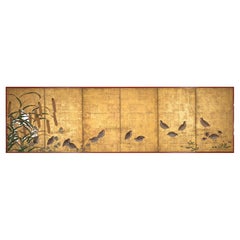
A six-fold paper screen painted in ink and colour on a gold ground with a covey of uzura (quails) and chicks amongst kibi (millet), grasses, nokongiku (aster) and tampopo (dandelion)...

Category

Antique Early 19th Century Japanese Edo Paintings and Screens

Materials

Gold Leaf

You May Also Like

17th Century Japanese Screen. Flowers & Birds of Winter and Early Spring.

17th Century Japanese Screen. Flowers & Birds of Winter and Early Spring.

Located in Kyoto, JP

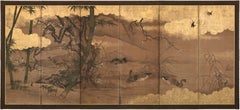
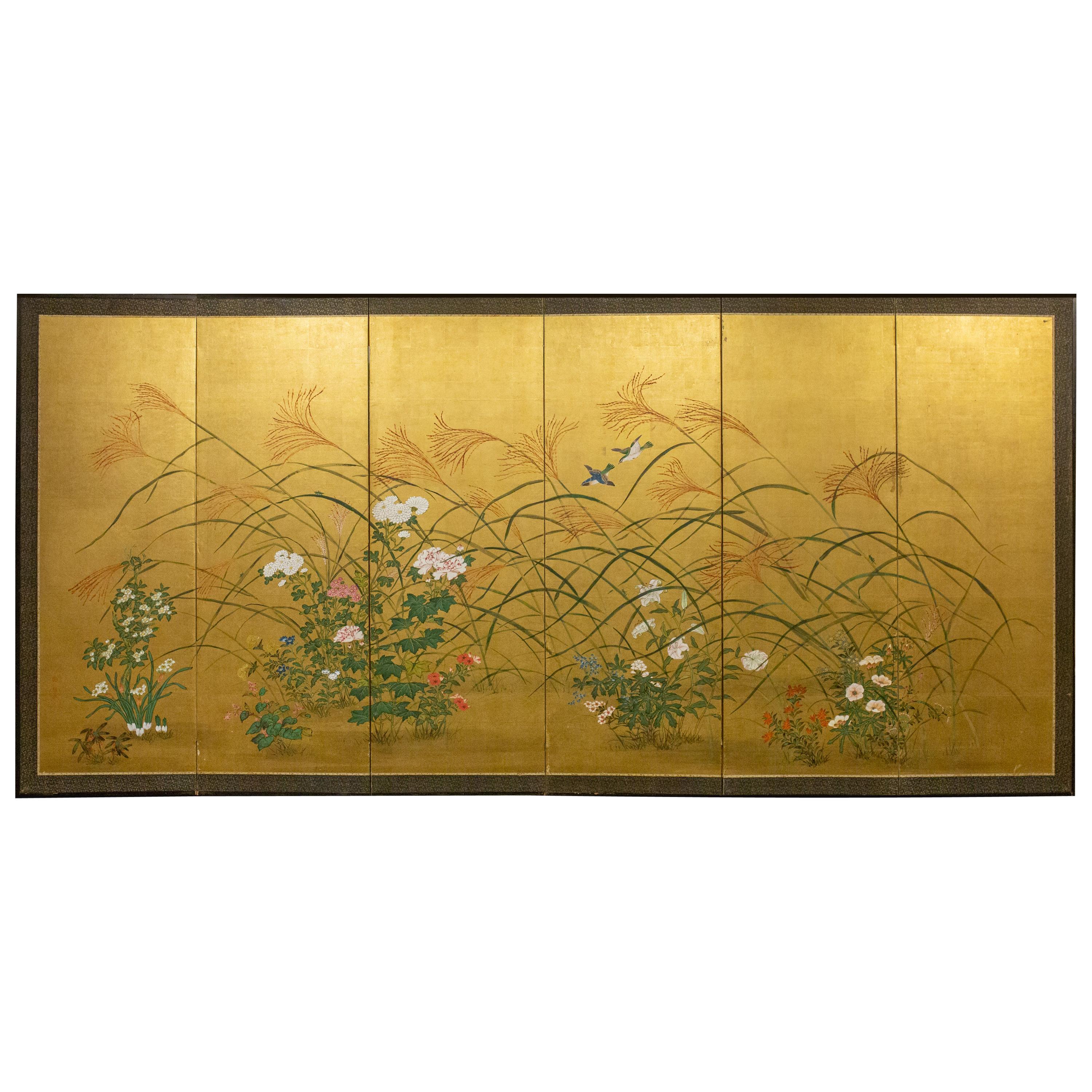
Signed Unkoku Toyu (1660-1716) Flowers & Birds of Winter and Early Spring A Six-panel Japanese Screen. Ink, color and gold leaf on paper. This later 17th century Japanese screen is signed Unkoku Tōyū (1660–1716), a leading figure of the Unkoku school in the early Edo period. Tōyū was the eldest son of Unkoku Tōji, and he carried forward a lineage that deliberately anchored itself in the authority of Sesshū Tōyō. The mood of the scene is observational and seasonal, not emblematic of power as were many screens from the more wide-spread Kano school. The composition is unified by wind and atmosphere. Everything — bamboo, plum, reeds, water, birds — participates in a single directional force moving from left to right. Unlike certain later screens that flatten elements across the surface, this composition preserves a sense of depth. Yet the recession is moderated by gold clouds and frontal placement of forms. The result is a balanced tension between depth and surface. The compositional structure — with its expansive sweep across the panels — reflects the decorative ambition of Momoyama screen...

Category

Antique Late 17th Century Japanese Edo Paintings and Screens
Materials

Gold Leaf

Japanese Six-Panel Folding Screen with Ancient Pine and Bamboo, 19th Century

Japanese Six-Panel Folding Screen with Ancient Pine and Bamboo, 19th Century

Located in Fukuoka, JP

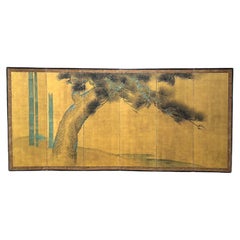
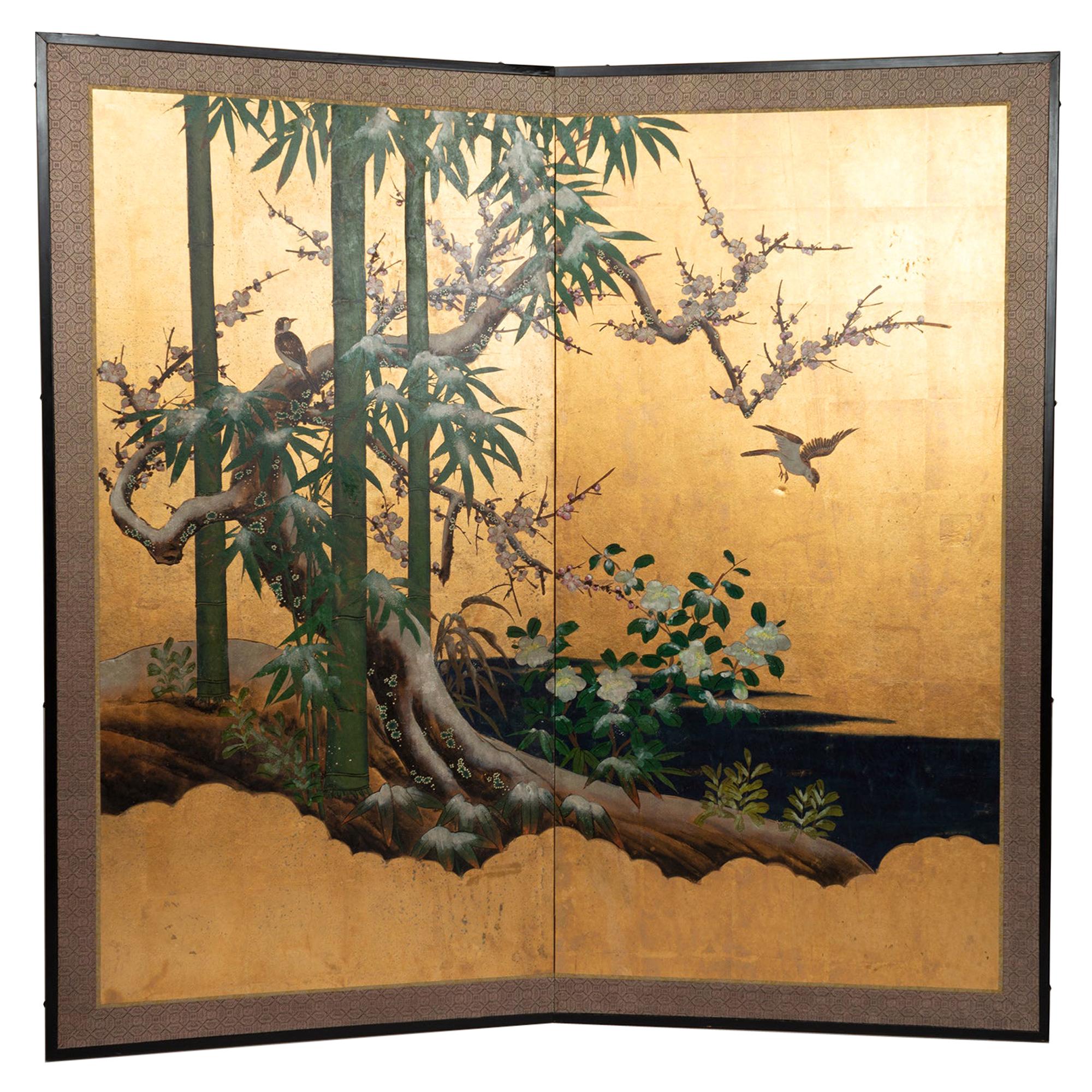
A Japanese six-panel folding screen depicting an ancient pine extending dramatically across a gold-leaf ground, accompanied by a small grouping of upright bamboo. The composition is...

Category

Antique 19th Century Japanese Edo Paintings and Screens
Materials

Gold Leaf

Antique Japanese Six-Panel Screen by Kano Chikanobu "Shushin"

Antique Japanese Six-Panel Screen by Kano Chikanobu "Shushin"

Located in Prahran, Victoria

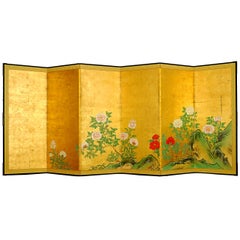
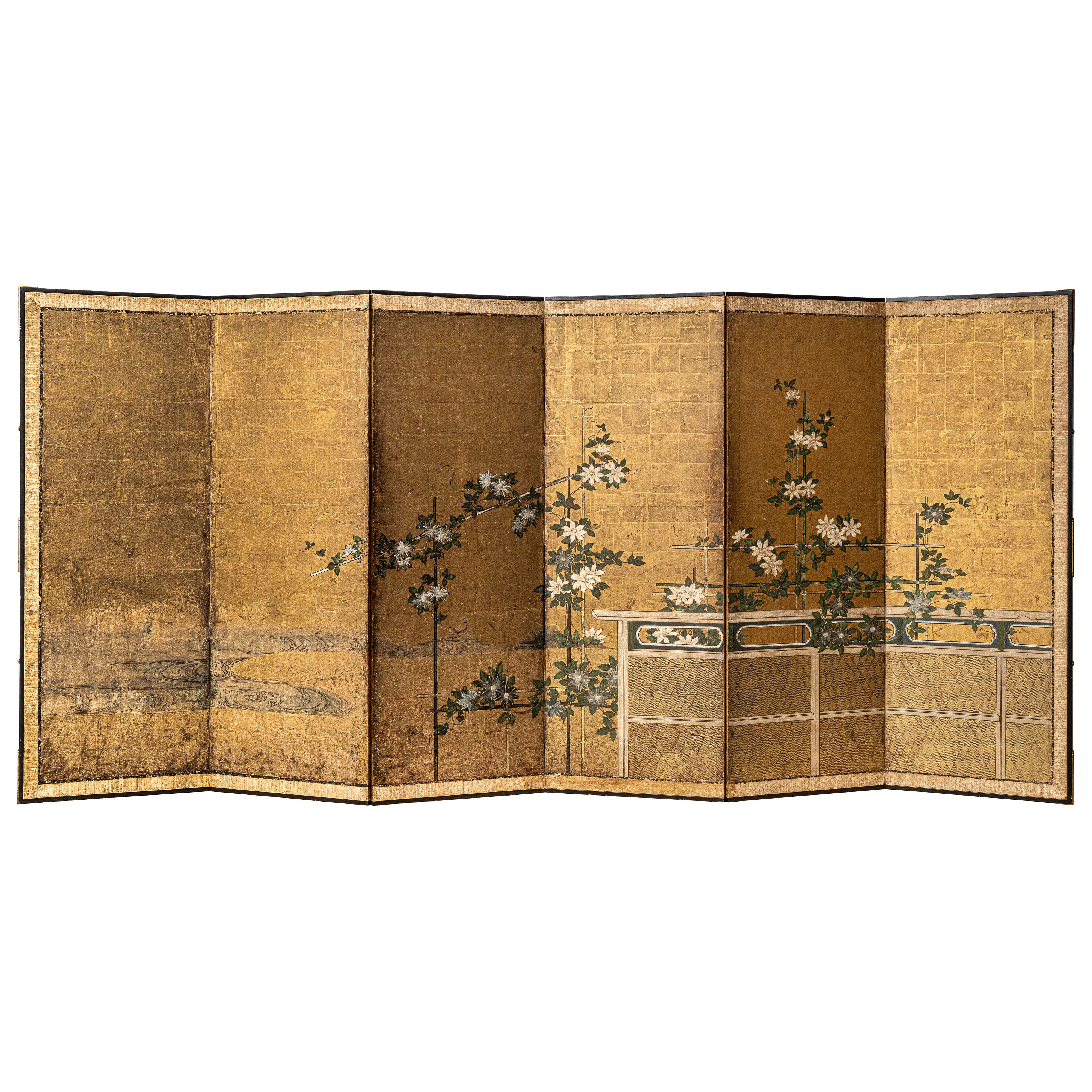
Late 17th century Kano school peony landscape screens. Both screens signed: Hogan Josen Fujiwara Chikanobu Hitsu - Kano Chikanobu (Shushin) (1660 - 1728...

Category

Antique Early 18th Century Japanese Edo Paintings and Screens
Materials

Gold Leaf

Early 20th Century Japanese Two-Panel Screen with Plum Blossoms and Bamboo

Early 20th Century Japanese Two-Panel Screen with Plum Blossoms and Bamboo

Located in Fukuoka, JP

An early 20th-century Japanese two-panel folding screen presenting a finely balanced composition of flowering plum, bamboo, and a small bird. Across the two panels, the substantial ...

Category

Early 20th Century Japanese Showa Paintings and Screens
Materials

Wood, Paper

Japanese Six-Panel Byōbu Screen with Pine, Late 18th–Early 19th Century

Japanese Six-Panel Byōbu Screen with Pine, Late 18th–Early 19th Century

Located in New York, NY

A large and beautiful late 18th-early 19th century Japanese screen, painted in mineral pigments on a gold leaf ground. The composition reads as a single continuous landscape, cente...

Category

Antique Early 19th Century Japanese Paintings and Screens

Materials

Gold Leaf