Want more images or videos?
Request additional images or videos from the seller
1 of 8

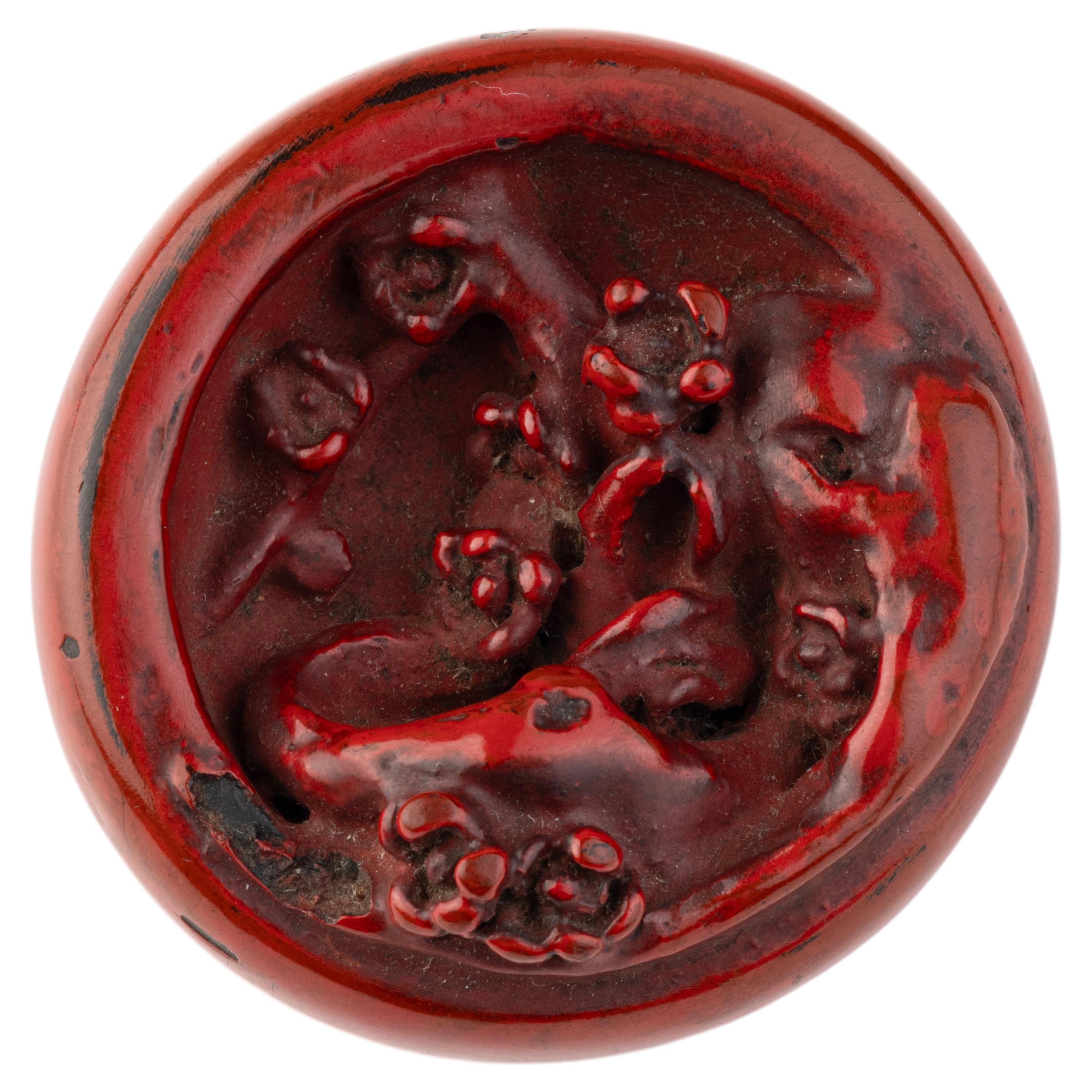
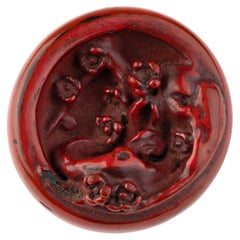
Manju Netsuke in red lacquer carved using tsuishu technique

$1,429.55
£1,050.08
€1,200VAT Included
CA$1,972.67
A$2,007.97
CHF 1,142.98
MX$24,237.70
NOK 13,327.72
SEK 13,488.42
DKK 9,150.09

About the Item

Manju-type netsuke (round in shape) in red lacquer, carved using the tsuishu technique, depicting a shōjō (young girl) standing before a waterfall. Round or oval in form, the manju netsuke takes its name from the soft, round, steamed cake whose recipe was introduced from China in the early 13th century by Shōichi Kokushi, a monk and founder of Tōfuku-ji, a Buddhist temple in Kyoto. These cakes were believed to have the power to expel the ill winds associated with seasonal change. While most manju netsuke were made of ivory, examples in iron or wood—either plain or lacquered—are not uncommon. Most, as in this case, measure between 2 and 6 cm in diameter. Their rounded shape, reminiscent of modern buttons, earned them the nickname “mandarin buttons,” although this comparison is entirely inaccurate in terms of their actual use. Various attachment systems were employed; here, the manju is carved from a single block and pierced with two holes to allow a cord to pass through, for attachment to a potential inrō or other object. Provenance: Collection of William “Billy” Wilberforce Winkworth. William “Billy” Wilberforce Winkworth was the son of Stephen D. Winkworth, who founded the Oriental Ceramic Society at his home in 1921. After serving in the army during the First World War, he joined the staff of the British Museum from 1922 to 1926 under R. L. Hobson in the Department of Ceramics. He later left this position to become a full-time collector and “amateur dealer.” From 1948 to 1970, he worked as a part-time cataloguer for Sotheby’s, where he catalogued netsuke, lacquerware, and Japanese sword fittings. He was renowned for his eye and expertise, particularly in ceramics, and exerted considerable influence on his generation of British collectors. His few publications are listed in John Mallet’s obituary. He retired to the Isle of Wight in 1972. Japan – Edo period (1603–1868) Longueur : 3.5 cm – largeur : 3.5 cm -Hauteur : 1.5 cm
  • Dimensions:
    Height: 0.6 in (1.5 cm)Width: 1.38 in (3.5 cm)Depth: 1.38 in (3.5 cm)
  • Style:
    Edo (Of the Period)
  • Materials and Techniques:
  • Place of Origin:
  • Period:
  • Date of Manufacture:
    1603-1868
  • Condition:
    Wear consistent with age and use.
  • Seller Location:
    PARIS, FR
  • Reference Number:
    Seller: 2026-14861stDibs: LU8311249489402

More From This Seller

View All
Manj netsuke in red lacquer, carved and decorated with red and black lacquer

Manj netsuke in red lacquer, carved and decorated with red and black lacquer

Located in PARIS, FR

Manju-type netsuke (round in form) in red lacquer, carved using the tsuishu technique, decorated with blossoming cherry branches (sakura). Round or oval in form, the manju netsuke...

Category

Antique Late 19th Century Japanese Edo Sculptures and Carvings

Materials

Lacquer
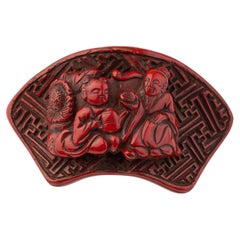
Nestuke in red lacquer carved in theform of a fan using the tsuishu technique

Nestuke in red lacquer carved in theform of a fan using the tsuishu technique

Located in PARIS, FR

Manju-type netsuke (round in form) in red lacquer, carved using the tsuishu technique (carved red lacquer), shaped as a fan and decorated with a carved scene of a scholar and his attendant. Round or oval in form, the manju netsuke...

Category

Antique Late 18th Century Japanese Edo Sculptures and Carvings

Materials

Lacquer
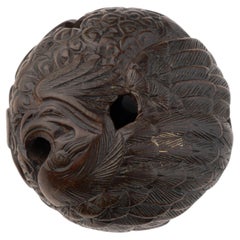
Ryusa Manju netsuke depicting a phénix

Ryusa Manju netsuke depicting a phénix

Located in PARIS, FR

Ryūsa-type manju netsuke (round in form, openwork) in carved wood, depicting a coiled phoenix. Signed Sentsui (?). Round or oval in form, the manju netsu...

Category

Antique Late 19th Century Japanese Edo Sculptures and Carvings

Materials

Boxwood

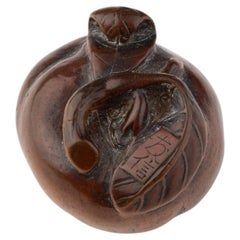
Katabori netsuke in boxwood in the form of a tachibana orange

Katabori netsuke in boxwood in the form of a tachibana orange

Located in PARIS, FR

Katabori-type netsuke (fully three-dimensional) in carved boxwood, in the form of a tachibana orange within its foliage, the peel on the reverse opened to reveal the segments. Signed...

Category

Antique Early 19th Century Japanese Edo Sculptures and Carvings

Materials

Boxwood

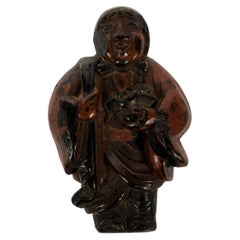
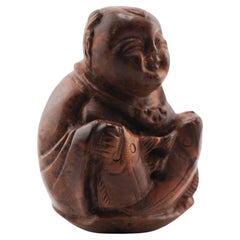
Lacquered Netsuke in the form of an old Lady carrying an Oni in her back

Lacquered Netsuke in the form of an old Lady carrying an Oni in her back

Located in PARIS, FR

Boxwood netsuke depicting a standing man carrying a pouch behind his back in which an oni is hidden. Onis are an integral part of the pantheon of yokai, the spirits and monsters of J...

Category

Antique Early 19th Century Japanese Meiji Sculptures and Carvings

Materials

Boxwood, Lacquer

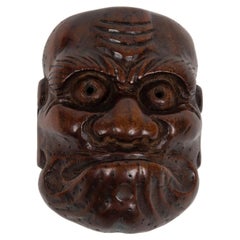
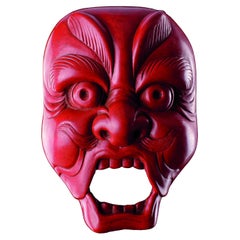
Netsuke in the form of a No mask representing the character of Obeshimi

Netsuke in the form of a No mask representing the character of Obeshimi

Located in PARIS, FR

Wooden netsuke depicting the Obeshimi mask in Noh theater. Obeshimi is a demon characterized by thick eyebrows, eyes that seem to protrude from the face and a closed mouth. Signed ...

Category

Antique Late 19th Century Japanese Meiji Sculptures and Carvings

Materials

Boxwood

You May Also Like

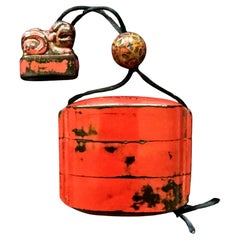
Rare Japanese Inro Netsuke and Omije with Negoro Red Lacquer Edo Period

Rare Japanese Inro Netsuke and Omije with Negoro Red Lacquer Edo Period

Located in Atlanta, GA

A Japanese three-case inro with stringed carved netsuke and bead ojime from early Edo period circa 17th century. The trio accoutrement is covered in red Negoro lacquer and displays w...

Category

Antique 17th Century Japanese Edo Lacquer

Materials

Wood, Lacquer

A Very Fine and Unusual Carved Red Lacquer Netsuke

A Very Fine and Unusual Carved Red Lacquer Netsuke

Located in London, GB

A Very Fine and Unusual Carved Red Lacquer Netsuke The reverse lacquered black Signed: Hosai Lacquer Japan Circa 1890 Size: 4.7cm high - 1⅔ ins high Provenance: W.L. Behrens...

Category

Antique Late 19th Century Japanese Lacquer

Materials

Lacquer

Old Wooden Netsuke 19/20th C Japanese Japan Fisherman Meiji Period

Old Wooden Netsuke 19/20th C Japanese Japan Fisherman Meiji Period

Located in Amsterdam, Noord Holland

Lovely and very detailed piece. Unsigned. Japan 19th or 20th century. Visible is a fisherman with 2 fishes in his hand. Weight: 19 grams Provenance: Collected in the 1980's. From t...

Category

Antique 19th Century Japanese Meiji Ceramics

Materials

Metal, Bronze

Antique Edo Netsuke 18/19th C Japanese Japan Ikkosai 'Different world in a cave'

Antique Edo Netsuke 18/19th C Japanese Japan Ikkosai 'Different world in a cave'

Located in Amsterdam, Noord Holland

Lovely and very detailed piece. Signed Ikkosai - Different world in a cave. It looks like a cave in a human brain. Very interesting Provenance: Collected in the 1980's. From the col...

Category

Antique 19th Century Japanese Edo Ceramics

Materials

Metal, Bronze

A boxwood netsuke depicting a mandarin with an engraved dragon, signed Tomomitsu

A boxwood netsuke depicting a mandarin with an engraved dragon, signed Tomomitsu

Located in Milano, IT

A boxwood netsuke depicting a mandarin fruit with a ryu dragon finely carved upside down, featuring a blonde horn-inlaid eye. Natural himotoshi formed from the mandarin's stem, en...

Category

Antique 19th Century Japanese Sculptures and Carvings

Materials

Boxwood

Japanese Lacquer Inro with Gold Maki-e and Carved Wood Netsuke Meiji Period

Japanese Lacquer Inro with Gold Maki-e and Carved Wood Netsuke Meiji Period

Located in Atlanta, GA

A Japanese four-case inro with a stringed carved wood netsuke circa 19th century. The inro has a near square form with rounded corners, The surface is decorated with gold hiramaki-e ...

Category

Antique 19th Century Japanese Meiji Lacquer

Materials

Wood, Lacquer