Video Loading
Want more images or videos?
Request additional images or videos from the seller
1 of 14

Group of 6 Franco/Dutch 19th/20th Century Japonisme Style Komodo Dragon Chenets

$9,850per set
£7,419.69per set
€8,656.92per set
CA$13,933.25per set
A$14,018.60per set
CHF 8,136.86per set
MX$170,848.81per set
NOK 93,920.53per set
SEK 96,375.08per set
DKK 64,707.90per set

About the Item

A Group of Six Franco/Dutch 19th/20th Century Japonisme Style Gilt and Ebonized Bronze and Gilt-Bronze Figural Chenets (Andirons), Gilt-Bronze Figural Fire-Tools and Metal Fire-Screen. The tall orientalist flavor chenets, each surmounted with a figure of a Komodo dragon, the fire-tools comprising of tongs, a poker and a shovel, the large spark screen with decorative elements. The chenets stamped 'Belgium'. Circa: 1900. Japonisme[a] is a French term that refers to the popularity and influence of Japanese art and design among a number of Western European artists in the nineteenth century following the forced reopening of foreign trade with Japan in 1858. Japonisme was first described by French art critic and collector Philippe Burty in 1872. While the effects of the trend were likely most pronounced in the visual arts, they extended to architecture, landscaping and gardening, and clothing. Even the performing arts were affected; Gilbert & Sullivan's The Mikado is perhaps the best example. From the 1860s, ukiyo-e, Japanese woodblock prints, became a source of inspiration for many Western artists.These prints were created for the commercial market in Japan. Although a percentage of prints were brought to the West through Dutch trade merchants, it was not until the 1860s that ukiyo-e prints gained popularity in Europe. Western artists were intrigued by the original use of color and composition. Ukiyo-e prints featured dramatic foreshortening and asymmetrical compositions. Japanese decorative arts, including ceramics, enamels, metalwork, and lacquerware, were as influential in the West as the graphic arts. During the Meiji era (1868–1912), Japanese pottery was exported around the world. From a long history of making weapons for samurai, Japanese metalworkers had achieved an expressive range of colours by combining and finishing metal alloys. Japanese cloissoné enamel reached its "golden age" from 1890 to 1910, producing items more advanced than ever before. These items were widely visible in nineteenth-century Europe: a succession of world's fairs displayed Japanese decorative art to millions, and it was picked up by galleries and fashionable stores. Writings by critics, collectors, and artists expressed considerable excitement about this "new" art. Collectors including Siegfried Bing and Christopher Dresser displayed and wrote about these works. Thus Japanese styles and themes reappeared in the work of Western artists and craftsmen. Chenets Height: 35 inches (89 cm) Chenets Width: 17 inches (43 cm) Chenets Depth: 6 1/2 inches (17 cm) Screen Height: 41 inches (104 cm) Screen Width: 52 inches (132 cm) Screen Depth: 11 inches (28 cm)
  • Dimensions:
    Height: 41 in (104.14 cm)Width: 52 in (132.08 cm)Depth: 11 in (27.94 cm)
  • Sold As:
    Set of 6
  • Style:
    Japonisme (In the Style Of)
  • Materials and Techniques:
    Bronze,Ebonized,Gilt
  • Place of Origin:
  • Period:
    1900-1909
  • Date of Manufacture:
    Circa: 1900
  • Condition:
    Wear consistent with age and use. Minor fading. A truly beautiful and rare set of fireplace andirons, tools and screen. In overall good used/aged condition. Please view all images.
  • Seller Location:
    Los Angeles, CA
  • Reference Number:
    Seller: Ref.: A27311stDibs: LU1796237145382

More From This Seller

View All
English 19th Century Empire Style Gilt & Patinated Bronze Fireplace Dogs Fender

English 19th Century Empire Style Gilt & Patinated Bronze Fireplace Dogs Fender

Located in Los Angeles, CA

A very fine and large English 19th century Empire style gilt and patinated bronze and steel figural fireplace fender - chenet. The beautifully designed fender flanked on each end by resting Bull...

Category

Antique 19th Century English Empire Revival Andirons

Materials

Bronze, Steel, Ormolu

Pair French 19th Century Baroque Revival Style Steel and Bronze Chenets Andirons

Pair French 19th Century Baroque Revival Style Steel and Bronze Chenets Andirons

Located in Los Angeles, CA

A pair of French 19th century Baroque Revival style steel and patinated bronze figural chenets (Andirons). Each with a posing male figure holding a satyr shield next to decorative sp...

Category

Antique Early 1900s French Baroque Revival Andirons

Materials

Bronze, Steel, Iron

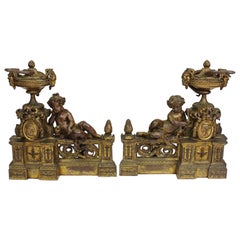
French 19th Century Louis XV Style Gilt Bronze Chenet Set with Playful Children

French 19th Century Louis XV Style Gilt Bronze Chenet Set with Playful Children

Located in Los Angeles, CA

A fine and large French 19th century Louis XV style gilt bronze figural Chenet (andiron) and Fender Suite. The impressive fender surmounted on each end by a figure of playful battlin...

Category

Antique Late 19th Century French Louis XV Andirons

Materials

Bronze

French 19th Century Louis XV Style Gilt-Bronze Chenets Andirons with Putti, Pair

French 19th Century Louis XV Style Gilt-Bronze Chenets Andirons with Putti, Pair

Located in Los Angeles, CA

A fine pair of French 19th century Louis XV style gilt-bronze mounted figural chenets. The ornately decorated andirons, each with a figure of a resting Putto (Children) holding a tor...

Category

Antique 19th Century French Louis XV Andirons

Materials

Bronze

An Anglo-Dutch 19th Century Walnut Carved 5 Piece Parlor Set, After Daniel Marot

An Anglo-Dutch 19th Century Walnut Carved 5 Piece Parlor Set, After Daniel Marot

Located in Los Angeles, CA

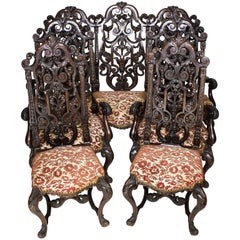
A Fine Anglo-Dutch 19th Century Baroque Style Ornately Carved Walnut Five Piece Parlor - Salon Suite, After Daniel Marot (French-Dutch, 1661–1752); comprising of a settee, two armchairs and two side chairs. The intricately pierced high-backs carved frames with scrolled and floral designs, curved armrests and cabriolet conjoined legs. Circa: 1890. Measures: Settee height: 54 3/4 inches (139.1 cm) Settee width: 70 3/4 inches (179.7 cm) Settee depth: 24 inches (61 cm) Armchairs Height: 52 inches (132.1 cm) Armchairs Width: 28 inches (71.1 cm) Armchairs Depth: 21 1/2 inches (54.6 cm) Side chairs Height: 50 inches (127 cm) Side chairs Width: 21 1/2 inches (54.6 cm) Side chairs Depth: 20 1/2 inches (52.1 cm) Seat height: 20 3/8 inches (51.8 cm). Daniel Marot or Daniel Marot the Elder (1661–1752) was a French-born Dutch architect, furniture designer and engraver at the forefront of the classicizing Late Baroque Louis XIV style. He worked for a long time in England and the Dutch Republic, where he was naturalised in 1709. Born in Paris, he was a pupil of Jean Le Pautre and the son of Jean Marot, who was also an architect and engraver. Marot was working independently as an engraver from an early age, making engravings of designs by Jean Bérain, one of Louis XIV's official designers at the Manufacture des Gobelins, where far more than tapestry was being produced. The family were Huguenots and were part of the wave of émigrés who left France in the year of the Edict of Fontainebleau and Revocation of the Edict of Nantes (1685) to settle in Holland. Daniel Marot brought the fully developed court style of Louis XIV to Holland, and later to London. In the end, the English style which is loosely called "William and Mary" owed much to his manner. In the Dutch Republic, Marot was employed by the Stadthouder, who later became William III of England; in particular, he is associated with designing interiors in the palace of Het Loo, from 1684 on. Though his name cannot be attached to any English building (and he does not have an entry in Howard Colvin's exhaustive Dictionary of British Architects) we know from his own engraving that he designed the great hall of audience for the States-General at the Hague. He also decorated many Dutch country-houses, introducing the “salon” and popularizing ornamented ceilings in The United Provinces/ Netherlands. State bed, designed by Daniel Marot, engraving, ca 1702 In 1694, he traveled with William to London, where he was appointed one of his architects and Master of Works. In England his activities appear to have been concentrated at Hampton Court Palace, where he designed the garden parterres, which were swept away in the following generation and have been restored at the end of the 20th century. His designs for the Great Fountain Garden survive. Much of the furniture, especially the mirrors, guéridons and state beds, in the new State Rooms readied for William at Hampton Court bears unmistakable traces of his authorship; the tall and monumental embroidered state beds, with their plumes of ostrich feathers, their elaborate valances and cantonnieres agree very closely with his later published designs. After William's death Marot returned to Holland where he lived at the Noordeinde 164 in The Hague from 1720 until his death in 1752. The house with his salon, kitchen, hallway and possibly some of his ceilings still exists. We owe much of our knowledge of his work to the folio volume of his furniture designs published at Amsterdam in 1712. Not surprisingly the designs show strong French and Dutch influences; what reads as their "English" look is more probably the result of Marot's court style on other London designers. Marot was a nephew of Pierre Gole...

Category

Antique Late 19th Century Dutch Baroque Revival Living Room Sets
Materials

Walnut

French Baroque Revival Style 3-Panel Wrought Iron and Metal Room-Divider Screen

French Baroque Revival Style 3-Panel Wrought Iron and Metal Room-Divider Screen

Located in Los Angeles, CA

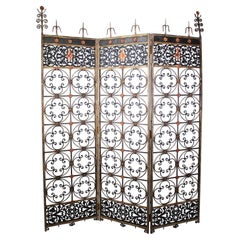
A Charming Ornate French Baroque Revival Style Three-Panel Wrought Iron and Metal Room-Divider Screen. The slender pierced screen with scrolled metalwork, floral rosettes, fleur-de-l...

Category

Mid-20th Century French Baroque Revival Screens and Room Dividers

Materials

Metal, Wrought Iron

You May Also Like

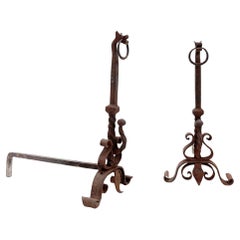
Italian Wrought Iron Dragon Andirons, Antique Fireplace Set, 1920s

Italian Wrought Iron Dragon Andirons, Antique Fireplace Set, 1920s

Located in Linkebeek, BE

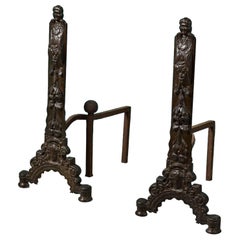
Italian wrought iron dragon andirons, 1920s Fireplace set - Antique Measures : 20x40cm H:42cm Pair of wrought iron andirons in the shape of dragon bodies and ring handles. The drago...

Category

Early 20th Century Italian Gothic Revival Andirons

Materials

Iron

Set of Cast Bronze Baroque Style Antique Fire Andirons

Set of Cast Bronze Baroque Style Antique Fire Andirons

Located in Wormelow, Herefordshire

A large set of cast bronze baroque style antique fire andirons circa 1820. Thanks to their impressive scale and elaborate design, these bronze firedogs...

Category

Antique Early 19th Century English Baroque Andirons

Materials

Metal, Bronze, Wrought Iron

19th Century French Louis XV Andirons or Firedogs

19th Century French Louis XV Andirons or Firedogs

Located in Amerongen, Amerongen

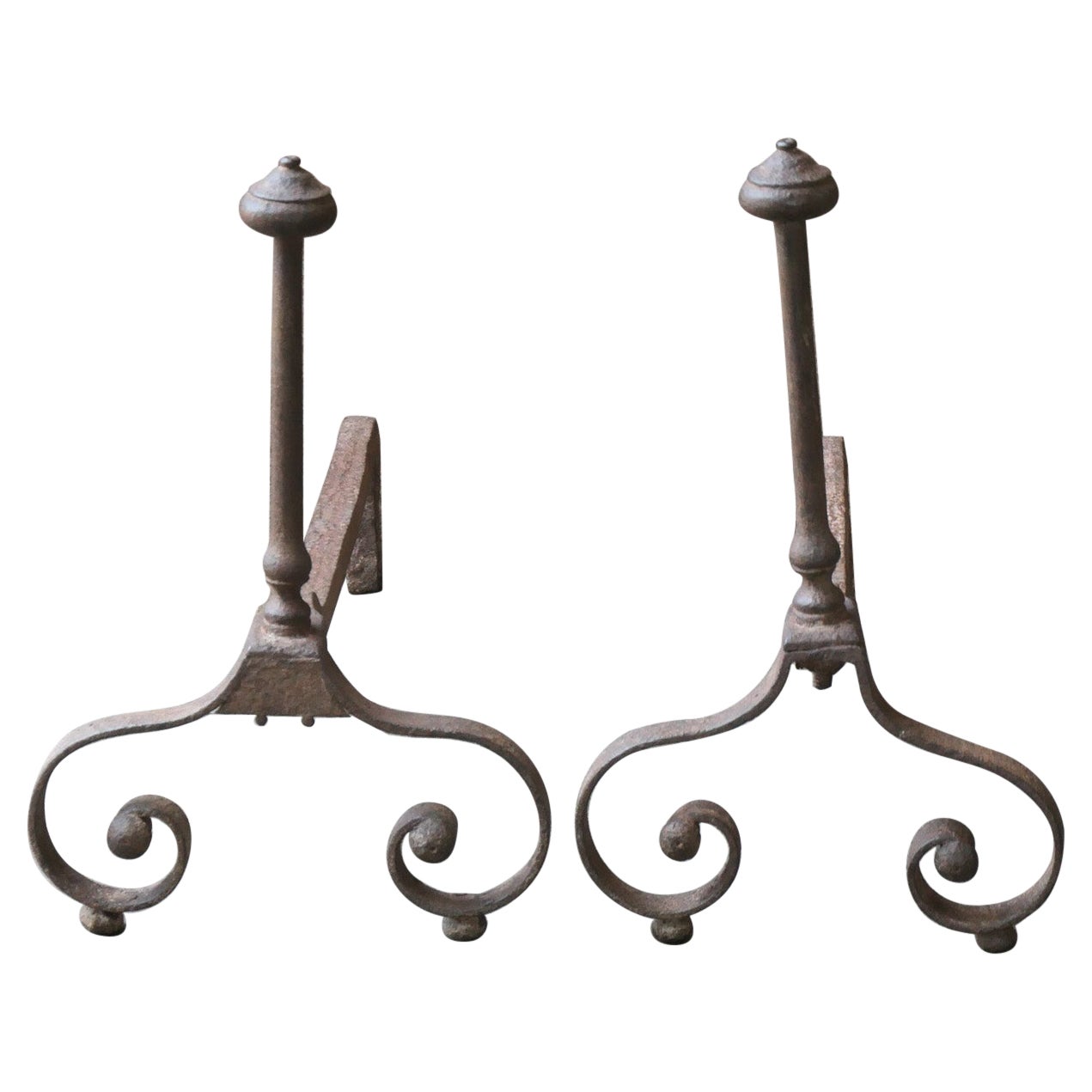
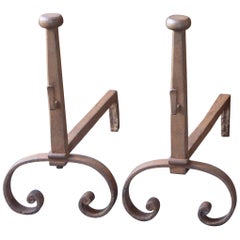
19th century French Louis XV style andirons made of wrought iron. The patina of the andirons is brown. Upon request it can be made black. The condition is good.   

Category

Antique 19th Century French Louis XV Andirons

Materials

Wrought Iron

Early 19th Century French Firedogs or Andirons

Early 19th Century French Firedogs or Andirons

Located in Amerongen, Amerongen

Early 19th Century French Louis XV Style andirons. Made of wrought iron. The andirons are in good condition and are fully functional.

Category

Antique Early 19th Century French Louis XV Andirons

Materials

Wrought Iron

18th Century French Louis XV Andirons or Firedogs

18th Century French Louis XV Andirons or Firedogs

Located in Amerongen, Amerongen

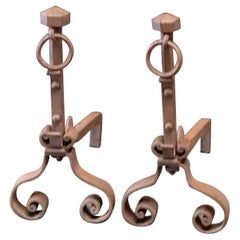
18th century French Louis XV andirons made of wrought iron. The andirons have spit hooks to grill food. The condition is good.

Category

Antique 18th Century French Louis XV Andirons

Materials

Wrought Iron

18th Century French Louis XV Andirons, Firedogs

18th Century French Louis XV Andirons, Firedogs

Located in Amerongen, Amerongen

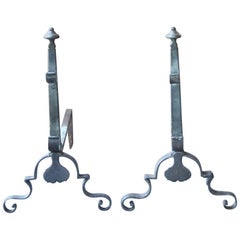
18th century French firedogs, andirons made of wrought iron. The condition is good.

Category

Antique 18th Century French Louis XV Andirons

Materials

Wrought Iron