Want more images or videos?
Request additional images or videos from the seller
1 of 10

J. Vieillard & Cie and A. de Caranza, Presentation Bowl, France, circa 1880

$8,111.20
£5,944.15
€6,800VAT Included
CA$11,166.44
A$11,358.63
CHF 6,485.94
MX$137,388.90
NOK 75,629.49
SEK 76,788.28
DKK 51,851.68

About the Item

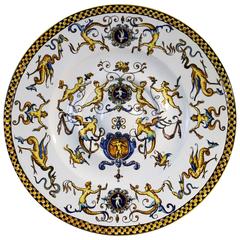
Manufacturer’s Mark of J.Vieillard & Cie à Bordeaux Beautiful circular earthenware bowl with polychrome decoration painted under glaze and heightened with manganese-brown lines. The rim and background are adorned with a rich, compartmentalized historicist design, alternating rectangular cartouches and circular medallions. The latter feature stylized zoomorphic figures (confronted lions and chimeras), rendered in black on a white ground encircled in turquoise blue, evoking a heraldic and Neo-Renaissance repertoire. The center is occupied by a large circular polychrome medallion depicting a coat of arms surmounted by a helmet. This central medallion is framed by an architectural motif in black and ochre reminiscent of cut leatherwork, with pronounced scrolls and projections, set against a dense reddish-brown ground covered with a repetitive vegetal design of scrolling foliage and leaves. A wide circular turquoise-blue frieze with black scrollwork separates the central decoration from the rim. The chromatic palette (turquoise blue, black, reddish-brown, ochre, and white) is characteristic of the productions of the Jules Vieillard & Cie manufactory, which here draws inspiration from Italian Renaissance maiolica and Hispano-Moresque decorative arts, reinterpreted in an eclectic idiom typical of the 19th century. The bowl is set within a finely chased and pierced gilt-bronze mount forming an openwork border decorated with regular scrolls and interlace, resting on three feet shaped as dog heads terminating in scrolls. This mount, probably contemporary with the object, reflects the practice of enhancing decorative earthenware with gilt-bronze mounts intended for prestigious display in a bourgeois or collectors’ context. The whole illustrates the high technical and decorative standards achieved by the Bordeaux manufactory under the direction of Jules Vieillard, as well as its taste for learned historical references adapted to the decorative arts of its time. Biography : Bordeaux knew at the beginning of the 19th century a great development of fine earthenware due to the establishment of a manufacture by Boudon de Saint-Amans. That factory was however quickly sold to David Johnston, whom opened a factory in Bacalan that counted then up to 700 workers. The production became industrial, with printed patterns of varied colors. Jules Vieillard took after in 1845 David Johnston’s company. His work was crucial to the industrial success of the Bacalan manufacture and also to the artistic quality, which was unanimously celebrated during the famous Universal Exhibitions. His earthenware even earned the generic name of « Vieillard ceramics ». In his last period, Jules Vieillard developed an exceptional Orientalism through his creations. In 1865, his sons Charles and Albert, took after the factory under the company name of « Manufacture Jules Vieillard et Cie », and produced a lot of various designed pieces, particularly decorated with birds and flowers. However, their printed decors were of quite poor quality. To solve that problem, they decided to renew the forms of the pieces, evolving towards fashionable decorative pieces, such as lamps, jardinieres and vases. As for the oldfashioned decoration, the artistic department worked hard under the direction of Amédée de Caranza newly arrived around 1875. This ceramist from Longwy, launched there in 1872 the famous eponymous enamels « Emaux de Longwy », renewing the ornemental vocabulary with his technique of partitioned enamel. His decorations mainly evoked the brilliance of Persian and Japanese objects. But, as Caranza left Longwy to Bordeaux, Longwy couldn’t keep any longer its exclusivity. Caranza became then the manager of the Vieillard factory workshop in 1882, which knew thus a new momentum, until his departure a few years later, probably in 1885. The Vieillard factory closed down in 1895.
  • Creator:
    Jules Vieillard et Cie (Manufacturer)
  • Attributed to:
    Amedee de Caranza (Designer)
  • Dimensions:
    Height: 4.34 in (11 cm)Diameter: 14.97 in (38 cm)
  • Style:
    Renaissance Revival (In the Style Of)
  • Materials and Techniques:
    Bronze,Earthenware,Gilt,Glazed,Polychromed
  • Place of Origin:
  • Period:
  • Date of Manufacture:
    circa 1880
  • Condition:
    Wear consistent with age and use.
  • Seller Location:
    PARIS, FR
  • Reference Number:
    1stDibs: LU3860348780042

More From This Seller

View All
Porcelain Bowl, Compagnie des Indes, France (mount) - China, 18th/19th Century

Porcelain Bowl, Compagnie des Indes, France (mount) - China, 18th/19th Century

Located in PARIS, FR

China 18th Century (bowl) – France 19th Century (mount) Beautiful enameled porcelain bowl in the pink-purple tones characteristic of the “Famille Rose” with polychrome decoration o...

Category

Antique 19th Century French Chinese Export Decorative Bowls

Materials

Bronze

G. Denière, "Cupids" Bowl, France, circa 1870

G. Denière, "Cupids" Bowl, France, circa 1870

By Guillaume Denière

Located in PARIS, FR

Beautiful oval-shaped bowl with flared edges, in engraved crystal with floral interlacing decoration. It is enclosed in an elegant openwork frame in chiseled and gilded bronze with e...

Category

Antique 1860s French Napoleon III Decorative Bowls

Materials

Crystal, Bronze

Planter and Decorative Dish Attributed to Samson & Cie, France, Circa 1880

Planter and Decorative Dish Attributed to Samson & Cie, France, Circa 1880

By Samson & Cie

Located in PARIS, FR

Important porcelain planter and decorative dish attributed to Samson & Cie. They are decorated with golden and red friezes of intertwined lotus, fruits and flower cups, fans and...

Category

Antique 1880s French Planters, Cachepots and Jardinières

Materials

Porcelain

Aesthetic Movement Enameled Plate Attributed to Elkington and A. Willms, c. 1875

Aesthetic Movement Enameled Plate Attributed to Elkington and A. Willms, c. 1875

By W. Albert Willms, Elkington & Co.

Located in PARIS, FR

Important tray made in gilded bronze and “cloisonné” enamel attributed to Elkington and Willms. Ornamented with a centering polychrome enameled peacock plaque, made of very high standard quality, mounted on a gilt-bronze dish, decorated in relief with Japanese Nô theater masks. The great Birmingham firm of Elkingtons, was largely the creation of George Richards Elkington (1800-1865), who worked from 1824 in Birmingham as a manufacturer of silver-mounted scent bottles. By 1829 the business had expanded sufficiently for a branch to have been established in London. In the late 1830s the Elkingtons began making experiments to apply the principles of electro-metallurgy to gilding and plating with silver and in 1840 the patent was at last taken out. Elkingtons owed their rise to a position amongst the most important silversmiths of the country to their exploitation of this new process and the two of the most famous designers then employed, both of them French, Albert Wilms (1827-1899) and Morel-Ladeuil (1820-1888), who helped to make Elkingtons’ reputation with their elaborate exhibition pieces. Albert Willms was apprenticed as modeler and engraver to Klagman, Dieterle and Constant in Paris before working for Morel & Co. in London in 1848. On his return to Paris he was employed by the great Parisian silversmiths including Christofle and Froment-Meurice, for whom he designed pieces to be presented at the 1855 Universal Exhibition in Paris. It was during this period that he joined the firm of Elkington in London as head decorator. Elkington was soon to become one of the first to produce refined pieces in “champlevé” enamel in the Chinese and Japanese styles, which were presented with great success at the London Universal Exhibition in 1862 (see Masterpieces of Industrial Art & Sculpture at the International Exhibition 1862, J.B. Waring, London, 1863, III, pl. 211). Willms’ “champlevé” enamels could not be compared, however, with the delicate “cloisonné” enamels exhibited by Japan at the Universal Exhibition in Paris in 1867. This explains why Elkington adapted the ancient Japanese technique to produce pieces according to European taste and custom. Followings the 1867 Exhibition all the major European artists rivaled in ingenuity for the 1873 Universal Exhibition in Vienna. In London Albert Willms presented his luxurious vases and cups in “cloisonné” enamel for Elkington (see Illustrations of Art Manufacturers in the Precious Metals exhibited by Elkington & Co., Inventors, Patentees and Manufactures of electroplate, 1873), whilst in Paris, Ferdinand Thesmar (1843-1912) produced in the workshops of Ferdinand Barbedienne (1810-1892) a tray decorated with a golden pheasant in “cloisonné” enamel on copper...

Category

Antique 1870s English Aesthetic Movement Decorative Dishes and Vide-Poche
Materials

Enamel, Bronze

Neo-Renaissance Centerpiece, France, circa 1840

Neo-Renaissance Centerpiece, France, circa 1840

Located in PARIS, FR

Beautiful chiselled and gilded bronze centerpiece composed of a finely pierced bowl with an openwork rim of remarkable delicacy, decorated with scrolling foliage, arabesques, and int...

Category

Antique 1830s French Renaissance Decorative Bowls

Materials

Bronze

H. Journet & Cie, Japanese style Planter, France, Circa 1880

H. Journet & Cie, Japanese style Planter, France, Circa 1880

By H. Journet & Cie

Located in PARIS, FR

Signed Sté des onyx ; H. Journet & Cie ; 24 Bd Italiens ; 3167 Beautiful planter made of banded onyx from Algeria, mounted in gilded bronze. Resting on four legs connected by aprons...

Category

Antique 1880s French Japonisme Decorative Bowls

Materials

Onyx, Bronze

You May Also Like

French Art Deco Ceramic Centerpiece Bowl by Longwy, Floral Design

French Art Deco Ceramic Centerpiece Bowl by Longwy, Floral Design

By Faïenceries et Emaux de Longwy

Located in Winter Park, FL

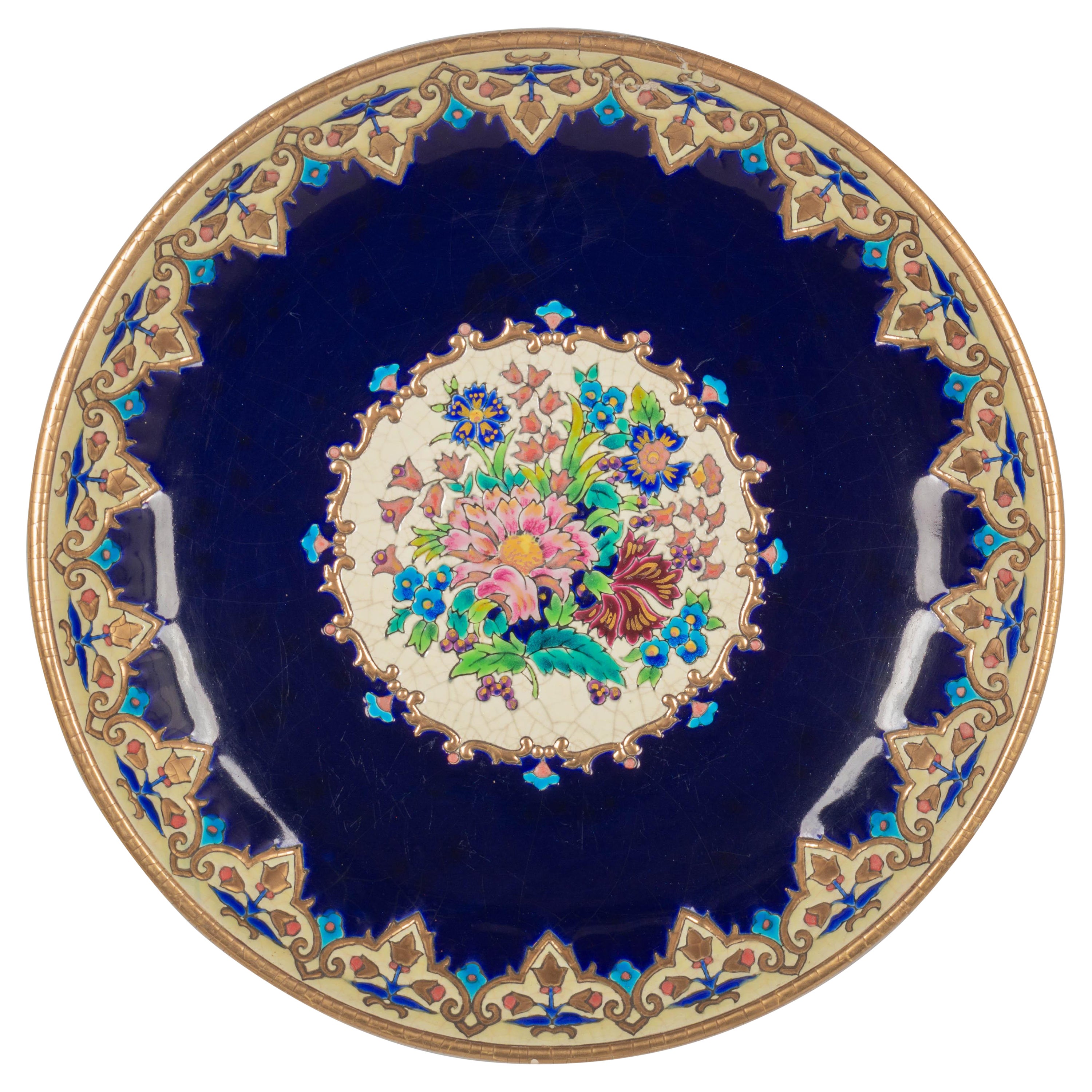
A French Art Deco Longwy large ceramic centerpiece bowl, hand-painted in the style of Chinoiserie cloisonné enamel. Dark cobalt blue ground with ...

Category

20th Century French Art Deco Delft and Faience

Materials

Ceramic

19th Century French Faience Charger or Plate

19th Century French Faience Charger or Plate

Located in Hamilton, Ontario

19th century French faience charger or plate with Gien mark.

Category

Antique 19th Century French Decorative Dishes and Vide-Poche
Large 19th Century Nazari-Style Spanish Ceramic Plate

Large 19th Century Nazari-Style Spanish Ceramic Plate

Located in Madrid, ES

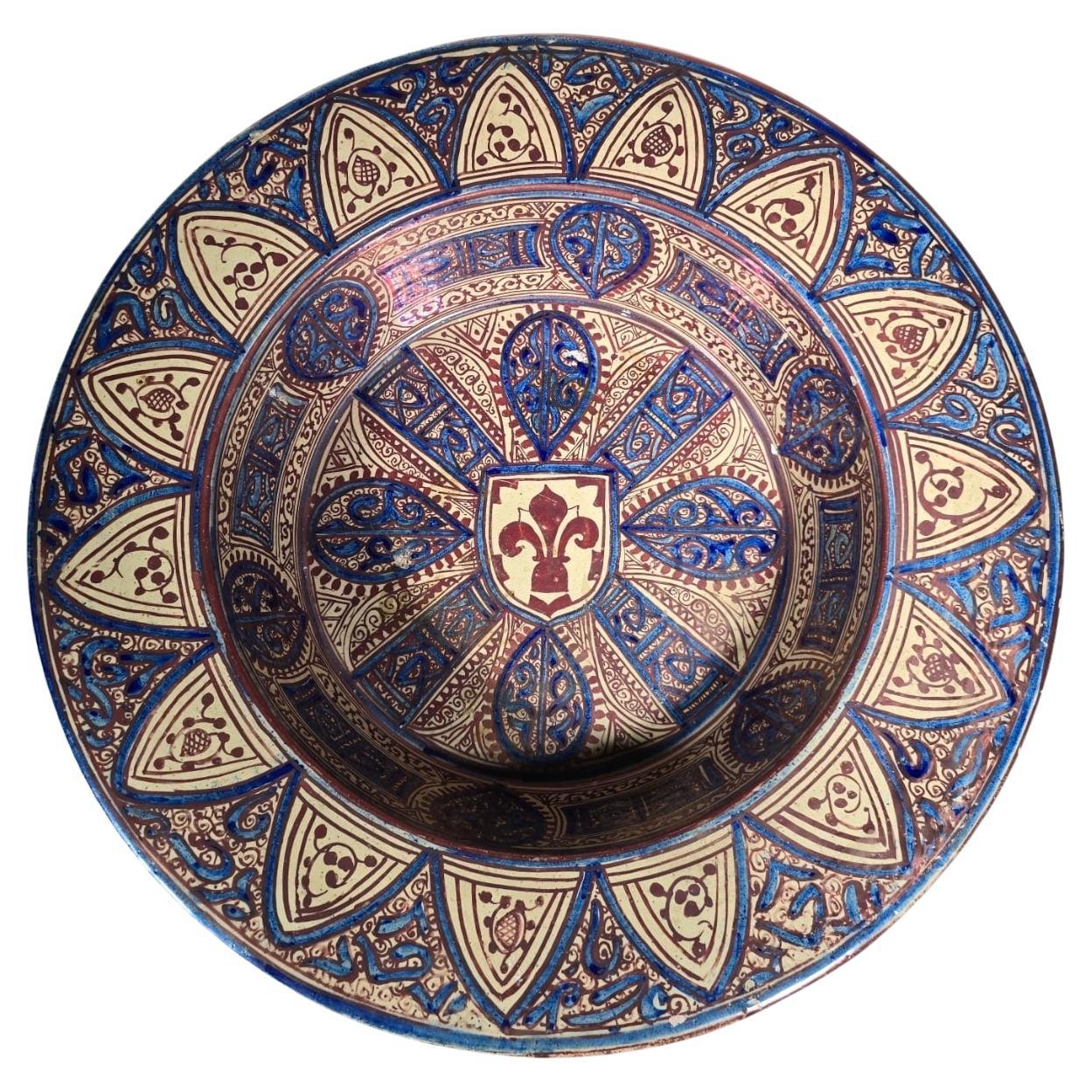
A magnificent ceramic plate measuring 47 cm in diameter and 10 cm in height, crafted in 19th-century Spain in the Nazari-Arabic style influenced by Al-Andalus culture. The piece show...

Category

Antique 1880s Serving Bowls

Materials

Ceramic

French 19th Century Champlevé Barbedienne Compote

French 19th Century Champlevé Barbedienne Compote

By F. Barbedienne Foundry

Located in Los Angeles, CA

Delightful compote bowl made of slate and gilt bronze, having a beautiful Champlevé enamel design around the piece. Made in France, 19th Century (Barbedienne). Makers mark on the bas...

Category

Antique 19th Century French Decorative Bowls

Materials

Bronze, Enamel

Late 19th Century Footed Bowl Attributed to Alfredo Santarelli

Late 19th Century Footed Bowl Attributed to Alfredo Santarelli

Located in Kilmarnock, VA

A finely hand-thrown footed bowl attributed to Alfredo Santarelli, a key figure in the 19th-century revival of Renaissance Italian maiolica. Executed in the Urbino tradition, this pi...

Category

Antique 19th Century Italian Decorative Bowls

Materials

Ceramic