Video Loading
Want more images or videos?
Request additional images or videos from the seller
1 of 13

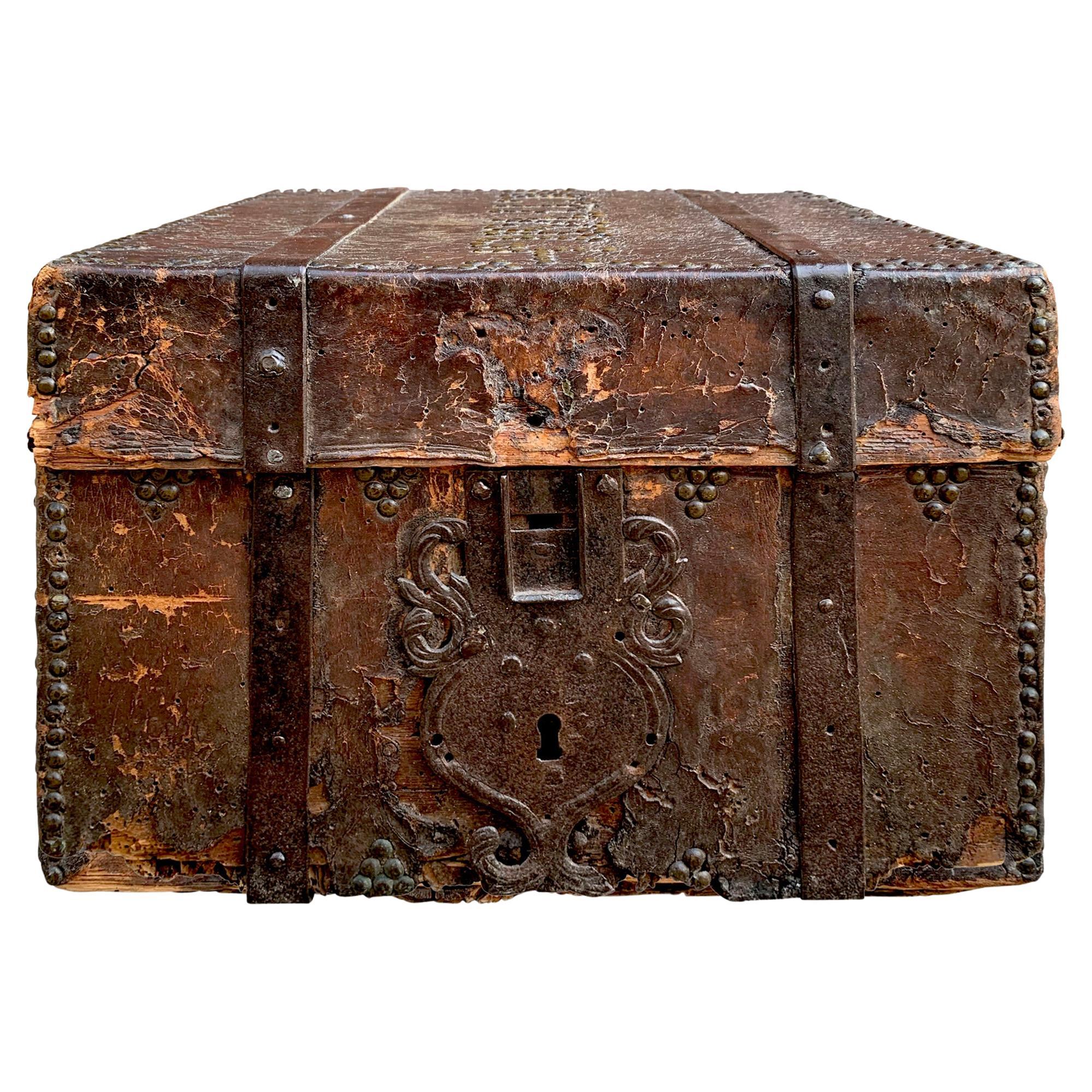
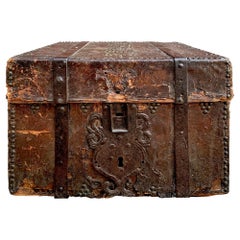
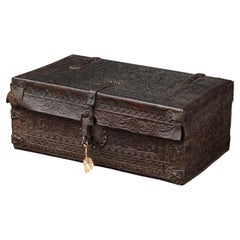
Late 17th Century Leather And Brass Travelling Box

$3,052.98
£2,331VAT Included
€2,646.36
CA$4,283.79
A$4,352.69
CHF 2,465.93
MX$52,961.54
NOK 28,915.06
SEK 29,072.60
DKK 19,796.33

About the Item

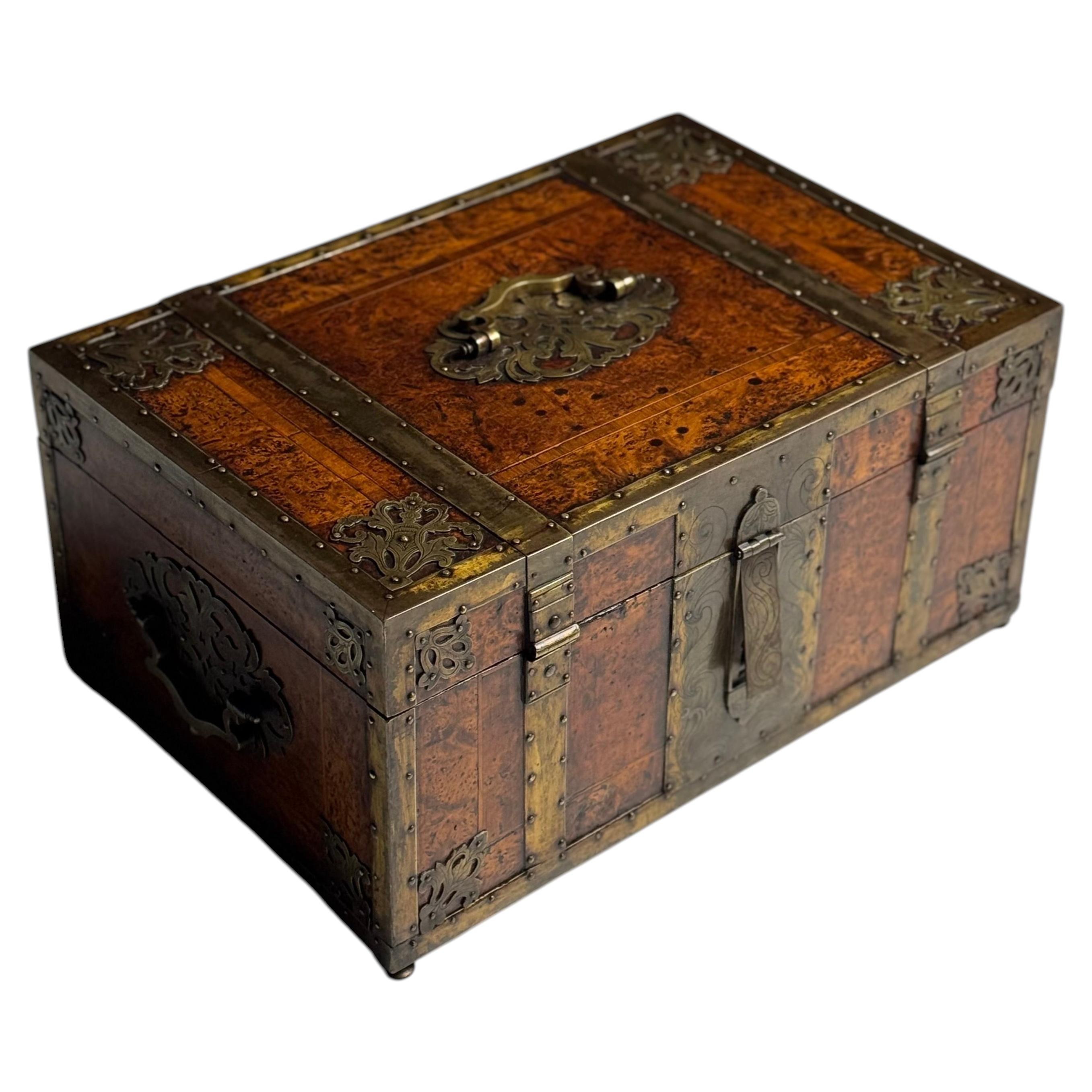
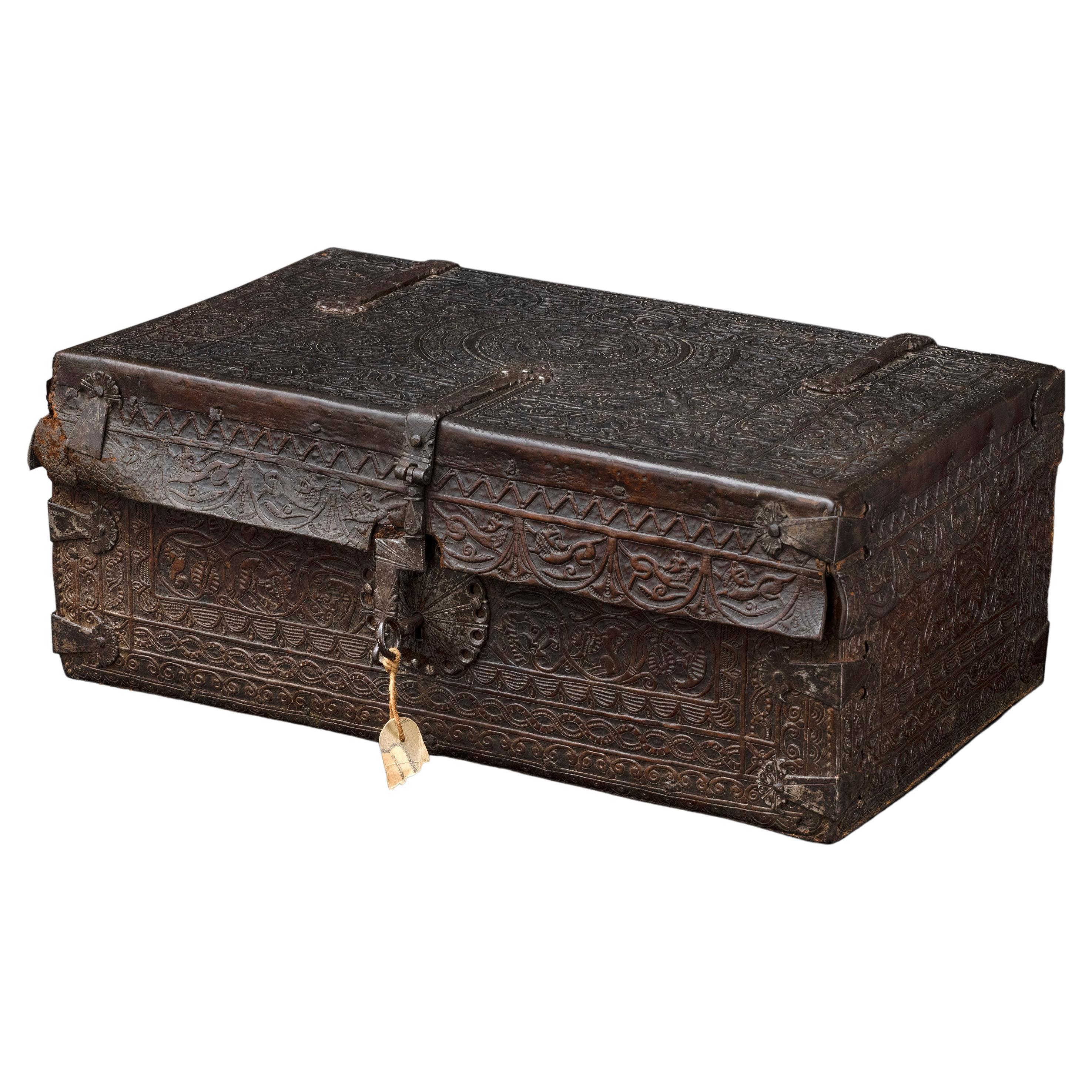
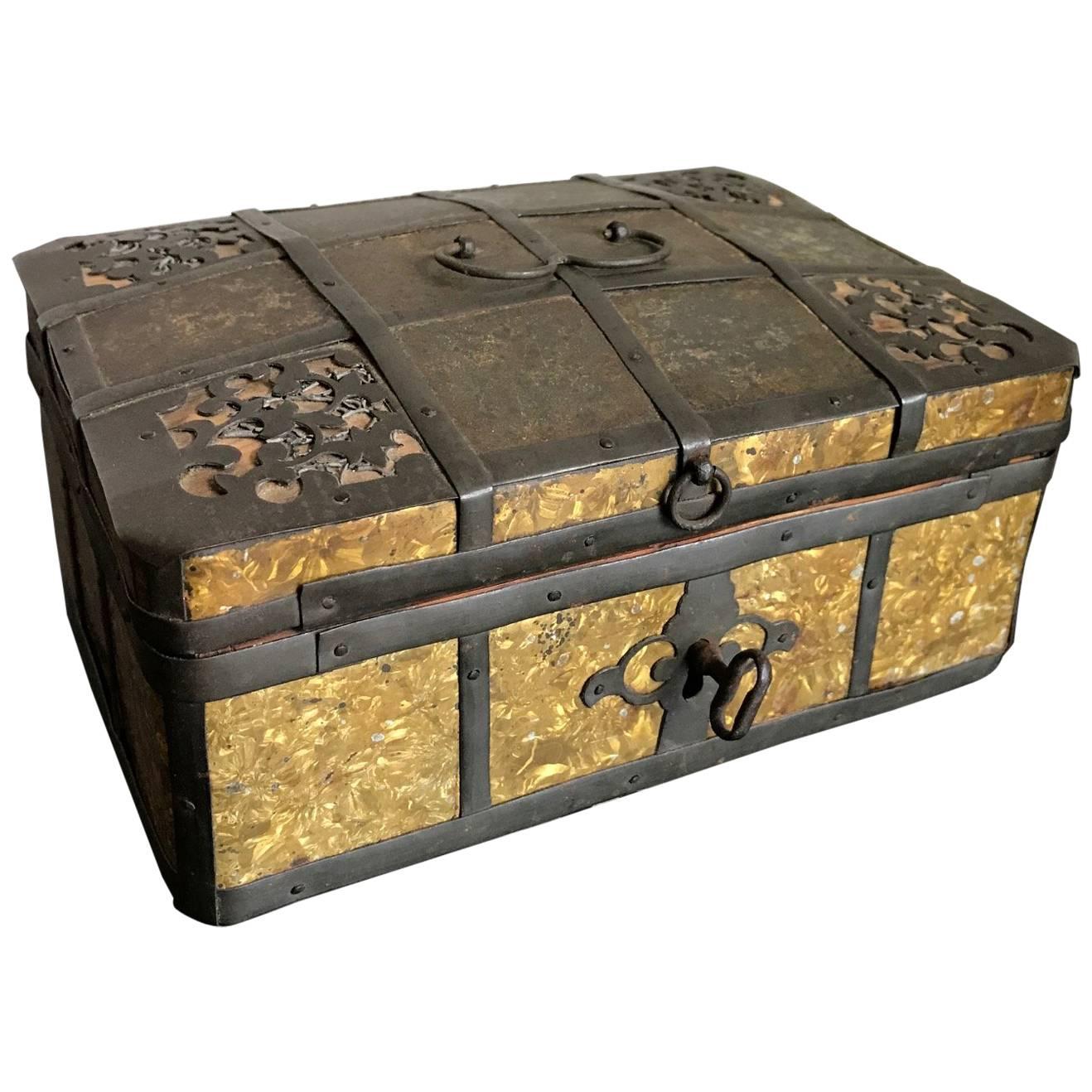
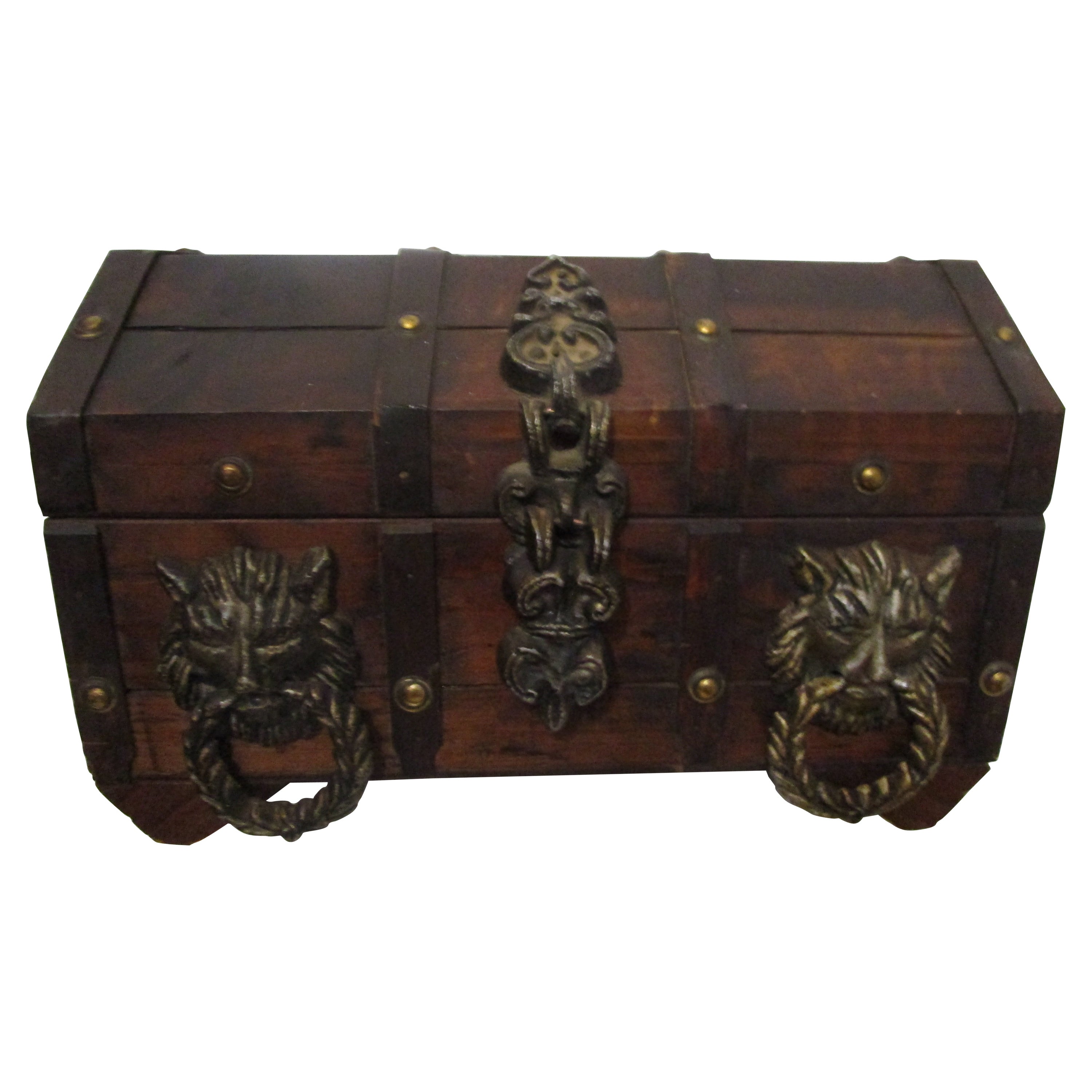
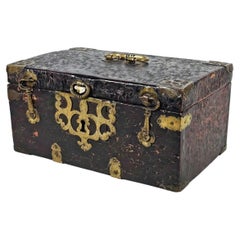
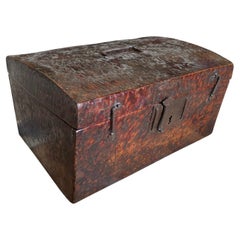
A very fine and interesting late 17th century English work box or travelling case English Circa 1680 Of conventional form with slightly domed lid, this piece has acquired a magnificent patina and colour-the leather showing all the wear one would expect and gaining much more character as a result. The central plate escutcheon is large and impressive and is inspired by the strapwork designs utilised so effectively on silver of this period. The unusual latches to the left and right of the front suggest that this piece was perhaps designed for travelling, providing additional security as the piece was bumped up and down in a carriage or on board a ship. They are also highly decorative. The other mounts are designed to protect the corners and reinforce areas where the leather might be subject to additional wear and tear. The leather has aged in such a way that it is highly reminiscent of polished burr walnut-the most sought-after timber during this period and so likely not entirely coincidental. The original hinges are strong and without repair and the interior is partially lined but otherwise plain as would be expected. The lock on the piece is very well made and of stronger than usual construction, signifying that this box was clearly intended to be used to carry valuable items when necessary. A charming and unusual example of its kind and a very rare survival from this early period.
  • Dimensions:
    Height: 7.09 in (18 cm)Width: 13.39 in (34 cm)Depth: 9.06 in (23 cm)
  • Materials and Techniques:
  • Place of Origin:
  • Period:
    1680-1689
  • Date of Manufacture:
    Circa 1680
  • Condition:
    Wear consistent with age and use. A charming and unusual example of its kind and a very rare survival from this early period.
  • Seller Location:
    Benington, GB
  • Reference Number:
    Seller: 29361stDibs: LU1183235288352

More From This Seller

View All
Imposing 17th Century Portuguese Colonial Mahogany and Brass Chest

Imposing 17th Century Portuguese Colonial Mahogany and Brass Chest

Located in Benington, Herts

An imposing 17th century mahogany Portuguese colonial trunk / chest, of grand proportions, decorated with pierced brass panels. Probably Brazil, circa 1670. This rare chest...

Category

Antique Late 17th Century Brazilian Trunks and Luggage

Materials

Brass, Iron

Extremely Rare Pair of Regency Cast-Iron Sarcophagus Shaped Strong Boxes

Extremely Rare Pair of Regency Cast-Iron Sarcophagus Shaped Strong Boxes

Located in Benington, Herts

An extremely rare pair of Regency cast-iron sarcophagus shaped strong boxes. Regency, circa 1820 Painted to simulate palisander wood and with parcel-gilt, the cavetto-moulded hinged lids cast with flower sprays above foliate-cast bands over front panels relieved with river gods within canted corners cast with standing muses, the sides with lion mask and ring handles over leafy aprons on massive lion’s paw feet; the Brahmah type lock stamped “T. Davis from London” and impressed with the Royal Crown. These extraordinary pieces are modelled on Regency wine coolers. The forms are classic Greco-Roman revival with the boat-hook handles, mythic figures and the overall sarcophagus pattern. You would struggle to find one let alone a pair. Good items for any collection. Research on going into these strong boxes but we have found possible information on the lock stamped Davis….(historyoflocks ) The relationship of King George III and George Davis of Windsor, who was locksmith in ordinary to His Majesty. Davis, in 1799, invented and patented a unique style of lock, which was also beautifully engraved with a warning not to make duplicate keys. Sensitive government secrets always demanded, then as today, locks that were state of the art. Davis locks ended up on government dispatch boxes...

Category

Antique Early 19th Century English Regency Commodes and Chests of Drawers

Materials

Iron

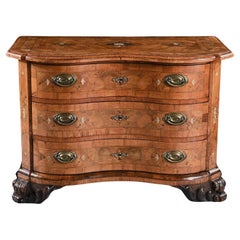
Rare Mid 18th Century German Walnut Pewter & Marquetry Serpentine Commode

Rare Mid 18th Century German Walnut Pewter & Marquetry Serpentine Commode

Located in Benington, Herts

A Fine 18th Century German Walnut shaped oxbow-fronted Commode inlaid with Ivory and Pewter German - Probably made in Braunschweig Circa 1740 A masterful example of a fine 18th ce...

Category

Antique 1740s German Commodes and Chests of Drawers

Materials

Tapestry, Walnut

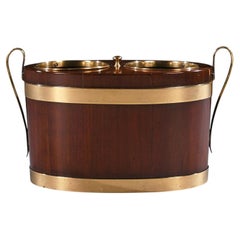
George III Brass Bound Mahogany Oval Table Wine Cooler

George III Brass Bound Mahogany Oval Table Wine Cooler

By Gillows of Lancaster & London

Located in Benington, Herts

A Fine and Rare Mahogany George III Period Table Wine or Bottle Cooler, c.1790 Of coopered construction, this fine piece is made of mahogany bound together with brass bands, having extremely rare brass Grecian scroll handles. The top, having a useful inset handle, lifts off to allow the section below to be easily emptied and cleaned. That section has copper lined sections to hold the bottles and a lead lined section designed to be filled with ice to chill their contents. Wooden table coolers are much rarer than their silver or porcelain equivalents and far rarer than standalone wine coolers or cellarets. A virtually identical piece, quite possibly the pair to the present example, was sold by Christie's in the Apter-Fredericks stock sale on the 19th of January 2021, making £17,500. Like the Apter-Fredericks piece, another aspect of the present example which makes it so unusual are the curving handles set into the side of the cooler. Usually table coolers have much simpler ring handles. These curving handles are indicative of the neoclassical taste and are seen on some of the Matthew Boulton ormolu perfume burners of the 1770s which may have provided the indirect inspiration for these pieces. See for example A double bottle cooler is featured in R. Butler and G. Walkling, Wine Antiques...

Category

Antique Late 18th Century English George III Wine Coolers

Materials

Brass

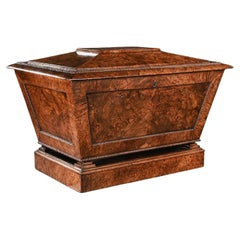
Regency Pollard Oak Sarcophagus Shaped Cellarette

Regency Pollard Oak Sarcophagus Shaped Cellarette

Located in Benington, Herts

An Outstanding George IV Period Wine Cooler or Cellarette in Pollard Oak of Exceptional Colour and Patina English - George IV, circa 1825. This fine piece is of late regency/George...

Category

Antique 19th Century British Regency Wine Coolers

Materials

Oak

You May Also Like

17th Century Italian Leather Box

17th Century Italian Leather Box

Located in Chicago, IL

A stunning 17th century Italian leather covered wood trunk covered in brass nail heads, some spelling out a word on top, and with iron strap hinges a...

Category

Antique 17th Century Italian Baroque Decorative Boxes

Materials

Leather, Wood

Antique 18th Century Leather & Brass Casket

Antique 18th Century Leather & Brass Casket

Located in Leesburg, VA

In an era where craftsmanship was an intimate, measured pursuit, objects of daily utility were elevated to functional works of art. This handsome 18th-century European casket is a st...

Category

Antique Early 18th Century Belgian Dutch Colonial Decorative Boxes

Materials

Brass

French 17th Century Leather Box, Coffre

French 17th Century Leather Box, Coffre

Located in Round Top, TX

A very charming late 17th century French Coffre - Box crafted from beautifully patina'd leather. A wonderful piece to serve as a jewelry box or to adorn any table top.

Category

Antique 17th Century French Decorative Boxes

Materials

Leather

An Italian Gold Embossed Leather Knife Box, 18th Century

An Italian Gold Embossed Leather Knife Box, 18th Century

Located in ARMADALE, VIC

An Italian Gold Embossed Leather Knife Box, 18th Century Description: The wooden surface with leather overlay and painted gilt surface decoration consisting of florets and a central...

Category

Antique 18th Century Italian Decorative Boxes

Materials

Leather, Wood

Chinese Leather & Brass Lidded Lacquered Trinket Box

Chinese Leather & Brass Lidded Lacquered Trinket Box

Located in San Diego, CA

A wonderful Chinese leather and brass lidded lacquered trinket box, circa 1970s. The handcrafted box measures 6.25"W x 3.75"D x 4"H and has a great look with tapered brass trim. It...

Category

Mid-20th Century Chinese Decorative Boxes

Materials

Brass

Boiled Leather Trunk, Spanish, 17th Century

Boiled Leather Trunk, Spanish, 17th Century

Located in Bruxelles, BE

Leather trunk Spanish, 17th century Boiled Leather, wood and iron Measures: 22 x 53 x 32 cm. Provenance : - collection Metz-Noblat, Château de Clevant, France Rectangular trunk of the form and size of a small suitcase with wrought iron hinges and lock-plate. Wood, covered with leather, cut and embossed with every surface of the thick cow hide covered in interlace, zoomorphic features. The construction method is boiled leather, often referred to by its French translation cuir-bouilli: a process used to change flexible, vegetable-tanned leather into rigid, moulded objects. For shaping of the vegetable-tanned leather, heat and moisture were used, as indicated by the term boiled leather. No written medieval sources describing the production of decorated cuir bouilli objects survive, so knowledge of the process relies on the important studies of the Scottish leather historian John William Waterer. A large range of methods, materials and techniques could be used in various combinations. The vegetable-tanned leather, made supple with moisture and heat, was stuffed, shaped and nailed to the rigid wooden coffer support. The stuffing material was probably modeled beeswax or stearin wax. To shape the leather, to create its topography, « Cushions » were made by lacing a thread through an awl hole and attaching the flexible leather and stuffing to the rigid wooden support on the bottom. Then the decoration was done: lines were incised through the upper layer of the leather (epidermis) with different thicknesses of knives or needles. Contours were created with deep v-shaped cuts, decoration with thin incision and final details with a needle point. For the incision and pouncing stage, the leather was probably kept heated and moistened for suppleness. Once dry, the leather would be hard and rigid. the saturated leather is worked over a form, possibly even damp sand, with the pattern shaped using bone or wooden tools. Compare to metal, leather was lighter and it offered protection from cuts and punctures. Cuir bouilli objects were produced by specialist leather workers and needed skillful craftsmanship. The surface is filled with roundels shaped foliages enclosing animals, lions and peacocks. The foliate arabesques creating a vegetal connection tweet the animals create the impression of a lush verdant space . The vegetal pattern here employed in combination with geometrical pattern came from the pre-islamic artistic traditions of the Byzantine and Sasanian empires. An aspect of Islamic geometry Is the basic symmetrical repetition and mirroring of the shapes that create a sense of harmony. The decoration of this truck is inspired by the islamic « arabesque » a form of vegetal ornament composed of spirals, intertwining plants and abstract curvilinear motifs. An arabesque character is given to the birds of the decorations through extreme stylisation. This arabesque maintained the classical tradition of median symmetry, freedom in Detail and heterogeneity of ornament. The presence of the peacocks is a paradisiacal allusion: in popular Islamic literature they were among the original inhabitants of the garden of Paradise expelled with Adam and Eve. Peacock as a decorative motif may have originated in the West, despite their eastern provenance. There was an ancient belief that the flesh and feathers of peacock do not decay. This led to the peacock becoming a christian symbol for Christ’s resurrection. Renowned for their decorative wall hangings, seventeenth-century Spanish leatherworkers also produced utilitarian objects, such as this trunk. A similar trunk is on display at the Metropolitan museum of art ( 09.158.1). Related literature : Davies L. 2006. Cuir bouilli. Conservation of leather and related materials, 94-102, Oxford: elsevier Butterworth-Heinemann Grabar, Oleg. The Mediation of Ornament. Princeton: Princeton University Press, 1992 Gabriela Germana Roquez, "El mueble en el Peru en el siglo XVIII...

Category

Antique 17th Century Decorative Boxes
Materials

Iron