Want more images or videos?
Request additional images or videos from the seller
1 of 10

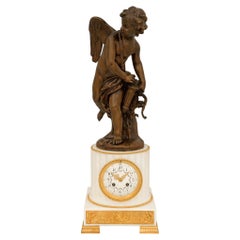
Louis XVI Style Figural Pedestal Clock

$75,793.30
£55,000
€65,661.10
CA$105,590.52
A$107,395.54
CHF 61,410.61
MX$1,299,037.22
NOK 719,527.21
SEK 719,354.40
DKK 490,854.06

About the Item

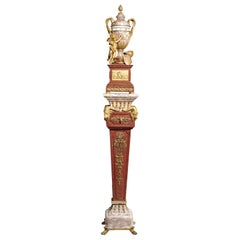
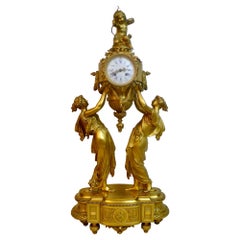
A Large Louis XVI Style Patinated Bronze and Rouge Griotte Marble Figural Pedestal Clock. The patinated bronze figural group of Bacchantes is cast from a model by Claude Michel, known as Clodion (French, 1738-1814). It is set atop a Rouge Griotte marble fluted column filled with gilt-bronze flower chains. On a square foot with laurel wreath surround. Fronted by a dial with leaf-cast bezel and black enamelled dial with fine-minute markers and Roman numerals. Pierced and engraved brass hands. The brass twin train movement with outside countwheel striking on a bell, with pendulum and winding key. The clock dial signed Agnew & Sons, Paris. France, Circa 1900. On a later simulated porphyry painted pedestal. Height of pedestal: 92 cm 36 inches. Height together with pedestal: 216 cm 85 inches.
  • Similar to:
    Claude Michel Clodion (Sculptor)
  • Dimensions:
    Height: 48.82 in (124 cm)Width: 14.97 in (38 cm)Depth: 14.97 in (38 cm)
  • Style:
    Louis XVI (In the Style Of)
  • Materials and Techniques:
  • Period:
  • Date of Manufacture:
    Circa 1900
  • Condition:
    Wear consistent with age and use.
  • Seller Location:
    Brighton, GB
  • Reference Number:
    Seller: B779901stDibs: LU1028042720172

More From This Seller

View All
Fine Louis XVI Style Gilt and Patinated Bronze Figural Clock, circa 1870

Fine Louis XVI Style Gilt and Patinated Bronze Figural Clock, circa 1870

Located in Brighton, West Sussex

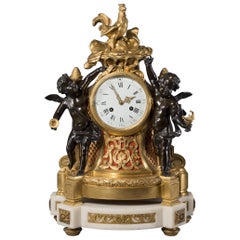
A fine Louis XVI style gilt and patinated bronze figural clock. French, circa 1870. This fine clock has a waisted body decorated with scrolls and trellis centred by a white ena...

Category

Antique Late 19th Century French Louis XVI Mantel Clocks

Materials

Bronze

Louis XVI Style Annular Dial Clock in the Manner of Lepaute, French, circa 1890

Louis XVI Style Annular Dial Clock in the Manner of Lepaute, French, circa 1890

By Jean-André Lepaute 1

Located in Brighton, West Sussex

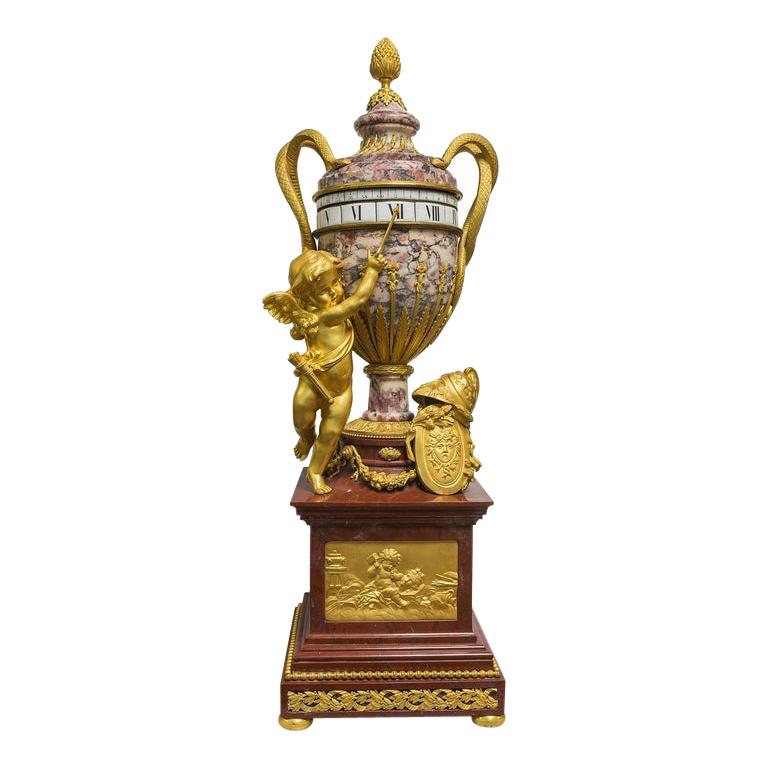
A rare Louis XVI style gilt-bronze mounted marble annular dial pedestal clock in the manner of Jean-André and Jean-Baptiste Lepaute, attributed to Dufaud, Paris. The eight-day twin-train movement with circular plates and lateral lever escapement on a gilt platform, with cut bimetallic compensation balance, flat balance spring and index regulator, striking the hours and half-hours on a bell. The dial having twin revolving chapter rings with white enamel cartouches with Roman numerals on a revolving ring, with a revolving minute ring above with Arabic numerals, the time indicated by Cupid pointing with an arrow. This fine annular dial or ‘cercles tournants’ clock...

Category

Antique Late 19th Century French Louis XVI More Clocks

Materials

Marble, Bronze

Louis XVI Style Porcelain Mounted Figural Clock, Allegorical of the Arts

Louis XVI Style Porcelain Mounted Figural Clock, Allegorical of the Arts

Located in Brighton, West Sussex

A Louis XVI style gilt bronze and Sèvres style porcelain mounted figural clock, Allegorical of the Arts. The dial signed 'Colin, Paris'. The movement stamped 'Vincenti et Cie'. ...

Category

Antique 19th Century French Louis XVI Mantel Clocks

Materials

Ormolu

A Louis XVI Style Mantel Fine Gilt-Bronze Clock by François Linke

A Louis XVI Style Mantel Fine Gilt-Bronze Clock by François Linke

By François Linke

Located in Brighton, West Sussex

A Very Fine Gilt-Bronze Clock With A White Marble Base by François Linke. The case signed 'Linke'. This rare example of a clock by François Linke has a twin train eight-day mov...

Category

Antique 19th Century French Louis XVI Mantel Clocks

Materials

Marble, Enamel, Ormolu

Grand Figural Cartel Clock, After a Design by Gilles-Marie Oppenord

Grand Figural Cartel Clock, After a Design by Gilles-Marie Oppenord

Located in Brighton, West Sussex

An Important and Extremely Rare Grand Figural Cartel Clock, After a Design by Gilles-Marie Oppenord. Of grand proportions and of exceptional quality this rare cartel clock is after...

Category

Antique 19th Century French Louis XVI Wall Clocks

Materials

Ormolu

Empire Clock in the Form of a Classical Urn, by Maison Lepautre, circa 1825

Empire Clock in the Form of a Classical Urn, by Maison Lepautre, circa 1825

By Pierre-Basile Lepaute

Located in Brighton, West Sussex

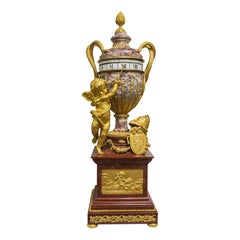
A gilt bronze Empire clock in the form of a classical urn, by Maison Lepautre. French, circa 1825. The dial signed 'Lepaute a Paris'. The clock has an ornate cast bezel with a 3-inch porcelain dial with Roman numerals and Breguet style hands. The twin train eight-day movement with outside count wheel striking on a bell and silk thread suspension. This elegant Empire style clock has a gilt bronze case in the form of a classical urn with swan neck handles and a winged cherub to the neck. The circular pedestal base is raised on a footed stepped square plinth. The Lepaute family were the premier French clockmakers of their day. Their significance lies in their contribution to the clock making industry which had hitherto come under the trade of locksmiths. The family held the brevet Horlogers du Roi. Jean-André Lepaute (1720–1789) arrived in Paris at an early age and in 1740 founded the family business. A skilled artist and mechanic, he quickly gained an excellent reputation. He was received as maître by the clockmakers guild in 1759, was granted royal lodgings from the king in The Luxembourg Palace, and was entrusted with the construction of the majority of the great public clocks of Paris. He executed, amongst others, those in The Luxembourg Palace, the Jardin des Plantes, the Château de Bellevue and the Château des Ternes. His clock at Paris’s École Militaire still works today. Three editions of his Traité d’Horlogerie were published in Paris in 1755, 1760 and 1767. A small volume, Description de Plusieurs Ouvrages d’Horlogerie appeared in 1764. Jean-André’s wife, Nicole-Reine Etable de la Brière (1723-1788), was a highly esteemed mathematician and astronomer. Her passion for science lent itself to Lepaute’s work and she played an active role in the scientific and mathematical aspects of the clock making. Jean-André’s younger brother Jean-Baptiste Lepaute (1727-1802) joined him in Paris in 1747 and immediately started working for the family business. He was received as maître in 1776 and was known for the clocks he constructed for the Paris Hôtel de Ville (1780), destroyed in a fire of 1871, and for the Hôtel des Invalides (1784). Jean-Baptiste took over the workshop when Jean-André retired in 1775. After Jean-Baptiste’s death in 1802, the firm was taken over by his nephew Pierre-Basil Lepaute (1750-1843) where he was duly joined by his own nephew Jean-Joseph (1768-1846) and son Pierre-Michel (1785-1849). By 1816, Pierre-Michel Lepaute was in charge of the business. His masterpieces include the astronomical clock in Paris’s Bureau...

Category

Antique Early 19th Century French Empire Mantel Clocks
Materials

Bronze

You May Also Like

French mid 19th century Louis XVI st. clock, signed Aux Mille Pendules

French mid 19th century Louis XVI st. clock, signed Aux Mille Pendules

Located in West Palm Beach, FL

An attractive and high quality French mid 19th century Louis XVI st. white Carrara marble, patinated Bronze and Ormolu clock, signed Aux Mille Pendules. This impressive clock is rais...

Category

Antique 19th Century French Louis XVI Mantel Clocks

Materials

Carrara Marble, Bronze, Ormolu

19th Century Monumental Louis XVI Style Ormolu Mounted Rotary Mantel Clock

19th Century Monumental Louis XVI Style Ormolu Mounted Rotary Mantel Clock

Located in Atlanta, GA

A monumental Louis XVI style ormolu mounted and rouge marble rotary mantel clock. A stunning monumental Louis XVI style gilt bronze mounted and rouge marble rotary mantel clock in th...

Category

Antique 19th Century French Louis XVI Mantel Clocks

Materials

Marble, Bronze

French 19th Century Classical Mantel Clock

French 19th Century Classical Mantel Clock

Located in Brighton, Sussex

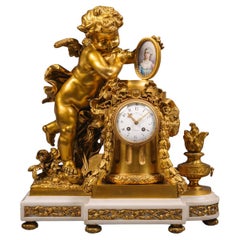
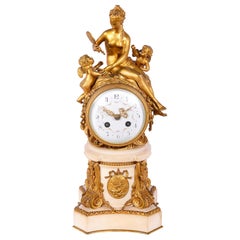
A very impressive 19th century classical French Louis XVI style mantel clock, having gilded ormolu figures of a naked maiden looking in a mirror with two cherubs to her side, above a...

Category

Antique Late 19th Century French Louis XVI Mantel Clocks

Materials

Marble, Ormolu

French 19th Century Louis XVI Style Clock, Stamped Vincent, 1855

French 19th Century Louis XVI Style Clock, Stamped Vincent, 1855

Located in West Palm Beach, FL

A stunning and most unique French 19th century Louis XVI st. ormolu, patinated bronze and marble clock, stamped Vincent 1855. The clock is raised by fine ormolu supports below the ci...

Category

Antique 19th Century French Louis XVI Mantel Clocks

Materials

Marble, Bronze, Ormolu

20th Century Louis XVI Style Museum Pedestal Clock after Jean-Henri Riesener

20th Century Louis XVI Style Museum Pedestal Clock after Jean-Henri Riesener

By Jean-Henri Riesener

Located in Berlin, DE

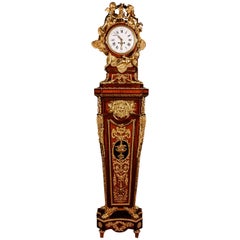
A Model of Jean Henri Riesener (Received Master in 1768) executed in 1785. (Inv. OA 5501 in Louvre Museum). 19th century. This fine and sumptuous “Regulateur de Pendule” presents a fine amaranth. Of Sycamore oeuil de vermeuil, ebony and buis stringing marquetry. The base and the gaine are decorated with diamond shapes. The hours are inscribed in Roman numerals and the munutes in Arabic. It takes place in a magnificent gilt décor of three winged children playing with garlands on clouds. The regulator is enriched with a delicate garniture of bronze. The dial and each panel are framed by an elegant frieze of palms and pearls. The top of the gaine is enhanced with a frieze of palms and ovums, foliages and garlands of flowers. Each corner is ornated with fleurons. The front of the gaine is embellished by an Apollo mask (Sun Symbol) and each side with laurel crowns. Under the mask the cartouche is decorated by a stylized vase of flowers. Folliated scrolls, flowers, garlands, cornucopias and musical instruments such as a harp (Apollo Reference) The cherubs are underlined by pearls, scrolls of Acanthus Leaves and garlands dawning out in foliages, framed with ropes until the lions feet. The feet rest on a base ornated with fleurons and foliages with buds of flowers ending in four conical feet with acanthus leaves. With André-Charles Boulle (1642-1732) and Charles Cressent (1685-1768), Riesener was arguably one of the three greatest French ébénistes of the 18th century. Eventually taking over the workshop after Oeben’s death in 1763, and marrying his widow some four years later. He is renowned for completing the famous bureau du Roi...

Category

20th Century Louis XVI Grandfather Clocks and Longcase Clocks

Materials

Bronze

Louis XVI Neo-Classical Style Figural Ormolu Clock by Charpentier & Cie

Louis XVI Neo-Classical Style Figural Ormolu Clock by Charpentier & Cie

By Charpentier et Cie

Located in Pittsburgh, PA

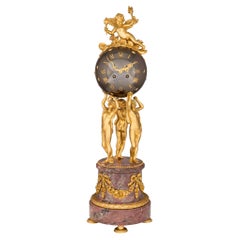
This large and impressive clock is by the renown French Bronzier Lemerle Charpentier & Cie. It features Classical maidens holding a large urn form case surmounted by Cupid with his ...

Category

Antique Late 18th Century French Neoclassical Mantel Clocks

Materials

Ormolu